
How often to feed roses: fertilizer choice and timing
Which fertilizer should you use for roses, and when?
Feed garden roses with a rose fertilizer or balanced fertilizer twice a year: before flowering in spring, then in midsummer after the first flush. The source calendar gives March-April for the first feed; use local growth to time it. Container mix runs out of nutrients quickly: use liquid fertilizer every fifteen days from midspring to late summer during active growth, switch to high potassium at the first buds, and stop before a cold winter.
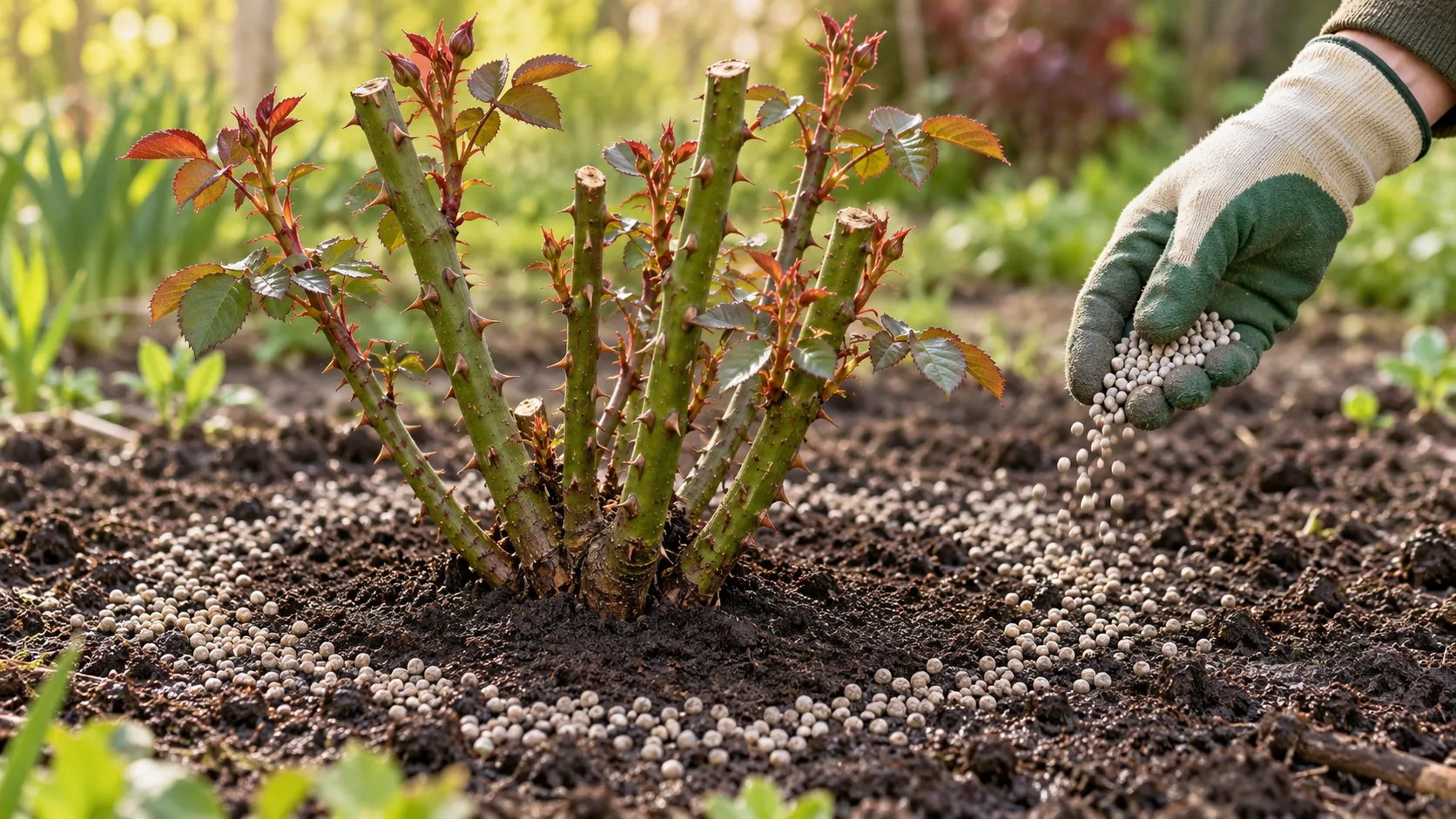
When to fertilize roses
Feed a rose (Rosa) during active spring and summer growth, never during winter dormancy. In its UK calendar, the Royal Horticultural Society (RHS) places the first feed in March or April, before flowering, and the second in midsummer, after the first flush, especially for repeat-flowering varieties1. The Société française des roses (SFR) gives its second feed in late June or early July in France, using the same fertilizer as in spring2. Elsewhere, follow local growth and flowering rather than those months alone.
- Feeding
- March and AprilFirst application · before flowering · in the groundSource: Royal Horticultural Society
- Feeding
- June and JulySecond application · late June or early July in the source’s temperate Northern Hemisphere calendar · in the groundSource: Société Française des Roses
- Feeding
- During active growthLiquid fertiliser · from mid-spring to late summer · in a potSource: Royal Horticultural Society
- No fertilizer
- In autumnfrom late August in the source’s temperate Northern Hemisphere calendar, to avoid soft new growth · in a potSource: Royal Horticultural Society
- Frequency
- Two applications a yearin the groundSource: Royal Horticultural Society
- Frequency
- Every 15 daysin a potSource: Royal Horticultural Society
- Avoid
- Excess nitrogen, applying fertilizer to a dry root ball, exceeding the dose on the labelSources: Royal Horticultural Society; Washington State University
| Conditions | January | February | March | April | May | June | July | August | September | October | November | December |
|---|---|---|---|---|---|---|---|---|---|---|---|---|
| First application, in the ground | no feeding | no feeding | Feeding | Feeding | no feeding | no feeding | no feeding | no feeding | no feeding | no feeding | no feeding | no feeding |
| Second application, in the ground | no feeding | no feeding | no feeding | no feeding | no feeding | Feeding | Feeding | no feeding | no feeding | no feeding | no feeding | no feeding |
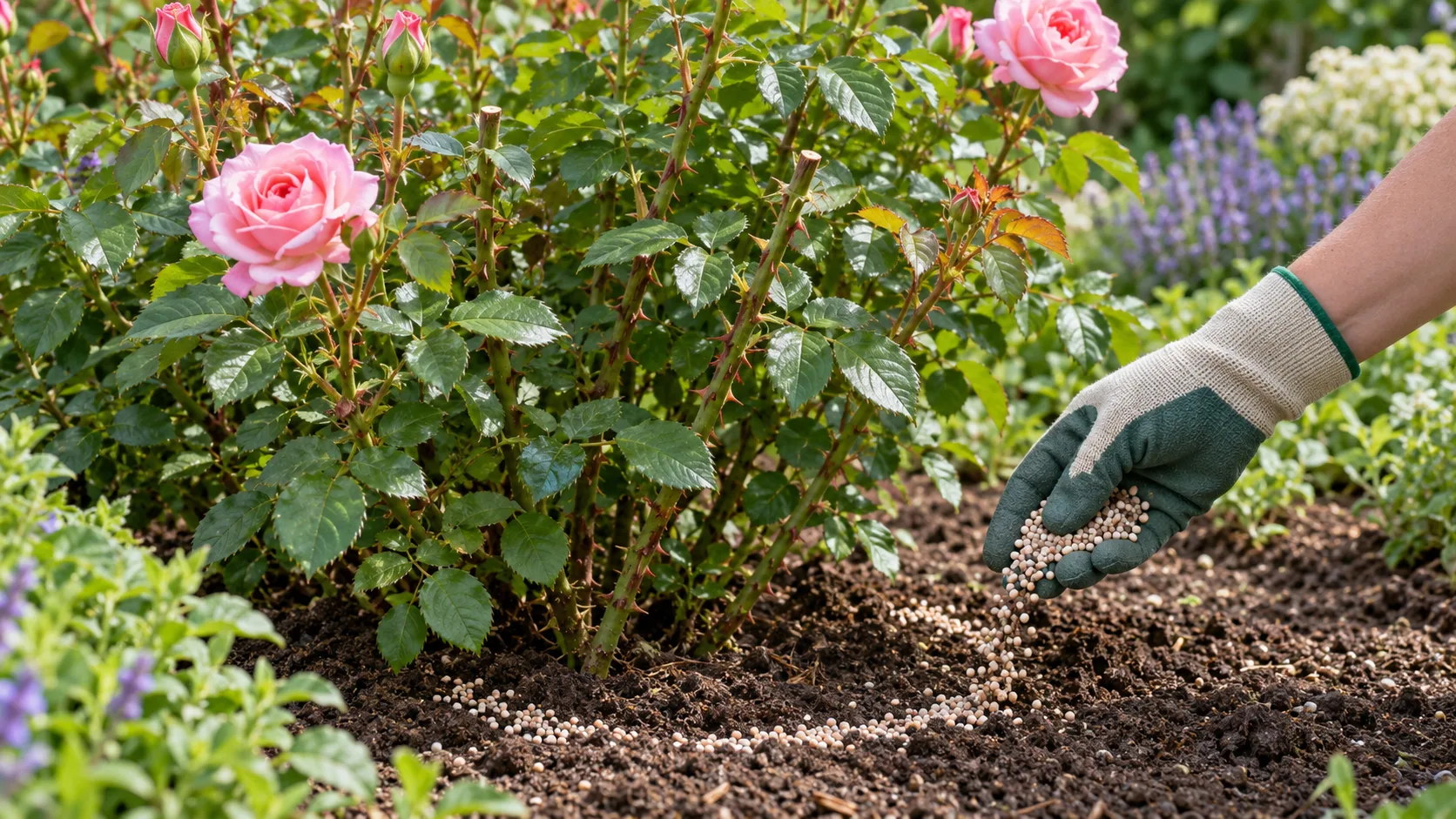
The first feed follows pruning. In late winter, the SFR lightly digs around the base and adds compost and a suitable rose fertilizer2. In the source's Northern Hemisphere calendar, slower dry organic fertilizers go on from February-March, mineral fertilizers in March-April3. Match these late-winter and spring stages to local conditions.
Stopping matters as much as starting. For pots, the RHS advises against feeding after August in its UK calendar: the tender shoots it encourages are vulnerable to cold4. Few plants, it notes, need fertilizer during winter3. Use approaching cold and the end of active growth as the local cutoff.
Which fertilizer should you choose?
Rose fertilizer or a balanced fertilizer is enough in the garden. The RHS calls for either, scattered on the soil around the base1. To read a label, look at its three numbers, the NPK:
- Nitrogen (N) supports leaves and stems;
- phosphorus (P) supports roots and shoots;
- potassium (K) supports flowering and cold resistance3.
For container roses, this is why the RHS switches from a balanced liquid feed to a high-potassium fertilizer, such as tomato feed, as soon as buds form1. Too much nitrogen has the opposite effect: leaves at the expense of flowers5.
| Form | Action | Use for roses |
|---|---|---|
| Organic granules (bone, blood, and fish meal, poultry manure) | Slow, low concentration3 | In the garden in February-March in the source climate; match local late winter3 |
| Mineral granules, balanced or rose fertilizer | Faster3 | In the garden in March-April, then summer in the source climate; follow local spring growth and flowering1 |
| Liquid fertilizer | Fast, ideal for pots3 | In pots, every fifteen days during active growth1 |
| Slow-release fertilizer | Coated, released gradually3 | In pots at planting, top-dressing, or repotting6 |
| Well-rotted manure or compost | Feeds soil, retains moisture1 | As mulch, 10 cm (4 in) away from stems1 |
In the ground or in a pot: how often?
In the ground, feed twice a year at 70 g of fertilizer per square meter (0.23 oz per sq ft). This is the RHS rate, scattered around the base1. On poor soil or a poorly growing rose, a balanced granular fertilizer may also be added1. Then mulch with well-rotted manure or compost, leaving a clear 10 cm (4 in) circle around the stems1.
Container mix loses nutrients quickly. The RHS feeds potted roses every fifteen days from midspring to late summer1, and lists roses among hungry plants fed from April to late August in its UK calendar6. Follow the local active growing season. Each spring, it also adds granular rose fertilizer to the surface4.
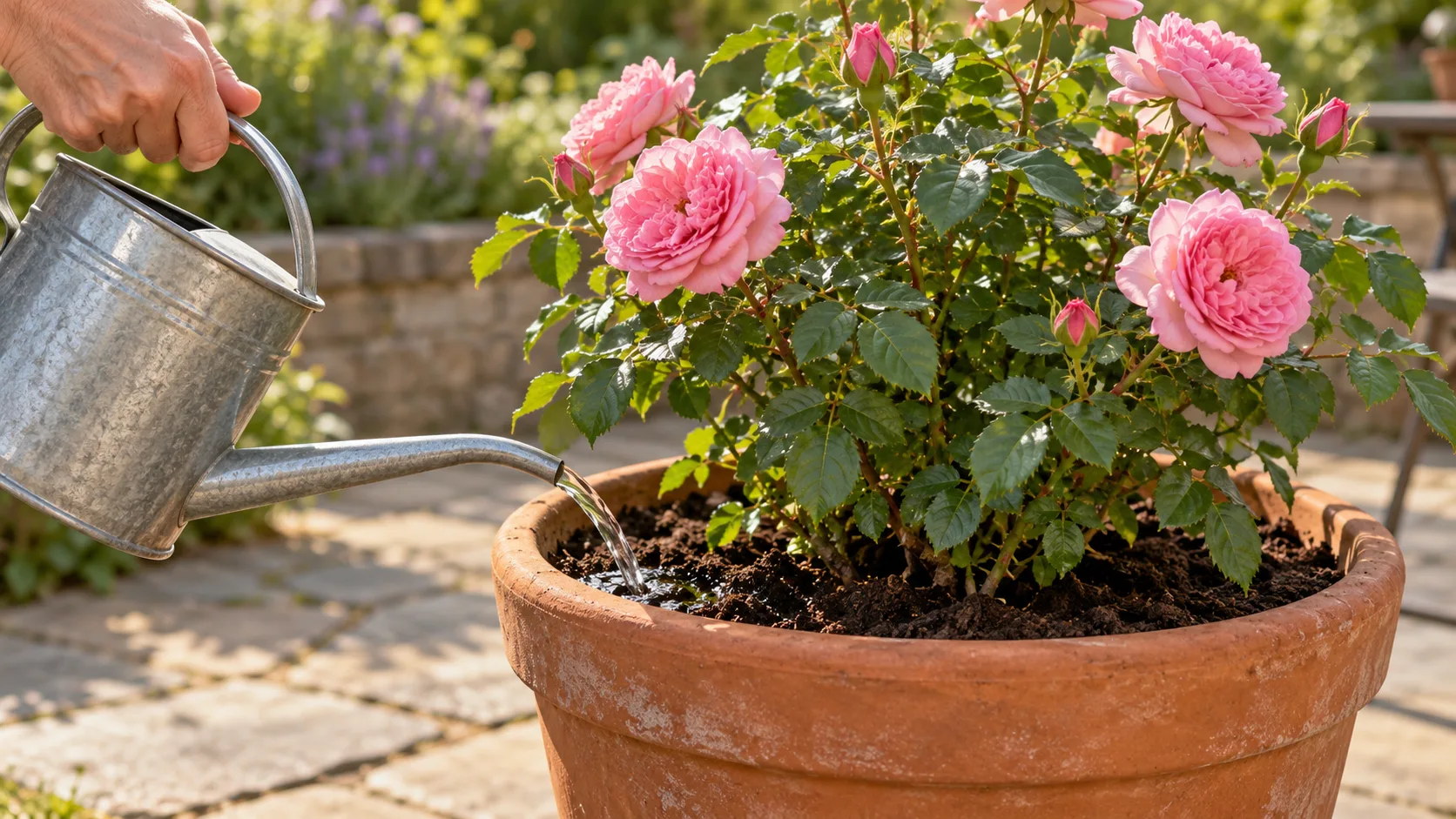
Two rules apply everywhere:
- Use the label rate, never more3. Extra fertilizer does not feed better; it burns roots.
- Start with moist soil. Washington State University recommends applying to moist soil, then watering, and never feeding a plant stressed by heat or drought7.
Pot profond, terreau, surfaçage tous les deux ans : growing roses in pots demande un suivi plus serré qu'au jardin.
Natural and homemade fertilizers: what the sources say
Compost and well-rotted manure remain the main natural fertilizers recommended for roses here. The SFR spreads compost with the late-winter feed2; the RHS mulches the base with rotted manure1. Homemade recipes need a separate assessment for each ingredient.
| Homemade fertilizer | Assessment |
|---|---|
| Comfrey liquid | Often rich in potassium, especially when grown on clay soil; the source recipe dilutes 1 part in 20 parts water, applied at the base8 |
| Wood ash | Some potassium, but it raises soil pH: the source limits sifted ash to 100 g per 10 liters of plant liquid (3.5 oz per 2.6 US gal)8 |
| Coffee grounds | Only 1 to 2% nitrogen, with nearly neutral pH: put in compost at no more than 20% of its volume9 |
| Poultry manure | High in nitrogen: use small amounts or leaves develop at the expense of flowers5 |
The source gives precautions for homemade plant liquid: never spray it on leaves, to avoid inhaling its microbes; wear gloves when handling it and use it within three months8. It describes this liquid as weaker than commercial fertilizer and calls for frequent, generous applications8. These are source recipes, not established guarantees of safety or effectiveness.
Too much or too little fertilizer: the signs
A very green rose with few flowers has often received too much nitrogen, especially from poultry manure or ammonium sulfate5. Excess also produces tender shoots that powdery mildew readily attacks10.
Excess fertilizer burns. Leaf tips and edges turn brown, young shoots may die, and pots may develop a whitish or brownish crust on the mix or rim7. For pots, the remedy given is thorough watering to flush salts out through drainage holes7. See excess salts and flushing salts from potting mix.
Deficiency shows on older leaves. General yellowing starting at the bottom points to low nitrogen; yellow young leaves with green veins point to low iron11. See nitrogen deficiency.
Avant d'accuser l'engrais, vérifiez le sol et l'arrosage : yellow rose leaves ont souvent une autre cause qu'une carence.
Add your rose: Floralens reminds you when to fertilize, in the garden or in a pot (Pro mode). Get reminders
Frequently asked questions
When should I fertilize roses?
In the garden, before spring flowering and again in midsummer after the first flush: the RHS gives March or April for the first feed in its UK calendar1; the SFR gives late June or early July for the second in France2. Follow local growth and flowering elsewhere. In pots, feed every fifteen days from midspring to late summer during active growth1.
Which fertilizer helps roses flower?
When should I avoid fertilizing a rose?
Are coffee grounds good fertilizer for roses?
They are a weak fertilizer: only 1 to 2% nitrogen, and they do not acidify soil, with a pH around 6.5 to 6.8. Add them to compost at no more than 20% of its volume9.
Can I give roses comfrey liquid?
The source allows it at the base: comfrey is often high in potassium, especially when grown in clay soil. The RHS recipe dilutes 1 part liquid in 20 parts water and prohibits spraying it on leaves8. This preserves the source recipe without treating its safety or effectiveness as proven.