
Feeding olive trees in pots and in the ground
Which fertilizer for olive trees, and when?
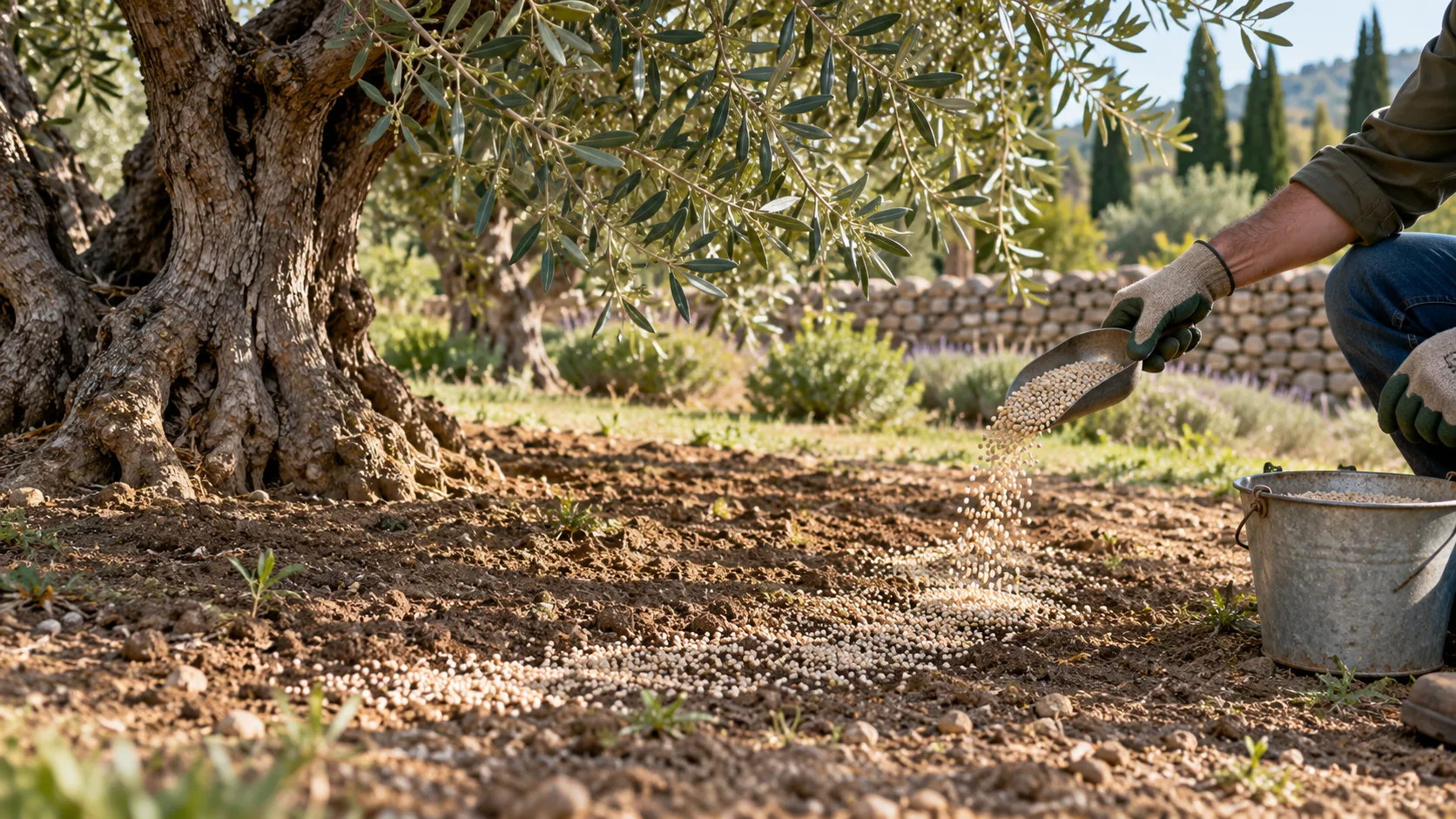
In France Olive’s French seasonal calendar, complete olive fertilizer supplying nitrogen, phosphorus and potassium is spread beneath the canopy in late March at the packet dose and is enough for most olive trees (Olea europaea). Manure or organic feed goes on earlier, in mid-February; pots receive balanced liquid feed monthly during growth. Time applications by local growth and frost: never add nitrogen in fall, as it makes the tree vulnerable to frost.
When should you fertilize an olive tree?
Feed olive trees in late winter and spring, never in fall. France Olive explains why: fall nitrogen makes olive trees vulnerable to frost1. The garden calendar has two dates:
- Fertilizer
- BalancedOrganic soil amendment, slow-release, liquidSource: France Olive
- Feeding
- FebruaryOrganic fertiliser or manure · mid-February, as winter ends in the source’s temperate Northern Hemisphere calendar · in the groundSource: France Olive
- Feeding
- MarchComplete fertiliser · late March in the source’s temperate Northern Hemisphere calendar, beneath the canopy · in the groundSource: France Olive
- Feeding
- In winterCompost or strawy manure · 30–40 kg (about 66–88 lb) per tree, every 4–5 years · in the groundSource: France Olive
- Feeding
- During active growthBalanced liquid fertiliser · in a potSource: Royal Horticultural Society
- No fertilizer
- In winterfrom late summer to mid-spring · in a potSource: Royal Horticultural Society
- No fertilizer
- In autumnNo nitrogen · an autumn application increases vulnerability to frostSource: France Olive
- Frequency
- Once a month during growthin a potSource: Royal Horticultural Society
- Frequency
- Two applications of organic fertiliser a yearolive tree watered in a basin around its base · in the groundSource: France Olive
- Avoid
- Excess nitrogen, exceeding the dose on the label, fresh manureSource: France Olive
| Conditions | January | February | March | April | May | June | July | August | September | October | November | December |
|---|---|---|---|---|---|---|---|---|---|---|---|---|
| Organic fertiliser or manure, in the ground | no feeding | Feeding | no feeding | no feeding | no feeding | no feeding | no feeding | no feeding | no feeding | no feeding | no feeding | no feeding |
| Complete fertiliser, in the ground | no feeding | no feeding | Feeding | no feeding | no feeding | no feeding | no feeding | no feeding | no feeding | no feeding | no feeding | no feeding |
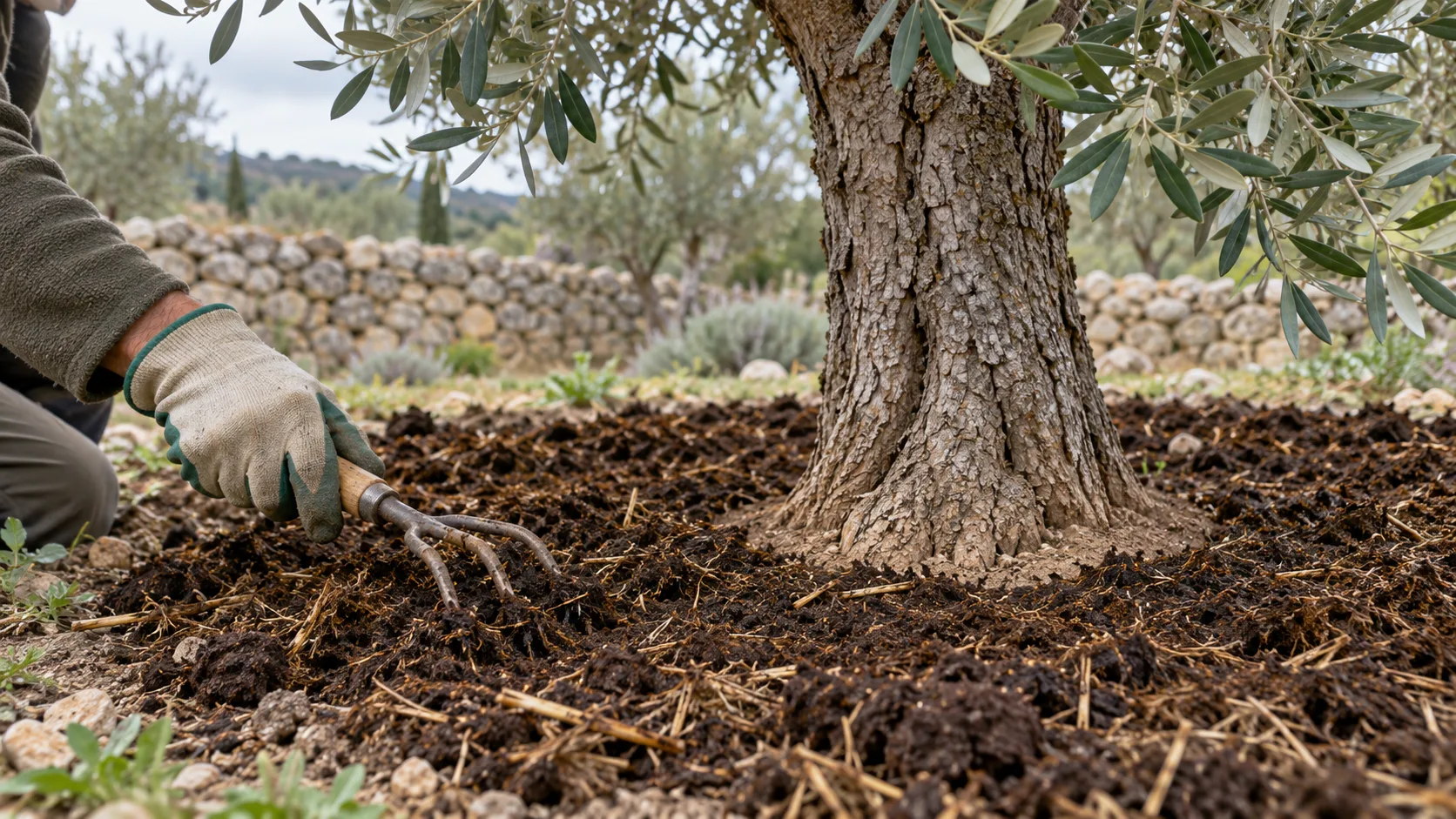
- mid-February in France Olive’s French seasonal calendar for organic fertilizer or manure, which needs time to decompose; lightly scratching it into the surface speeds nutrient release1;
- late March in that French seasonal calendar for complete or organo-mineral olive fertilizer, spread beneath the tree at the packet dose2.
Only nitrogen has a prohibited season. Nitrogen-free fertilizer can be applied at any time if the tree lacks a nutrient or has had an exceptionally heavy crop1. After spring frost, do not cut off supplies: France Olive asks growers to maintain nitrogen and trace elements to support new leaf emergence3.
Une fois la saison des apports passée, reste le froid : overwintering an olive tree se décide selon le pot et la région.
Add your olive tree: Floralens reminds you when to feed, with reminders following the seasons (Pro mode). Get reminders
Which fertilizer should you choose for an olive tree?
A complete fertilizer is the simplest option, containing the three major nutrients: nitrogen, phosphorus and potassium. Garden centers sell mineral or organo-mineral olive formulas, and France Olive considers these applications sufficient in most cases2. The association stresses that a well-pruned but underfed tree grows very slowly and yields little.
Label figures always follow the same order. A 5-10-8-2 fertilizer contains 5% nitrogen, 10% phosphorus, 8% potash and 2% magnesia1. France Olive's handbook gives 6-3-8 as a suitable olive formula and recommends comparing nitrogen content: a fertilizer well supplied with nitrogen is preferable to one mainly rich in potash4.
| Nutrient | What it provides |
|---|---|
| Nitrogen (N) | Tree growth, leaf renewal, flowering quality4 |
| Phosphorus (P) | Roots and main limbs, budbreak, fruit set, fruit firmness4 |
| Potassium (K) | Crop quality, water economy, resistance to disease and frost4 |
| Magnesium (Mg) | Photosynthesis, fertilization, drought resistance4 |
What dose? For a mature, unirrigated olive, France Olive allows 250 to 300 g (8.8 to 10.6 oz) of nitrogen annually, equivalent to 2.5 to 3 kg (5.5 to 6.6 lb) of complete fertilizer at 10% nitrogen or 5 to 6 kg (11 to 13.2 lb) at 5%. An irrigated tree receives 20 to 50% more4. Formula choice then depends on age and situation.
| Olive tree | Fertilizer | Why |
|---|---|---|
| Mature, in the ground | Complete or organo-mineral olive fertilizer, late March in France Olive’s French calendar | Nitrogen, phosphorus and potassium in one application2 |
| Young, not yet productive | High phosphorus, moderate nitrogen, no potash | Phosphorus supports rooting; potash waits until the first crops2 |
| Potted | Balanced liquid feed monthly, slow-release granules at planting | A pot's potting mix is depleted quickly56 |
| Soil low in organic matter | Manure or compost in late winter | Feeds the tree and replenishes soil reserves1 |
Harvested olives remove much more nitrogen and potassium than shoot growth does: France Olive therefore bases the dose on the expected crop, reducing it slightly when a small crop is expected2.
Manure, compost and coffee grounds: natural fertilizer
Organic fertilizers suit olive trees, releasing nutrients at the rate the tree absorbs them1. Horse manure has an approximate analysis of 0.8-0.3-0.9, sheep manure 0.6-0.4-1.2. These concentrations are low, and only half the manure becomes available within the year: the rest feeds subsequent years, hence the value of a supplement1.
- Well-rotted, straw-rich manure: avoid fresh manure low in straw or sawdust, whose nitrogen washes away in heavy rain. Sheep manure makes soil more alkaline1.
- Compost: 30 to 40 kg (66 to 88 lb) per tree every 4 to 5 years, in winter, especially on bare soil4.
- Shredded prunings: left beneath the tree, they return some extracted nutrients to the soil and reduce fertilizer needs accordingly2.
Coffee grounds are not an olive fertilizer. They mainly supply nitrogen, with variable pH, sometimes acidic, sometimes alkaline; spread alone, they compact into a crust7. Put them in compost at no more than 20% by volume. Other garden uses are covered in using coffee grounds.
What should you put around an in-ground olive?
Spread fertilizer beneath the canopy, where roots work, rather than against the trunk. For an unirrigated olive, France Olive spreads it around the tree in a band at least 2 m (6.6 ft) wide beneath the canopy edge, preferably before rain to dissolve it4.
- Drip-irrigated olive: place fertilizer near emitters in a 1 m (3.3 ft) band4.
- Olive watered in a basin: apply in the watered area; two applications annually are possible4.
Light surface cultivation improves the effect of organic and coated fertilizers4; stay away from the trunk and work dry soil several days after rain, since olive knot bacteria also enter through injured roots8.
Potted olive: liquid feed every month
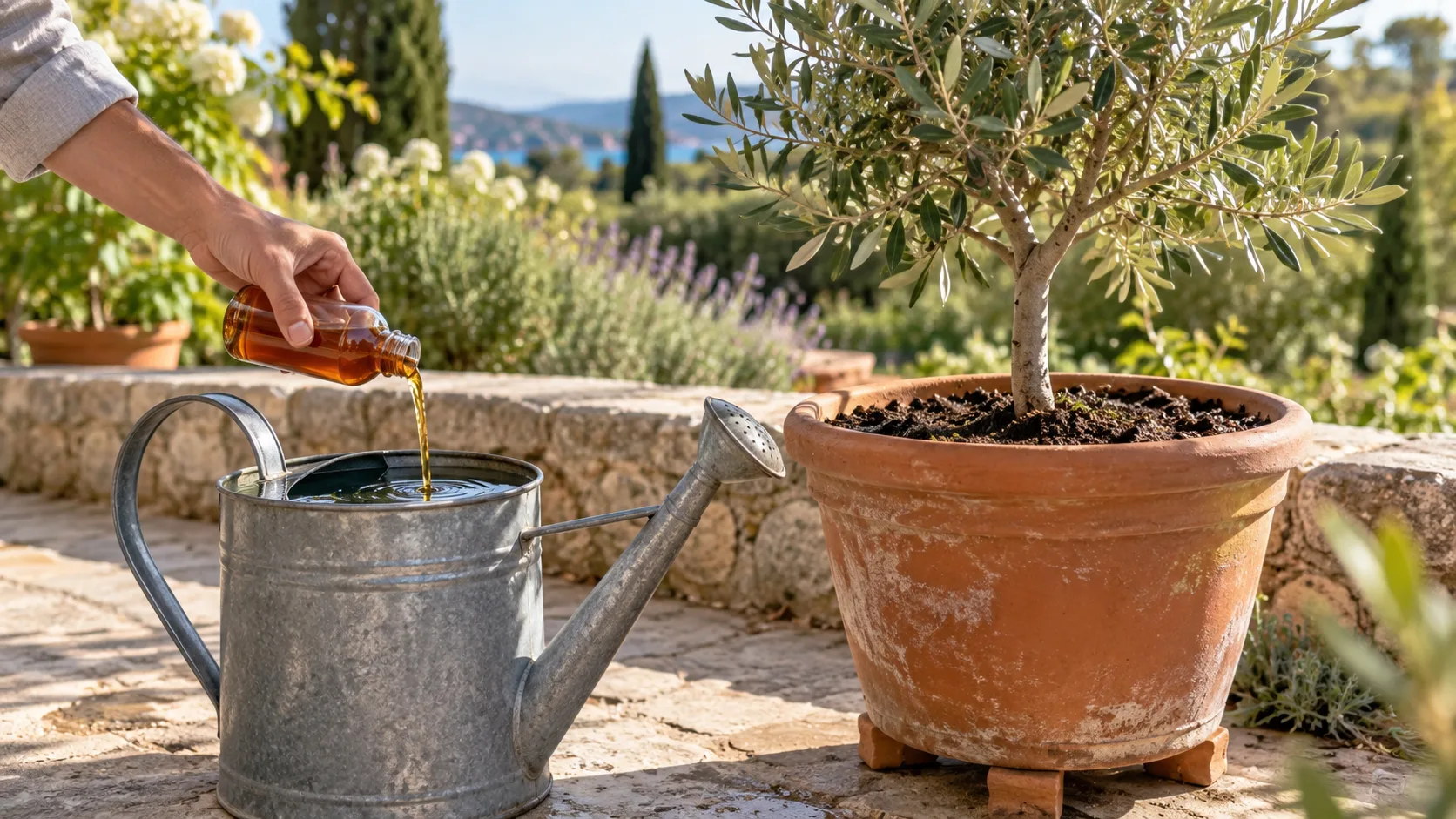
In pots, give balanced liquid feed once a month during the growing season. This is the RHS rule for an olive intended to flower and fruit5. A pot holds only limited potting mix, and container plants quickly exhaust its reserves6.
- At planting or repotting, mix slow-release granules into potting mix5.
- During growth, add liquid fertilizer to watering water monthly, onto already moist potting mix56.
- From late summer to mid-spring, stop: winter feeding is unnecessary6.
Diamètre, terre, arrosage d'été et abri d'hiver : growing an olive tree in a pot demande des gestes que la pleine terre ignore.
How can you boost an olive tree's growth?
A struggling olive first needs regular complete fertilizer, not a miracle product. France Olive places feeding first, before pruning2. Three targeted supplements then exist:
- boron before flowering improves flower-cluster formation and fruit set1;
- zinc after flowering, often lacking in southern French olive soils1;
- foliar fertilizers, sprayed onto current-year shoots, correct deficiency quickly; however, they are ineffective on an old tree neglected for years1.
Before buying, a soil analysis, quoted by the French source at around €85 excluding tax for a complete analysis, shows what is actually missing and avoids adding nutrients already in excess2. Leaf analysis completes the picture: the French source’s seasonal example samples in late July or during winter dormancy. Follow the tree’s local growth cycle.
Too much nitrogen or poor timing: mistakes
Excess nitrogen does more damage than deficiency. It creates a vigorous but fragile tree, and France Olive links it to several problems1:
- frost, when fall nitrogen produces tender tissue before winter1;
- alternate bearing, a heavy year followed by an empty one, worsened by poorly adjusted nitrogen feeding1;
- olive knot, whose bacterium becomes more virulent with excess nitrogen8;
- Verticillium wilt, for which France Olive recommends reducing nitrogen9.
Conversely, a genuine shortage of nitrogen, magnesium, zinc, potassium or boron weakens the tree and contributes to decline10. Follow the packet dose: doubling it does not feed twice as well2.
Un feuillage qui pâlit n'a pas toujours faim : yellow olive leaves se lisent selon leur position et la saison.
Galles, branches qui sèchent ou taches cerclées : olive diseases se reconnaissent à d'autres signes que la faim.
Frequently asked questions
When should you fertilize olive trees?
What should you put around an in-ground olive?
Are coffee grounds good for olive trees?
Not as fertilizer: they mainly supply nitrogen, their pH varies and they form a crust when spread alone7. Put them in compost, below 20% by volume.