
Olive tree frost protection: winter care
Olive trees in winter: cold limits and protection
A mature olive (Olea europaea) tolerates gradually developing cold to around −12 °C (10 °F) for leaves and −15 to −16 °C (5 to 3 °F) for branches; roots die around −6 °C (21 °F), and young plants cannot survive −6 to −8 °C (21 to 18 °F). In the ground, leave it outdoors where frost is moderate; in pots, bring it into bright, cool, frost-free shelter or place it against a wall under thick fleece. Return it outdoors only after frost has passed.
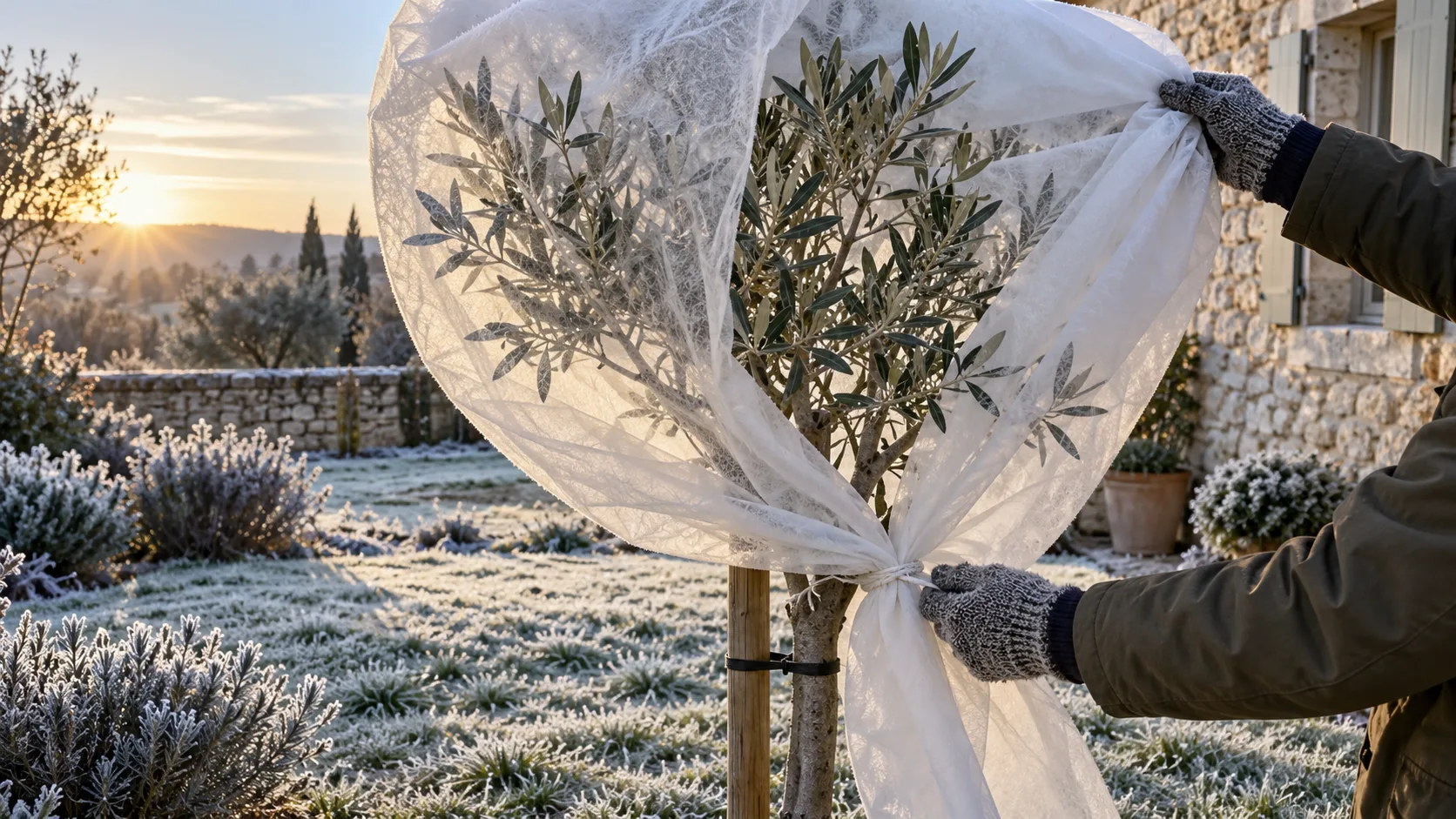
What sub-zero temperatures can olive trees tolerate?
It depends on the organ affected and how quickly cold arrives. France Olive describes olive as the temperate-zone fruit tree most sensitive to frost, and gives three median lethal temperatures (LT50) established by Larcher: −12 °C (10 °F) for leaves and buds, −16 °C (3 °F) for main limbs and trunk, −6 °C (21 °F) for roots1.
Temperatures for olive
In °C, thresholds given by the sources.
- Main branches and trunk (LT50)-16 °C
- Mature tree: lethal around −15 to −16 °C (5 to 3 °F)-15 °C
- Leaves and buds (LT50)-12 °C
- Roots (LT50)-6 °C
- Young plant: lethal at −6 to −8 °C (21 to 18 °F)-6 °C
- Two months at 4–10 °C (39–50 °F) to flower4 °C
- Tolerated: -7 to 40 °C
Cold that builds gradually from fall is tolerated well: the tree enters dormancy progressively. Beyond −15 to −16 °C (5 to 3 °F), a mature olive's above-ground parts may die, as in 1956; a young plant dies at −6 to −8 °C (21 to 18 °F)1. Around −6 °C (21 °F), water also begins freezing in bark, potentially splitting it1.
The RHS rates olive H4, corresponding to minima of −10 to −5 °C (14 to 23 °F), provided it is sheltered2. Two circumstances worsen cold damage:
- duration: very low temperatures briefly do less damage than slightly milder temperatures lasting longer, and slow thawing causes less damage than rapid thawing1;
- waterlogged soil: water conducts cold, and frost may then kill the entire root crown1.
Can olive trees stay outdoors in winter?
Yes in the ground, wherever winters remain moderate. The real danger is not steady cold but a sudden cold snap after mild weather: mild winters that wake the tree too early are the most worrying1. On , Perpignan recorded +12 °C (54 °F) and the following day −8 °C (18 °F); Montpellier subsequently fell to −17 °C (1 °F)1.
- Bring indoors
- Before the first frostsFrost-free room · in a potSource: Royal Horticultural Society
- Move back outside
- After the last frostsin a potSource: Royal Horticultural Society
- Protect
- In winterThick winter fleece · provides about 2 °C (about 4 °F) of extra protection · in a potSource: Royal Horticultural Society
- Protect
- In winterPots grouped against a wall · saucers removed, sheltered from prolonged rain · in a potSource: Royal Horticultural Society
- Protect
- Before the first frostsGrass kept short at the base · dense grass cover intensifies the cold · in the groundSource: France Olive
- Light
- A bright roomSource: Royal Horticultural Society
- Winter watering
- Check once a weeknever water if frost is forecastSource: Royal Horticultural Society
France Olive distinguishes two frost types:
- black frost, arriving with a cold air mass, often windy, responsible for major winter freezes; only coastal areas beside a large body of water partly escape;
- white frost, overnight under clear, still skies, more frequent in spring1.
In cool climates, the RHS recommends planting in the ground only in a very sheltered garden: plant in spring, in well-drained soil near a sunny wall, and stake until established3.
Potted olives in winter: frost-free shelter or fleece
In pots, roots freeze first. No mass of soil insulates them, and they fail around −6 °C (21 °F) while the crown still tolerates around −12 °C (10 °F)1. The RHS gives two options: bring the pot into frost-free shelter or wrap branches in horticultural fleece3.
Indoors, olive needs a frost-free, bright, cool shelter, never a heated living room. It needs around two months at 4 to 10 °C (39 to 50 °F) to flower4: a warm winter means no olives the following year.
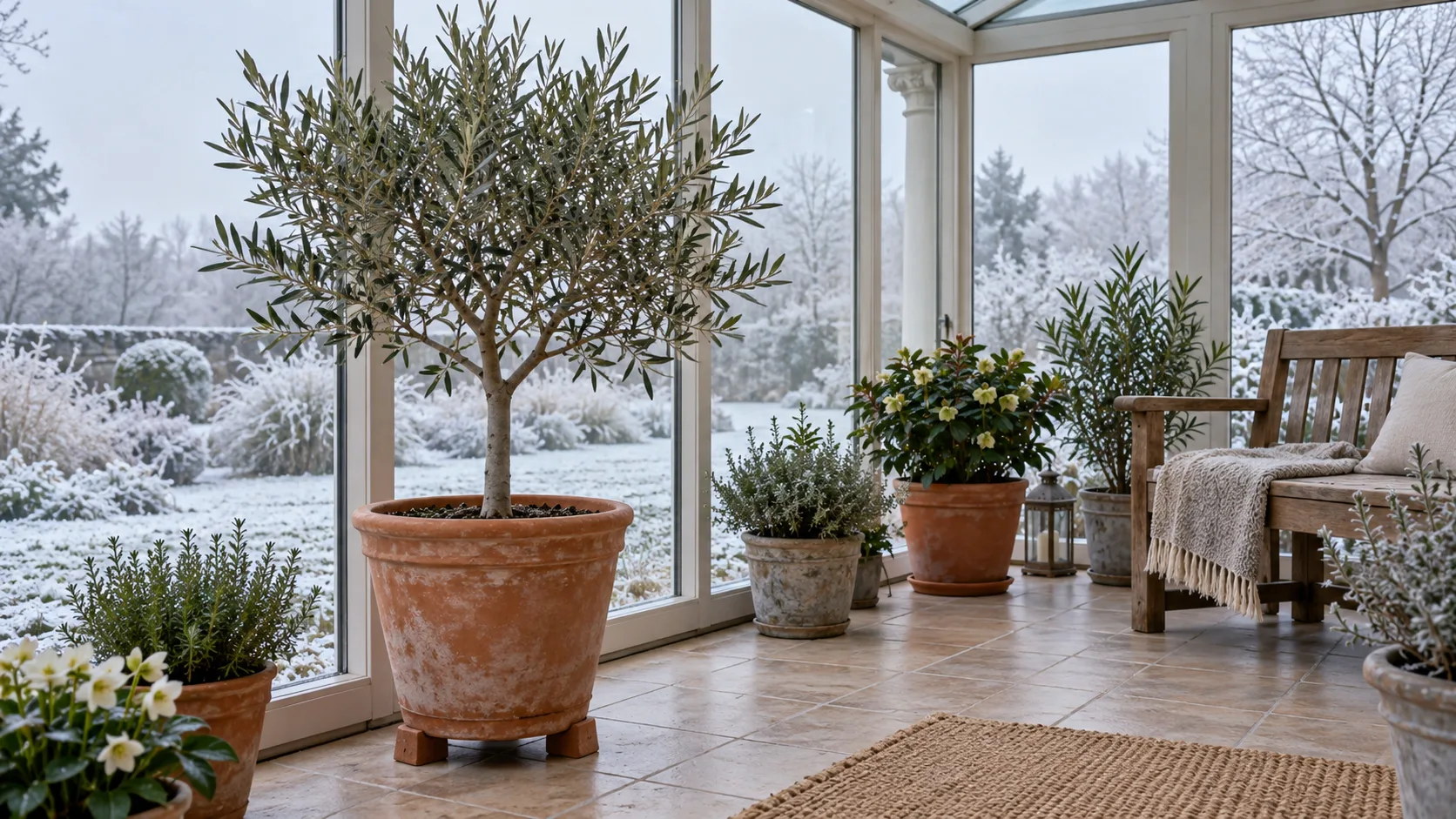
Outdoors, four steps protect the rootball:
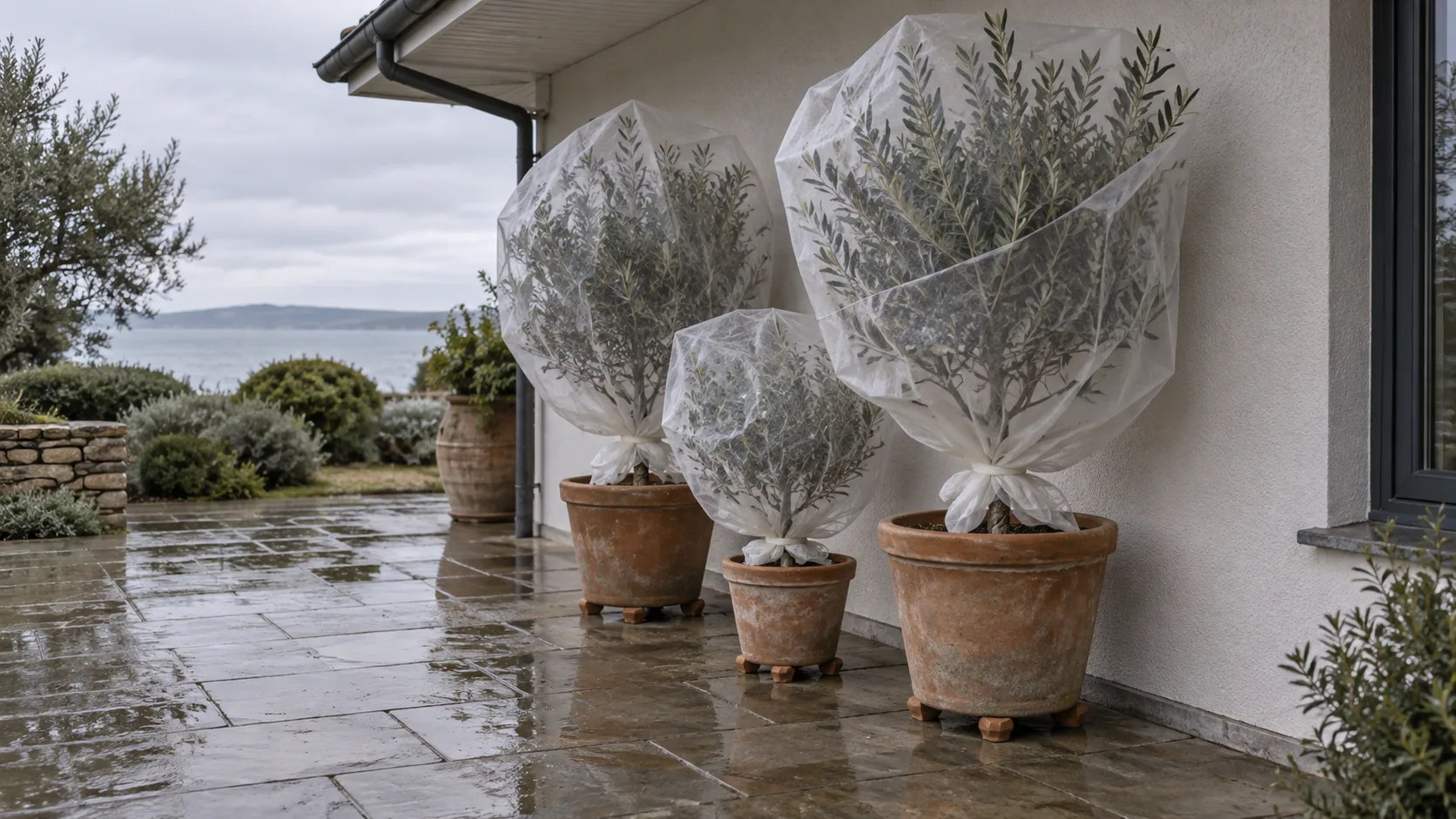
- group pots against a house wall, sheltering roots from cold5;
- cover branches with thick fleece, gaining around 2 °C (3.6 °F)3;
- shelter the pot from prolonged rain, beneath an overhang or against a wall, until potting mix drains5;
- keep it on pot feet so excess water escapes, and remove the saucer35.
Watering becomes rare but does not stop: an evergreen may be thirsty, especially under cover where rain cannot reach it. Check once a week, and never water when frost is forecast5. No fertilizer either: winter feeding is unnecessary in pots5, and fall nitrogen makes olive more frost-sensitive6.
Pot, terre et arrosage d'été se décident dès la plantation : growing an olive tree in a pot prépare aussi son hiver.
Should you cover an olive tree in winter?
Thick horticultural fleece is sufficient, and only during severe cold. Heavy grades gain around 2 °C (3.6 °F)3: useful for a potted or young tree, but insufficient against prolonged black frost.
For in-ground trees, France Olive reviews orchard protection. Frost candles warm the air down to around −4 to −5 °C (25 to 23 °F), but are expensive and reserved for small areas. Overhead sprinkling, common in fruit growing, is discouraged for olive: ice weight breaks main limbs, and wet foliage encourages peacock spot1.
In the ground: position does half the work
A well-positioned olive is much less vulnerable to frost. France Olive lists these indirect protections, considered at planting1:
- avoid hollows and valley bottoms, where heavier cold air collects and stagnates, and poorly drained soil; on slopes, lower trees freeze more than higher ones;
- beware of dense hedges downhill: blocking cold-air drainage increases risk;
- choose a late, local variety suited to the growing area;
- mow grass beneath the tree during risk periods: dense grass cover increases cooling;
- do not prune too early in frost-prone areas: pruned trees restart sooner, exposing young growth1.
Le calendrier des coupes tient compte de ce risque : pruning an olive tree attend la fin des gelées en zone froide.
Spring frost: the trap of mild winters
Spring frost never kills an olive tree, but it can destroy the crop. Young shoots and flower buds, with sap rising strongly, are the organs affected1. In France Olive’s French seasonal setting, white frosts occur mainly from to May.
Two French episodes described by France Olive show the scale. Overnight on 25 to 26 March 2020, humid white frost fell to −7 °C (19 °F) in some municipalities. On 8 April 2021, dry black frost after days of mistral dropped temperatures 5 to 6 °C (9 to 11 °F) in an hour, to −9 °C (16 °F)1.
Damage is not always immediately visible: some appears only three to four weeks after frost, and apparently normal flowers may be malformed, revealed only by poor fruit set1.
Frost-damaged olive: what to do afterwards
Scratch the bark before cutting anything: green beneath means wait for regrowth; brown means the branch is dead there1. Do not cut off supplies: France Olive asks growers to maintain water, nitrogen and trace elements, and protect foliage, since frost wounds admit olive knot bacteria1.
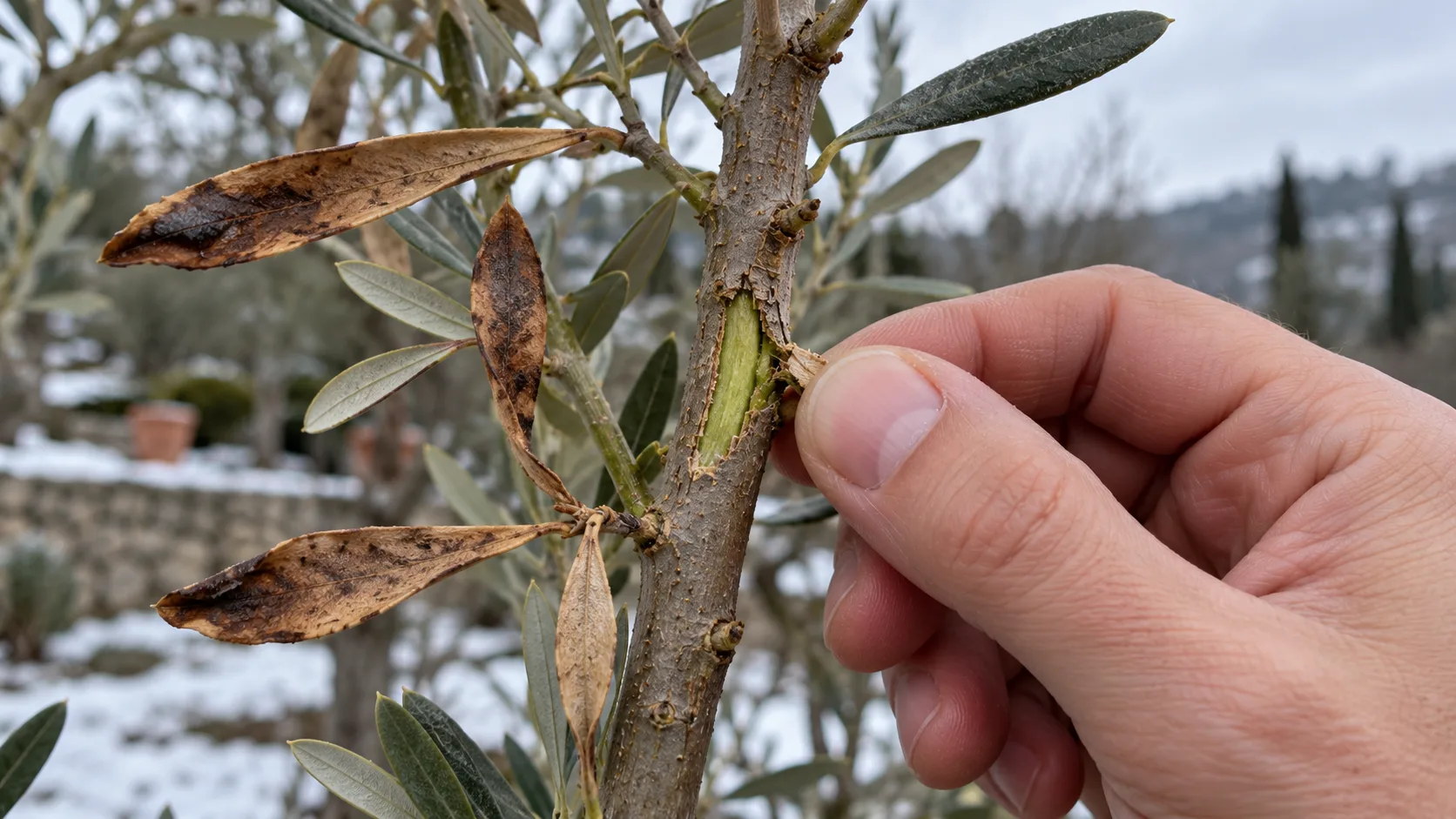
Recovery pruning, branch by branch according to damage, is detailed in pruning an olive after frost.
Des galles sur les rameaux gelés l'année d'avant : olive diseases commencent souvent par une plaie de gel.
When should you return an olive outdoors in spring?
Only once all frost risk has passed. The RHS returns potted olives outdoors after the last frost3. In France, the popular marker remains the Ice Saints, from to 7.
Add your olive tree: Floralens reminds you when to bring it in and take it out, season by season (Pro mode). Get reminders
Frequently asked questions
How do you care for an olive tree in winter?
What sub-zero temperature can an olive tolerate?
A mature tree loses leaves and buds around −12 °C (10 °F) and main limbs around −16 °C (3 °F); roots die around −6 °C (21 °F). A young plant cannot tolerate −6 to −8 °C (21 to 18 °F)1.
Can an olive tree stay outdoors in winter?
Should you cover an olive in winter?
In severe cold, thick horticultural fleece gains around 2 °C (3.6 °F)3. It protects a pot or young tree, not an olive exposed to prolonged black frost.
Should you water an olive in winter?
Little, but not never: check weekly, especially under cover, and do not water when frost is forecast5.