
Yellow leaves on potted olive trees: finding the cause
Why olive leaves turn yellow
Each spring an olive (Olea europaea) sheds some two- to three-year-old leaves as new ones grow: this yellowing is normal. Ringed spots or gray felt beneath leaves point to peacock spot or Cercospora; foliage yellowing over constantly wet soil points to oxygen-starved roots. Frost, a suddenly drying branch and lack of fertilizer complete the list.
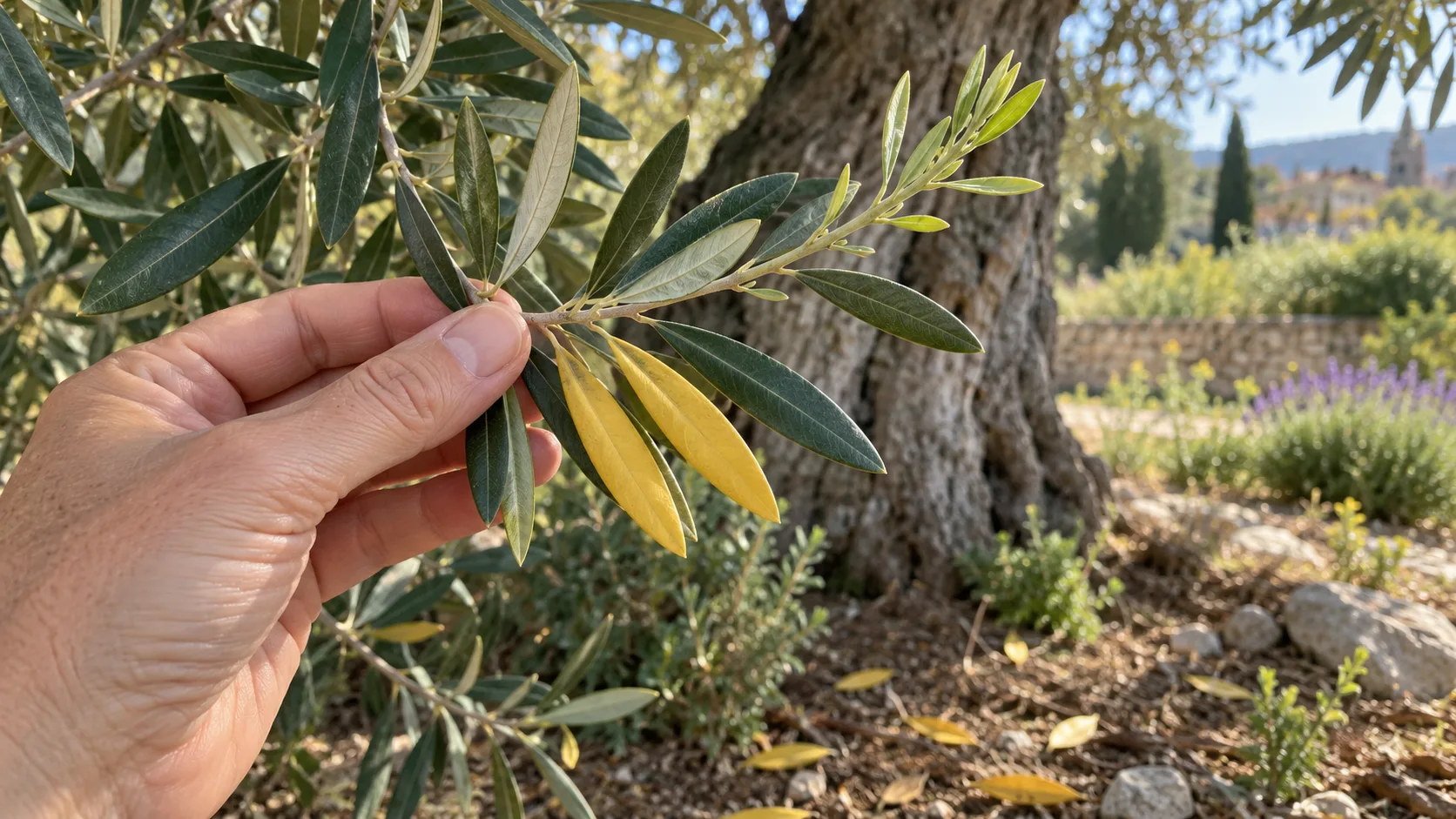
Normal or worrying: check which leaves are yellow
Look at where the yellow leaves are before searching for disease. Older leaves yellowing together in spring while branch tips remain green are normal evergreen renewal1. Spots, a felt-like coating, a whole affected branch or saturated soil point elsewhere.
| Problem | January | February | March | April | May | June | July | August | September | October | November | December |
|---|---|---|---|---|---|---|---|---|---|---|---|---|
| Peacock spot, infection, leaves | nothing to report | nothing to report | watch for this | watch for this | watch for this | watch for this | nothing to report | watch for this | watch for this | watch for this | watch for this | nothing to report |
| What you see | Likeliest cause | Section |
|---|---|---|
| Old yellow leaves in spring, green and growing branch tips | Natural renewal | Renewal |
| Dark round spots ringed with yellow, falling leaves | Peacock spot | Peacock spot |
| Yellow above, gray felt-like coating beneath | Cercospora leaf spot | Cercospora |
| All foliage pales and falls, soil or rootball constantly wet | Excess water, oxygen-starved roots | Too much water |
| A single branch yellows then dries, leaves still attached | Verticillium wilt | Verticillium wilt |
| Yellowing days to weeks after a frosty night | Frost | Frost |
| Pale foliage throughout, slow growth, no fertilizer for years | Nutrient deficiency | Lack of feed |
| Sticky then black leaves, small brown shells on shoots | Black scale and sooty mold | Sooty mold |
Old yellow leaves in spring: renewal
Olive replaces leaves in rotation, and spring is changeover time. The University of Florida states it plainly: like many evergreens, olive generally sheds two- to three-year-old leaves as new growth appears2.
Three signs identify the pattern, described by Clemson Extension for broadleaved evergreens1:
- the oldest leaves turn uniformly yellow, together, throughout the tree;
- young leaves at shoot tips stay green, with visible new growth;
- once those leaves fall, yellowing stops.
Nothing is needed except checking fallen leaves for spots. If yellowing continues after spring growth, look below.
Ringed spots then leaf fall: peacock spot
Yellow leaves covered in dark round spots indicate peacock spot, olive's most widespread fungus. Affected leaves yellow and fall prematurely3. Disease begins on lower branches, then spreads through the tree, which may become severely bare until leaves renew4.

Collect spore-bearing fallen leaves and open the crown by pruning so it dries quickly after rain3. Infection periods, testing and copper protection are detailed under olive peacock spot.
Yellow above, gray below: Cercospora
Turn the leaf over: gray felt beneath a yellow upper surface indicates Cercospora leaf spot. It affects leaves over a year old from fall to spring, with yellow chlorosis eventually killing tips and edges5. Affected leaves fall from late spring to late summer, often adding to peacock-spot losses5.
The response is the same: annual pruning for airflow and copper after the first fall rains. See olive Cercospora leaf spot.
All foliage yellowing, wet soil: too much water
Olive dies more often from standing water than thirst. Growers sum it up: olive likes water that passes through, not water that stays
. Standing water causes root suffocation, and France Olive identifies a classic trap: an olive in a watered lawn on clay soil very often receives too much water6. Compacted, airless soil also causes yellowing then leaf fall7.
How can you tell an olive has too much water? Check soil, not leaves:
- in the garden, dig around twenty centimeters (8 in) down in the root zone: moist or sticky soil needs no water8;
- in a pot, push a finger a third of the way down: if still damp, wait9.
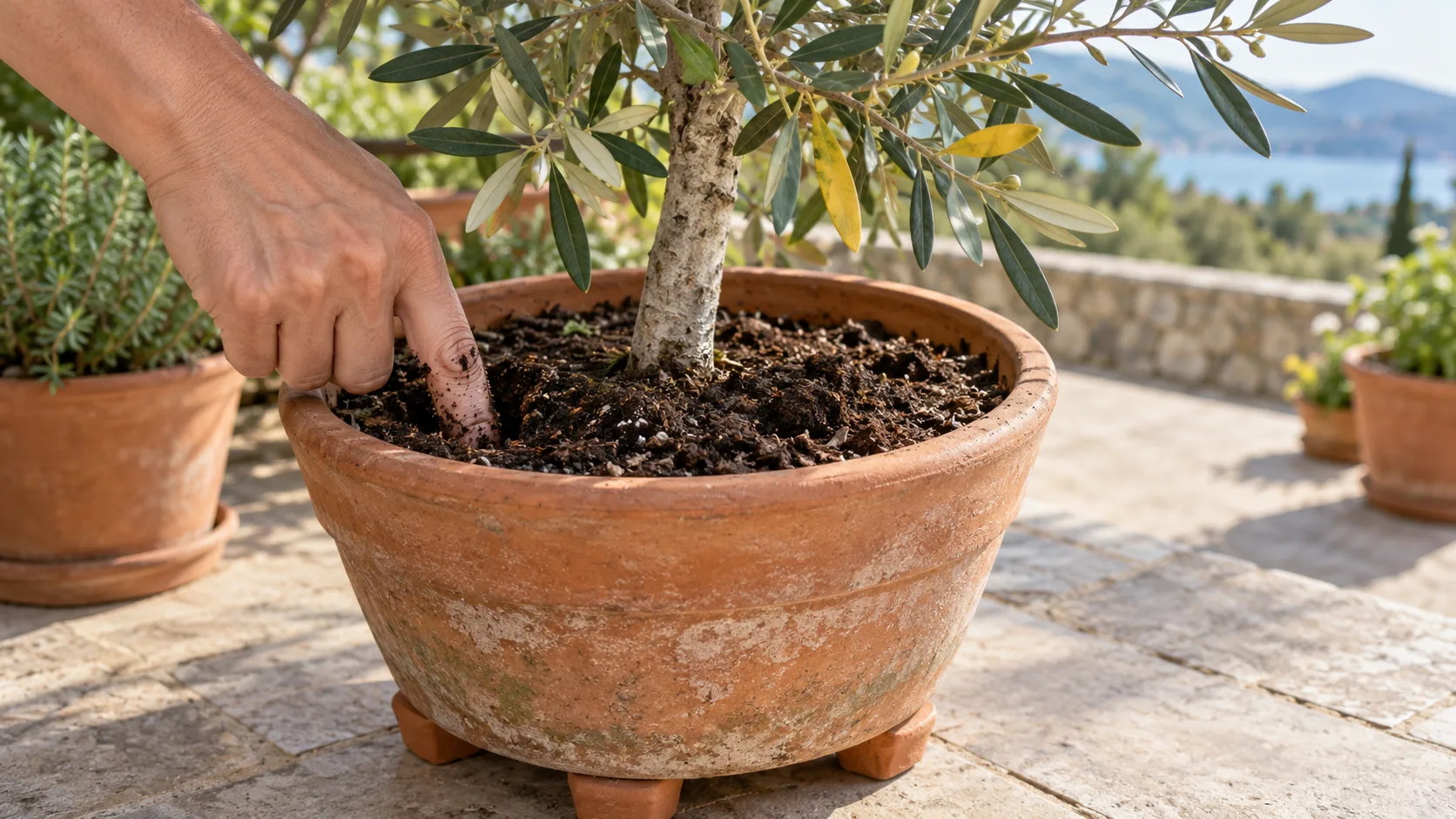
Overwatering is the leading cause of container-plant loss: potting mix should stay moist, never saturated10. Space out watering, empty saucers and see root rot if the rootball stays waterlogged.
One branch yellowing then suddenly drying: Verticillium wilt
When yellowing is confined to one branch that then dries, consider Verticillium wilt. In its rapid form, leaves yellow then dry while remaining attached to the branch and bark browns; in France Olive’s French seasonal observations, the process peaks in and 11. Remove declining branches promptly with disinfected tools and take cut wood out of the garden11.
Other measures, including not growing tomatoes beneath the tree, are covered in olive Verticillium wilt.
Yellowing after a cold snap: frost
Frost yellows foliage, sometimes weeks later. France Olive describes yellowing followed or not by leaf fall; sometimes leaves brown immediately12. Symptoms may appear only three to four weeks after frost, complicating diagnosis12.
Scratch a shoot's bark: green beneath means it lives and will regrow; brown means it is dead there12. Wait for regrowth before pruning.
Pour l'hiver suivant, voile, mur et local hors gel : overwintering an olive tree se décide selon le pot et la région.
Pale foliage and slow growth: lack of feed
An olive never fed eventually pales. France Olive repeats that a well-pruned but underfed tree grows very slowly and yields little13. Nitrogen deficiency yellows the oldest leaves first1.
France Olive lists deficiencies of nitrogen, magnesium, zinc, potassium and boron, plus induced potassium or iron deficiencies, among causes of decline7. France Olive’s French seasonal example gives complete fertilizer in late March as usually sufficient; time feeding by local growth, and if yellowing persists, soil analysis reveals imbalances and nutrient lock-up13.
Formule, dose et calendrier : feeding an olive tree se donne en sortie d'hiver et au printemps.
Black, sticky leaves: sooty mold
A black deposit on yellowing leaves almost always comes from black scale. Its brown shells excrete honeydew supporting sooty mold, which blocks photosynthesis and causes leaf fall14.

How do you treat sooty mold on olive? Treat its cause. Sooty mold does not infect the plant: it decreases once insects are controlled, and a water jet or soapy water removes it15. A sticky trunk band keeps away ants protecting scales15. For the pest itself, see black scale and sooty mold.
Should you cut yellow olive leaves off?
No, not leaf by leaf. Old spring leaves fall by themselves. Against peacock spot, collect fallen leaves and cut declining shoots3. Remove a whole Verticillium-affected branch as soon as it dries11; a frost-damaged shoot waits for regrowth before pruning12.
Taches, galles, olives piquées : olive diseases se reconnaissent symptôme par symptôme.
A yellow leaf you cannot explain? Photograph it: Floralens identifies the problem and tells you what to do. Diagnose with the app
Frequently asked questions
How do you treat yellow olive leaves?
Find the cause first. Spring shedding of old leaves is normal2. Ringed spots call for canopy-opening pruning and collecting fallen leaves3; saturated soil calls for less frequent watering6; a tree never fed needs complete fertilizer at the start of local growth, late March in France Olive’s French seasonal example13.