
Why are my oleander leaves yellow? Causes and care
Why oleander leaves turn yellow
A few yellow leaves inside an oleander, while new shoots stay green, are normal renewal in an evergreen shrub. When all the foliage or young leaves turn yellow, look for a cause, usually in the pot: too much water, too little, or exhausted potting mix.
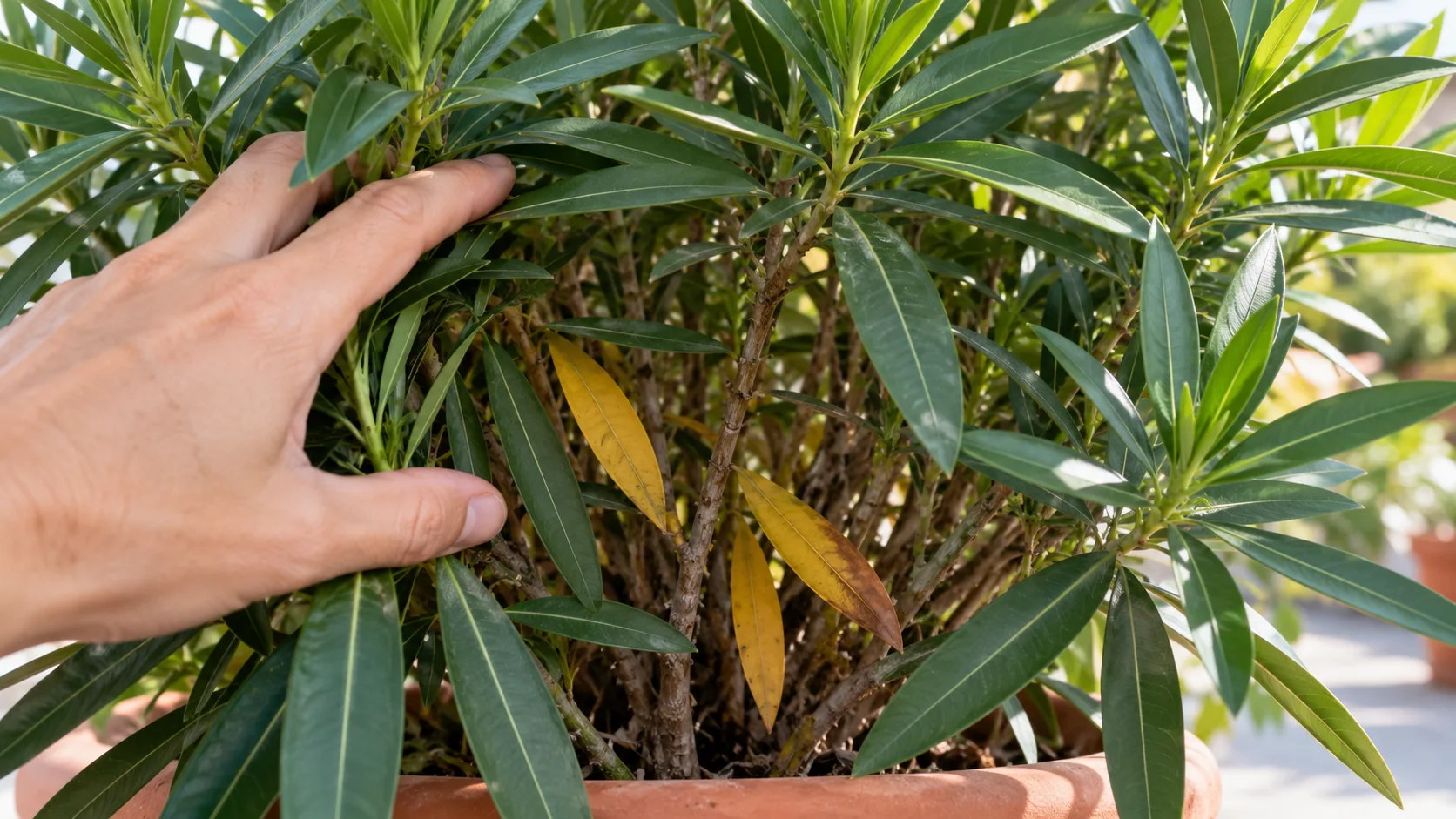
Normal or worrying: check which leaves are yellow
First, look at where the yellow leaves are. Like other evergreen shrubs, oleander (Nerium oleander) keeps its leaves for only one to a few years, then sheds the oldest ones, close to the trunk. While new shoots at the branch tips stay green, nothing needs correcting1.
Yellowing becomes a warning when it affects young growth or all the foliage at once1. Three questions guide the diagnosis: which leaves, what pattern on the leaf, and what condition the potting mix is in.
| What you see | Likely cause | First step |
|---|---|---|
| A few yellow leaves inside the shrub, with healthy green new growth | Renewal of older leaves1 | None; collect fallen leaves |
| Yellowing, wilting foliage, saturated potting mix, heavy pot | Too much water, roots starved of oxygen2 | Empty the saucer, let the potting mix drain and check the roots |
| All branches yellow and droop together, dry potting mix | Too little water3 | Water until it runs out through the base |
| One branch after another, leaves scorched from the tip, no recovery after watering | Xylella fastidiosa3 | Take no cuttings; report it to the French authorities4 |
| Oldest leaves yellow first, growth slows | Lack of nitrogen5 | Resume seasonal feeding |
| Young leaves yellow between veins that remain green | Iron deficiency5 | Check drainage before adding iron |
| Pale young leaves in spring after a cold spell | Cold-induced chlorosis5 | Wait for the next shoots |
| Yellow stippling, falling leaves, insects or webs underneath | Scale insects or spider mites67 | Turn leaves over, identify and treat |
Older inner leaves turning yellow: natural renewal
An evergreen shrub is not green forever: it replaces leaves in small batches. Clemson University's extension service compares it to replacing worn tires: old inner leaves turn yellow, red or brown, then fall, while young leaves at the branch tips remain healthy1. This shedding lasts a few days to a few weeks, often in spring, which can be surprising when the rest of the garden is turning green1.
This yellowing is senescence. As the leaf changes color, the shrub recovers some of its nitrogen and phosphorus1. The RHS adds that an evergreen sometimes loses many old leaves at once, and only loss of young leaves, wilting or dying shoots warrants investigation5.
Yellowing lower leaves explains this situation, common to many plants.
All foliage yellowing, heavy pot: too much water
In containers, this is the most common and most misleading cause. Waterlogged potting mix drives out air: roots lack oxygen, leaves yellow, and the plant may wilt as though thirsty, because its roots can no longer absorb water or nutrients2. The RHS ranks overwatering first among causes of container-plant loss8.
The test is simple: lift the pot and touch the potting mix. A heavy pot, wet potting mix a third of the way down9 and drooping yellow leaves point to excess water. Remove the pot if doubt remains: blue-black roots with a sour smell indicate root suffocation2.
- Empty the saucer, and remove it before winter8.
- Let the potting mix drain and dry somewhat before watering again, and check that drainage holes are clear.
- Cut away soft, rotten roots when repotting10, then water until it runs out through the base9.
Summer is the dangerous season: in cold soil, roots respire little and tolerate excess water better than in warm weather, when they need plenty of oxygen2. Root rot explains how to rescue an affected rootball.
Pour doser l'eau selon le pot et la saison, watering oleander se règle sur la terre, pas sur le calendrier.
Foliage yellowing and drooping, light pot: thirst
The RHS lists oleander as drought-tolerant11, but in a pot its water supply lasts only a few days. The specialist interviewed by SNHF is clear: do not assume oleander withstands drought for very long
12. On hot days, a container-grown oleander may need water morning and evening13.
Underwatering has a signature: leaves on every branch yellow and droop together, either uniformly yellow or along the midrib. Unless drought is severe, the plant recovers when watered3. Water slowly at the base: fill the pot to the rim, let the water soak in, then repeat once9.
See underwatering and water stress.
One branch yellowing then scorching: not thirst
One affected branch, leaves yellowing from the tips or edges, and no recovery after watering: consider Xylella fastidiosa. This bacterium blocks the vessels carrying sap upwards, cutting off water to affected branches3. The RHS lists oleander as a high-risk host11.
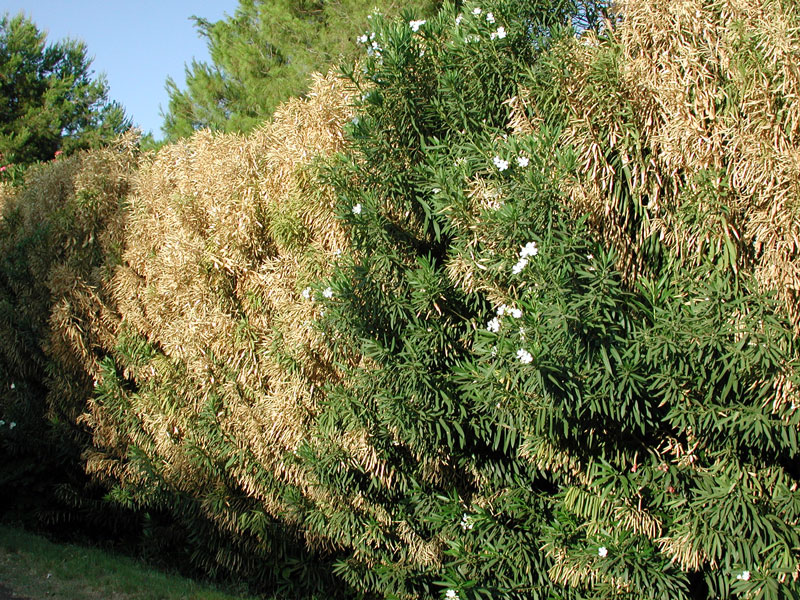
| Sign | Thirst | Xylella |
|---|---|---|
| Affected branches | All at once | One, then others |
| Leaf yellowing | Uniform, or along the midrib | From the tip or edges |
| After watering | The plant recovers | No recovery |
Both columns come from the same University of California bulletin3. A third condition browns the edges of older leaves without drooping: excess salts or boron, which improves when the potting mix is flushed with plenty of water3. See flushing salts from potting mix.
Que faire en cas de doute, et à qui le signaler : oleander diseases détaillent la démarche, Xylella comprise.
Old yellow leaves and slow growth: the pot needs feeding
The oldest leaves yellow first, fairly uniformly, and the shrub grows little: this is the pattern of nitrogen deficiency. The RHS describes general, sometimes reddish yellowing that starts with older leaves and accompanies poor vigor5. With potassium deficiency, yellowing concentrates more on leaf edges5.
An oleander in a tub depends entirely on its potting mix. The Bavarian Garden Academy feeds it weekly from April to late August, with a complete soluble fertilizer at 3 g per liter (0.4 oz per US gallon)13. A pot never fed eventually yellows. To correct a deficiency, the RHS recommends liquid feed, which acts faster than granules14.
Do not overdo it: too much nitrogen mainly promotes leaves, and the SNHF specialist calls for a potassium-rich formula to encourage flowering12.
Formule, dose et calendrier : feeding oleander se choisit pauvre en azote, riche en potasse.
Young yellow leaves with green veins: iron
Yellowing between veins that remain green is interveinal chlorosis. The RHS attributes it to a lack of iron, manganese or magnesium. Iron deficiency first affects the youngest leaves, whereas manganese and magnesium deficiencies first affect older ones5.
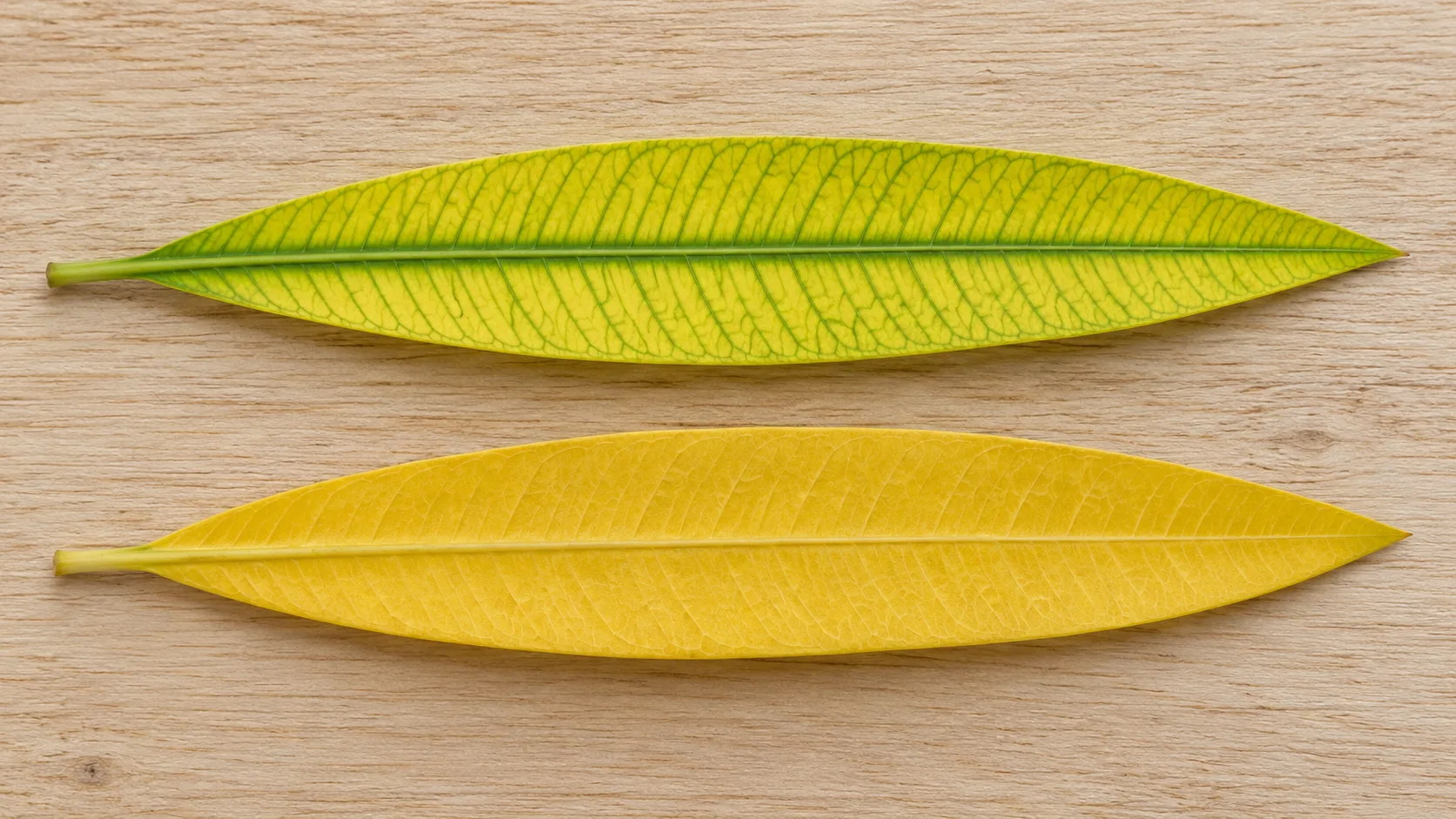
A high soil pH alone can yellow an evergreen1, even though the RHS lists oleander among shrubs that tolerate chalky soil11. Check drainage first: waterlogged roots can no longer absorb soil nutrients2, and adding iron will change nothing.
See iron deficiency, correcting iron deficiency and yellow leaves with green veins.
Pale young leaves in spring: cold
A spring cold spell can discolor actively growing young leaves. The RHS describes this cold-induced chlorosis, common in spring on developing leaves; affected leaves may stay yellow for the rest of the season5. No treatment is needed: subsequent shoots emerge green.
Do not confuse it with scorch after winter storage. An oleander moved straight from shelter into full sun scorches: the Bavarian Garden Academy first keeps it in partial shade for a few days13.
Pour rentrer et ressortir le pot au bon moment, overwintering oleander donne les seuils de froid et la transition de printemps.
Yellow stippling and falling leaves: a pest
Turn a few leaves over before watering or feeding. Sap-sucking pests, especially aphids and spider mites, often cause yellowing, and the culprit is on the leaf itself5. Under cover, the RHS notes scale insects, mealybugs and spider mites on oleander11.
- Scale insects: small fixed shields along veins and stems. They cause yellowing and premature leaf fall6.
- Spider mites: these mites leave pale stippling and fine webs beneath leaves. Badly affected leaves yellow and fall; damage is greatest in hot, dusty weather, on a water-stressed plant7.
Pour reconnaître chaque insecte et choisir le traitement, oleander diseases and pests sont classés symptôme par symptôme.
Yellow leaves during overwintering
Leaf loss in winter storage is normal. The Saxon environment and agriculture office (LfULG) notes that even evergreens regularly shed older leaves there, and container plants are more susceptible to fungal diseases15.
- Collect fallen leaves to prevent fungi establishing15. SNHF notes Septoria leaf spot, white spots that become sunken as they dry, on oleanders kept in excessively damp rooms16.
- Keep potting mix slightly dry rather than too wet: check the rootball once a week, and when dry, water thoroughly rather than just wetting the surface15.
- A dark room must stay cool: the less light, the lower the temperature should be15. For oleander, LWG aims for 4 to 8 °C (39 to 46 °F) in a room as bright and easy to ventilate as possible13.
Should you cut yellow leaves off oleander?
No, not while they remain attached. An old yellowing leaf returns some nitrogen and phosphorus to the shrub before falling1: cutting it off while green-yellow loses that recycling. It detaches by itself when dry.
Do collect fallen leaves, especially in winter shelter, where they encourage fungi15. A whole branch turning yellow then dying requires a different response: rule out Xylella first, since pruning tools can transmit the bacterium4, and take no cuttings from it.
Cannot place a yellow leaf in one of these categories? Photograph it: Floralens identifies the problem and suggests the appropriate action.