
Oleander poisoning symptoms and what to do
Is oleander poisonous?
Yes, unequivocally: every part of oleander, fresh or dried, is poisonous to cats, dogs, horses and humans. Its glycosides affect the heart, so any ingestion, even without visible symptoms, calls for immediate contact with a vet or poison center.
Every part is poisonous, fresh or dried
Oleander (Nerium oleander) is poisonous to dogs, cats and horses: the ASPCA lists it unequivocally as toxic to all three species1. For humans, ANSES adds that it can be fatal if swallowed, that all varieties are affected and that every part of the plant is toxic2.
The Western France Animal Poison Center lists leaves, flowers, seeds, sap and wood3. White flowers, dwarf forms and double flowers make no difference2, nor does drying: the plant remains poisonous whether green or dry45. Our oleander botanical profile records severe cardiac toxicity for every part and every variety.

The culprit has a name: oleandrin, a cardiac glycoside. Pet Poison Helpline states that it occurs throughout the plant6, and SFMU estimates that leaves contain around 1.5% glycosides, mainly oleandrin and neriine7.
These molecules block a pump in heart cells, the sodium-potassium pump. The heart then beats more strongly but more slowly, and then irregularly. The Merck Veterinary Manual groups oleander with foxglove and lily of the valley among plants containing cardiac glycosides, places oleander and foxglove highest for toxicity, and notes their narrow safety margin8.
This is quite different from a plant that simply irritates: monstera irritates the mouth without causing systemic poisoning, whereas oleander enters the bloodstream and affects the heart.
What quantities are dangerous?
Poison centers publish no safe threshold, only approximate quantities drawn from observed cases. These show how different this is from a merely irritating plant: we are talking about a few leaves, not an entire bush being eaten.
| Animal | Quantity reported as fatal | Source |
|---|---|---|
| 10 kg (22 lb) dog | 2 or 3 leaves | CAPAE-Ouest3 |
| Cat | Dose not established, presumed comparable to that for dogs | CHV Frégis9 |
| Guinea pig | 5 g (0.18 oz) of leaves | CAPAE-Ouest3 |
| 500 kg (1,102 lb) horse | 25 g (0.88 oz), about ten fresh leaves | RESPE5 |
| Horse or cattle | 30 to 60 g (1.1 to 2.1 oz) of leaves | CAPAE-Ouest3 |
For cats, Merck adds that they are considered more sensitive than dogs to cardiac glycosides8. The only reasonable reference quantity is therefore zero.
One detail matters in accidents: fresh leaves are bitter and animals often leave them alone, whereas they more readily eat dried leaves3. A pile of cut branches drying at the back of the garden is therefore more dangerous than the growing shrub.
Symptoms in cats, dogs and horses
Signs are digestive at first, then neurological and cardiac39. The ASPCA lists excessive salivation, abdominal pain, diarrhea, colic, depression and death1; Pet Poison Helpline adds loss of appetite, irregular heartbeat, weakness and collapse6.
In dogs and cats
Nausea and vomiting appear within two hours of ingestion and may last several days. Salivation, abdominal pain and sometimes bloody diarrhea accompany them. Within three days, the animal may lose its balance, tremble, have seizures or remain prostrate3.
Two distinctions matter for cats. Signs generally appear between 30 minutes and 2 hours, but more rarely after 24 to 48 hours, and recovery may take up to a month9.
In both dogs and cats, Merck states that signs may persist for up to 4 to 5 days, with a heartbeat that is too slow or too fast and hyperkalemia8.
These delays explain why an animal that has vomited and then seems better is not out of danger, and neither is one showing nothing after an hour. The prognosis remains guarded for the first three days, even with early treatment3. To compare oleander with other garden hazards, see plants poisonous to cats and plants poisonous to dogs.
In horses
Oleander is one of the leading causes of plant poisoning in equines. On the shrub, its tough, bitter leaves deter horses: accidents involve prunings thrown into pasture, contaminated hay and water in a trough where leaves have soaked. Death may occur within hours or even minutes, through heart paralysis, and toxins can pass into mares' milk5. Other pasture hazards are covered in plants poisonous to horses.
In rodents and birds
CAPAE-Ouest reports that guinea pigs are particularly fond of oleander and mainly develop seizures and agitation. Birds show diarrhea, regurgitation, salivation, prostration or tremors3. For such small animals, a few grams are enough: no branch should end up in a cage or enclosure.
What if your animal has eaten some?
- Remove any pieces still in the mouth, if the animal allows it without a risk of biting.
- Call your vet or a veterinary poison center (numbers below), then leave if instructed to do so.
- Do not induce vomiting without instructions, and give nothing by mouth. The vet decides according to the time elapsed and the animal's condition: inducing vomiting in an agitated animal or one already showing signs is inadvisable and may be dangerous9. At the clinic, induced vomiting is combined with activated charcoal in an animal still showing no signs8.
- Take a branch or photo of the plant, and note the time and suspected quantity.
- Keep other animals away from the plant and waste while you deal with the situation.
At the clinic, treatment involves decontamination, intravenous fluids, monitoring the heart and potassium, and sometimes digoxin-specific antibodies. Merck notes an excellent prognosis while the heart and potassium remain normal, but deaths from oleander poisoning are reported even with intensive treatment8.
| Center | Telephone | Affiliation |
|---|---|---|
| CNITV, Lyon (Marcy-l'Étoile) | 04 78 87 10 40 | VetAgro Sup |
| CAPAE-Ouest, Nantes | 02 40 68 77 40 | Oniris |
Both centers answer members of the public and vets103, and the French Veterinary Council states that CAPAE-Ouest does so free of charge11. Between midnight and 8:30 am, call your clinic: its answerphone gives the vet on call.
In children and adults
ANSES describes nausea, vomiting, diarrhea, drowsiness or agitation, headaches and visual disturbances, followed in severe cases by a slowing of the heart that may progress to cardiac arrest2. MedlinePlus adds that symptoms last one to three days and may require hospital admission12.
SFMU gives an approximate quantity: the toxic dose is 10 to 20 leaves or flowers for an adult, and 2 to 3 leaves or flowers for a child, with initial signs within two hours13. A hospital team in Rabat gives the same figures for serious harm14. As with animals, these figures come from observed cases and are not a safety threshold.
These quantities explain SFMU's observation in young children: swallowing leaves, flowers or seeds is rarely serious because the quantity is insufficient. Severe poisonings mainly involve deliberate ingestion; mistaken identity in cooking is the other trap7. The Belgian Poison Center states that most accidents involve children aged 18 months to 3 years, who rarely swallow much because the leaf is bitter15.
Rarely serious does not mean harmless, hence ANSES's instruction: rinse inside the mouth, then seek advice from a poison center even without symptoms. In France, for severe symptoms or a life-threatening emergency, ANSES says to call 15 or 1122.
Poison centers give three prohibitions: do not induce vomiting, do not give anything to drink, and do not rely on milk, which is not an antidote16.
| Center | Telephone |
|---|---|
| National number (ORFILA) | 01 45 42 59 59 |
| Angers | 02 41 48 21 21 |
| Bordeaux | 05 56 96 40 80 |
| Lille | 08 00 59 59 59 |
| Lyon | 04 72 11 69 11 |
| Marseille | 04 91 75 25 25 |
| Nancy | 03 83 22 50 50 |
| Paris | 01 40 05 48 48 |
| Toulouse | 05 61 77 74 47 |
These centers do not treat animals16: for a dog or cat, use the two veterinary numbers above.
Touching, pruning and burning: other exposures
Contact. NC State lists oleander among plants that cause contact dermatitis4, and ANSES asks people to wash their hands after handling it2. Soaking feet or knees in a leaf infusion, a traditional remedy, caused deep chemical burns in two patients treated in Morocco14. For pruning, gloves and long sleeves are enough.
Pour les dates et les gestes de coupe, voyez comment pruning oleander sans laisser traîner un seul rameau.
Licking. CAPAE-Ouest has described poisonings in animals that licked sap after contact3. A cat that rubs against a freshly pruned oleander and then grooms itself is in this situation.
Water. The same center cites drinking water in which part of the plant has soaked3. A vase of cut flowers from which a cat drinks, a saucer beneath the pot or a pasture trough pose the same problem.
Smoke. Never burn the branches: NC State considers the smoke harmful, and CAPAE-Ouest reports poisoning through inhalation during burning43. Branches should not be used as skewers or vegetable-garden stakes either.
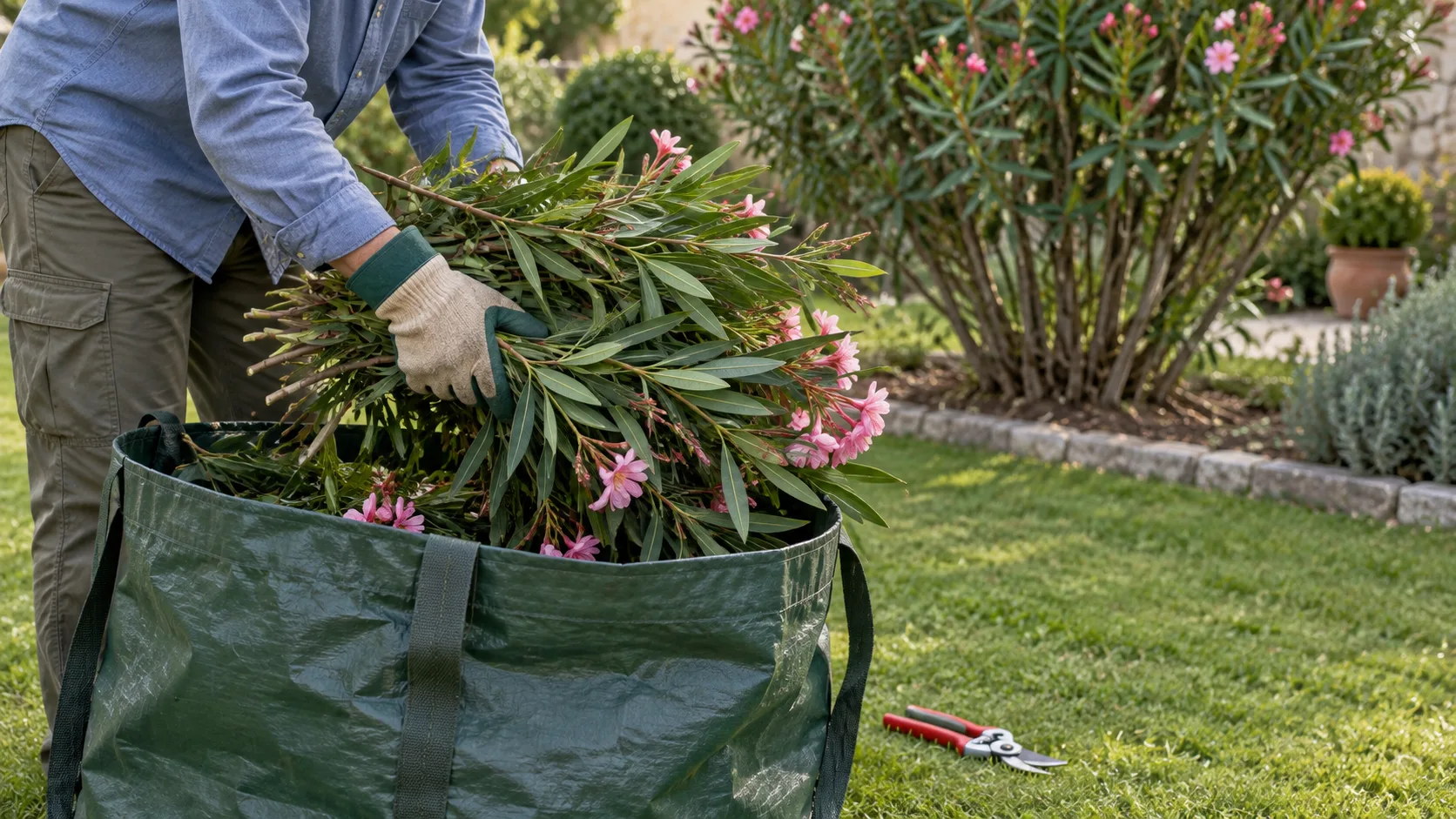
Prunings. RESPE recommends collecting everything and taking it to a waste collection center, never leaving it within animals' reach5.
Le risque change de pièce quand la plante rentre pour l'hiver : un bac posé dans le salon devient accessible au chat, et overwintering oleander se prépare en pensant aussi à lui.
Other care, from watering to repotting, is covered in our oleander care guide.
Which laurel is not poisonous?
The French word “laurier” refers to several unrelated plants, and SFMU lists at least four: oleander, cherry laurel, bay laurel and laurustinus. It reports poisonings through mistaken identity, with oleander leaves mistaken for bay leaves in cooking or eucalyptus in infusions7.
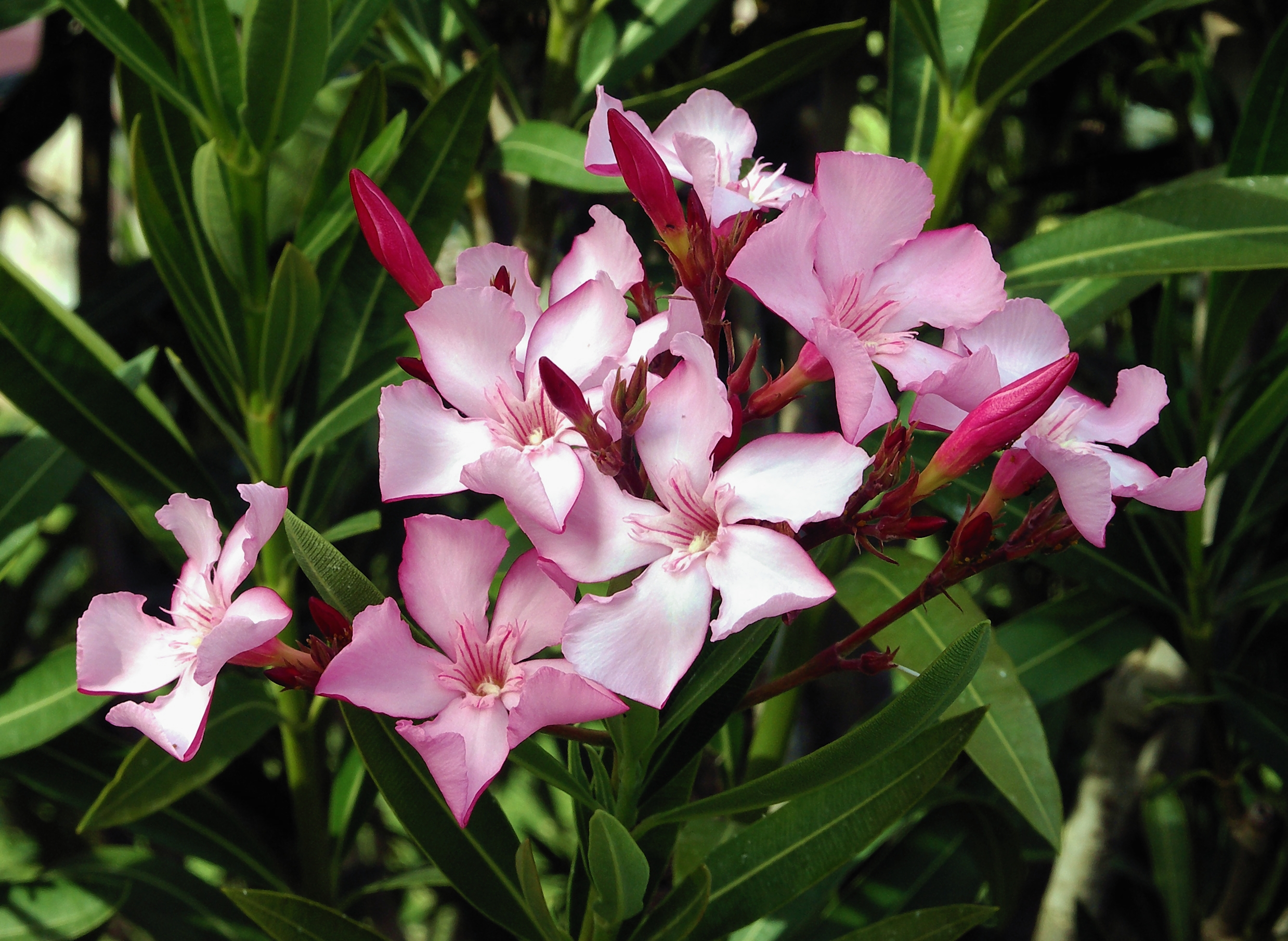

Only bay laurel (Laurus nobilis) is used in cooking. Take care, though: what is edible for you is not necessarily edible for your animal. The ASPCA lists bay laurel as toxic to dogs, cats and horses, causing vomiting and diarrhea, with an obstruction risk if many whole leaves are swallowed17.
Cherry laurel (Prunus laurocerasus) is poisonous to everyone, but by a different mechanism. This plant, rather than oleander, releases cyanide: Merck places it among plants containing cyanogenic glycosides, whose seeds and chewed leaves release this poison8.
What can replace oleander?
With a cat that climbs everywhere, a dog that chews sticks or a horse in pasture, keeping the plant out of reach is not always enough. Replacing it with a shrub listed as non-toxic to cats and dogs addresses the problem at its root. The five plants below meet this condition in our profiles and the ASPCA lists, which also classify them as non-toxic to horses.
| Plant | What it offers | Position | Cold tolerance |
|---|---|---|---|
| Crape myrtle (Lagerstroemia indica)18 | Deciduous, white, pink, red or purple flowers in summer and fall; tolerates drought | Full sun | -20 °C (-4 °F) |
| Rosemary (Salvia rosmarinus)19 | Evergreen, blue, mauve or white flowers; tolerates drought and salt | Full sun | -10 °C (14 °F) |
| Rose (Rosa)20 | Flowers from spring to fall; bear thorns in mind | Full sun, at least 4 hours | -20 °C (-4 °F) |
| Japanese camellia (Camellia japonica)21 | Evergreen, flowers in winter and spring | Light shade to partial shade | -15 °C (5 °F) |
| Arabian jasmine (Jasminum sambac)22 | Evergreen, highly fragrant white flowers; grown in a container | Bright partial shade | Frost-free, brought indoors for winter |
Crape myrtle is the closest replacement for a container or bed in full sun: similarly generous summer flowers and the same love of heat. It loses its leaves in winter, though: for an evergreen hedge, camellia or rosemary provides a year-round screen. By the sea, rosemary fits the role, since, like oleander, it tolerates drought and salt spray. For jasmine, check for the Latin name Jasminum on the label: the ASPCA's assessment covers this genus, and other plants sold as jasmine do not belong to it.
The olive tree (Olea europaea), listed as non-toxic to cats and dogs in its profile, adds to the Mediterranean selection. For more options, browse plants non-toxic to cats and plants non-toxic to dogs, or our selection of non-toxic houseplants for cats and dogs.
Frequently asked questions
Is oleander poisonous to touch?
Touching the plant does not cause systemic poisoning, but the sap can irritate skin: NC State lists oleander among plants causing contact dermatitis4. ANSES asks people to wash their hands after handling it2. The real contact risk comes from what happens next: a hand touching the mouth, or an animal licking sap from its coat3.
What are the drawbacks of oleander?
The first is its toxicity to everyone, animals and humans alike, extending to dried leaves and water in which it has soaked3. Then come skin-irritating sap4 and prunings that must go to a waste collection center rather than be burned5. As a garden plant, it dislikes severe frost, hence the question of when to bring oleander indoors, and attracts aphids and scale insects, detailed in oleander diseases and pests.
How many oleander leaves can kill a dog?
The Western France Animal Poison Center gives an approximate quantity: 2 or 3 leaves for a 10 kg (22 lb) dog3. This comes from observed cases and is not a safety threshold. A smaller dog, a dried leaf more readily eaten or a vulnerable animal changes the situation. Any ingestion warrants a call to a vet, without waiting for vomiting.
Can you keep oleander with a cat or dog?
It is possible with an animal that leaves it alone, provided you collect fallen leaves, faded flowers and prunings as they appear, since dried leaves are most often eaten3. An indoor pot, a saucer of water or a puppy that chews everything makes the risk difficult to manage. In these situations, a shrub listed as non-toxic by the ASPCA, such as crape myrtle, resolves the issue18.
Are oleander flowers poisonous too?
I ate a laurel leaf. Is it serious?
It depends on the plant. Bay laurel (Laurus nobilis) is a common culinary seasoning and safe for you. If it is oleander, or you are unsure, call a poison center even without symptoms, and, in France, ANSES says to call 15 if you feel unwell, have an irregular heartbeat or visual problems2. Do not induce vomiting or drink milk16.