
Oleander diseases: recognizing the signs
Sick oleander: find the cause from the symptoms
A sick oleander (Nerium oleander) most often has sap-feeding aphids or scale insects followed by sooty mold, bacteria causing stem swellings, or damage from frost, waterlogged potting mix or drought. The location and texture of symptoms almost always help distinguish them.
Diagnosis at a glance
Start with the symptom's location, then feel it. A sticky leaf suggests insects, a hard stem swelling bacteria, a dry, brittle leaf cold or drought damage. The RHS lists oleander (Nerium oleander) as susceptible to scale insects, mealybugs and spider mites under cover, and a high-risk host of Xylella fastidiosa1.
| What you see | Likely cause | Read more |
|---|---|---|
| A few yellow inner leaves in spring, with healthy green new shoots | Normal replacement of old leaves | Yellow leaves |
| Widespread yellowing, heavy pot, waterlogged potting mix | Overwatering, suffocating roots | Yellow leaves |
| Bright yellow colonies on shoots and buds | Oleander aphid | Aphids |
| Small round beige shields or dark shells on stems | Scale insects | Scale insects |
| White deposits: cottony clumps in leaf axils, or fine white powder | Usually mealybugs, rarely powdery mildew | White cotton |
| Sticky leaves, then a black coating that wipes off | Honeydew followed by sooty mold | Sooty mold |
| Rough swellings on stems, leaves or buds | Bacterial knot | Bacterial knot |
| Brown leaves after a cold night, blackish twigs drying out | Frost or woody dieback | Brown leaves |
| Leaves scorch from the tips, branch by branch, without recovery after watering | Suspected Xylella fastidiosa, to be reported | Xylella |
| Pale stippling, bronzed leaves, fine webs | Spider mites | Spider mites |
| Buds stay closed or rot | Cool summer, rain on double flowers | Buds |
Symptoms outside this table? Photograph the affected part: Floralens names the problem and suggests an appropriate step.
Why oleander leaves turn yellow
A few yellow inner leaves in spring are not a disease: evergreens replace their oldest leaves. Yellowing of young shoots or all the foliage at once warrants investigation2. First check for too much or too little water in the pot3, then insufficient feeding, lime, cold or insects beneath leaves4.
Le diagnostic complet, feuille par feuille : yellow leaves on oleander séparent le renouvellement normal de l'excès d'eau, de la soif et des carences.
Sans noyer les racines ni les laisser sécher : watering oleander se règle sur la motte et sur la saison.
Yellow aphids on young shoots
Clusters of bright yellow insects on shoots and buds are oleander aphids (Aphis nerii). The University of Florida describes this bright yellow aphid with black legs and antennae as a specialist on Apocynaceae, the oleander family5.

Aphids pierce tender shoots, curl leaves and excrete honeydew, attracting ants and feeding sooty mold6. Established shrubs usually tolerate them and regrow without lasting harm6.
Work from gentlest to strongest:
- A strong water jet knocks colonies off twigs; cut off the worst-infested shoots6.
- Keep ants away: they protect aphids from predators6.
- Let beneficial insects and mites work: ladybugs, lacewings, hoverfly larvae and small wasps that turn aphids into brown “mummies”6.
- Black soap as a last resort: the SNHF recommends a 5% spray7.
Avoid propellant aerosols on foliage: the Bayerische Gartenakademie warns of cold burns8. Limit nitrogen fertilizer too: UC IPM discourages overfertilizing because aphids feed on tender growth6.
The aphids and removing aphids pages explain each method.
Scale insects: shields, shells and white cotton
Three forms of scale insect colonize oleander; treatment timing differs.
Oleander scale (Aspidiotus nerii) has a nearly round, matte pale beige shield 1.8–2.2 mm (0.071–0.087 in) across. In its French source context, INRAE records three generations yearly: first crawlers in March–April, the next generation 8–9 weeks later, the last in September–October. Crawlers prefer shaded leaf undersides. Damage includes weakened shrubs, falling leaves and drying twigs9.

Black scale (Saissetia oleae) hides beneath a tough shell on stems and leaves. In INRAE’s French source calendar, it has one generation yearly, active March to October10. This is a soft scale: UC IPM says it excretes honeydew, unlike armored scales11. Along with aphids, it therefore feeds sooty mold.

Mealybugs form white cottony clumps in leaf axils. The Gartenakademie treats them like other scale insects8.
White cotton or white powder? Scrape the deposit first: cottony material hiding an insect means mealybugs. The RHS does not list powdery mildew among oleander diseases, only Xylella fastidiosa and, rarely, honey fungus1. A true powdery coating without insects falls under powdery mildew and its treatment.
Target newly emerging crawlers. Adults are protected beneath shields; only the yellow-orange crawler is exposed11. The method:
- Light infestation: wipe leaves and stems with a wet sponge8.
- Established infestation: treat several times, three to five days apart, as crawlers emerge8. UC IPM recommends horticultural oil or another contact product such as insecticidal soap, thoroughly wetting leaf undersides11.
- Before overwintering: inspect the shrub before bringing it in, a routine Gartenakademie check8.
Un pot rentré avec ses cochenilles les multiplie à l'abri : overwintering oleander commence par une inspection du feuillage.
More detail: armored scales, removing scale insects, mealybugs, and our guide to recognizing and removing each kind of scale insect.
Sooty mold: black deposits on leaves
A soot-like black coating that rubs off is sooty mold, rather than a disease infecting the leaf. These fungi (Capnodium, Fumago, Scorias) grow on honeydew without infecting the plant12.

The coating is still harmful: it blocks light, slows photosynthesis and can cause premature leaf fall12. It signals a sap-feeding insect is, or was, active nearby12: first inspect branches above the deposit.
- Find the insect: aphids on shoots, black scale on stems. Sooty mold returns while they remain.
- Wash foliage with a strong water jet or soapy water12, such as black soap diluted as for aphids7.
- Be patient: after controlling the insects, sooty mold gradually subsides on its own12.
See sooty mold, sticky leaves and cleaning honeydew.
Stem swellings: bacterial knot
Rough wart-like growths on stems, bark, leaves or flower buds indicate oleander bacterial knot, also called bacterial gall (Pseudomonas savastanoi pv. nerii)13. The SNHF journal describes blackish, distorting cankers, mainly on young shoots, branches and flower clusters7. On leaves, dark spots appear first, followed by leaf fall8.

Each swelling is a gall. Affected parts die back, but UC IPM says overall shrub health is rarely threatened13.
How bacteria enter. They survive in cracked bark and galls, multiply in wet winter and early spring weather, and spread through rain splashes, hands and tools. They enter fresh wounds: pruning cuts and frost cracks13.
No product cures an existing gall. The Gartenakademie is categorical: there is no cure; only timely cutting saves the plant, and severely affected plants must be destroyed8. Steps:
- Cut affected twigs in dry weather, when bacteria are inactive, removing all galled tissue13.
- Disinfect blades before every cut in a 10–20% diluted bleach solution13.
- Water at the base, never over foliage: water spreads bacteria13.
- When buying, galls are visible from late spring to fall; plants bought in the rainy season may conceal infection13.
For prevention, the SNHF recommends a copper-based product such as Bordeaux mixture, in spring then every two or three months, depending on climate, early or late in the day7. It protects healthy shoots, rather than curing existing galls.
Une coupe au mauvais moment ouvre la porte à la bactérie : pruning oleander se fait au printemps, après les gelées, avec des outils propres.
Les déchets de taille restent dangereux pour les animaux : les symptoms in cats et le chien, et les bons réflexes, sont détaillés à part.
See also galls and sanitation pruning.
Brown leaves and dry twigs
Three main causes of browning are cold, drought and salt. How browning spreads distinguishes them.
| Cause | Where and how leaves brown | Recovery |
|---|---|---|
| Lack of water | Uniform yellowing or yellowing along the midrib, across all branches at once | Yes, after watering, unless drought is severe |
| Excess salts or boron | Brown edges, mainly on older leaves, without drooping | Yes, after leaching the soil |
| Xylella fastidiosa | Browning spreads inward from tips or edges, branch by branch | No, even after watering |
This table follows UC IPM criteria14. See underwatering and dry leaf edges.
Frost. Oleander withstands −5 °C (23 °F) according to its botanical profile. Cold leaves foliage looking scorched, shoots brown or black, with damage often appearing only several days after frost15. See weather damage.
Sunburn after winter. Moving a sheltered pot straight into full sun causes scorching: the Gartenakademie recommends a few days in partial shade first8.
Whole twigs turning black. Branches and shoots dying blackish brown indicate dieback caused by Botryosphaeria, more frequent after drought or severe frost. Cut affected twigs until no discolored tissue remains in the cut16.
Pour éviter le coup de froid, protecting oleander from frost se décide selon la région et le pot.
Branch-by-branch scorch: suspect Xylella
Leaf scorch spreading from tips, one branch after another, without recovery after watering suggests Xylella fastidiosa. This bacterium blocks sap-carrying vessels, stopping water reaching affected branches. In the United States, infected oleanders decline and die within 3–5 years; there is no treatment14.
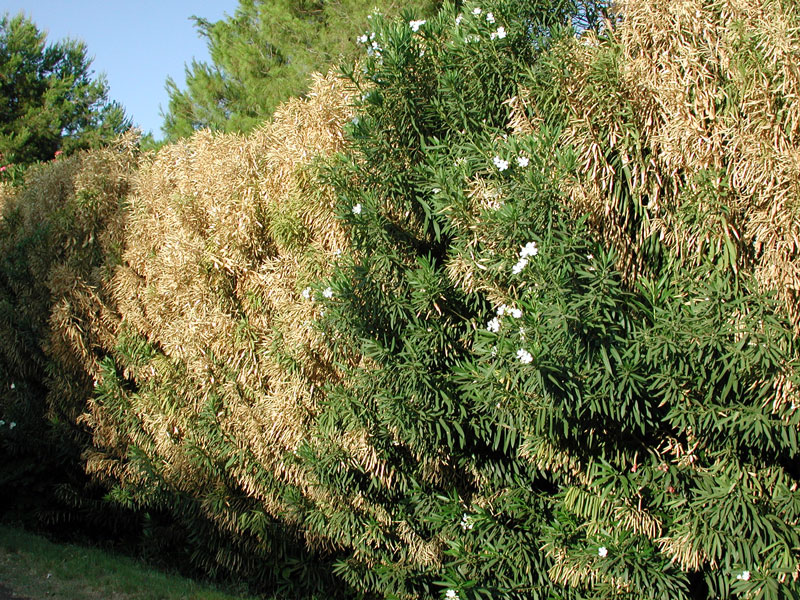
In France, the bacterium is a priority quarantine organism. The DRIAAF factsheet records it in Corsica, coastal Provence-Alpes-Côte d'Azur and Occitanie, with oleander symptoms most pronounced in summer17. It spreads mainly through sap-feeding insects feeding on xylem sap17.
If you suspect it:
- Contact your regional food service (SRAL) within your French region's DRAAF, the service named in the factsheet for suspected cases17.
- Do not use the same pruning shears on other plants: pruning tools can also spread the bacterium17.
- Keep the plant in place, taking no cuttings while awaiting the service's response.
The commonest confusion is drought. Check the previous table before concluding: a thirsty oleander yellows across all branches at once and recovers after watering14.
Spider mites: pale stippling and fine webs
Pale stippling, sometimes bronzed foliage, with fine webs beneath leaves indicates spider mites. The RHS notes them on oleander mainly under cover1, including warm conservatories in winter.
Damage is worst in hot, dusty weather and on water-stressed plants; severe attacks cause yellowing and leaf fall18. Start with water: water correctly and shower leaf undersides at least daily. Insecticidal soaps and oils come next, while preserving predatory mites18.
See spider mites and removing spider mites.
Buds that dry out or stay closed
Buds staying closed in a cool summer are not diseased. The Gartenakademie notes that oleander flowers abundantly only in hot summers; in cool weather buds often fail to open8.
Two other possibilities to check on the bud:
- Rotting double flowers: double varieties rot badly in wet years; the Gartenakademie recommends shelter from rain8.
- Distorted, swollen buds: bacterial knot also attacks flower buds13. Cut them off like diseased twigs.
Aphid clusters also weaken buds: look closely before deciding.
Monitoring through the year
Watch two periods closely: spring for insects, wet winter weather for bacteria. The calendar below combines published timings for each problem, each with its source.
| Problem | January | February | March | April | May | June | July | August | September | October | November | December |
|---|---|---|---|---|---|---|---|---|---|---|---|---|
| Black scale, stems | nothing to report | nothing to report | watch for this | watch for this | watch for this | watch for this | watch for this | watch for this | watch for this | watch for this | nothing to report | nothing to report |
| Oleander scale, crawlers, stems | nothing to report | nothing to report | watch for this | watch for this | watch for this | watch for this | nothing to report | nothing to report | watch for this | watch for this | nothing to report | nothing to report |
| Oleander aphid | nothing to report | nothing to report | nothing to report | watch for this | watch for this | watch for this | watch for this | watch for this | watch for this | nothing to report | nothing to report | nothing to report |
| Bacterial canker, infection | watch for this | watch for this | watch for this | watch for this | nothing to report | nothing to report | nothing to report | nothing to report | nothing to report | nothing to report | nothing to report | watch for this |
| Xylella fastidiosa, symptoms, leaves | nothing to report | nothing to report | nothing to report | nothing to report | nothing to report | watch for this | watch for this | watch for this | nothing to report | nothing to report | nothing to report | nothing to report |
In spring, inspect leaf undersides weekly as the first scale crawlers and aphids appear. In winter, avoid pruning in rainy weather. Before fall sheltering, inspect all foliage before bringing the pot in.
For other care, including watering, pruning and cold protection, see oleander care.
Frequently asked questions
How do I treat a sick oleander?
What is the treatment for oleander bacterial knot?
How do I treat powdery mildew on oleander?
First confirm powdery mildew: the RHS does not list it among oleander diseases1. White cottony deposits usually mean mealybugs; wipe them with a wet sponge in light infestations8. Treat true powdery growth as powdery mildew on other plants.
What should I do about spots on oleander leaves?
Rub the spot first. A black coating that wipes off is sooty mold on insect honeydew: look for aphids or black scale on branches above, then wash foliage12. Persistent dark spots followed by leaf fall may herald bacterial knot: cut affected parts in dry weather813. Fine pale stippling with webs beneath leaves means spider mites18.
Why are my oleander leaves brown and dry?
How do I prune a sick oleander?
Why is my oleander losing leaves?
Is sooty mold serious for oleander?
It does not infect the plant, but blocks light and can cause leaf fall12. It gradually disappears after aphids or scale insects are controlled; washing with soapy water speeds cleaning.