
How often to water oleander and how much it needs
Watering oleander
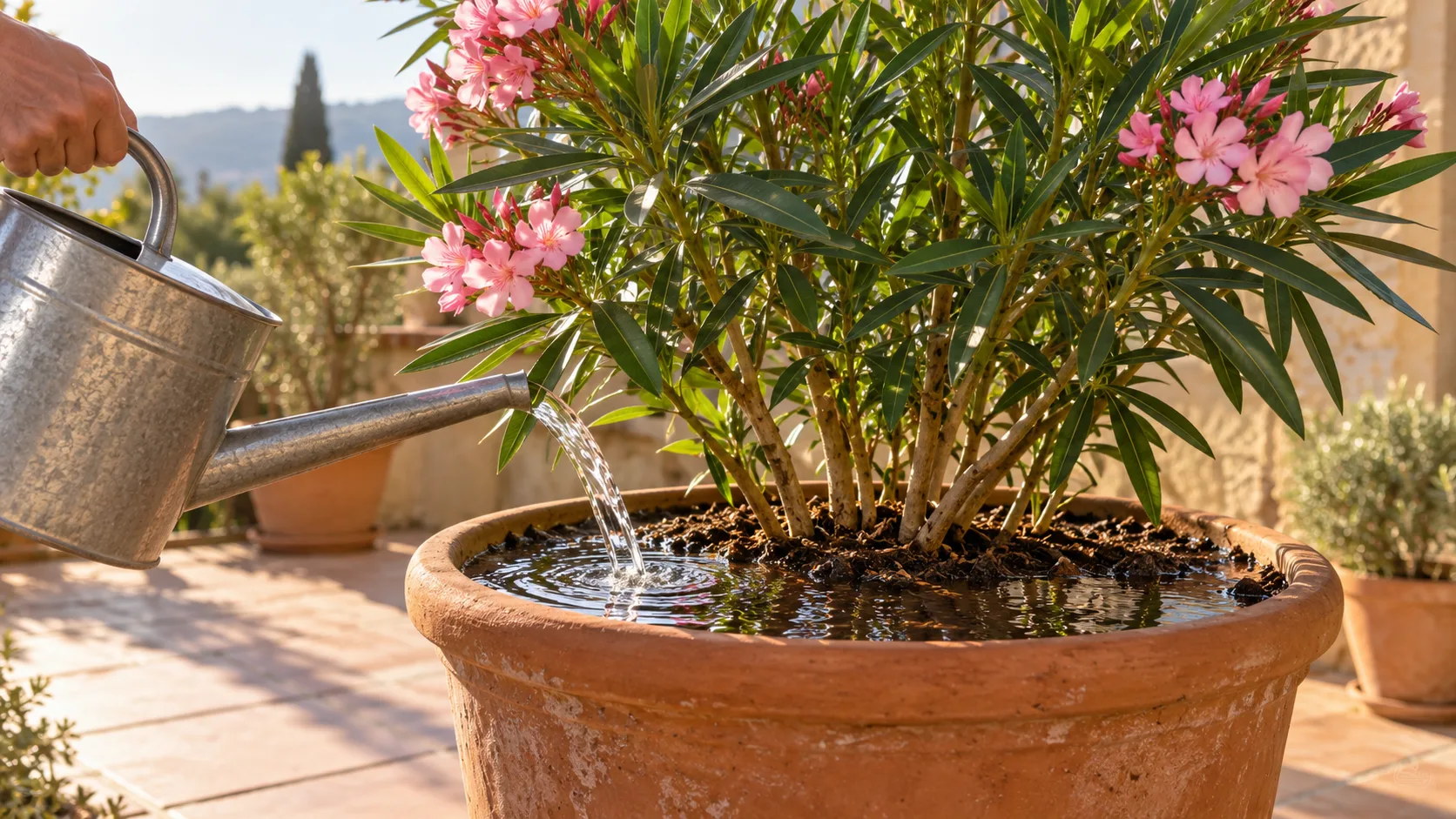
Potted oleander needs plenty of summer water: every hot day, sometimes morning and evening, when soil is dry one-third down the pot. In winter shelter at 4–6 °C (39–43 °F), watering every two to three weeks is enough. Established ground-grown plants need deep watering during droughts.
How often to water oleander
There is no fixed frequency: pot, season and heat determine it. Oleander (Nerium oleander) has a drought-plant reputation and the RHS rates it drought-resistant1, but container roots have only the pot's volume. The SNHF specialist sums it up: watering is vital
2.
10 L every 30 days
One to two times a day
Every 14 to 21 days
Water generously during droughts
| Task | January | February | March | April | May | June | July | August | September | October | November | December |
|---|---|---|---|---|---|---|---|---|---|---|---|---|
| Watering | reduced | reduced | reduced | moderate | high | high | high | high | moderate | reduced | reduced | reduced |
| Growth | resting | resting | active | active | strong | strong | strong | strong | active | active | resting | resting |
| Feeding | no | no | yes | yes | yes | yes | yes | yes | no | no | no | no |
| Repotting | no | no | favorable window | favorable window | no | no | no | no | no | no | no | no |
Pots in summer
Water needs are high: on hot days, Bavaria's Gartenakademie waters container oleanders morning and evening3. The RHS checks pots daily in hot or windy weather, twice daily in intense heat4. The SNHF says regular watering ensures good container flowering, especially in hot positions5.
Large pots dry more slowly than small ones; unglazed terracotta dries faster than plastic6: two neighboring oleanders need not be thirsty on the same day.
Pots in winter shelter
Less light and warmth, less water. Brighter, warmer rooms increase water use. The LWG checks the root ball once or twice weekly; at 4–6 °C (39–43 °F), watering every two to three weeks suffices3. The SNHF specialist notes this evergreen needs water year-round: in winter, moderately but regularly, especially in pots2.
The Saxon environment and agriculture office (LfULG) gives this container overwintering rule: slightly dry rather than too wet, root balls checked weekly, and thorough watering when dry rather than surface wetting7.
In the ground
Established plants largely manage themselves. Clemson describes them as very drought-tolerant once established, responding well to occasional deep watering8. University of Florida recommends a little water during the hottest or driest periods, avoiding excess9. The SNHF says ground-grown plants may need watering in intense heat5.
Newly planted oleanders lack these deep roots. Young and recent plantings need regular, sometimes daily watering in hot, dry weather10.
How to tell whether oleander needs water
Use a finger rather than a calendar. Push it down one-third of the pot's height: water if soil is dry there10. Hot, windy weather increases water use10.
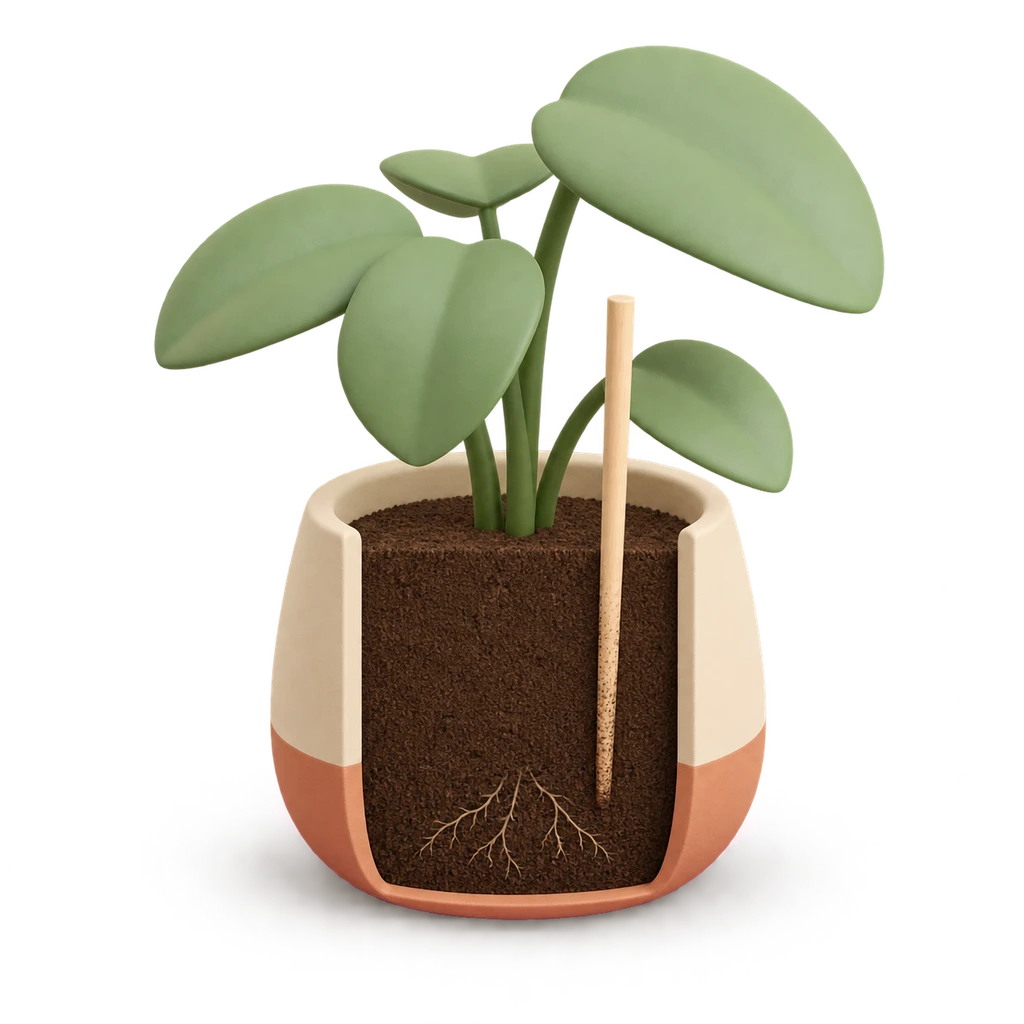
Potting mix dry to 15% of the pot height: still moist
The finger test
In a pot, push your finger one-third of the way down the pot: if it is dry at that depth, water; if it is still moist, wait.
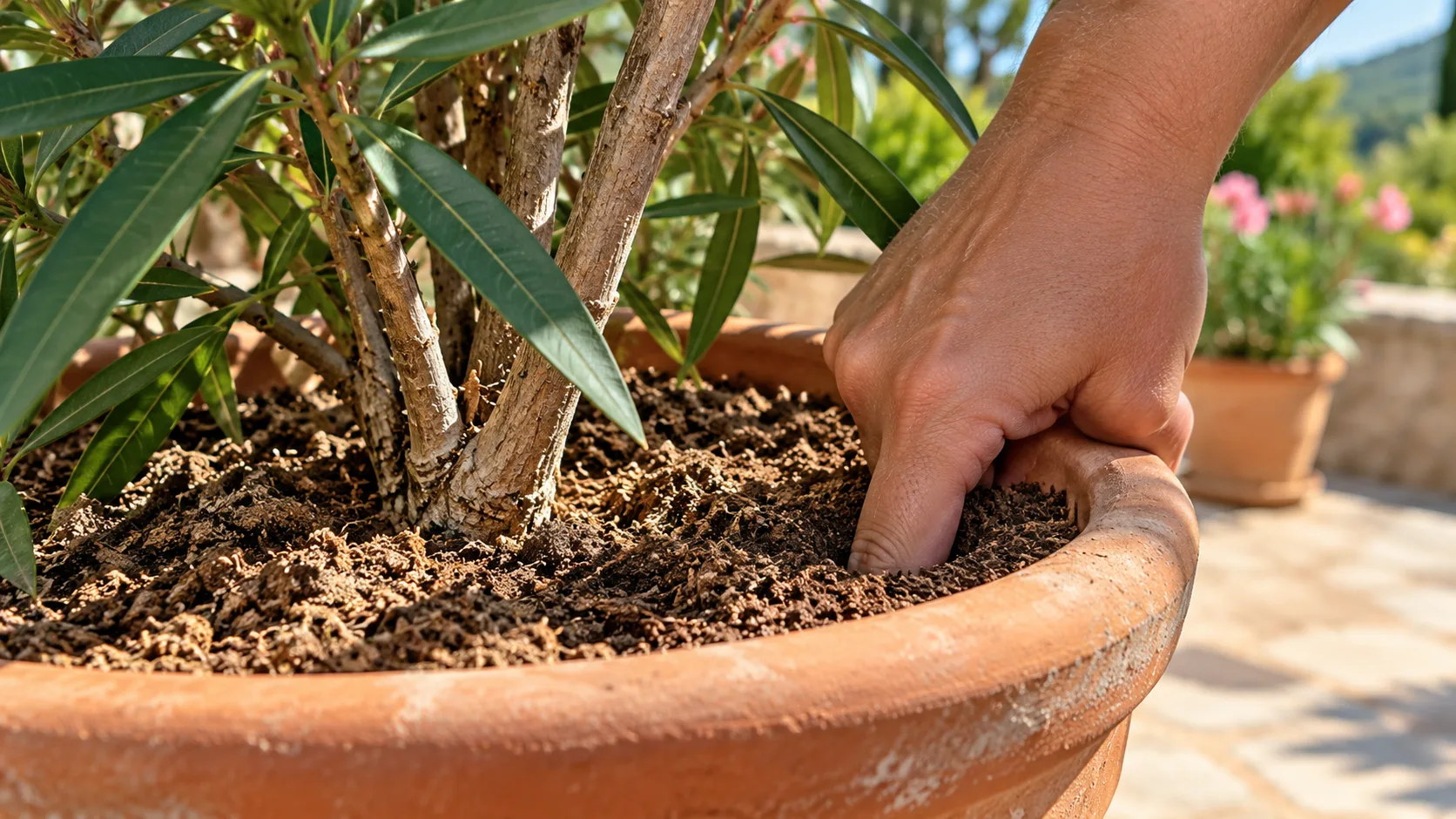
Do not rely on showers. Light or brief rain wets only the top few centimeters of potting soil, so watering may still be needed immediately afterwards10. Sheltered pots get no rain; the RHS checks evergreens there at least weekly4.
Thirst becomes visible: leaves on all branches yellow and droop simultaneously, then recover after thorough watering11.
How to water oleander
At the base, slowly, until water drains. The SNHF specialist waters at the base, never over leaves, keeping oleanders away from lawn sprinklers: wet foliage encourages disease2. The RHS adds that water caught by leaves does not reach roots10.
- Water early morning or early evening, in cool hours, to limit evaporation10.
- Pour slowly, close to soil, filling to the rim. Let water soak in, then repeat once10.
- Stop as water exits drainage holes10.
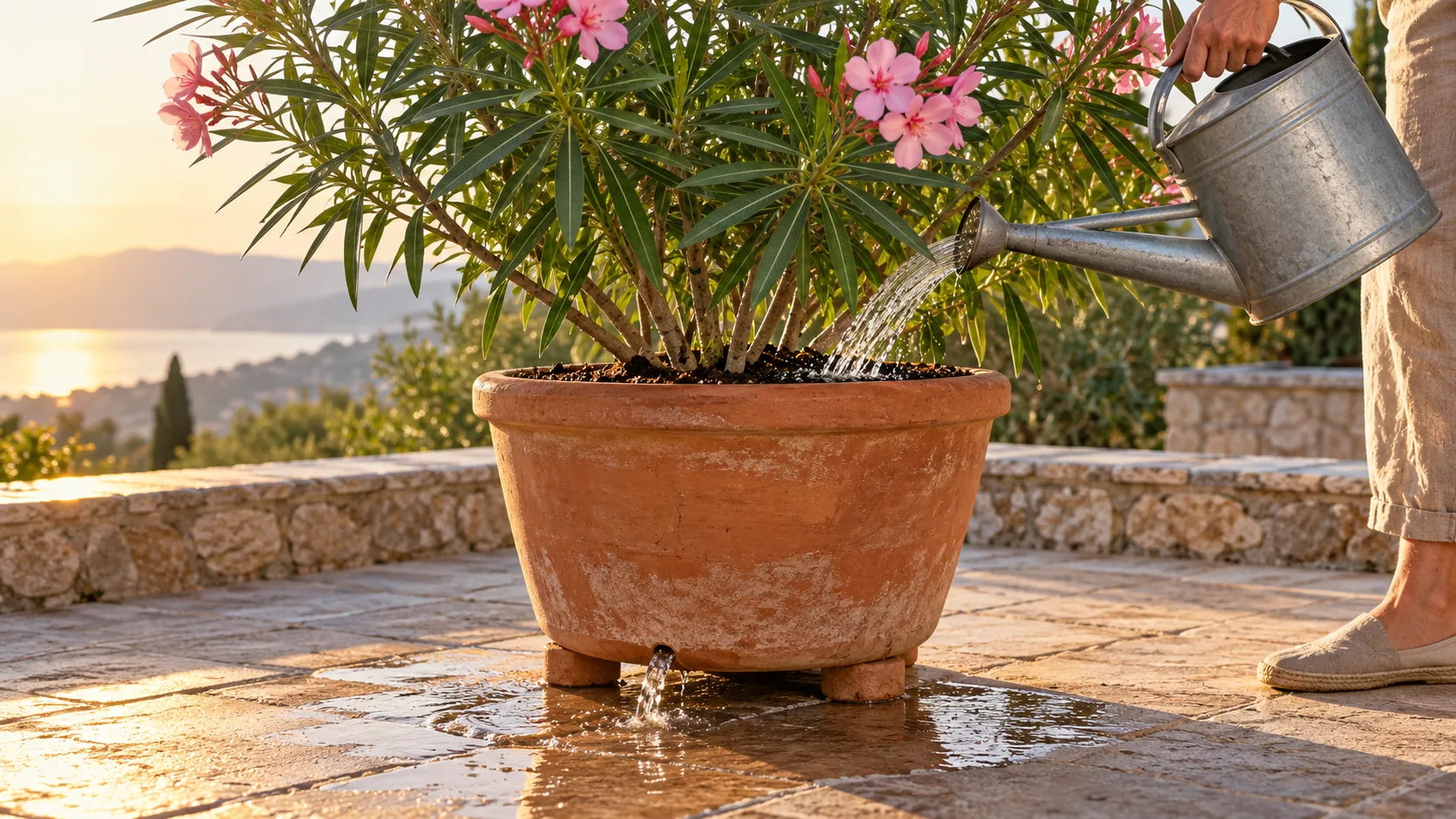
Soil staying wet long after watering often indicates cramped roots blocking drainage12, a sign repotting is due.
Racines qui tournent, terre qui ne retient plus l'eau : repotting oleander se fait au printemps, un pot au-dessus.
Saucers: yes in summer, no in winter
In summer, saucers catch drainage; empty a few hours after watering to avoid saturated soil10. They also save some water and fertilizer in dry weather4.
Remove them in winter. Container plants are prone to waterlogging then6; the RHS specifies removing saucers and trays before winter4. Instead, stand pots on blocks or pot feet, keeping drainage holes clear6.
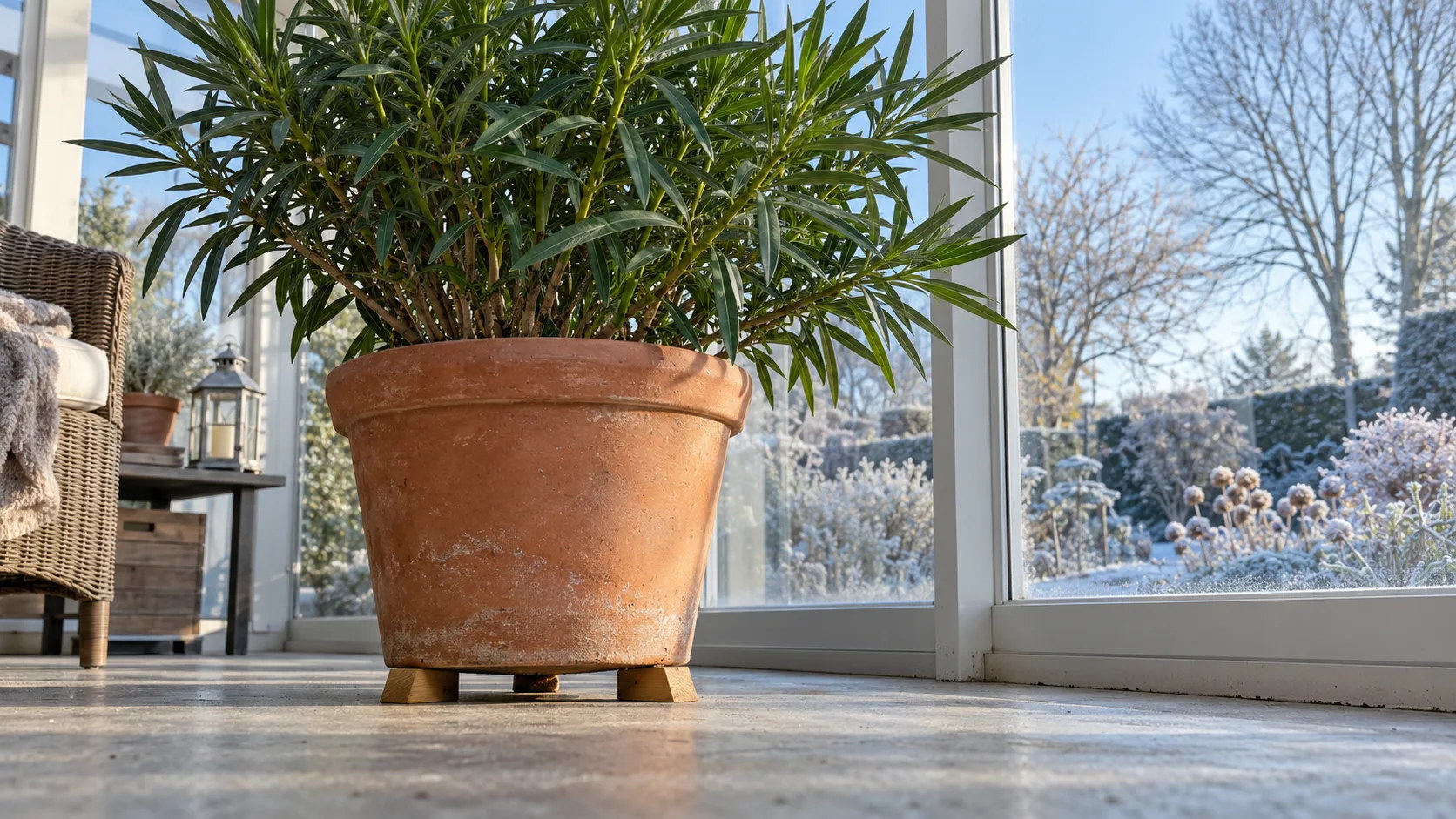
Pot, terre, cales et abri d'hiver : potted oleander se règle une fois pour plusieurs années.
Which water to use
Rainwater when available, tap water otherwise. The RHS recommends collecting rainwater and using it whenever possible10. Hard water is not a particular problem: the RHS lists oleander as accepting all pH levels and chalky soil1.
One sign merits attention: older leaf edges browning without drooping. The University of California bulletin links this to excess salts or boron, improving after leaching soil thoroughly11. See flushing potting mix salts.
Too much or too little: reading leaves
Both cause yellowing, which can mislead. Waterlogged soil deprives roots of oxygen, causing root suffocation: plants may wilt as though thirsty, though roots cannot absorb water13. The RHS calls overwatering the leading cause of container plant losses4.
| Sign | Too much water | Too little |
|---|---|---|
| Soil one-third down the pot | Wet10 | Dry10 |
| Leaves | Yellow, sometimes wilted13 | Yellow and drooping on all branches11 |
| After watering | No improvement13 | Plant recovers11 |
| Roots | Bluish black, sour smell13 | Dry, shrunken soil12 |

One branch yellowing from its tip without recovery after watering is different: suspect Xylella fastidiosa, bacteria blocking sap vessels11. See also overwatering and underwatering.
Quand l'eau n'explique pas tout, yellow leaves on oleander passent en revue l'engrais, le froid et les insectes.
Unsure what you see? Photograph a leaf: Floralens identifies the problem and suggests the appropriate step.