
Growing oleander in containers: year-round care
Potted oleander
An oleander can live in a pot for years with three things: a container with drainage holes just wider than its root ball, loam-based potting mix, and water every hot day, sometimes morning and evening. In the SNHF’s French growing context outside southern France, pots go into a bright room at 4–8 °C (39–46 °F) in November and return outside in early May after the last frosts. Use local frost conditions to time that move.
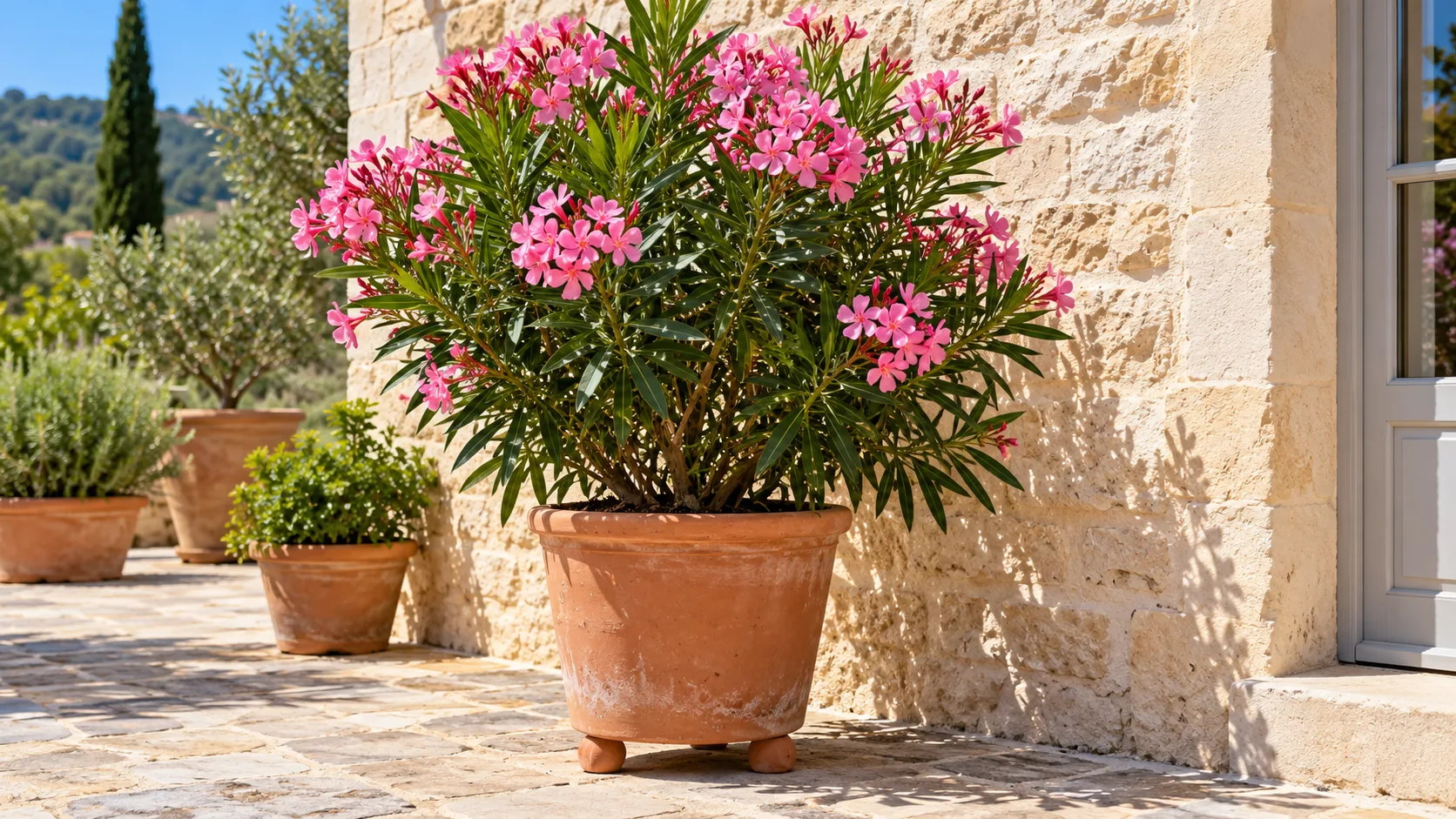
Can an oleander stay in a pot all its life?
Yes; outside southern France, this is standard practice. The SNHF recommends planting it in the ground only in southern France and around the Mediterranean; elsewhere, grow it in a container or large pot and overwinter it in a conservatory or garage with daylight1. The RHS lists oleander (Nerium oleander) as a patio and container plant2.
Pots bring demands. Container plants need more water and fertilizer than plants in the ground; their roots are more exposed to cold, and standing water is a winter hazard3. A shrub left in the same container for years suffers if never repotted4.
Choose a variety that fits your balcony when you buy. The grower interviewed by the SNHF divides mature oleanders into three sizes5:
| Size | Mature height |
|---|---|
| Dwarf | 60–80 cm (24–31 in) |
| Compact | 80 cm–1.50 m (31 in–4.9 ft) |
| Large-growing | 2–3.50 m (6.6–11.5 ft) |
A large plant in a small space needs repeated pruning, and every cut gives disease a way in5.
Choosing a pot for oleander
Drainage holes, and a pot just wider than the root ball. Drainage holes are essential3: oleander needs moist but well-drained
soil2, and a pot without holes becomes a swamp. The RHS recommends a pot just larger than the root ball, never much larger: excess potting mix stays waterlogged and rots the roots3.
| Material | Recommendation | Why |
|---|---|---|
| Terracotta | Suitable | Dries quickly; choose a frost-proof pot Source: Royal Horticultural Society |
| Plastic | Suitable | Lightweight, retains moisture better Source: Royal Horticultural Society |
| Wood | Suitable | A sturdy half-barrel, but the wood rots over time Source: Royal Horticultural Society |
| Metal | Avoid | Heats up in summer sun, becomes icy cold in winter Source: Royal Horticultural Society |
When repotting, the new pot should be no more than one-third larger; for pots under 25 cm (10 in) across, add 2.5–5 cm (1–2 in) in width and depth6. Large containers dry more slowly than small ones, easing summer watering3.
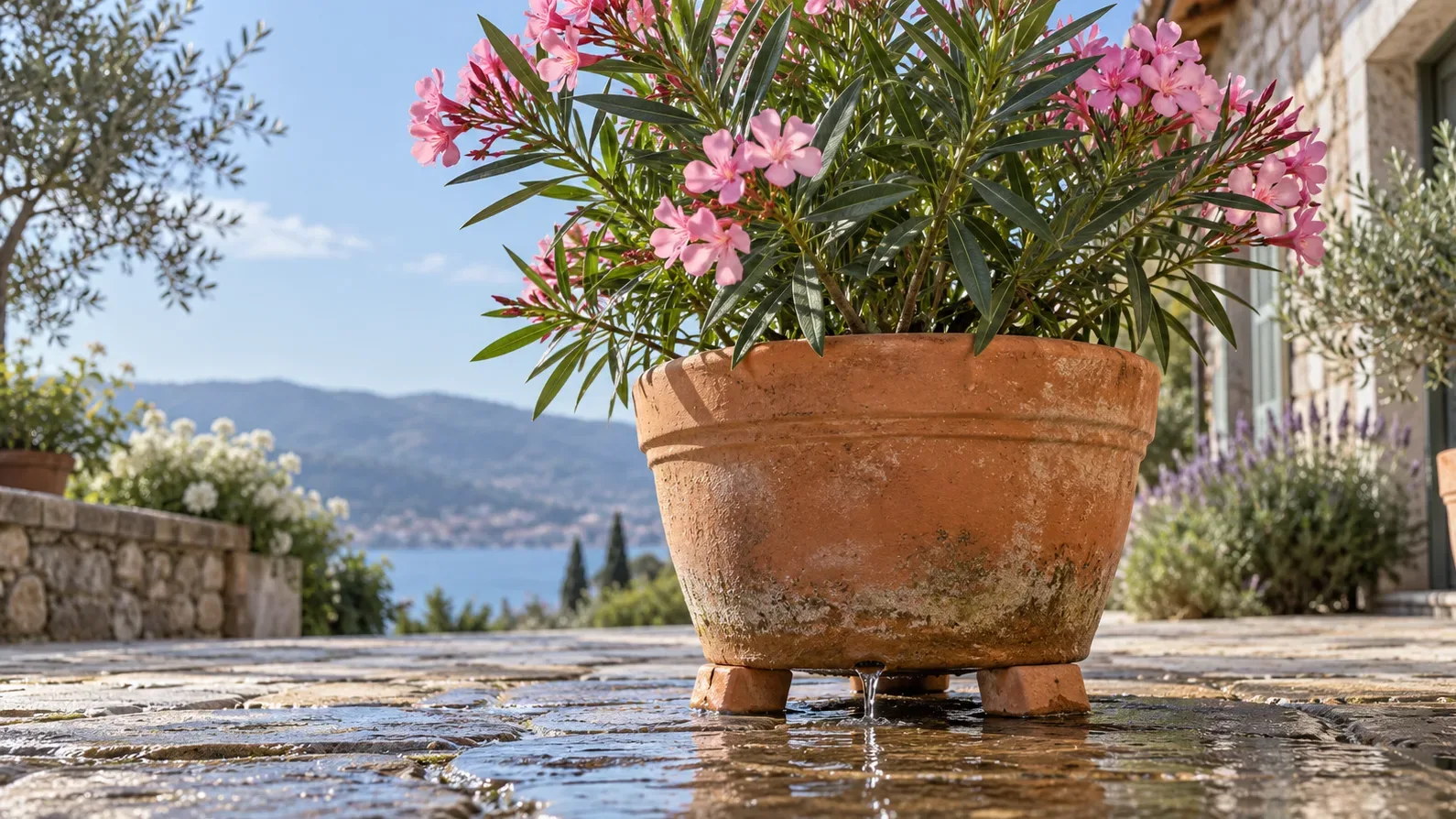
Stand the container on blocks or pot feet so water drains and holes stay clear3. A large oleander in a tall, narrow pot can blow over: weight the bottom with bricks or stones and give it shelter3. Choose frost-proof terracotta, rather than merely “frost-resistant”: ordinary terracotta cracks in winter3.
Soil for a potted oleander
Loam-based potting mix, made progressively heavier as the shrub ages. For growing under glass, the RHS specifies peat-free loam-based potting mix2, such as John Innes No. 3, intended for plants staying in place for years3.
The mix
- Loam-based potting mixPeat-free, for long-term container growing Source: Royal Horticultural Society
- Garden soilOr compost; use a heavier mix for an old plant Source: Bayerische Gartenakademie (LWG)
- Coarse sandOne part in five in the LWG recipe Source: Bayerische Gartenakademie (LWG)
For a young plant, the specialist interviewed by the SNHF considers commercial potting mix sufficient5. At each subsequent repotting, Bavaria's Gartenakademie adds garden soil and a little sand: the older the plant, the more loamy the mix should be7.
Remove the saucer before winter: weeks standing in cold water lead straight to root rot3. In summer, empty it a few hours after each watering8.
Les proportions du mélange et le geste pas à pas : repotting oleander les détaille, motte et racines comprises.
Watering a potted oleander through the seasons
A potted oleander depends entirely on you. Its roots have only the container's volume; as the SNHF specialist puts it, watering is vital
5.
68 cL every 9 days
One to two times a day
Every 14 to 21 days
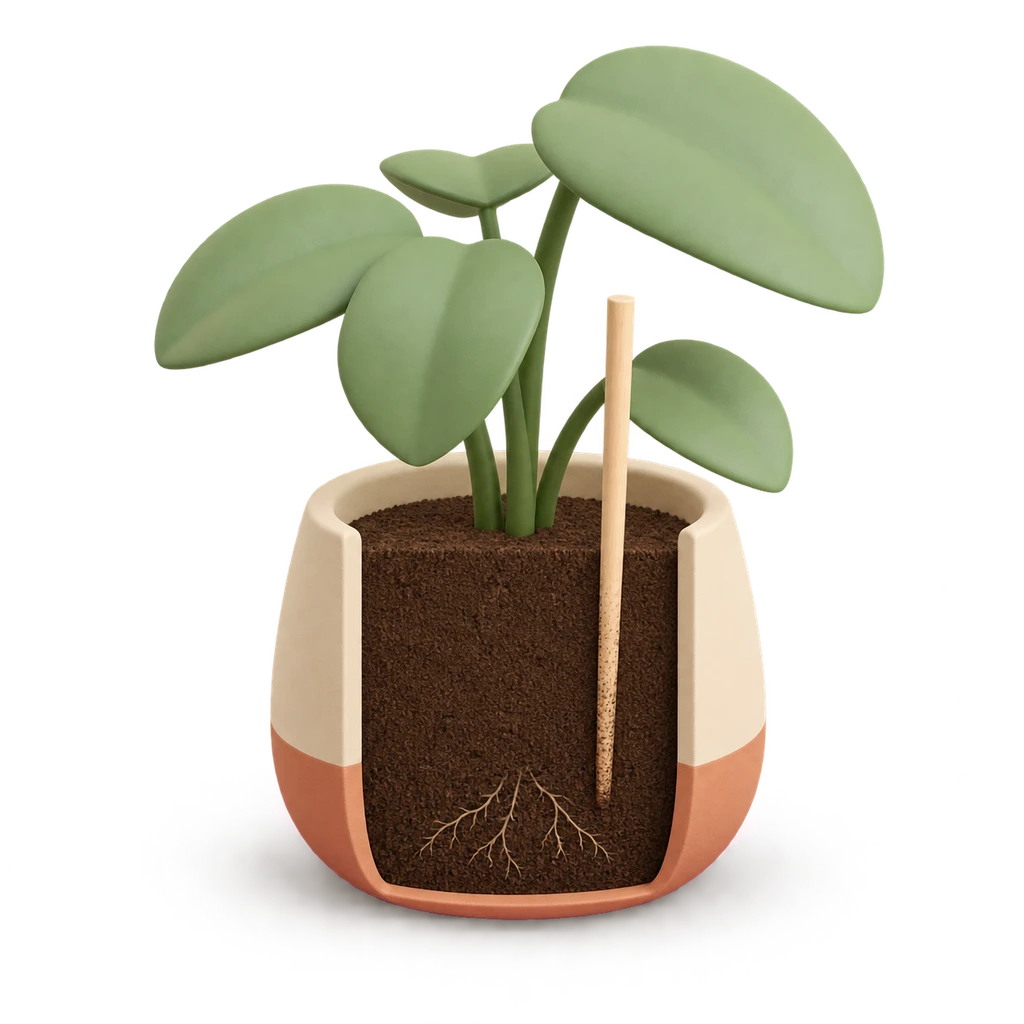
Potting mix dry to 15% of the pot height: still moist
The finger test
In a pot, push your finger one-third of the way down the pot: if it is dry at that depth, water; if it is still moist, wait.
- Summer: water needs are high; on hot days you may need to water morning and evening7. Check the soil daily in hot or windy weather, twice daily in intense heat4.
- The test: push a finger down to one-third of the pot's height; water if dry there8.
- The method: water at the base, never over the foliage: wet leaves encourage disease5.
- Winter under cover: the brighter and warmer the room, the more water the plant uses. Check the root ball once or twice weekly; at 4–6 °C (39–43 °F), watering every two to three weeks is enough7.
Pots tolerate a missed watering better than excess: the RHS calls overwatering the leading cause of container plant losses4. Overwatering describes the signs, including root symptoms.
Quand les feuilles jaunissent, l'eau n'est qu'une piste parmi d'autres : yellow leaves on oleander se lisent selon l'âge des feuilles touchées.
Pour le calcul selon le diamètre du pot et la saison, watering oleander détaille le volume et les signes d'excès.
Feeding a potted oleander
Potting mix soon runs out of nutrients: feed weekly during summer growth. In its Bavarian seasonal calendar, the LWG feeds container oleanders from April to late August, weekly, with a soluble complete fertilizer at 3 g per liter (0.40 oz per US gal)7. For shrubs staying in place for years, the RHS adds slow-release fertilizer at planting, top-dressing or repotting, and always feeds already moist soil4.
- Fertilizer
- Low in nitrogen, high in potassiumSource: Jardins de France (SNHF)
- Feeding
- April to Augustin a potSource: Bayerische Gartenakademie (LWG)
- No fertilizer
- September to FebruarySource: Floralens guide
- Frequency
- Liquid fertiliser once a monthin a potSource: Royal Horticultural Society
- Frequency
- Every 7 daysIntensive summer feeding · 3 g of soluble fertiliser per litre (about 0.4 oz per US gallon) · in a potSource: Bayerische Gartenakademie (LWG)
- Avoid
- Excess nitrogen, applying fertilizer to a dry root ball, exceeding the dose on the labelSources: Clemson Cooperative Extension; Washington State University; Royal Horticultural Society
Formule, rythme et signes d'excès : oleander fertilizer se choisit pauvre en azote, riche en potasse.
Winter pots: bring them in before frost
Potted roots freeze well before foliage. Roots are much less hardy than above-ground growth, and a pot's small soil volume cools far more than border soil9. Hardiness thresholds for oleanders in the ground therefore do not apply to containers.
- Bring indoors
- Novemberearlier if frost arrives · in a potSource: Société nationale d'horticulture de France
- Move back outside
- Mayafter the last frosts · usually early May in the source’s temperate Northern Hemisphere calendar · in a potSource: Société nationale d'horticulture de France
- Protect
- Before the first frostsas soon as a night at −2 °C (28 °F) is forecastSource: Jardins de France (SNHF)
- Light
- A bright roomSource: Bayerische Gartenakademie (LWG)
- Winter watering
- Every 14 to 21 daysin a room at 4–6 °C (39–43 °F)Source: Bayerische Gartenakademie (LWG)
- Protect when −2 °C (28 °F) is forecast: fleece over the foliage, bubble wrap around the pot5. Grouping pots against a house wall protects roots better4.
- Bring them in as late as possible, in November in most regions of France1: in Bavaria, the LWG keeps oleanders outside from mid-April to mid-October, bringing them in as late as weather permits7.
- Choose a bright room at 4–8 °C (39–46 °F) that is easy to ventilate; inspect the foliage before bringing the pot in7.
- Return it outside after the last frosts, in early May in the SNHF’s French calendar1, initially in partial shade for a few days: without this transition, sun scorches foliage overwintered under cover7.
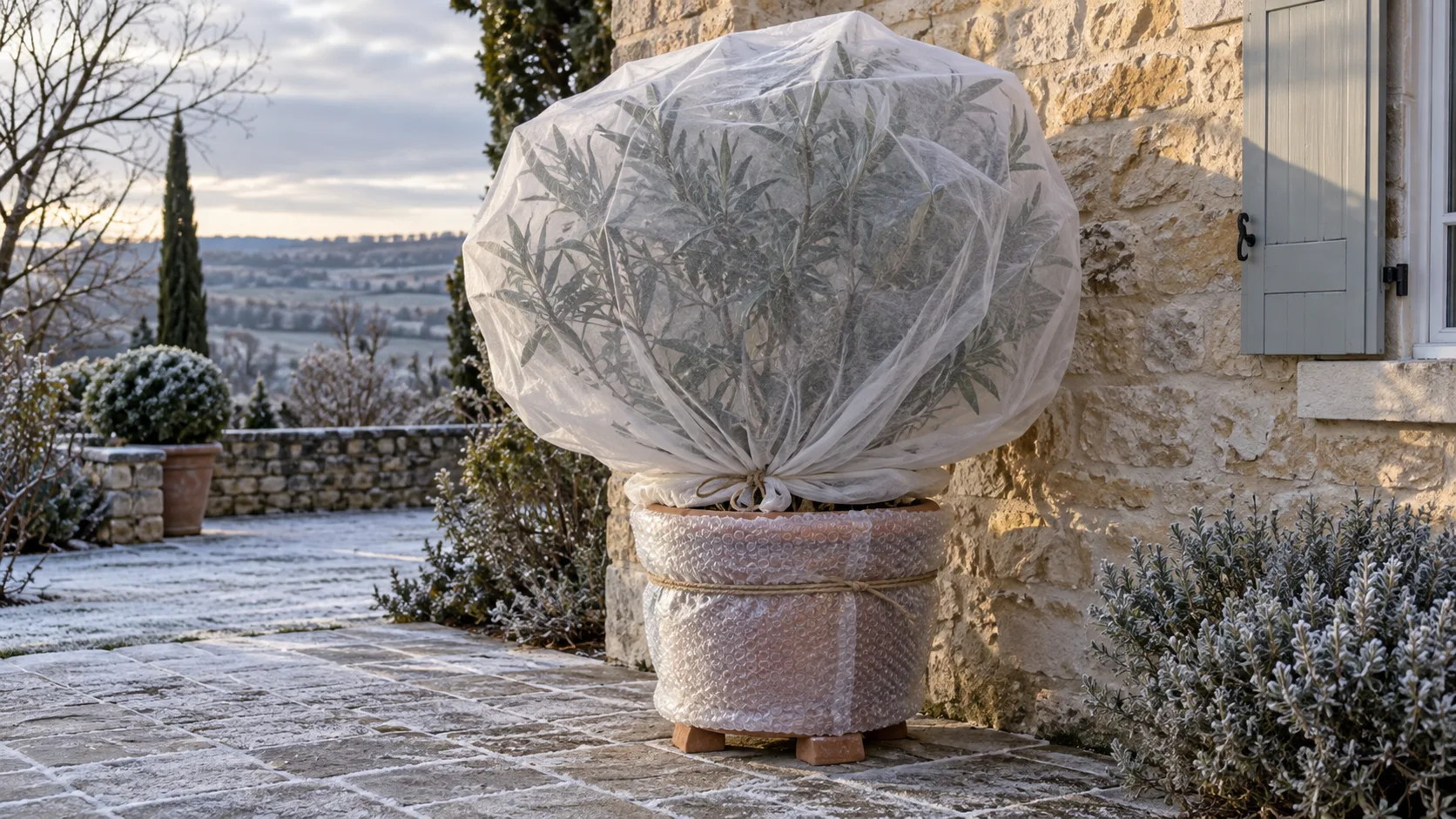
Outside, remove the saucer and do not water when frost is forecast4. Protection from temperature shocks covers emergency measures for an unexpected cold snap.
Seuils de froid, local, arrosage d'hiver et sortie de printemps : overwintering oleander se décide selon la région et le pot.
Repotting or top-dressing a potted oleander
Repot young oleanders yearly, older plants every three to five years. This is the LWG's schedule7; the RHS recommends spring, as growth resumes6. Between repottings, the SNHF renews potting mix by top-dressing annually1.
- Repot
- Every 1 yearsYoung plant · in a potSource: Bayerische Gartenakademie (LWG)
- Repot
- Every 3 to 5 yearsOlder plant · in a potSource: Bayerische Gartenakademie (LWG)
- When to repot
- In springas growth beginsSource: Royal Horticultural Society
- When to repot
- In summerin early or midsummer, if neededSource: Royal Horticultural Society
- Avoid
- In autumnfresh potting mix would stay too wetSource: Royal Horticultural Society
- Avoid
- In winterthe plant is no longer growingSource: Royal Horticultural Society
- The new pot
- 2,5 to 5 cm widerfor a pot less than 25 cm (about 10 in) in diameterSource: Royal Horticultural Society
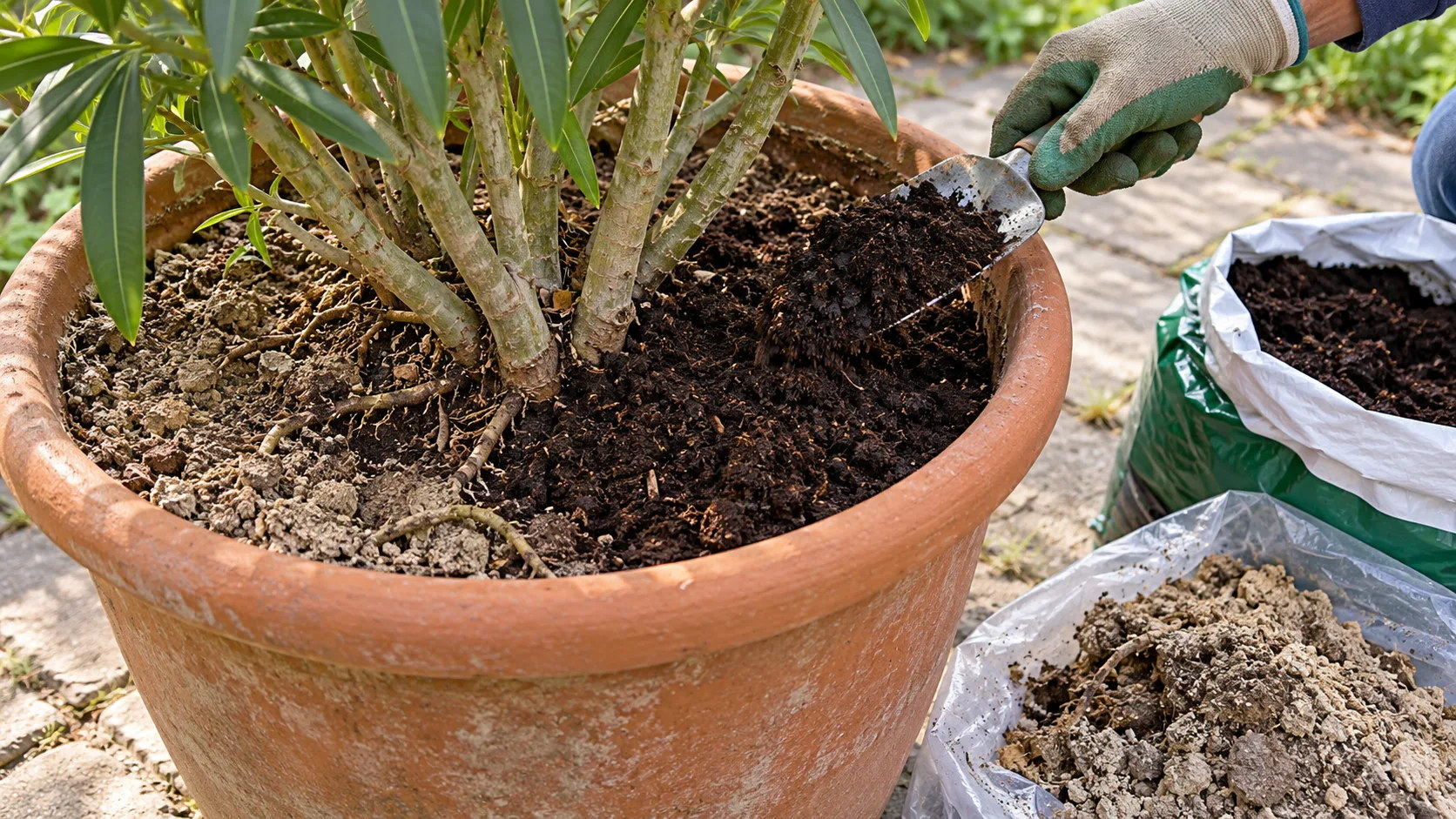
You can reuse a large container: the LWG loosens the root ball with a pointed stick and cuts free roots so the plant fits back into the same pot with fresh potting mix7. After repotting, keep the shrub in shade for fourteen days7.
Les signes, le geste et la taille des racines : repotting an oleander se font au printemps, quand la plante repart.
A spot, pale foliage or an insect under a leaf? Photograph it: Floralens identifies the plant and problem.