
Best fertilizer for oleander: what to use and when
Which fertilizer does oleander need, and when?
Give oleander a low-nitrogen, high-potassium fertilizer during active growth after frost, then stop as growth slows. In the French source’s seasonal example, this means spring after the frosts to late August, with frequency determined by soil volume: two ground applications in spring and early July; pots receive monthly liquid feeding. Time the season by local frost and growth.
When to fertilize oleander
Feed oleander (Nerium oleander) during growth, never in winter. Its encyclopedia profile uses a source-climate example of March–August feeding, the six months when shoots lengthen and buds form, followed by slower growth and no fertilizer from September to February. Follow local growth and frost conditions rather than those months alone.
- Fertilizer
- Low in nitrogen, high in potassiumSource: Jardins de France (SNHF)
- Feeding
- After the last frostsFirst application · in the groundSource: Jardins de France (SNHF)
- Feeding
- JulySecond application · early July in the source’s temperate Northern Hemisphere calendar · in the groundSource: Jardins de France (SNHF)
- Feeding
- April to Augustin a potSource: Bayerische Gartenakademie (LWG)
- No fertilizer
- September to FebruarySource: Floralens guide
- Frequency
- Liquid fertiliser once a monthin a potSource: Royal Horticultural Society
- Frequency
- Every 7 daysIntensive summer feeding · 3 g of soluble fertiliser per litre (about 0.4 oz per US gallon) · in a potSource: Bayerische Gartenakademie (LWG)
- Frequency
- Two applications a yearin the groundSource: Jardins de France (SNHF)
- Avoid
- Excess nitrogen, applying fertilizer to a dry root ball, exceeding the dose on the labelSources: Clemson Cooperative Extension; Washington State University; Royal Horticultural Society
| Conditions | January | February | March | April | May | June | July | August | September | October | November | December |
|---|---|---|---|---|---|---|---|---|---|---|---|---|
| Second application, in the ground | no feeding | no feeding | no feeding | no feeding | no feeding | no feeding | Feeding | no feeding | no feeding | no feeding | no feeding | no feeding |
| Feeding, in a pot | no feeding | no feeding | no feeding | Feeding | Feeding | Feeding | Feeding | Feeding | no feeding | no feeding | no feeding | no feeding |
| No fertilizer | No fertilizer | No fertilizer | no feeding | no feeding | no feeding | no feeding | no feeding | no feeding | No fertilizer | No fertilizer | No fertilizer | No fertilizer |
Wait until frosts end for the first feed. In the French growing context, nurseryman Olivier Faure, interviewed by the SNHF journal, fertilizes in spring after the frosts, then in early July1: as early as March on mild coasts, in April where cold lingers.
Stopping as growth slows matters as much as starting. In its Bavarian calendar, the Gartenakademie feeds container oleanders from April to late August2, and the RHS notes that very few plants need winter feeding3.
Late fertilizer can restart growth in shrubs with several flushes of shoots; Clemson then recommends only a fraction of the annual dose4. We consider oleander, with new shoots growing all summer5, to be among them. Let its wood mature before cold weather through lignification.
Une fois les apports arrêtés, reste à préparer le froid : overwintering oleander dépend de votre climat et du pot.
Add your oleander: Floralens reminds you when to feed, with seasonal reminders in Pro mode. Get reminders
Choosing fertilizer for oleander
Low nitrogen, high potassium. Three label numbers give the formula: NPK. Nitrogen (N) supports leaves and stems, phosphorus (P) roots and shoots, potassium (K) flowering and cold resistance3.
Oleander is a heavy feeder, but excess nitrogen favors foliage. The SNHF specialist recommends a formula such as NPK 10-10-30, three times as much potassium as nitrogen1; the RHS recommends balanced liquid fertilizer in pots6. Their common point: never a very high-nitrogen feed. Flowering-plant or tomato fertilizer, with K higher than N, encourages flowering3.
| Fertilizer form | Speed of action | When to use it |
|---|---|---|
| Liquid, diluted in a watering can | Fast | Pots, throughout growth |
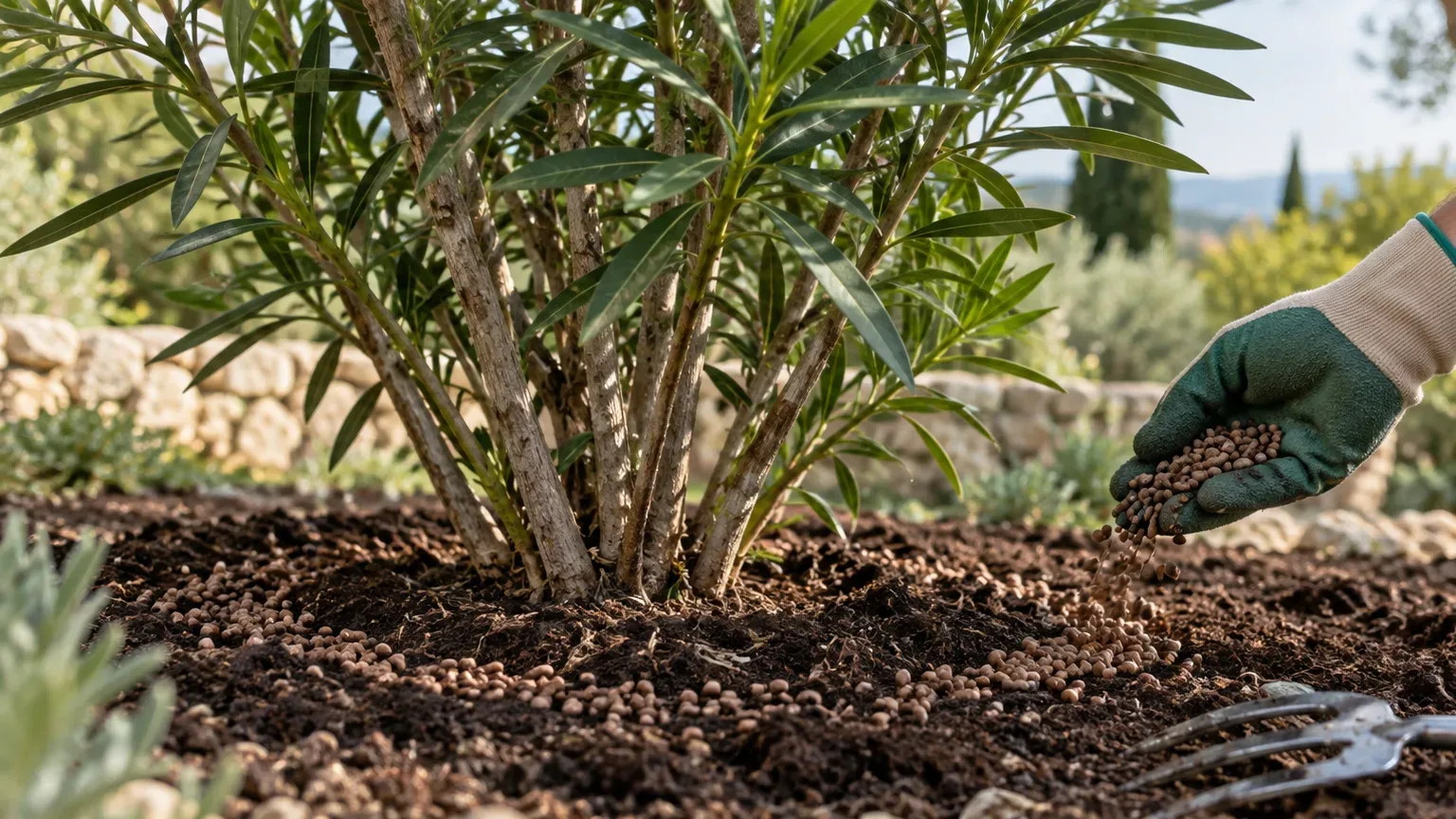
| Organic granules | Slow, several weeks | Ground-grown plants, applied early in spring |
| Mineral granules | Fast | Ground-grown plants, slightly later in spring |
| Controlled-release granules | Slow and steady | Pots, one spring application |
| Mature compost | Very slow | Ground-grown plants, on the surface in spring |
In its UK seasonal context, the RHS applies slow organic granules as early as February–March, mineral granules in March–April, and mainly reserves fast liquid feeds for potted plants3. Clemson prefers slow-release fertilizers to fast nitrogen sources, which leach more readily4.
No need for acid-soil fertilizer: the profile gives a pH of 5.5–7.8. Formulas intended for hydrangea offer no advantage over flowering-plant fertilizer.
How often to feed in pots or in the ground
In the ground, twice yearly. In the French seasonal example, the SNHF specialist feeds in spring after frost, then early July, with a potassium-rich formula1. The RHS says improved soil feeds most garden plants adequately3: a mature oleander in rich soil may need only compost in spring.
Potting mix soon runs out of nutrients. The default is the RHS schedule: monthly liquid fertilizer at the labeled rate6, or at most six applications from March to August in the source’s seasonal example. Bavaria's Gartenakademie uses an intensive regime as its local summer raises demand: weekly at 3 g per liter of water (0.40 oz per US gal), April to late August, with soluble complete fertilizer2. Choose one regime, never both.
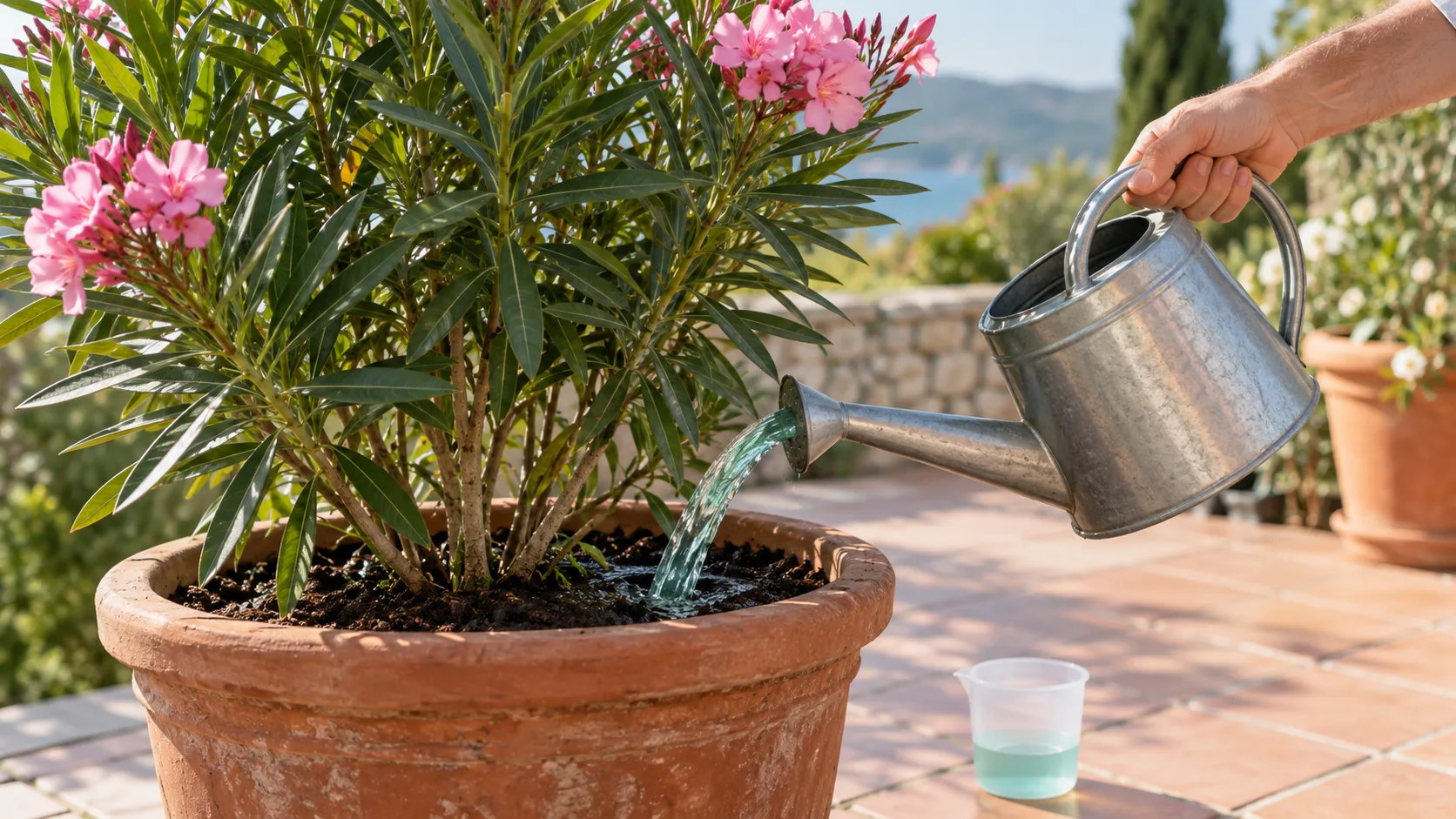
Use the label dose, never more3. Apply to an already moist root ball: Washington State University advises against feeding plants stressed by heat or drought7. When repotting, the Gartenakademie mixes 1.5–2 g of complete fertilizer per liter (0.20–0.27 oz per US gal) of fresh substrate2; for older plants too heavy to repot, see refreshing potting mix.
Le volume du bac règle aussi la soif et l'appétit de l'arbuste : potted oleander demande un contenant à sa taille.
Pour le moment et le substrat : repotting oleander se fait au printemps, avant la reprise des apports.
Natural and homemade fertilizers: what works
Comfrey feed is the most useful homemade fertilizer for oleander, because comfrey is potassium-rich. Kitchen scraps belong in compost.
| Natural fertilizer | Assessment for oleander |
|---|---|
| Comfrey feed | Potassium-rich: a natural flowering feed, used diluted8 |
| Liquid seaweed fertilizer | Organic, encourages flowers: a good container option3 |
| Mature compost | Useful on the soil surface in spring for ground-grown plants |
| Banana peel | Contains potassium, but buried peel ties up nitrogen while decomposing: compost it9 |
| Eggshell | Calcium is not released quickly enough for plants: not a fertilizer10 |
| Coffee grounds | Nitrogen-rich, variable pH: compost, at most 20% by volume11 |
| Wood ash | Some potassium but alkaline: small amounts in compost, or on bare soil in winter12 |
| Nettle feed | Nitrogen-rich, supports growth rather than flowers; plant-protection effects unproven13 |
Comfrey (Symphytum) is generally potassium-rich, especially on clay soil, according to the RHS. Its liquid feed, made by letting fresh leaves rot without water, is diluted 1 part to 20 parts water and watered at the base, never sprayed8. Commercial liquid seaweed tomato fertilizers are among organic formulas encouraging flowers3.
Toutes les parties de l'arbuste sont concernées : oleander toxicity pour vous, vos enfants et vos animaux.
Encouraging oleander flowers
Fertilizer is only one of four factors, and rarely the first.

- Light. Oleander wants full sun; shade makes it leggy and less floriferous15.
- Potassium without excess nitrogen. Too much nitrogen favors leaves over flowers, with soft growth more vulnerable to cold4.
- Faded flowers. Remove spent flower clusters wearing gloves6: Clemson says this can extend flowering5.
- Correct pruning time. Oleander flowers on current-season wood: prune in early spring5, wearing gloves6, rather than fall, which stimulates frost-sensitive shoots1.
A constantly dry pot flowers poorly even when well fed: see watering in the oleander care guide.
Coupes, période et outils : pruning oleander sans supprimer les boutons à venir.
Signs of too much or too little fertilizer
Lots of leaves and few flowers is the classic sign of excess nitrogen1. Check light before blaming fertilizer15.
Excess fertilizer burns. Leaf tips brown, young shoots may die, and a whitish or brownish crust forms on potting mix or pot rims. Container plants are particularly sensitive7.
The remedy is leaching: use plain water, let it drain beneath the pot, and repeat with at least the pot's volume each time16. Then stop feeding for a few weeks. See flushing salts from potting mix, fertilizer burn and brown leaf tips.
Deficiency shows on older leaves. Uniform yellowing from the bottom suggests nitrogen deficiency, common in pots unfed for years. Young leaves yellowing between green veins indicate chlorosis: see yellow leaves with green veins and iron deficiency.
L'engrais n'explique pas tous les jaunissements : yellow leaves on oleander ont d'autres causes, à commencer par l'arrosage.
Taches, chancres ou ravageurs : oleander diseases se reconnaissent à d'autres signes que la faim.
Frequently asked questions
When should I fertilize oleander?
What is the best fertilizer for oleander?
Which natural fertilizer suits oleander?
How often should I fertilize potted oleander?
Are coffee grounds good for oleander?
Not as fertilizer: they mainly supply nitrogen and their pH varies11. Compost them at less than 20% by volume.