
When to bring oleander indoors: winter care
When to bring oleander indoors: winter care
Oleander (Nerium oleander) withstands −5 °C (23 °F) without damage in the ground and loses foliage around −7 to −9 °C (19–16 °F); potted roots freeze much sooner. Protect it when −2 °C (28 °F) is forecast overnight. In the French seasonal setting described here, bring pots into a bright, frost-free room at 4–8 °C (39–46 °F) in November and return them outside in early May after the last frosts.
What temperatures can oleander withstand?
Three figures answer different questions. The protection threshold is when to intervene: nurseryman Olivier Faure, interviewed by the Société nationale d'horticulture de France, sets it at a forecast −2 °C (28 °F)1.
Temperatures for nerium
In °C, thresholds given by the sources.
- 'Villa Romaine'-12 °C
- Foliage lost, rootstock still alive-9 °C
- No damage (RHS H3 rating)-5 °C
- Protect-2 °C
- Ideal: 18 to 30 °C
- Tolerated: -5 to 38 °C
- Bright, well-ventilated winter shelter: 4 to 8 °C
The damage-free limit is −5 °C (23 °F), the lower bound of the RHS H3 rating for oleander (Nerium oleander), hardy only in coastal and mild UK regions2. The oleander encyclopedia profile uses the same value.
Below this, damage begins without necessarily killing the shrub. The SNHF gives resistance to −7 or −8 °C (19 or 18 °F)3; Clemson Cooperative Extension observes most established oleanders survive around −7 to −9 °C (19–16 °F), with damaged foliage, then quickly regrow from the base if roots survive4.
The species' hardiness is also listed as USDA zones 8–105. Yet USDA zone 8 means minima of −12.2 to −6.7 °C (10–20 °F)6: reading “zone 8” as “withstands −12 °C (10 °F)” overestimates most oleanders, which lose foliage at −7 to −9 °C (19–16 °F). More cautiously, Clemson gives zone 8b4, −9.4 to −6.7 °C (15–20 °F)6, exactly where it observes damage. Only a few varieties such as 'Villa Romaine' withstand −12 °C (10 °F)3.
Pots and ground-grown plants freeze at different thresholds
Soil buffers cold around roots in the ground. Pots lose this protection: roots are much less hardy than above-ground growth, and a container's small substrate volume cools more than border soil7. Illinois Extension therefore recommends plants hardy two zones colder than the garden for pots left outside7. The −5 °C (23 °F) limit no longer applies to potted oleander in winter: the root ball fails first.
Frost-damaged oleander: what to do after a cold snap
Do not prune immediately. Cutting brown growth is the wrong first response: damaged leaves and twigs still insulate living tissue while more frosts remain possible. University of Georgia Extension advises leaving them until spring growth resumes8.
Hard frost browns and dries evergreen leaves; foliage initially dark green and water-soaked eventually blackens9. On woody plants, the RHS warns that damage may appear only months after frost9. Wait until spring to assess it.

- Wait for frost to end, then for new shoots: leave everything while frost remains forecast8.
- Scratch bark with a fingernail, twig by twig. Green cambium means living wood; brown or black means dead wood8.
- Cut back to healthy wood once regrowth is visible8. Oleander tolerates hard spring pruning to remove frozen wood4.
- Watch for blackening twigs in summer: Botryosphaeria dieback develops more readily after severe frost. Cut until no discolored tissue remains in the cut4.
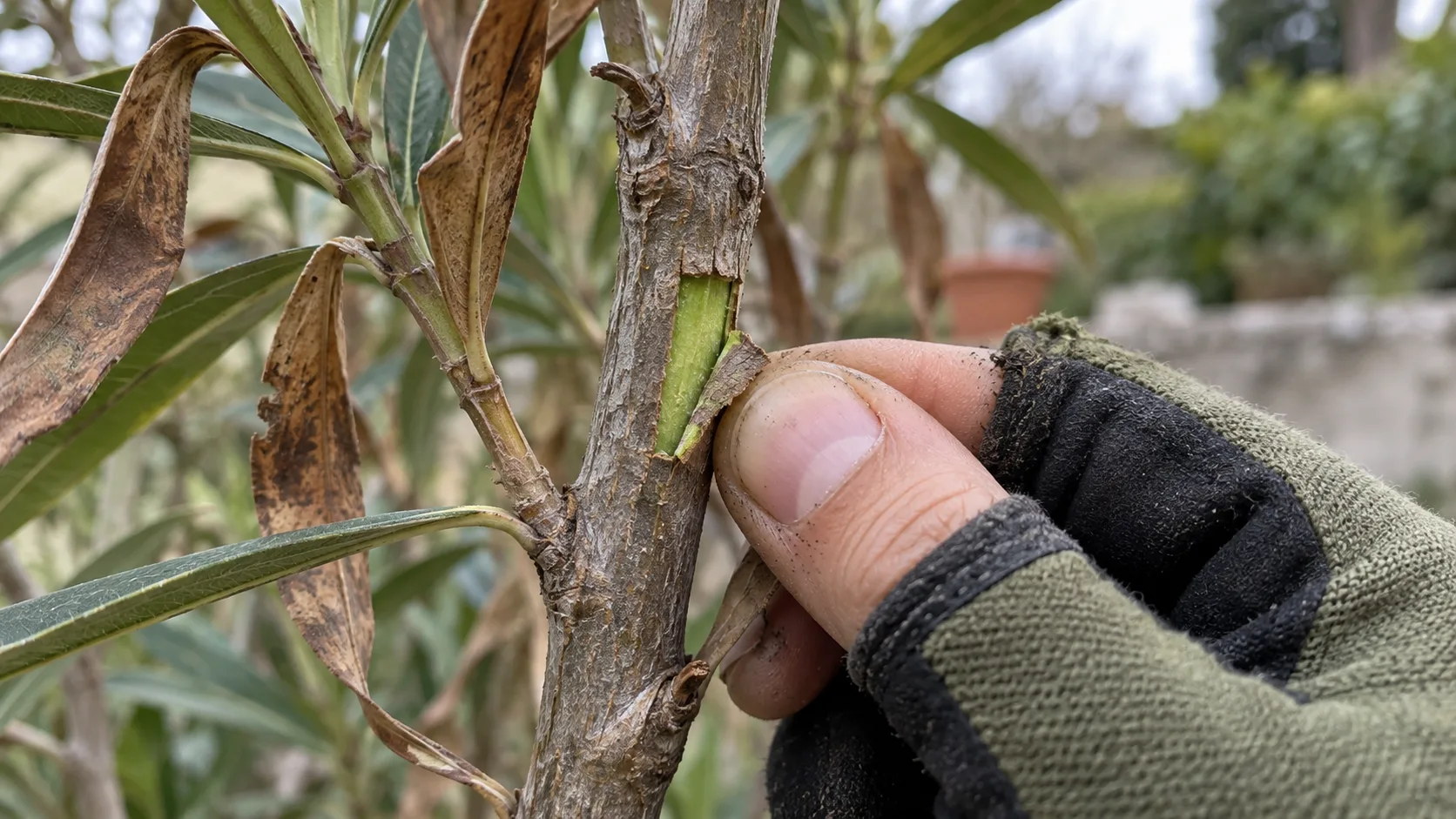
When to give up? Not before summer. Ground-grown plants frozen to ground level regrow from the base if roots survive4; the RHS advises waiting until midsummer before removing frost-damaged plants9.
Frost is not the only suspect. Brown leaves and dry twigs usually follow weather damage: the RHS lists drought, excess water, snow, frost and hail9. Recognizing weather damage distinguishes the signs.
Des rameaux qui noircissent sans avoir gelé orientent vers une autre piste : oleander diseases se reconnaissent à leurs taches et à leurs chancres.
Un chien qui mâchonne une branche coupée, un enfant près du tas de taille : ce qui rend le oleander toxicity to dogs vaut aussi pour l'enfant, avec les symptômes et les bons réflexes.
Hors dégâts de gel, la coupe annuelle obéit à d'autres règles : pruning oleander se pratique au printemps, une fois les gelées passées.
Can oleander stay outdoors in winter?
Oleander is associated with southern France, but Olivier Faure notes its northward spread as far as the Paris region1. Your garden's lowest temperature matters more than its region. Cold air flows downhill and collects at the bottom, forming a frost pocket with harder frost9. Young or newly planted shrubs are also more vulnerable than established ones9.
- Bring indoors
- Novemberearlier if frost arrives · in a potSource: Société nationale d'horticulture de France
- Move back outside
- Mayafter the last frosts · usually early May in the source’s temperate Northern Hemisphere calendar · in a potSource: Société nationale d'horticulture de France
- Protect
- Before the first frostsas soon as a night at −2 °C (28 °F) is forecastSource: Jardins de France (SNHF)
- Light
- A bright roomSource: Bayerische Gartenakademie (LWG)
- Winter watering
- Every 14 to 21 daysin a room at 4–6 °C (39–43 °F)Source: Bayerische Gartenakademie (LWG)
| Growing situation | Rare, brief frosts | Regular nights below −5 °C (23 °F) |
|---|---|---|
| In the ground | Outside, mulched base, fleece on nights below −2 °C (28 °F) | Survival uncertain: foliage lost, regrowth from the base possible |
| Large immovable container | Outside against a south-facing wall in the source’s UK setting, wrapped pot, fleece over foliage | High risk: root ball freezes before foliage |
| Movable pot | Shelter from the first night forecast below −2 °C (28 °F) | Sheltered all winter |
This table combines the RHS damage-free limit2, SNHF protection threshold and methods1, and the vulnerability of potted roots7.
When to bring oleander indoors
November in most French regions: the SNHF recommends bringing containers into a cool, ventilated room then3. Weather moves the date earlier or later. Protect from a forecast −2 °C (28 °F), even in October1, but leave it outside while cold holds off: the Bayerische Gartenakademie advises bringing it in as late as possible10. In Bavaria, it keeps oleanders outside roughly mid-April to mid-October, since they tolerate brief light frosts10.
Bringing it in too early costs weeks of light and hardening off: plants need several cold days before frost to prepare, explaining why sudden fall frost can damage otherwise hardy species9.
Where to keep oleander in winter
The Gartenakademie specifies 4–8 °C (39–46 °F) in a room as bright as possible, easy to ventilate10. Light determines flowering: the brighter the winter shelter, the more flower buds form for the following summer10.
| Shelter | Assessment | What matters |
|---|---|---|
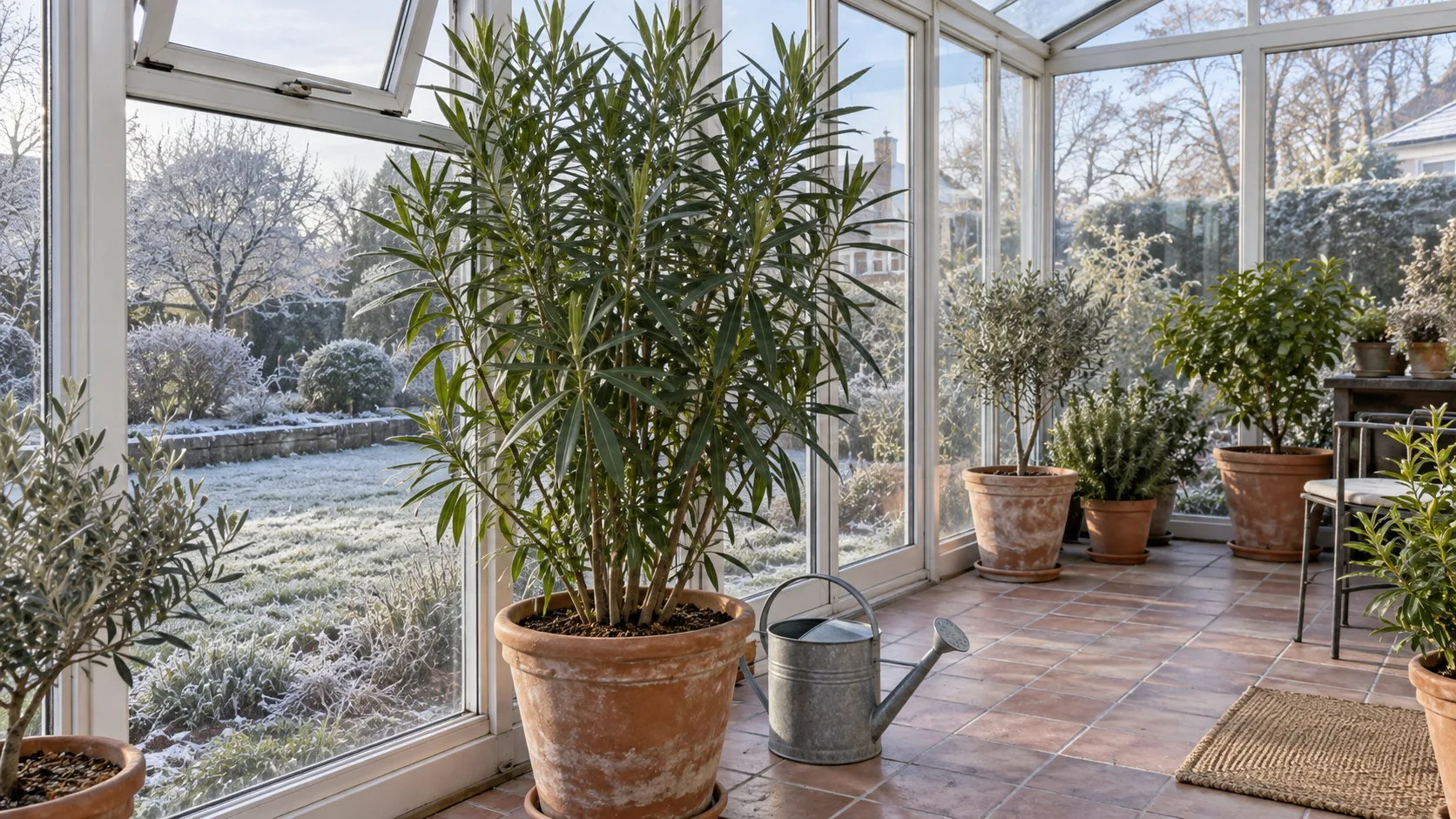
| Cool greenhouse, unheated conservatory | Ideal | Light and cool conditions, provided it remains frost-free |
| Garage or storeroom with a window | Acceptable | Low light: keep the room as cool as possible |
| Dark cellar | Last resort | No light, so fewer flowers next summer |
| Heated room | Avoid | Warmth without greenhouse light, increased water needs |
A cool greenhouse best combines the two conditions other shelters struggle to provide: light and moderate cold. Olivier Faure adds shelter from drafts, while retaining daylight1.
Protecting outdoor oleander in the ground or in pots
For outdoor plants, start with foliage: use two layers of horticultural fleece on nights forecast to freeze9. Its effect is limited: thick fleece adds only around 2 °C (3.6 °F) of protection9, enough for light frost rather than a cold wave.
Then protect roots. In the ground, thick mulch or fleece at the base prevents soil freezing19. Wrap containers in bubble wrap and place them in a sheltered garden corner91. Water a dry root ball before the cold wave: moist substrate freezes more slowly than dry substrate7.
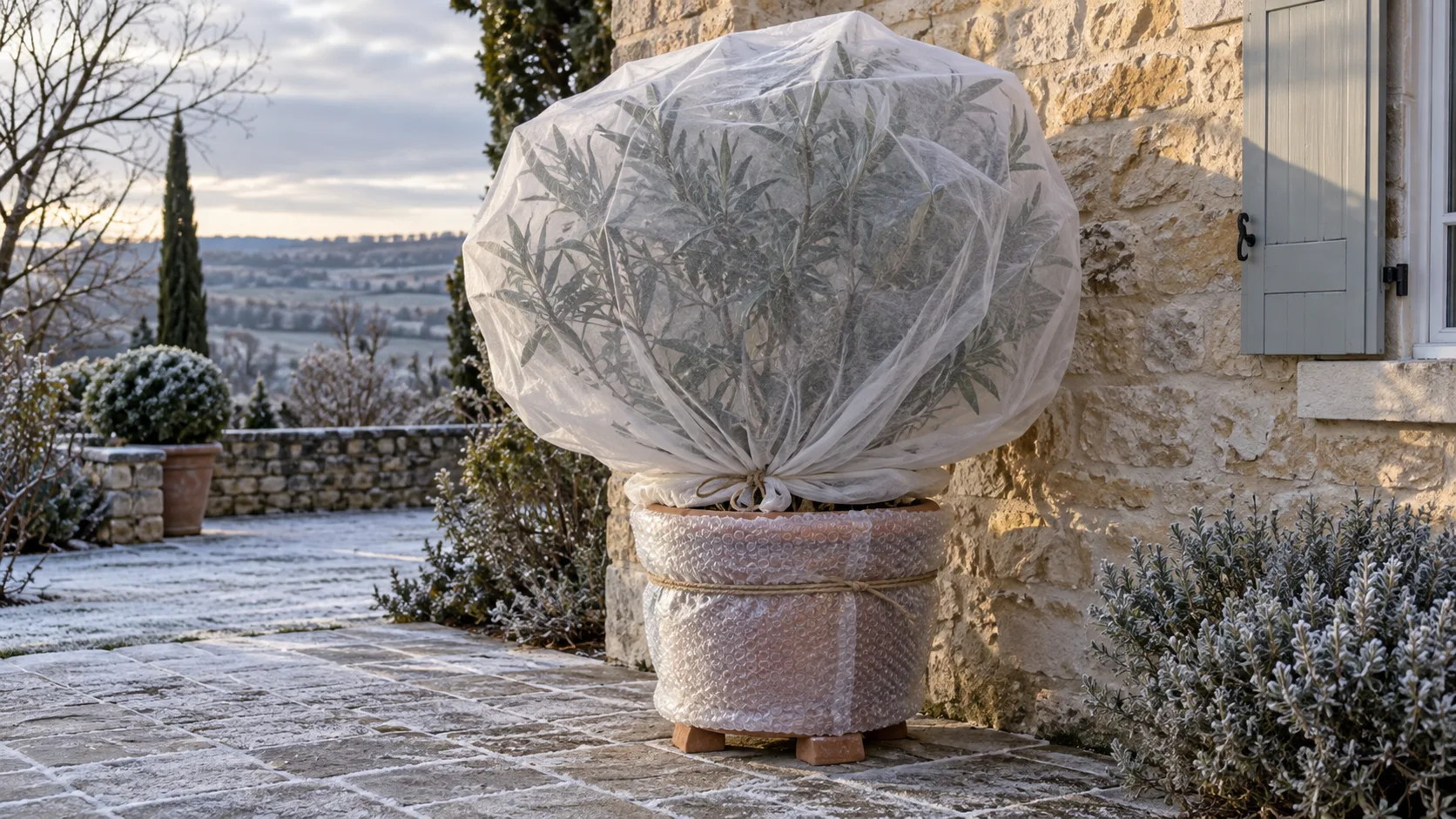
Wind matters too. Below freezing, strong wind worsens frost, while cold wind dries evergreen foliage faster than roots replace moisture: leaves brown at tips and edges9. In the RHS’s UK growing context, a south-facing wall gives warmth and shelter9.
Le bac lui-même décide d'une partie de la résistance au froid : potted oleander demande un contenant et un substrat à sa taille.
Winter watering and care
No fixed watering dates. Brighter, warmer rooms increase water use; the Gartenakademie advises checking once or twice weekly, watering only every two to three weeks at 4–6 °C (39–43 °F)10. Oleander keeps its leaves and needs water year-round: moderate, regular watering, especially in pots1. Resume summer frequency as warm weather returns; the oleander care guide covers this with light and substrate.
Du local d'hiver aux jours de canicule, watering oleander se décide au doigt, au tiers de la hauteur du pot.
No fertilizer during dormancy: in its French seasonal example, the SNHF feeds in spring after frost, then early July1; the RHS warns that late nitrogen produces tender shoots more vulnerable to frost9. Ventilate in mild weather10.
La reprise des apports se prépare dès la sortie : oleander fertilizer se choisit riche en potasse, pauvre en azote.
Pruning follows two rules depending on winter location. Outdoors, no fall pruning: it stimulates frost-sensitive shoots1. Before sheltering, you can thin the longest and oldest stems to save space, without shortening every stem: buds still closed in fall flower the following year10.
Returning oleander outside after the Ice Saints
After the last local frosts: early May is the SNHF’s French seasonal example3. In its harsher Bavarian climate, the Bayerische Gartenakademie puts oleanders out from mid-April, since they withstand brief light frosts10.
In France, the Ice Saints, 11–13 May, have guided gardeners since the Middle Ages11. They do not mark frost's end: across 130 lowland stations from 1951 to 2023, Météo-France counts 49 years out of 73 when at least one station recorded frost between the Ice Saints and 30 June, two years in three11. Frost also occurs during the Ice Saints: on 12 May 2026, Mourmelon-le-Grand (Marne) recorded screen-level frost at −1.7 °C (29 °F)11.
Tender shoots grown under shelter are first hit by spring frost9: keep fleece ready and put it on in the evening when frost is forecast9.
Return outside in stages. After months of filtered light, foliage scorches in full sun: the Gartenakademie first gives it a few days in partial shade10. The first feed follows once frosts end1. This timing also guides garden planting: what to plant in May after the Ice Saints covers French regions.
The cold-hardiest oleander varieties
Oleanders differ in frost resistance. The SNHF names 'Villa Romaine' among the few varieties tolerating −12 °C (10 °F)3. Clemson Cooperative Extension calls 'Hardy Red' the hardiest cultivar, with 'Hardy Pink' similar: both may survive in USDA zone 7b4, with minima −15 to −12 °C (5–10 °F)6. 'Calypso' is described as resistant and vigorous4; NC State confirms 'Hardy Pink' tolerates cold better5.
Conversely, dwarf 'Petite Pink' and 'Petite Salmon' are less hardy than average and need very sheltered sites4. For unlabeled plants, thick, dark green, leathery foliage tends to accompany better hardiness4. Clemson also notes nurseries often sell oleanders by color rather than name4: without a variety name, assume −5 °C (23 °F).
Frequently asked questions
Does oleander lose its leaves in winter?
Does horticultural fleece really protect against frost?
Does overwintering under cover reduce flowering?
Only if shelter is dark. Winter light encourages flower buds; in the LWG’s Bavarian seasonal example, raising the room to around 10–12 °C (50–54 °F) in March brings flowering forward10. Cellar-overwintered oleanders form fewer buds and generally flower less.