
Care guide
Oleander care
Nerium oleander
Oleander tolerates drought in the ground, not in a pot: summer water makes the flowers. Give it full sun, prune lightly in spring and protect it when a night at −2 °C (28 °F) is forecast. One rule comes first: the whole plant is poisonous, so wear gloves for pruning and never burn the waste.
How often should you water oleander?
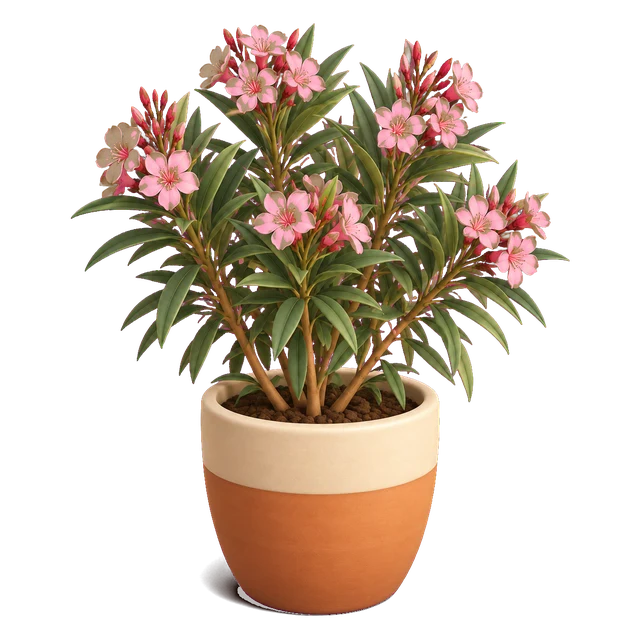
In a pot, oleander (Nerium oleander) drinks heavily: in midsummer, watering may be daily, sometimes morning and evening; in the ground, an established plant needs thorough watering during drought. 1 2 Its reputation as a Mediterranean scrubland plant is misleading: the specialist interviewed by SNHF says plainly that watering is vital
and the shrub does not withstand drought for long. 3
10 L every 30 days
One to two times a day
Every 14 to 21 days
Water generously during droughts
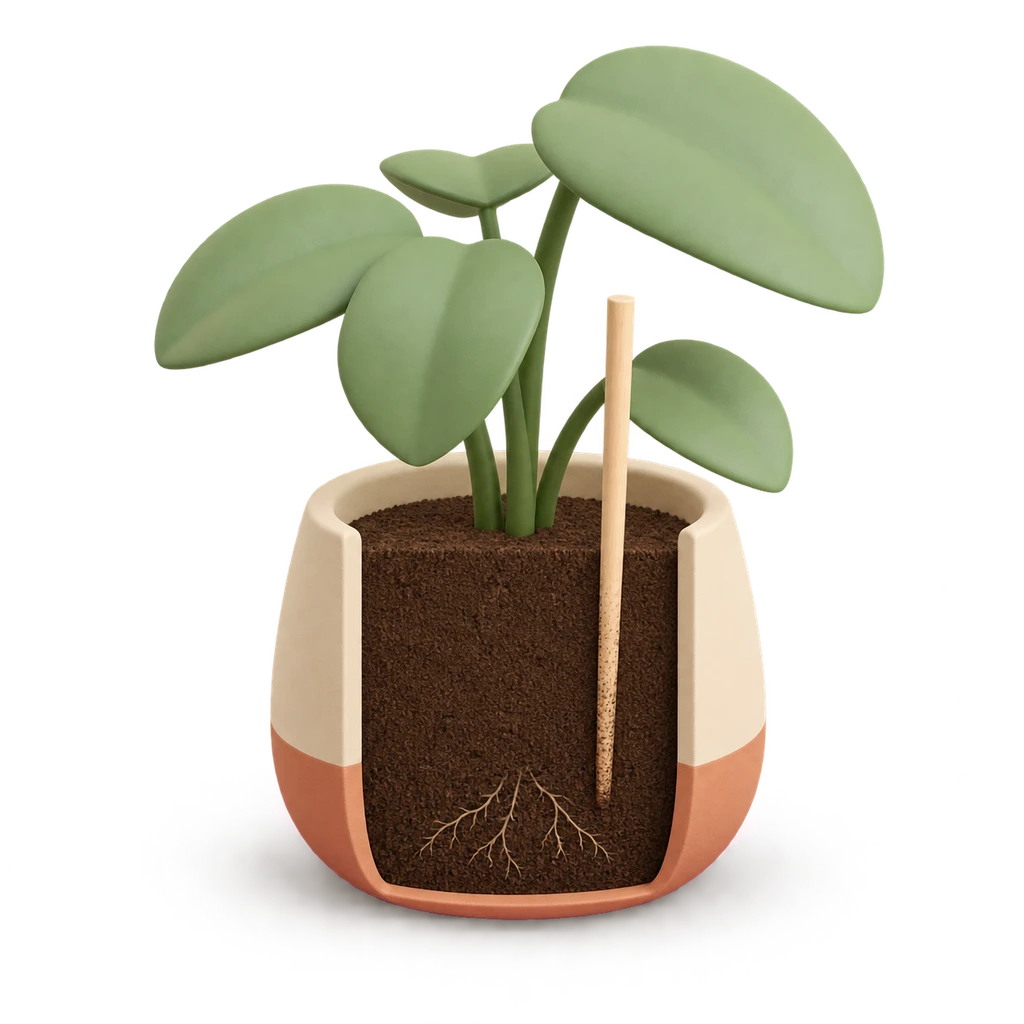
Potting mix dry to 15% of the pot height: still moist
The finger test
In a pot, push your finger one-third of the way down the pot: if it is dry at that depth, water; if it is still moist, wait.
In the wild it grows beside rocky watercourses that dry up for part of the year: a streambed plant, not a rock-garden plant. In the ground its roots seek moisture deep down; in a tub they have only the pot's volume. Its foliage is also evergreen, so it needs water all year, moderately but regularly in winter. 3
- In summer, in a pot: on hot days, water morning and evening if the rootball dries between waterings. 1
- In winter, under cover: the brighter and warmer the room, the more it drinks. In a room at 4 to 6 °C (39 to 43 °F), watering every two to three weeks is enough. 1
- Always at the base: never over the foliage, and away from lawn sprinklers, since wet leaves encourage disease. 3
- The test: push a finger into the potting mix. If dry two finger joints down, water until it runs out beneath the pot.
- Never leave standing water: the shrub does not thrive in waterlogged soil, and the University of Florida warns against overwatering. 2 4 Empty the saucer after every watering, especially under cover in winter: roots deprived of air cause yellow leaves, then rot. 5 Signs are detailed under overwatering.
How can you tell it is thirsty? When oleander lacks water, leaves on every branch yellow and droop together, then the plant perks up after thorough watering. 6 One yellowing branch that fails to recover signals something else (see the diagnosis below).
Pot, pleine terre, canicule ou hiver à l'abri : watering oleander se règle sur la motte, pas sur le calendrier.
Where should you put oleander?
In the garden’s most direct sun, sheltered from cold winds. South- or west-facing walls are the sources’ UK and US examples of this sunny position. The RHS specifies full sun, a southerly aspect and shelter; Clemson Cooperative Extension adds that it even tolerates reflected heat from a south- or west-facing wall. 7 2
Garden exposure
Choose the side of the house where nerium will grow.

- Due south or west in the sources’ UK and US settings: the ideal sunny position, where it flowers most. Choose by actual local light.
- Partial shade: it grows, but stretches, becomes loose in habit and flowers less. 4
- By the sea: it tolerates salt spray and wind, making it a reliable coastal hedge. 2
- Beneath an overhang: recommended for double-flowered varieties, whose flowers rot on the plant in rainy summers. 1
- A heated room: avoid it. Indoors, only a bright conservatory or greenhouse suits it.
One spring detail: an oleander emerging from winter shelter is no longer used to sunshine. The Bavarian Garden Academy first gives it a few days in partial shade, otherwise foliage scorches. 1
When and how should you plant oleander in a pot or garden?
In southern France and around the Mediterranean, oleander grows in the ground; elsewhere, SNHF recommends a large tub, brought into a conservatory or well-lit garage for winter. 8 This boundary is shifting: the grower interviewed by SNHF sees plantings as far north as the Paris region, provided a cold-tolerant variety is chosen. 3
In the SNHF specialist’s French growing context, container-grown plants can be planted almost all year, depending on local frost and growth conditions. 3 Outside southern France, spring after frost has passed gives a full season to root before the first winter.
- Prepare free-draining soil. Lighten clay with sand, potting mix and organic matter. 3 SNHF describes ideal soil as deep and well-drained, with neutral to slightly acidic pH 8, but its profile gives a tolerated pH range of 5.5 to 7.8.
- Do not loosen the rootball, unless roots form a tightly circling mass. 3
- Space plants 1.5 to 2.1 m (5 to 7 ft) apart for a hedge that closes into a green wall. 4
- Water generously, then keep the soil moist throughout the first summer.
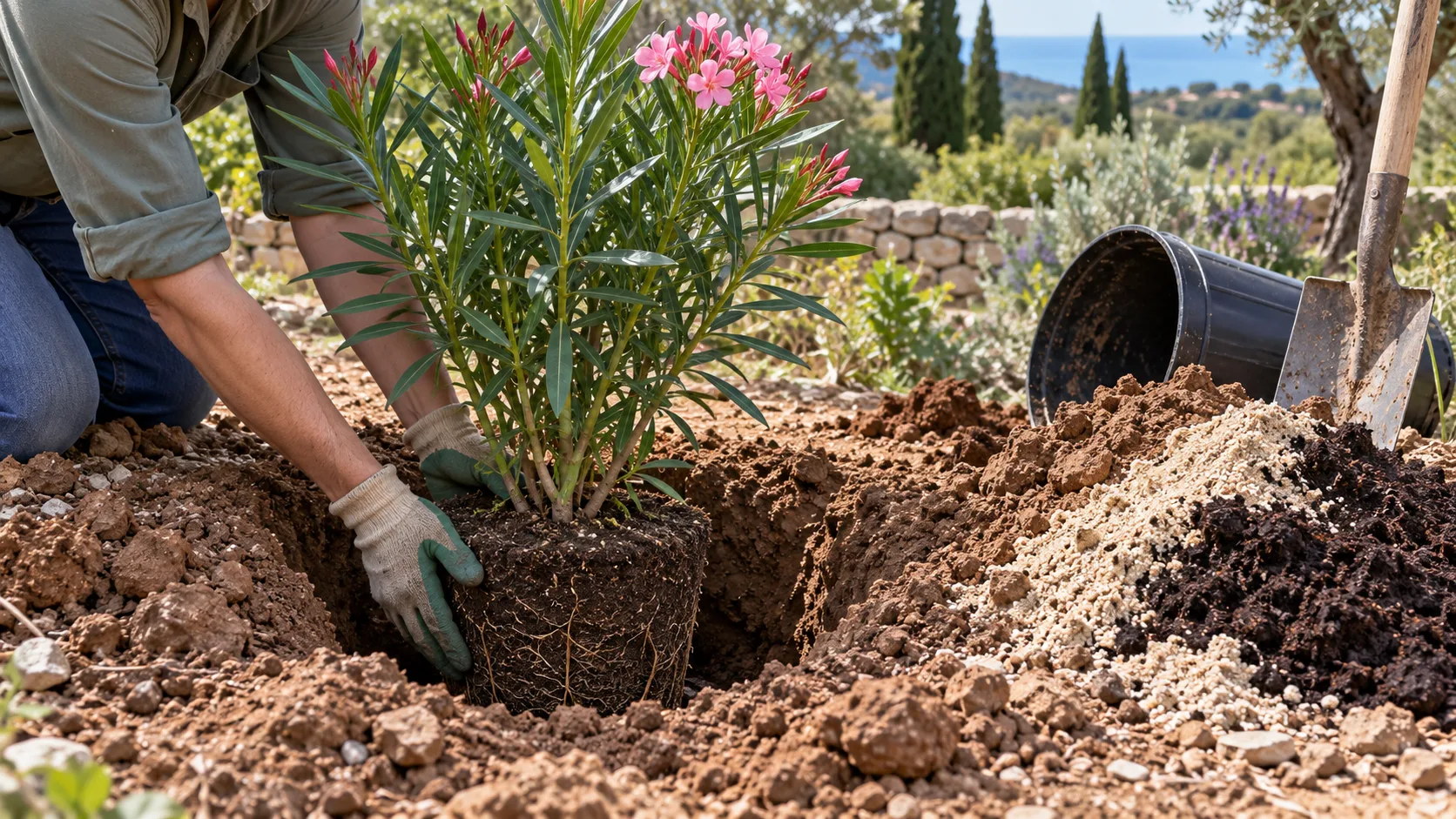
In a pot, choose a tub with holes in the base, since the shrub requires good drainage 2, and a peat-free loam-based potting mix. 7 The older the plant, the heavier and more soil-based the mix should be. Repot a young oleander every year, an old one every three to five years, then keep it in shade for two weeks. 1 Between repottings, annual top-dressing renews the soil. 8
Diamètre du bac, substrat, rempotage d'un vieux sujet : oleander in a pot a ses propres règles.
Signes, taille du pot, mélange et geste : repotting oleander se fait au printemps, quand l'arbuste repart.
What fertilizer does oleander need, and when?
A low-nitrogen, potassium-rich fertilizer, such as NPK 10-10-30, applied after the last local frost and stopped as growth slows, in late August in the LWG’s Bavarian calendar. 3 1 The three NPK figures are read in order: nitrogen makes leaves, potassium makes flowers. An oleander overfed with nitrogen produces lots of foliage and few flowers. 3
- Fertilizer
- Low in nitrogen, high in potassiumSource: Jardins de France (SNHF)
- Feeding
- After the last frostsFirst application · in the groundSource: Jardins de France (SNHF)
- Feeding
- JulySecond application · early July in the source’s temperate Northern Hemisphere calendar · in the groundSource: Jardins de France (SNHF)
- Feeding
- April to Augustin a potSource: Bayerische Gartenakademie (LWG)
- No fertilizer
- September to FebruarySource: Floralens guide
- Frequency
- Liquid fertiliser once a monthin a potSource: Royal Horticultural Society
- Frequency
- Every 7 daysIntensive summer feeding · 3 g of soluble fertiliser per litre (about 0.4 oz per US gallon) · in a potSource: Bayerische Gartenakademie (LWG)
- Frequency
- Two applications a yearin the groundSource: Jardins de France (SNHF)
- Avoid
- Excess nitrogen, applying fertilizer to a dry root ball, exceeding the dose on the labelSources: Clemson Cooperative Extension; Washington State University; Royal Horticultural Society
- In the ground: two applications a year, in spring after frost, then early July in the French source’s seasonal example. 3
- In a pot: liquid feed once a month during growth, since potting mix is quickly depleted. 9 The Bavarian Garden Academy prefers soluble fertilizer weekly from April to late August, at a low dose: 3 g per liter (0.4 oz per US gallon) of water. 1
- During winter rest, September to February in the source’s seasonal calendar: none. Late feeding encourages tender shoots that cannot harden before cold arrives.
A feed for flowering plants or tomatoes, with more potassium than nitrogen, is suitable. Follow the label dose, applied to an already moist rootball.
Granulés, liquide ou compost, et les signes d'un excès : feeding oleander se choisit selon le pot ou la pleine terre.
When and how should you prune oleander?
Prune in early spring once frost has passed, shortening no more than a third of the shoots; never prune an in-ground plant in fall. 8 3 Fall pruning triggers young growth that the first frost burns. 3
Everything depends on how it flowers. Oleander bears flowers in clusters at branch tips 8, on the current year's growth 10; and clusters still in bud in fall resume flowering the following year. 1 Shortening every stem to the same height therefore means cutting off next summer's flowers.
- Routine pruning: in spring, remove dead wood, weak branches and crossing growth. 8
- Thin rather than shorten: every few years, cut the longest, oldest stems back into old wood. The Garden Academy places this after flowering, or just before a potted plant goes into shelter, where regrowth is protected from frost. 1 For tubs, SNHF recommends renewal every two years. 8
- Rejuvenating an old plant: it tolerates being cut hard back to 50 cm (20 in) above ground, but flowers little or not at all that year. 8
- Faded flowers: removing them prolongs flowering. 2 Cut off the spent flower, not the cluster tip still carrying buds.
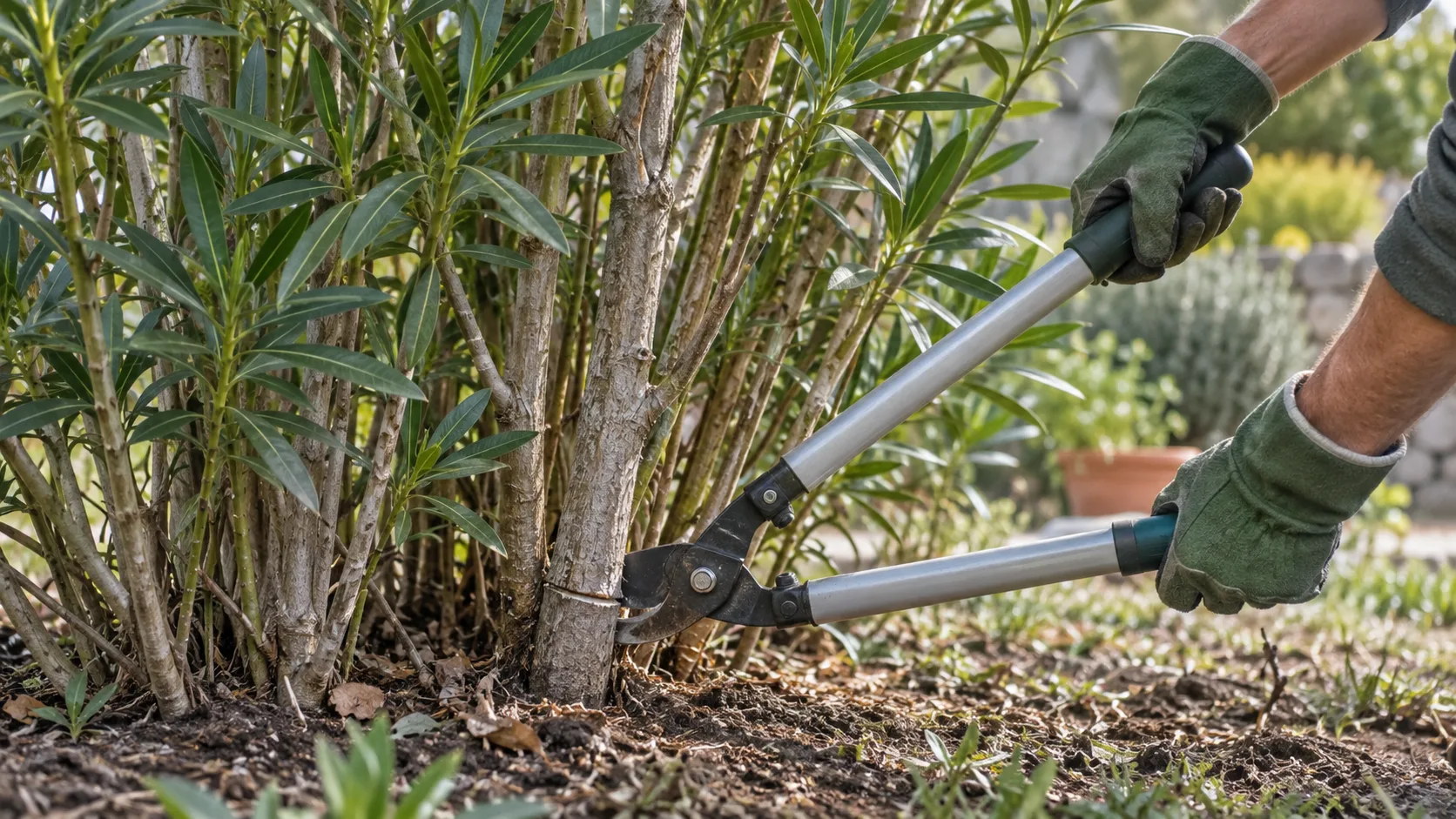
Two precautions apply to every cut: gloves, since sap irritates skin 4, and disinfected blades, since oleander's main disease enters through pruning wounds. 11 Never burn waste: the smoke is toxic. 2
Guides to pruning plants, from roses to monstera, are grouped by species.
Taille de formation, de haie ou de rajeunissement : pruning oleander demande de savoir où sont les futurs boutons.
How much frost can oleander withstand?
Oleander is frost-sensitive: protect it when a night at −2 °C (28 °F) is forecast. It withstands −5 °C (23 °F) without damage, survives around −7 to −9 °C (19 to 16 °F) with leaf loss, and only a few varieties such as 'Villa Romaine' tolerate −12 °C (10 °F). 3 7 2 8
Temperatures for nerium
In °C, thresholds given by the sources.
- 'Villa Romaine'-12 °C
- Foliage lost, rootstock still alive-9 °C
- No damage (RHS H3 rating)-5 °C
- Protect-2 °C
- Ideal: 18 to 30 °C
- Tolerated: -5 to 38 °C
- Bright, well-ventilated winter shelter: 4 to 8 °C
- Bring indoors
- Novemberearlier if frost arrives · in a potSource: Société nationale d'horticulture de France
- Move back outside
- Mayafter the last frosts · usually early May in the source’s temperate Northern Hemisphere calendar · in a potSource: Société nationale d'horticulture de France
- Protect
- Before the first frostsas soon as a night at −2 °C (28 °F) is forecastSource: Jardins de France (SNHF)
- Light
- A bright roomSource: Bayerische Gartenakademie (LWG)
- Winter watering
- Every 14 to 21 daysin a room at 4–6 °C (39–43 °F)Source: Bayerische Gartenakademie (LWG)
Oleander's RHS hardiness rating is H3: hardy only in coastal and mild parts of the UK, corresponding to minima of −5 to 1 °C (23 to 34 °F). 7 Clemson Cooperative Extension places it in zones 8b to 10 on the American map 2, NC State from zone 8a 10, and USDA zone 8b corresponds to minima of −9.4 to −6.7 °C (15 to 20 °F). 12
Clemson translates those figures into garden behavior: around −7 to −9 °C (19 to 16 °F), most oleanders survive but lose their foliage, then quickly regrow from the base if roots survive. 2 For frost-scorched foliage, see weather damage.
These thresholds do not apply in pots: the rootball lacks the ground's protection and freezes long before the foliage. There are three practical situations:
- In the ground, mild climate: mulch or fleece over the soil protects roots when −2 °C (28 °F) is forecast. 3
- A tub too heavy to move: fleece over foliage, bubble wrap around the pot. 3
- A movable pot: bring it in as late as possible, into a bright, ventilated room at 4 to 8 °C (39 to 46 °F). 1 In its French seasonal calendar, SNHF places this in November, with the return outdoors in early May, after the last frost. Let local frost conditions set those moves. 8 The Ice Saints, 11 to 13 May, remain the traditional marker, without a guarantee: Météo-France still records frost somewhere in France after that date two years out of three. 13
Not all varieties withstand frost equally. These have cold tolerance documented by an authoritative source:
| Variety | Cold tolerance | Mature height |
|---|---|---|
| 'Villa Romaine' | down to −12 °C (10 °F) | not specified |
| 'Hardy Red' | the hardiest, may survive in zone 7b (−15 to −12 °C / 5 to 10 °F) | 2.4 m (8 ft) |
| 'Hardy Pink' | similar to 'Hardy Red', zone 7b | similar to 'Hardy Red' |
| 'Calypso' | hardy and vigorous | 3 to 5.5 m (10 to 18 ft) |
| 'Sister Agnes' (white) | hardy and vigorous | 3 to 3.6 m (10 to 12 ft) |
| 'Petite Pink', 'Petite Salmon' | less hardy than average | 0.9 to 1.2 m (3 to 4 ft) |
| Unnamed oleander | assume −5 °C (23 °F) | variable |
'Villa Romaine' comes from the SNHF profile 8; the other entries come from Clemson Cooperative Extension, corroborated by NC State for 'Hardy Pink'. 2 10 The zone 7b conversion comes from the USDA map. 12 Clemson offers a clue for unlabeled plants: thick, dark green, leathery foliage often accompanies better hardiness. 2
Other frost-sensitive plants have guides in overwintering plants.
Voile, papier bulle, local hors gel et sortie de printemps : overwintering oleander se décide selon le pot et la région.
How tall does oleander grow?
In the ground in a mild climate, oleander reaches 1.5 to 6 m (5 to 20 ft) tall and 1.8 to 3 m (6 to 10 ft) wide; in tubs and cool climates, it rarely exceeds 2.5 m (8 ft). 10 7 SNHF gives a range of 80 cm to 5 m (2.6 to 16 ft) depending on variety. 8
- Mature height
- 1,5 to 6 m
- Spread
- 3 m
- Growth
- Fast in a mild climate with plenty of light
Growth is fast: 30 to 60 cm (12 to 24 in) a year, sometimes more. 2 Yet the RHS allows 10 to 20 years for ultimate size. 7 Two practical consequences:
- A 1 m (3.3 ft) plant from a garden center may double in three seasons in a warm spot.
- Annual pruning to keep a large oleander in a small space weakens it: every cut is an entry point for disease. 3 Better to choose a variety with the right mature size from the outset.
To contain an over-tall plant, SNHF allows pruning a third of its branches in spring 8; training a standard also requires removing basal shoots as they appear. 4
When does oleander flower?
In southern France, oleander flowers from April to November; in the Paris region, from June to October, depending on variety. 8 Flowers open in cymes at branch tips, single or double, ranging from white through yellow and salmon to deep red. 8
- What triggers flowering
- Heat and sunSource: Bayerische Gartenakademie (LWG)
- Flowering
- April to NovemberSouthern FranceSource: Société nationale d'horticulture de France
- Flowering
- June to OctoberParis regionSource: Société nationale d'horticulture de France
| Conditions | January | February | March | April | May | June | July | August | September | October | November | December |
|---|---|---|---|---|---|---|---|---|---|---|---|---|
| Southern France | no flowers | no flowers | no flowers | Flowering | Flowering | Flowering | Flowering | Flowering | Flowering | Flowering | Flowering | no flowers |
| Paris region | no flowers | no flowers | no flowers | no flowers | no flowers | Flowering | Flowering | Flowering | Flowering | Flowering | no flowers | no flowers |
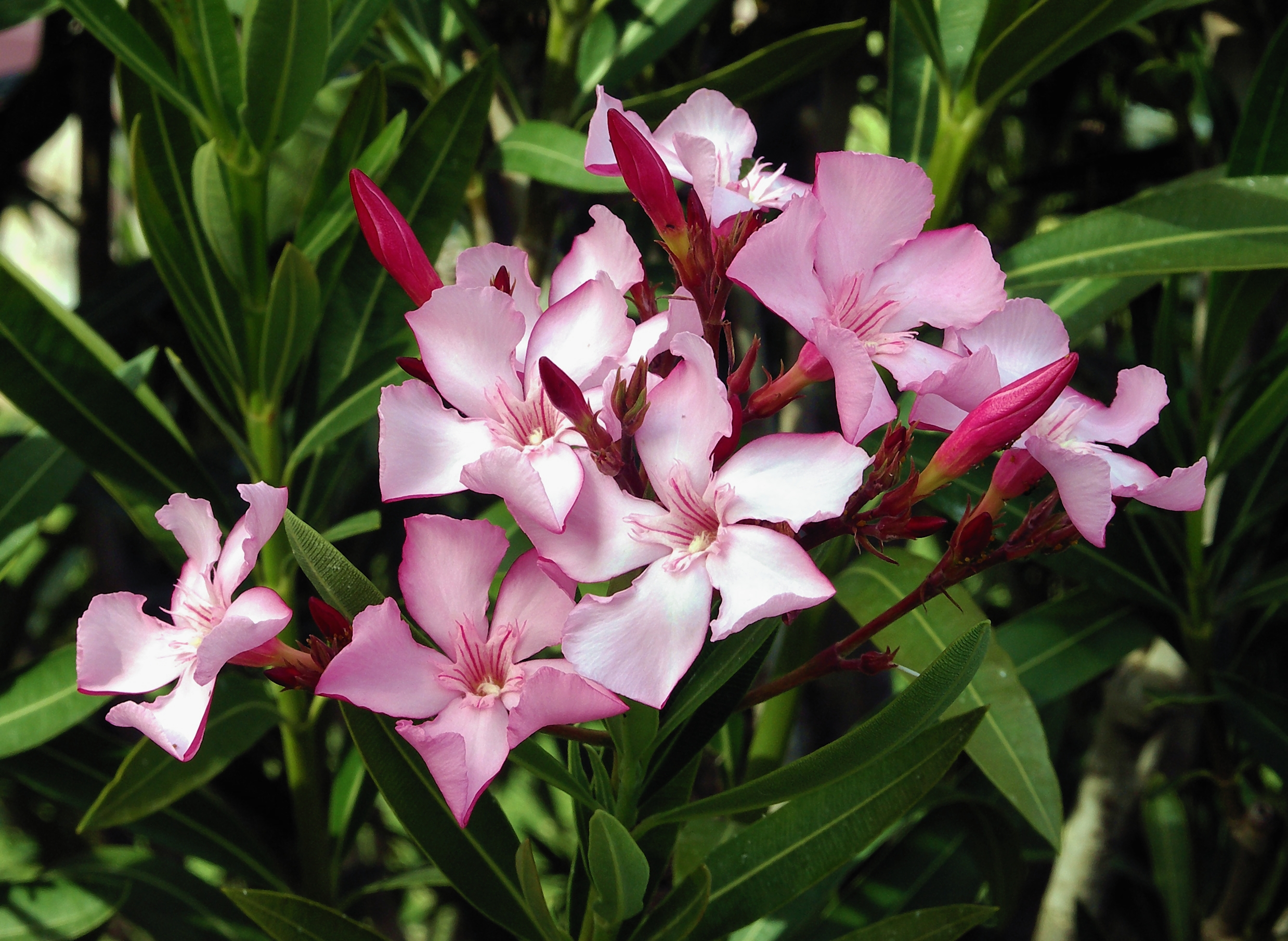
Flowering needs warmth: in a cool summer, buds often remain closed. 1 Bright winter storage increases bud numbers, and in the LWG’s Bavarian seasonal example, raising the room to 10 to 12 °C (50 to 54 °F) in March brings flowering forward. 1
Why is my oleander not flowering? Causes, from most to least common:
- Too little sun: in partial shade it stretches and flowers less. 4
- Pruning at the wrong time: shortening every stem, or hard pruning that leaves almost no flowers for a year. 1 8
- Excess nitrogen, producing leaves instead of flowers. 3
- Winter spent in darkness, reducing bud formation. 1
- A cool summer or irregular container watering: buds stay closed in cold weather, and SNHF considers regular water essential for good flowering. 1 8
The month-by-month care calendar
The routine follows local growth, heat and frost, rather than fixed months. The French source’s seasonal example is rest from November to February, repotting and resumed feeding in March-April, maximum watering from June to August, and no fertilizer after late August. For pots, its two dates are shelter in November and outdoors in early May after frost. 8
| Task | January | February | March | April | May | June | July | August | September | October | November | December |
|---|---|---|---|---|---|---|---|---|---|---|---|---|
| Watering | reduced | reduced | reduced | moderate | high | high | high | high | moderate | reduced | reduced | reduced |
| Growth | resting | resting | active | active | strong | strong | strong | strong | active | active | resting | resting |
| Feeding | no | no | yes | yes | yes | yes | yes | yes | no | no | no | no |
| Repotting | no | no | favorable window | favorable window | no | no | no | no | no | no | no | no |
How do you propagate oleander?
A tip cutting in a glass of water during active growth, between June and September in the LWG’s Bavarian example, roots in three to four weeks and faithfully reproduces the parent plant’s color. 1
- Softwood cutting
- In springYoung shoots, rooted in soil · in a light soil kept very moistSource: Société nationale d'horticulture de France
- Semi-ripe cutting
- June to SeptemberShoot tip without flower buds · roots in 3 to 4 weeks · roots well in waterSource: Bayerische Gartenakademie (LWG)
- Air layering
- In springSource: Royal Horticultural Society
- Sowing seed
- In springSource: Royal Horticultural Society
- Take a vigorous shoot tip without flower buds, wearing gloves. 1
- Immerse the base in 2 to 5 cm (0.8 to 2 in) of water, somewhere warm and bright, away from direct sun. 1 SNHF adds a piece of charcoal to keep the water clean. 8
- Pot up when roots measure 1 to 2 cm (0.4 to 0.8 in). 1
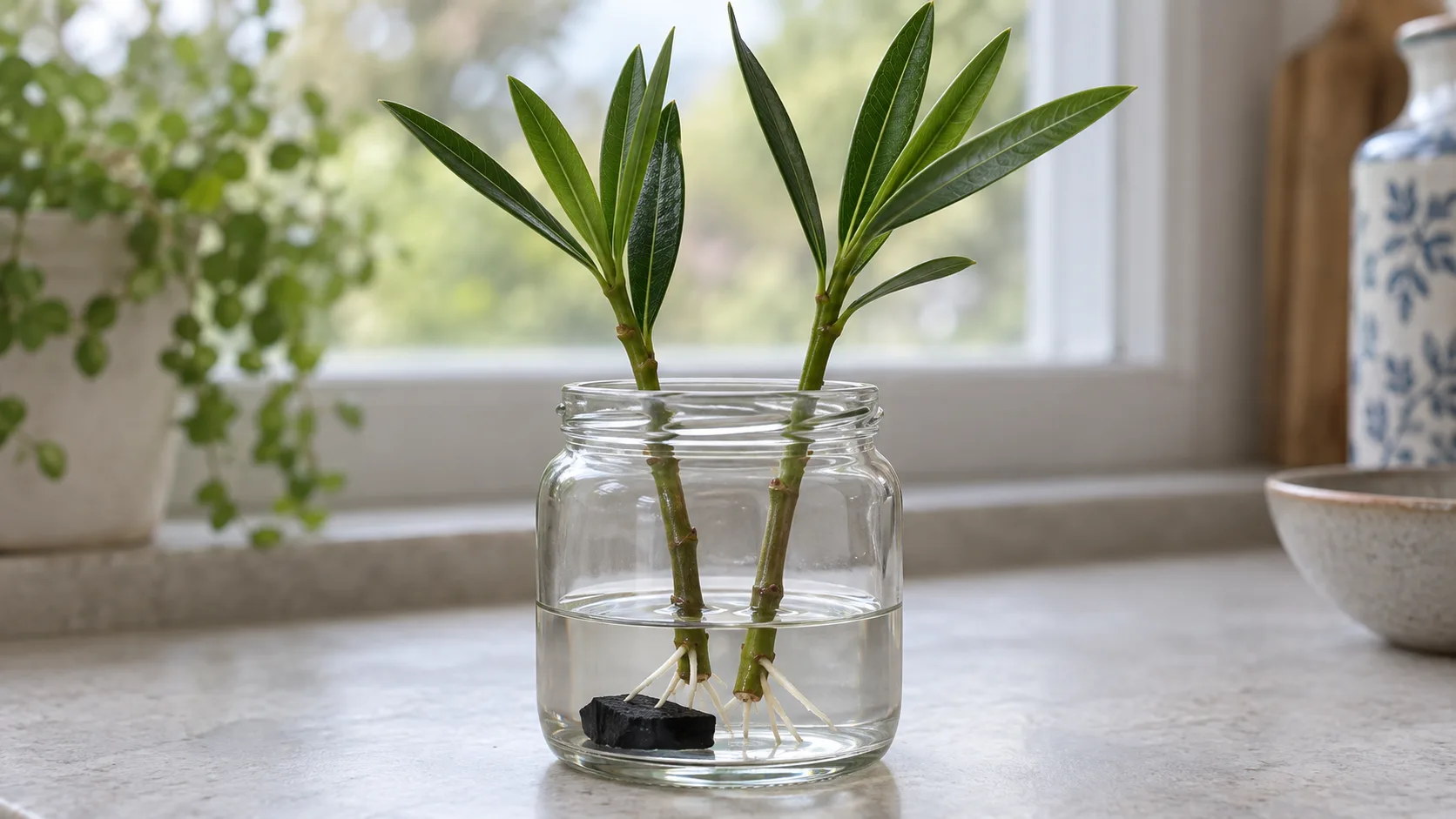
The RHS also lists seed, semi-ripe cuttings and air layering in spring. 7 Only cuttings guarantee the variety: seedlings do not necessarily have the parent's color. 1 Water propagation suits it: according to SNHF, cut branches root even without any care
with their bases in water. 8
Pour la période, le substrat et la reprise en terre : taking oleander cuttings demande surtout de la chaleur et de l'ombre claire.
Common problems: diagnosis
Oleander troubles come from three directions: a sap-sucking pest, bacteria entering a wound, or an excessively damp winter. The table starts with what you see.
| Symptom | Likely cause | Action |
|---|---|---|
| Rough, blackish growths on stems, leaves and buds | Bacterial knot (Pseudomonas savastanoi pv. nerii) | Cut below the growth in dry weather; disinfect tools |
| Shells stuck to veins, sticky foliage | Scale insects | Damp sponge, 5% black soap |
| Dense colonies on tender shoots | Aphids (Aphis nerii) | Water jet, black soap, ladybugs |
| Black coating dulling leaves | Sooty mold | Treat the honeydew-producing pest |
| Dull, stippled leaves under cover | Spider mites | Wet foliage, reduce air dryness |
| White spots becoming sunken as they dry | Septoria leaf spot | Ventilate winter storage |
| Shoots blackening after frost or drought | Botryosphaeria dieback | Cut back to healthy wood |
| Leaves on one branch browning at edges, no recovery after watering | Xylella fastidiosa | Have it tested; report it |
Bacterial knot is the main disease: deforming blackish growths, especially on young shoots and flower clusters. 3 The agent is a pathovar of Pseudomonas savastanoi that can also attack olive trees. 11 Bacteria travel in rain splash, on hands and tools, and enter through pruning wounds and frost cracks. 11

No product cures an affected plant: cut diseased parts promptly in dry weather and destroy a badly affected specimen. 1 SNHF advocates preventive copper protection (Bordeaux mixture) in spring, then every two or three months. 3 The same pathogen affects the olive tree, a frequent terrace neighbor.
Scale insects are a particular problem for oleander, with half a dozen species attached beneath leaves and along stems. 8 Young larvae shelter beneath their mother's shell: treatment must be repeated several times, three to five days apart. 1
Their honeydew feeds sooty mold. 8 For recognition, see the guide to identifying and getting rid of scale insects. The oleander aphid has its own species; a large colony yellows leaves and slows growth. 14
Septoria leaf spot mainly affects oleanders overwintered in excessively damp rooms. 8 Botryosphaeria dieback follows severe frost or drought: cut until no discolored wood remains in the cut surface. 2
Xylella fastidiosa is the only serious threat. The RHS lists oleander among its high-risk hosts 7, and the French Agriculture Ministry lists it among plants killed by the bacterium. 15 The distinguishing sign: on a thirsty plant, all leaves yellow and droop together; with the bacterium, yellowing begins at leaf edges, branch by branch, and watering makes no difference. 6 At any doubt, in France, contact the regional food authority (DRAAF) rather than treating.
Pour chaque maladie, le cycle et le bon moment d'intervenir : oleander diseases se préviennent surtout à la taille.
Un jaunissement n'annonce pas forcément une maladie : yellow leaves on oleander ont chacune leur cause, de la soif au froid.
A spotted or yellowing leaf? Photograph it: Floralens identifies the problem and what to do.
| What you see | Likely cause | What to do |
|---|---|---|
| Soil stays soggy, suffocating roots and causing rot. | OverwateringExternal Factors | Treating Waterlogged Soil |
| The plant wilts and yellows while the soil stays wet. | Root RotDiseases | Treating Waterlogged Soil |
| The soil is dry and leaves are soft and drooping. | UnderwateringExternal Factors | Rescue by Soaking |
| Tiny arachnids that spin fine webs under leaves. | Spider MitesPests | Eliminate Spider Mites |
| Small pear-shaped insects, often clustered on new growth. | AphidsPests | Eliminate Aphids |
| White cottony clumps in leaf axils and on stems. | MealybugsPests | Eliminate Armored Scale Insects |
| A white, powdery coating covering leaves and stems. | Powdery MildewDiseases | Eliminating Powdery Mildew |
| A black, soot-like deposit covering leaves. | Sooty MoldDiseases | Cleaning Honeydew and Its Source |
Is oleander poisonous?
Yes, severely: every part of every variety contains potentially fatal cardiac glycosides. 4 16

Symptômes et premiers gestes : oleander toxicity chez l'enfant et l'animal.
Which oleander variety should you choose?
Choose mature size first, then cold tolerance; color comes last. The grower interviewed by SNHF divides oleanders into three sizes that determine their garden position. 3
Calypso
Stable cultivar
A cultivar cited by NC State; the label does not change the species’ toxicity.
Hardy Pink
Stable cultivar
A pink selection reputed to be more cold-hardy, according to NC State.
Petite Pink
Stable cultivar
A dwarf form with pale pink flowers, cited by NC State.
Luteum Plenum
Horticultural name
A horticultural name for a double yellow form, found in the Perenual data consulted; check its status with the seller.
Album
Uncertain status
A historical name in WCVP synonymy; do not treat it as a current taxonomic rank.
Varieties documented in the botanical profile.
| Size | Mature height | Use |
|---|---|---|
| Dwarf | 60 to 80 cm (24 to 31 in) | Balcony, pot |
| Compact | 80 cm to 1.5 m (2.6 to 5 ft) | Terrace, poolside |
| Large | 2 to 3.5 m (6.6 to 11.5 ft) | Hedge, back of garden |
For cold tolerance, see the variety table above: outside southern France, this is decisive. Two flower details also matter. Single flowers fall cleanly, while doubles stay faded on the plant; in return, fragrant varieties are mainly doubles. 2 Be wary of labels: nurseries often sell oleanders by color rather than by cultivar name. 2
Variety names, synonyms and confusion with bay laurel are covered in oleander origins and botany.
Frequently asked questions
Should you remove faded oleander flowers and pods?
Yes, it is useful. Removing faded flowers prolongs flowering. The pods are its elongated fruits, reaching 15 cm (6 in), and remain poisonous like the rest of the plant. Cut them off wearing gloves, without removing cluster tips still carrying buds: those that did not flower in fall open the following year.2116
How can you revive an oleander that flowers poorly?
Check sun, water and fertilizer in that order. An oleander in partial shade stretches and flowers less. For tubs, SNHF considers regular watering the key to good flowering. In spring, repot or top-dress, then use potassium-rich feed to restart growth. If very bare, hard pruning rejuvenates it at the cost of a year with almost no flowers.48
Can oleander spend winter in the ground?
Yes in southern France and mild coastal areas, where it lives in the ground year-round. Elsewhere it depends on variety and winter minima: oleander tolerates −5 °C (23 °F) without damage, survives around −7 to −9 °C (19 to 16 °F) with leaf loss, and 'Villa Romaine' withstands −12 °C (10 °F). Mulch the base and keep fleece handy when a night at −2 °C (28 °F) is forecast.7283
Why are my oleander leaves turning yellow?
Most often for a relatively minor reason. If every branch yellows and droops together, then recovers after watering, it is thirst. A saturated rootball, full saucer or poorly drained pot also yellows leaves, and cold damages them. A large aphid colony yellows foliage and slows growth. If just one branch yellows from the leaf edges and fails to recover, consider Xylella fastidiosa and have the plant tested.65214