
Oleander (Nerium oleander, )
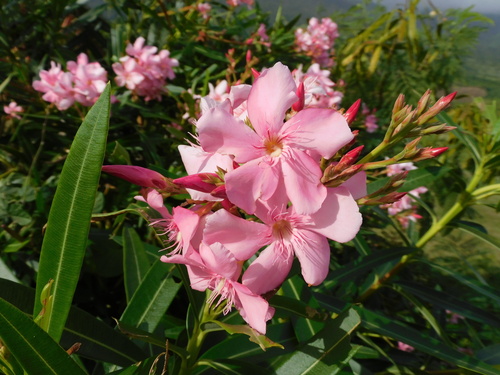
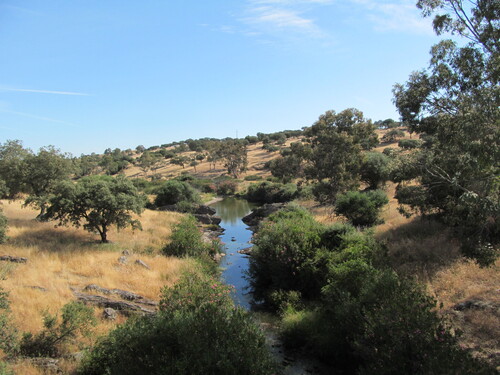
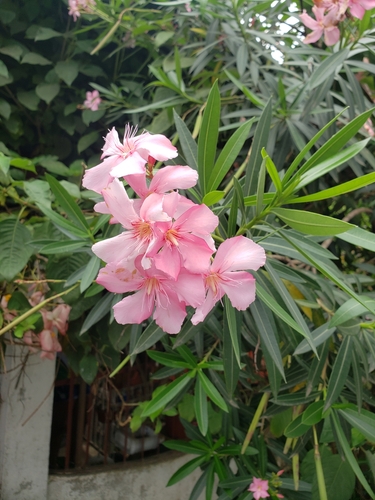
Oleander (Nerium oleander L.) is an evergreen shrub or small tree in the dogbane family, Apocynaceae, native from the Mediterranean Basin to Myanmar according to POWO/WCVP. Widely planted for its flowers and drought tolerance, it should above all be recognized as a hazardous plant, since every part of every variety contains toxic cardiac glycosides.
Read moreRose bay, Rose-laurel and Nerium
Allow a few hours of direct sun per day, preferably morning or evening.
Global distribution
POWO/WCVP gives a native range stretching from the Mediterranean Basin to Myanmar, with mainland France and Corsica inside it. The species has been introduced to many warm regions; no invasive status is recorded for metropolitan France.
- Native9
- Introduced4
- Mediterranean France
- Corsica
- Spain
- Italy
- Greece
- Turkey
- Iran
- India
- Myanmar
- California
- Hawaii
- Japan
- New South Wales
Hexagons: sourced regions. Green dots: native range. Statuses according to POWO (Kew).
Identity
Oleander (Nerium oleander L., 1753) is an accepted species in the genus Nerium, family Apocynaceae. POWO/WCVP gives it a broad native range running from the Mediterranean Basin to Myanmar, and the Trefle data consulted carry the same accepted taxon with Linnaean authority. 1 2 3
In English the plant also goes by rose bay and rose-laurel, and the French datasets consulted attach laurier-rose, nérion and oléandre to the same species. Names built on "laurel" or "bay" are misleading: this is not bay laurel, and the shared word must never lead anyone to use it in the kitchen. 4 5
Oleander is treated here as an ornamental with serious safety stakes, not as a culinary or medicinal plant. The references cite historical and traditional uses, but none of them is turned into a recommendation. 6 7
Recognition
Grown as a rounded clump, a hedge or a large tub specimen, Nerium oleander is an evergreen shrub or small tree. Kew describes a shrub reaching about 6 m (20 ft); for landscape plants, NC State gives a height of roughly 1.5–6 m (5–20 ft) and a spread of about 1.8–3 m (6–10 ft). 6 8
Leaves are simple, leathery, narrow and untoothed, opposite or in whorls of 3 or 4, with a prominent midrib. This linear-lanceolate evergreen foliage is one of the best clues when the plant is out of flower. 8 6
Flowers come in terminal cymes. Each is tubular with five lobes, usually pink in wild forms, while cultivars can be white, cream, yellow, salmon, red or double. The fruit is a pair of elongated follicles that split to release seeds tufted with hairs. 8 6
Taxonomy and related names
Anchor identification on the binomial Nerium oleander L. WCVP lists many synonyms, including Nerium indicum, Nerium odorum, Oleander vulgaris and several historical horticultural varieties. They account for the jumble of labels, but they do not displace the accepted name in French and international taxonomic references. 1 2 3 9
Laurel names call for particular care. The SFMU points out that several plants share the French word "laurier" in their common names, among them oleander, cherry laurel, bay laurel and laurustinus. Only bay laurel is the familiar kitchen herb; oleander is a cardiotoxic member of the Apocynaceae. 5
Trade names for white, pink, double, dwarf or yellow plants should not be read as separate species, or as safer forms. ANSES states explicitly that all varieties are toxic. 7 8
Habitat and range
Kew's POWO/WCVP data trace the native range of Nerium oleander from the Mediterranean Basin to Myanmar, with mainland France and Corsica included. EPPO summarizes the species as native to the Mediterranean region, western Asia, the Himalaya, India, Myanmar and the Sahel of Niger. 1 4
Kew describes its ecology as seasonally dry rocky watercourses in full sun. That apparent paradox sums the plant up well: it copes with drought in gardens, yet its natural stands can follow ravines and temporary streambeds. 6
Beyond its native range, the species is widely introduced and grown in warm, dry or coastal regions. Trefle and POWO list many areas of introduction, but the sources used here do not support publishing an invasive status for metropolitan France. 1 3 10
Ornamental growing
Gardeners plant oleander for its bloom, its evergreen screening and its tolerance of sun, drought, salt spray and some poor soils. Kew and NC State describe it as a plant for full sun to light partial shade, suited to mild climates, hedges, large containers and coastal gardens. 6 8
Where winters bring hard frost, growing it in a container and moving it to shelter for winter is safer than planting it in the ground. In mild climates, the main things to avoid are standing water, hard pruning just before cold weather and spots where pets or children could chew leaves, flowers or twigs. 8 6
Stem cuttings and seed both work, but propagation does not change the risk profile. A cutting, a spent flower, a dry leaf or a pruned twig is still plant material to handle as toxic. 8 7
Toxicity
Toxicity is the central issue with this plant. ANSES states that oleander is toxic if swallowed, that it can be fatal, that every variety is toxic and that all parts of the plant are involved. MedlinePlus lists the flowers, leaves, stems and twigs among the parts containing poisonous substances. 7 11
The compounds responsible are cardiac glycosides. ANSES and MedlinePlus name oleandrin, neriin or closely related compounds; the ASPCA sums up the toxic principle as cardiac glycosides. Reported signs include digestive upset, drowsiness or agitation, vision disturbances, a slowed heart rate, arrhythmias, low blood pressure, cardiac arrest and death. 12 7 11
For animals, the ASPCA lists Nerium oleander as toxic to dogs, cats and horses, and the ASPCA list consulted names the same three groups. NC State also flags the problem for cats, dogs, horses and people. These data justify high toxicity flags for every one of those groups. 12 13 8
Never burn oleander or use its stems as skewers, food stakes or cooking wood. Kew and NC State warn of risk from smoke or inhalation when it burns, and French sources also report dangerous mix-ups with leaves used in cooking or herbal teas. 6 8 5
If ingestion happens or is suspected, do not try to manage the exposure from written information: contact a doctor, a poison control center or a veterinarian right away, as appropriate. 7 11
Cultivars and look-alikes
Among the cultivars NC State names are 'Calypso', 'Hardy Pink' and 'Petite Pink'. The Perenual data consulted also include a horticultural entry for 'Luteum Plenum'. These names help identify garden plants, but without a complete label they should not be treated as firm botanical guarantees. 8 10
Historical synonyms such as Nerium indicum, Nerium odorum or Oleander vulgaris turn up in older texts, catalogs and aggregated databases. In an encyclopedia they mainly help decode labels and former subdivisions; they do not create separate species in the garden. 1 3
Name confusion matters more than confusion over shape. Bay laurel is eaten; oleander is not. Olive and oleander can also be linked through the word "oleander," yet Nerium oleander is not Olea europaea. 5 4
Main sources
- Plants of the World Online / Kew, Nerium oleander L.
- Kew Species Profiles, Nerium oleander general information
- EPPO Global Database, Nerium oleander
- NC State Extension Gardener Plant Toolbox, Nerium oleander
- ASPCA, Oleander toxicity entry
- ANSES, information sheets on plants hazardous to human health, oleander (laurier rose)
- MedlinePlus Medical Encyclopedia, Oleander poisoning
- SFMU, oleander (laurier-rose) toxicology
- Tela Botanica eFlore, Nerium oleander
Frequently asked questions
Is oleander edible?
No. No part of the plant is treated as edible here. ANSES states that all parts and all varieties are toxic, with a risk of death if swallowed.
Is oleander toxic to cats, dogs and horses?
Yes. The ASPCA lists Nerium oleander as toxic to dogs, cats and horses; veterinary and medical sources describe a cardiac mechanism.
Can oleander prunings be burned?
No. NC State and Kew warn of a risk from smoke or inhalation when the wood burns. Pruning waste should be disposed of without cooking over it or burning it at home.
Is oleander the same plant as bay laurel?
No. Bay laurel belongs to the genus Laurus and is used as a seasoning; oleander belongs to the Apocynaceae and must never be eaten.
Is oleander invasive in France?
No invasive alien status is recorded for metropolitan France: POWO/WCVP includes France and Corsica in the native range, and no reliable French invasive status has been found.
Are dwarf or white-flowered varieties less toxic?
No. French toxicology sources state that all varieties are toxic. Flower color, plant size or double flowers do not change the warning.
Similar plants
Botanical data compiled from reference sources (RHS, Kew Gardens, POWO). This profile is for guidance only and is not a substitute for advice from a botanist or veterinarian if you have concerns about toxicity.