
Flaming katy (Kalanchoe blossfeldiana, )
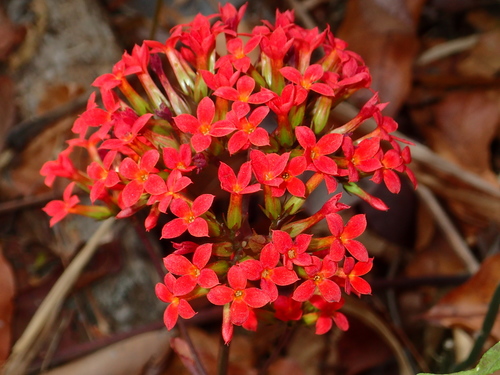
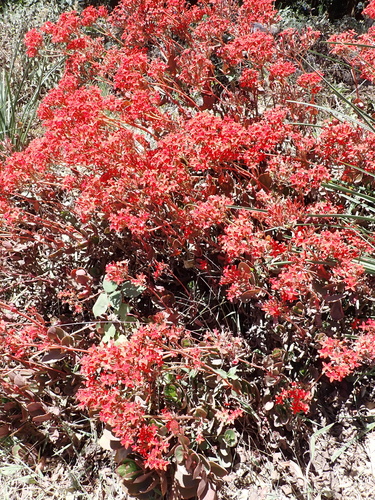
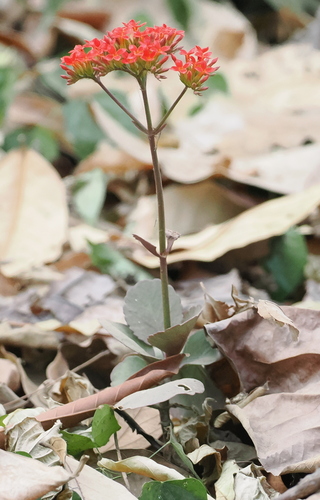
Flaming katy (Kalanchoe blossfeldiana Poelln., 1934) is a small perennial succulent in the stonecrop family, Crassulaceae, native to northeastern Madagascar. A staple of the flowering pot plant trade, it pairs thick, opposite, scalloped leaves with clusters of red, orange, yellow, pink or white flowers, often triggered by long nights.
Read moreFlorist kalanchoe, Christmas kalanchoe, Madagascar widow's-thrill, Kalanchoe and Calandiva
Allow a few hours of direct sun per day, preferably morning or evening.
Global distribution
POWO/WCVP and Trefle give northeastern Madagascar as the native range. POWO also lists introductions, including Florida, southwestern Mexico, Nicaragua, Puerto Rico, Sardinia, Senegal, Turkey and Vietnam. These records are not enough to class the species as invasive in mainland France.
- Native1
- Introduced8
- Northeastern Madagascar
- Florida
- Southwestern Mexico
- Nicaragua
- Puerto Rico
- Sardinia
- Senegal
- Turkey
- Vietnam
Hexagons: sourced regions. Green dots: native range. Statuses according to POWO (Kew).
Identity
Accepted under the name Kalanchoe blossfeldiana Poelln., this species belongs to the genus Kalanchoe in the stonecrop family, Crassulaceae. POWO/WCVP ties the name to a 1934 publication in Repertorium Specierum Novarum Regni Vegetabilis and gives northeastern Madagascar as its native range. 1 2
The names flaming katy, florist kalanchoe and Christmas kalanchoe mostly describe the flowering pot plant. The epithet blossfeldiana honors Robert Blossfeld, the German nurseryman linked to the plant's introduction into horticulture, while the botanical authority is Poellnitz. 3 4
Treat the name Calandiva with some care: it covers double-flowered horticultural forms, not a separate species. A Calandiva can look quite different in flower and still belong to the same horticultural group as K. blossfeldiana. 5 3
Recognition
Expect a small, compact succulent clump, upright and branching. Horticultural sources usually give a potted height of 15–45 cm (6–18 in), with a dense or slightly rounded habit. The stems are thick and green and can stiffen with age. 3 5
Leaves are opposite, simple, fleshy and glossy, oval to oblong, with a scalloped or shallowly toothed margin. That scalloped edge is a good clue for the common pot plant, but it will not identify every member of Kalanchoe, a highly variable genus. 3
Small tubular to bell-shaped flowers, often four-lobed in single forms, are held in terminal clusters above the foliage. Red, orange, yellow, pink and white are the usual commercial colors; the double forms look like miniature roses. 3 5
Useful taxonomy
The binomial Kalanchoe blossfeldiana Poelln. is the fixed point. The following names show up in its synonymy or as older designations, and can still appear in databases and catalogs: 1 6
- Kalanchoe coccinea (H.Perrier) Boiteau
- Kalanchoe coccinea var. blossfeldiana (Poelln.) Boiteau
- Kalanchoe globulifera var. coccinea H.Perrier
This synonymy accounts for part of the confusion with older retail names. For safety purposes the genus name still matters: the ASPCA and Merck issue warnings mainly at the level of Kalanchoe spp., while taxonomic databases pin down the exact species. 7 8
Habitat and range
In the wild, according to POWO/WCVP, Kalanchoe blossfeldiana is a succulent subshrub of the seasonally dry tropical biome, native to northeastern Madagascar. The Trefle data consulted also give Madagascar as the native range and note several tropical introductions. 1 6
A recent nomenclatural treatment fills in the background of the type material: Madagascar, the Tsaratanana massif, with a mention of lichen forest and high elevations, but also a history of plants cultivated by Perrier de la Bâthie before the herbarium specimen was prepared. That detail keeps "native to Madagascar" accurate without turning it into an oversimplified ecological map. 4
Beyond Madagascar, databases list Florida, southwestern Mexico, Nicaragua, Puerto Rico, Sardinia, Senegal, Turkey and Vietnam among its areas of introduction. No invasive status is recorded for mainland France; where winters bring frost, flaming katy is grown as a houseplant, in a sunroom or on a sheltered, frost-free balcony. 1 9
Life cycle, flowering and cultivation
Indoors, its visible cycle is that of a perennial potted succulent. The plant can be kept after flowering if it gets a very free-draining mix, strong light that does not scorch, and infrequent watering. Overwatering kills more of these plants than the odd forgotten drink. 3 5
Flowering depends heavily on day length. To bring on new buds, NC State recommends about 14 hours of complete darkness a day for at least 6 weeks in fall and winter. A classic plant physiology paper also describes Kalanchoe blossfeldiana as a typical short-day plant. 3 10
Growers propagate it mainly from stem or leaf cuttings; the RHS also mentions sowing seed or dividing offsets in spring. To keep a double or variegated form true, cuttings are more reliable than seed. 3 5
Toxicity and uses
Flaming katy is an ornamental, not a food plant. POWO notes medicinal and environmental uses, but the extract used gives no detail on plant part, preparation, dose or safety, so those mentions do not amount to usage advice. 1
Its toxicity comes from bufadienolides, glycosides that act on the heart. The ASPCA lists Kalanchoe spp. as toxic to dogs and cats, with vomiting, diarrhea and, rarely, abnormal heart rhythm. NC State extends the warning for K. blossfeldiana to people, children and pets. 7 3
Merck groups Kalanchoe spp. with the houseplants and ornamentals toxic to animals and links them to cardiac glycosides. For horses, historical data call for caution, whereas the ASPCA Kalanchoe entry explicitly names dogs and cats. The advice therefore stays cautious rather than claiming veterinary completeness. 8 7
Cultivars and look-alikes
Commercial forms differ mainly in flower color and shape. NC State lists 'Flaming Katy', 'Kerinci', 'Lanin', 'Queen Jodie', 'Queen Lindsay', 'Simone' and Kalanchoe blossfeldiana f. variegata, among others. The RHS records many cultivars and notes that the image on its page shows the Calandiva series. 3 5
Double forms, often sold as Calandiva, should not be mistaken for another species. They change the number and look of the petals, not the core needs: bright light, a pot with drainage holes, a free-draining mix, careful watering and long nights to trigger blooms again. 5 3
Mix-ups usually involve other kalanchoes: Kalanchoe tomentosa, fuzzy and grayish; K. daigremontiana and K. delagoensis, which can carry plantlets on their leaves; or unlabeled hybrids. When in doubt, opposite scalloped leaves, terminal flower clusters and the full scientific name are more reliable than the word "kalanchoe" alone. 3
Main sources
- Plants of the World Online / Kew, Kalanchoe blossfeldiana Poelln.
- Royal Horticultural Society, Kalanchoe blossfeldiana
- North Carolina Extension Gardener Plant Toolbox, Kalanchoe blossfeldiana
- ASPCA Animal Poison Control, Kalanchoe toxicity entry
- Merck Veterinary Manual, houseplants and ornamentals toxic to animals
- Fredericq, 1963, Flower Formation in Kalanchoe blossfeldiana by Very Short Photoperiods
- Gallo & Smith, 2024, Kalanchoe blossfeldiana Von Poellnitz 1934
Frequently asked questions
Is flaming katy toxic to cats?
Yes. The ASPCA lists Kalanchoe spp. as toxic to cats and dogs, citing bufadienolides and possible digestive or cardiac signs.
Why won't my kalanchoe bloom again?
The usual cause is a lack of long nights. NC State recommends about 14 hours of darkness a day for at least 6 weeks in fall and winter.
Is Calandiva a different species?
No. Calandiva refers to double-flowered horticultural forms that belong to the Kalanchoe blossfeldiana complex.
Can you eat kalanchoe?
No. Safety sources describe risks if it is swallowed, and no reliable food use is recorded.
Is it invasive?
No reference consulted classes it as invasive in mainland France. The introductions POWO reports are mostly in warm or island regions; local status elsewhere should be checked with regional authorities.
How does it differ from mother of thousands?
Mother of thousands, usually Kalanchoe daigremontiana or K. delagoensis, carries plantlets along its leaves. K. blossfeldiana mainly has oval, scalloped leaves and clusters of pot-plant flowers.
Similar plants
Botanical data compiled from reference sources (RHS, Kew Gardens, POWO). This profile is for guidance only and is not a substitute for advice from a botanist or veterinarian if you have concerns about toxicity.