
Jade plant (Crassula ovata, )
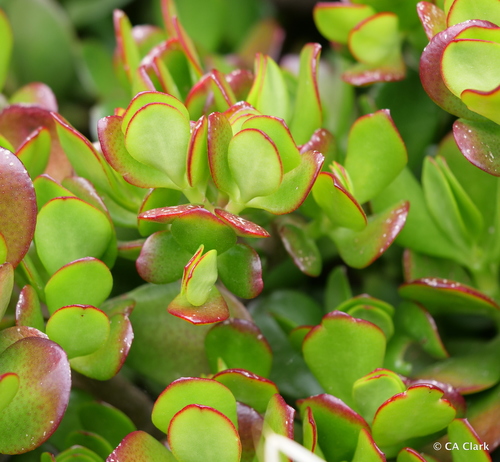
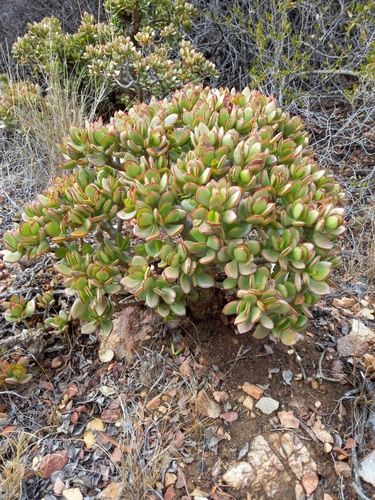
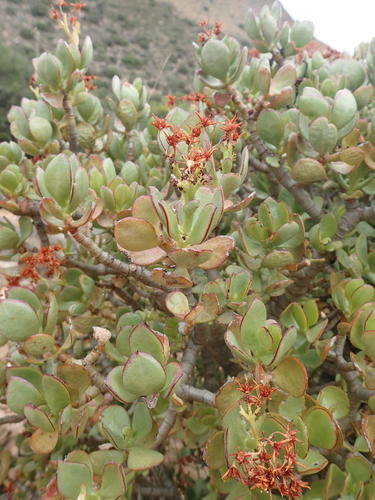
The jade plant (Crassula ovata) is a succulent shrub in the stonecrop family, Crassulaceae, native to southern Africa. Its thick, glossy, opposite leaves store water, and its green stems turn woody with age, giving a mature plant the outline of a small tree.
Read moreJade tree and Money plant
Place in full sun, with intense direct light all day long.
Global distribution
The native range accepted by the POWO/WCVP and Trefle datasets covers southern Africa, from southeastern Mozambique to the South African provinces of KwaZulu-Natal and the Cape. The plant is widely grown elsewhere, so records outside that range should be read as cultivated, escaped or introduced depending on the place.
- Native2
- Introduced4
- South Africa
- Mozambique
- California
- Canary Islands
- Madeira
- Saint Helena
Hexagons: sourced regions. Green dots: native range. Statuses according to POWO (Kew).
Identity
The jade plant is Crassula ovata (Mill.) Druce, an accepted species in the Crassulaceae. Its name joins two steps: Philip Miller first described it as Cotyledon ovata, and George Claridge Druce later moved it into Crassula. 1 2
Crassula alludes to the thick tissues typical of the genus, while the epithet ovata describes the oval leaves. Names such as jade plant, jade tree and money plant speak mostly to looks and decorative use, and they should not lead anyone to confuse it with Pachira aquatica, another "money tree" of the houseplant trade. 3 4
Recognition
An evergreen succulent shrub, Crassula ovata starts with green, fleshy stems. Older stems turn brown, thick and sometimes slightly flaky, which is why old specimens look like miniature trees. Given good conditions, horticultural sources quote a wide size range, from under 1 m (3 ft) in a compact pot to about 2 m (6.5 ft) or a little more on a mature plant. 5 3
The leaves are simple, set in opposite pairs, oval to obovate, smooth-edged, glossy and very fleshy. They often measure 2.5–9 cm (1–3.5 in) long and cluster toward the branch tips. A red margin is not, on its own, a cultivar trait: it shows up mainly under strong light, provided the plant was moved into it gradually and without scorching. 3 4
Flowers are a poor identification clue on an indoor plant. When they do appear, they form terminal clusters of small, starry, white to pinkish blooms, often after long nights, abundant light and a cooler or drier spell. Pollinated flowers set small seed capsules, inconspicuous and of no recognized food value. 3 4
Useful taxonomy
The accepted name Crassula ovata is the stable reference point. Older names still matter, because they turn up on toxicity pages, in catalogs and on old labels. The main synonyms recorded by the taxonomic databases consulted are: 1 2
- Cotyledon ovata Mill.
- Crassula argentea Thunb.
- Crassula portulacea Lam.
- Crassula obliqua Aiton
- Crassula articulata Zuccagni
- Crassula nitida Schönland
- Toelkenia ovata (Mill.) P.V.Heath
That synonymy has a safety angle. The ASPCA lists the jade plant under Crassula argentea, a name the databases consulted treat as a synonym of Crassula ovata. Read the old name as a trace of nomenclature, not as a separate plant. 1 6
Habitat and range
POWO/WCVP and Trefle place the native range in southern Africa: southeastern Mozambique, KwaZulu-Natal and the Eastern Cape. There the species belongs to valley thicket, dry rocky slopes and well-drained subtropical ground, not to humid rainforest. 1 4
Elsewhere, the jade plant is mainly an ornamental for pots, sunrooms, frost-free cool greenhouses or dry gardens in mild climates. Datasets record introduced populations in a few regions, including California, the Canary Islands, Madeira, Spain and Saint Helena; these records alone do not establish a general invasive status, nor an established invasive risk in mainland France. 1 2
The plant's build reflects that setting. Leaves, stems and sometimes roots store water, and the branching habit helps it ride out dry periods. In a pot, the same adaptation makes too much water more dangerous than an occasional missed watering. 7 4
Life cycle, flowering and propagation
Growth is slow and cumulative. A leaf or stem cutting can root, but the shrubby look takes several years to build as the stems turn woody and the branching thickens. An older plant often looks older than it is, since brown bark and leaf scars quickly suggest a small trunk. 4 7
Maturity and light rhythm matter more for flowering than the calendar does. Sources disagree on the season because the plant responds to how it is grown: long nights, relative coolness, strong light and reduced watering can all come before the flower clusters. In a heated room lit in the evening, a plant that never blooms is perfectly normal. 3 4
Vegetative propagation explains how far it has spread. A broken stem, or even a whole leaf left to callus over, can root in a very free-draining mix. Rooting easily is not the same as growing fast: a compact, well-branched plant that flowers is the product of years in cultivation. 5 4
Uses and risks
Ornament is its main use. In mild, frost-free climates, Crassula ovata can make a small shrub for a rock garden, a dry border or a large container; where winters bring frost, it is mostly kept as a houseplant in very bright light, a sunroom plant or an informal succulent bonsai. 5 7
Its toxicity deserves precise wording. The ASPCA lists the jade plant as toxic to dogs, cats and horses, with an unknown toxic principle and signs such as vomiting, lethargy and incoordination. Pet Poison Helpline generally describes mild toxicity in animals but advises veterinary care if signs persist. 6 8
For people, the references consulted do not support any food or medicinal advice. Ethnobotanical uses are sometimes reported elsewhere, but they are not offered here as a recommendation: identifying the tissue, the dose, the preparation and the medical context lie beyond a horticultural summary. 4
Cultivars, look-alikes and buying
Cultivars mostly change leaf shape or color. Gollum and Hobbit have tubular or spoon-shaped leaves; Hummel's Sunset colors its margins more strongly in yellow, orange and red under bright light; Tricolor and Variegata refer to variegation. None of these names is a separate species. 3 7
Three groups account for most mix-ups: Crassula arborescens, with rounder, blue-gray leaves; Portulacaria afra, often called dwarf jade but placed in another family; and Pachira aquatica, sold as money tree with no close botanical tie. The scientific name on the label is more reliable than any good-luck name. 4 3
When buying, the signs that really count are compact growth, a firm base, healthy roots and a pot that drains. A very green plant with long, floppy stems is not necessarily sick; more often it has lacked light and will need a gradual move into brighter conditions. 3 7
Main sources
- Plants of the World Online / Kew, Crassula ovata (Mill.) Druce
- GBIF Backbone Taxonomy, Crassula ovata
- North Carolina Extension Gardener Plant Toolbox, Crassula ovata
- Royal Horticultural Society, Crassula ovata
- Clemson Cooperative Extension HGIC, Jade Plant
- University of Wisconsin Extension, Jade Plant, Crassula ovata
- ASPCA Animal Poison Control, Jade Plant
- Pet Poison Helpline, Jade Plant
Frequently asked questions
Is Crassula ovata toxic to cats and dogs?
Yes. The ASPCA lists the jade plant as toxic to cats, dogs and horses, under the older name Crassula argentea. Reported signs include vomiting, lethargy and incoordination.
Why won't my jade plant flower?
Indoors, flowering is rare. It takes a mature plant, plenty of light and often longer, cooler nights; a young cutting kept in a living room can go years without blooming.
Is the jade plant a tree?
No. It is a succulent shrub. The stems turn brown and woody with age, which gives it the look of a natural bonsai, but the plant remains a succulent member of the Crassulaceae.
Can you eat Crassula ovata?
No edible use is recommended here. The references consulted give no sound basis for safe eating advice, and its toxicity to animals calls for caution.
What is the difference between Crassula ovata and Crassula arborescens?
Crassula arborescens usually has rounder, waxy, blue-gray leaves. Crassula ovata bears more oval, glossy green leaves, often edged in red under strong light.
Are Gollum and Hobbit different species?
No. They are horticultural cultivars of Crassula ovata, recognizable by their tubular or spoon-shaped leaves. The species name remains Crassula ovata.
Similar plants
Botanical data compiled from reference sources (RHS, Kew Gardens, POWO). This profile is for guidance only and is not a substitute for advice from a botanist or veterinarian if you have concerns about toxicity.