
Chinese money plant (Pilea peperomioides, )
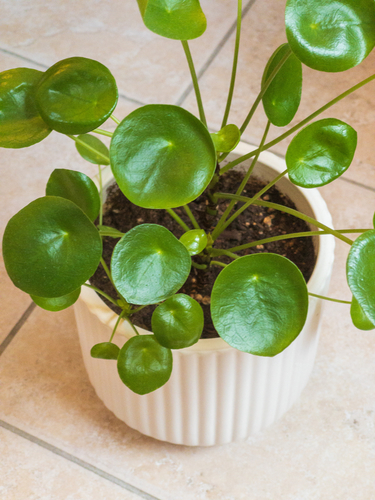
The Chinese money plant (Pilea peperomioides Diels), often simply called pilea, is a perennial or subshrub in the nettle family, Urticaceae, native to southwestern Sichuan and western Yunnan. It is easy to spot by its almost circular, peltate leaves held on long stalks, and by the offsets it produces so readily that owners pass them around.
Read morePilea, Missionary plant, Pancake plant, UFO plant and Coin plant
Give plenty of ambient light without direct sun on the leaves.
Global distribution
POWO and the WCVP data consulted give a native range in China, limited to southwestern Sichuan and western Yunnan. Trefle summarizes this range as China South-Central and records an introduction in Belgium; no invasive status is recorded in these sources.
- Native2
- Introduced1
- Southwestern Sichuan
- Western Yunnan
- Belgium
Hexagons: sourced regions. Green dots: native range. Statuses according to POWO (Kew).
Identity
Pilea peperomioides Diels is an accepted species in the genus Pilea, part of the nettle family, Urticaceae. It was published in 1912 in the Notes from the Royal Botanic Garden Edinburgh, and POWO treats it as a perennial or subshrub of the temperate biome. 1
The family name can come as a surprise. Urticaceae includes stinging nettle, yet Pilea lacks the stinging hairs that made Urtica dioica notorious. Here, "pilea" means a foliage plant, not a plant that bites back. 2 3
Nearly every common name comes from the leaf shape. "Chinese money plant," "coin plant," "pancake plant" and "UFO plant" all start from the same trait: an almost round blade on a long stalk, like a small coin or a disk. 4 5
Recognition
Look first for the peltate leaf. In Pilea peperomioides, the stalk does not meet the edge of the blade as it does on an ordinary leaf; it attaches underneath, close to the center. That arrangement produces a round, slightly suspended leaf, with a network of veins visible around the point of attachment. 4 6
The plant stays compact. NC State gives about 20–30 cm (8–12 in) in height and width in cultivation, while the RHS places the species in a 0.1–0.5 m (4–20 in) band. Mature leaves are glossy, dark green, fleshy and orbicular, and usually close to 10 cm (4 in) across on a houseplant. 4 5
The stem is upright, often single or sparsely branched, and it can go bare at the base as the plant ages or runs short of light. Basal offsets form small plants around the main stem; they explain why pilea became such a popular plant to share. 2 4
A recent study of reticulate venation used Pilea peperomioides as a model, because its round leaves show hydathodes and veins arranged in closed loops. You do not need this detail to identify a plant at the garden center, but it explains why the pilea leaf blade also interests plant morphologists. 7
Useful taxonomy
Compared with many houseplants, the published taxonomy here is comparatively simple: the references used record no tangled horticultural synonymy for Pilea peperomioides. The accepted name, genus, family and author agree across POWO/WCVP and Trefle. 1
The word "pilea" covers far more than this one species. The genus holds several hundred species, including very different houseplants such as Pilea cadierei, Pilea involucrata, Pilea nummulariifolia and Pilea depressa. A tag reading "Pilea" alone is therefore not enough to identify the Chinese money plant. 2 3
The mix-up most worth knowing involves Peperomia polybotrya, often sold as raindrop peperomia. Its leaves are also round to heart-shaped and carried on long stalks, but the plant belongs to the Piperaceae, not the Urticaceae. The full scientific name remains the safest reference. 4
Habitat and range
In the wild, the species occupies a narrow native range according to POWO: southwestern Sichuan and western Yunnan, in China. The Trefle data consulted summarize this distribution as "China South-Central" and list only Belgium as an area of introduction, with no invasive status recorded. 1
Morphological studies describe the species on damp, shaded rocks in forest, on humus-covered boulders or rocky ledges, at around 1,500–3,000 m (4,900–9,800 ft) elevation. That ecology explains its needs in a pot better than a vague "tropical" label: the plant likes bright light without scorch, good drainage and steady moisture, not waterlogging. 6 5
Its popularity as a houseplant should not be mistaken for a wide natural range. Pilea now travels through Europe and beyond via the plant trade and swapped cuttings, but that horticultural spread is distinct from its botanical range in China. 2 1
Life cycle, flowering and propagation
Indoors, what you see is mostly vegetative growth. The plant adds leaf after leaf on a fleshy stem, then produces basal or lateral offsets that can be separated once they have enough tissue and roots. Penn State and NC State both name offsets and stem cuttings as the practical ways to propagate it. 2 4
Flowers do appear, but they are not the point of the plant. NC State describes small white to pinkish flowers on spikes, rarely produced indoors; Penn State notes that on houseplant pileas the flowers are small and infrequent. To recognize the species, the peltate foliage is a far better guide than waiting for bloom. 4 2
Young offsets start out low, then the plant fills out into a small clump. On an older specimen, a bare stem at the base is not necessarily a sign of disease: it can reflect age, the direction of the light or a spot that is too dim. 4 5
Uses and risks
Its use is ornamental: a tabletop pot, an office plant, a bright shelf or a small grouping of houseplants. The references used do not support any food or medicinal use, and the Trefle data list the species as not edible. 5
On toxicity, some caution still applies. NC State lists Pilea peperomioides as safe for pets and children, and the data already available rated cats and dogs as safe. However, the ASPCA file consulted has no exact entry for Pilea peperomioides; that does not make the plant a food, and its status for horses remains unknown. 4
The practical risks are mostly horticultural: rot if the pot sits in water, leaf spots if foliage stays wet in stagnant air, and soft or leggy growth when light is lacking. None of this changes the identity of the species, but it can transform its silhouette. 4 5
Trade names, cultivars and look-alikes
The sources used do not support a stable list of cultivars. The names that turn up most often, "Chinese money plant," "missionary plant," "pancake plant" and "UFO plant," are therefore treated as trade names or descriptive nicknames, not botanical varieties. 4 5
Before buying or swapping, a few simple checks do the job: round peltate leaves, a fleshy stem, offsets or cuttings with stem tissue, and the full name Pilea peperomioides. A single leaf may stay decorative for a while, but reliable propagation needs an offset or a piece of stem able to produce roots and a new shoot. 2 4
Common look-alikes include:
- Peperomia polybotrya, with round leaves but a different family, Piperaceae
- Pilea cadierei, with elongated leaves marked in silver
- Pilea involucrata, with puckered, often bronze leaves
- Hydrocotyle and other plants with peltate leaves, rarely sold as indoor pileas
The pilea described here comes down to a precise combination: a non-stinging member of the nettle family, a small range in China, round peltate leaves, modest size, easy offsets and a role as a foliage plant. 1 3
Main sources
- Plants of the World Online / Kew, Pilea peperomioides
- NC State Extension Gardener Plant Toolbox, Pilea peperomioides
- Royal Horticultural Society, Pilea genus guide
- Penn State Extension, Pilea as a Houseplant
- Journal of Experimental Botany, biomechanical study of peltate leaves of Pilea peperomioides
- Nature Communications, reticulate leaf venation in Pilea peperomioides
- Encyclopaedia Britannica, Pilea
Frequently asked questions
Is the Chinese money plant a peperomia?
No. Pilea peperomioides belongs to the Urticaceae, while peperomias belong to the Piperaceae. The mix-up comes from the round leaves of some species such as Peperomia polybotrya.
Why is it called the Chinese money plant?
The name comes from its round, green, peltate leaves, which are likened to coins. It does not point to any particular ritual or financial use.
Is the Chinese money plant toxic to cats?
Cats and dogs remain listed as safe, backed by NC State and existing data. Because the ASPCA has no dedicated entry for it, caution still makes sense if a pet eats a large amount.
Why is my pilea making babies?
Basal offsets are a normal part of how this species grows in cultivation. They can be separated once they have enough tissue and roots to establish on their own.
Does it flower indoors?
It does flower, with small white to pinkish flowers on spikes, but horticultural sources note that blooms stay rare on houseplants.
Is the Chinese money plant invasive?
None of the references consulted supports an invasive status. It is treated as a cultivated houseplant.
Similar plants
Botanical data compiled from reference sources (RHS, Kew Gardens, POWO). This profile is for guidance only and is not a substitute for advice from a botanist or veterinarian if you have concerns about toxicity.