
Snake plant (Dracaena trifasciata, )


Snake plant (Dracaena trifasciata), long known as Sansevieria trifasciata, is a rhizomatous perennial in the Asparagaceae family. Native to tropical Africa, it is recognizable by its upright, leathery leaves patterned with crosswise bands.
Read moreSnake plant, Sansevieria, Mother-in-law’s tongue and Viper’s bowstring hemp
Place in indirect light or in a shaded room.
Bright indirect light to gentle sun after acclimation


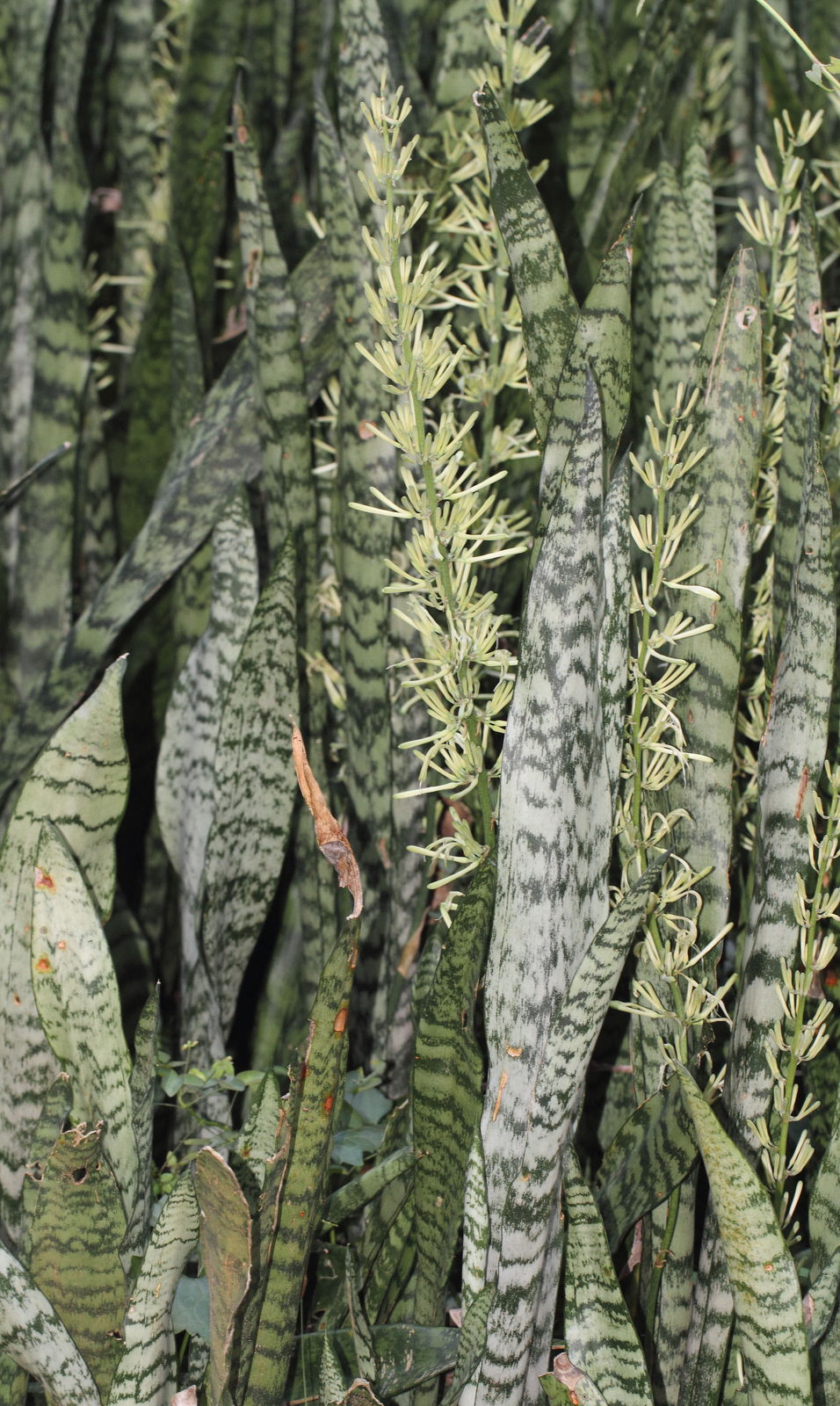


© photo
Wikimedia Commons · CC BY-SA or Public Domain
Wikipedia · CC BY-SA
© copyright of the Board of Trustees of the Royal Botanic Gardens, Kew.
Global distribution
WCVP places the native range of Dracaena trifasciata from southern Nigeria to west-central tropical Africa, with a Tanzanian extension for the species in its broad sense. Trefle records many tropical introductions; these do not establish invasive status in France.
- Native8
- Introduced4
- Nigeria
- Cameroon
- Gabon
- Equatorial Guinea
- Central African Republic
- Republic of the Congo
- Democratic Republic of the Congo
- Tanzania
- Florida
- Queensland
- Réunion
- Seychelles
Hexagons: regions where the plant occurs. Green dots: native range.1
Identity
Snake plant (Dracaena trifasciata (Prain) Mabb.) is the plant formerly called Sansevieria trifasciata Prain; WCVP/POWO accepts the name Dracaena trifasciata. The trade name sansevieria remains useful for recognizing it in garden centers, although Sansevieria is no longer its accepted genus in this classification. 1 2
Within Asparagaceae, this Dracaena is a rhizomatous perennial of seasonally dry tropical climates. The epithet trifasciata refers to its banded foliage. Mother-in-law's tongue and snake plant evoke the same visual features: long, stiff, pointed leaves with mottled markings. 8
Recognition
Evergreen leaves arise from a basal rosette and creeping rhizome to form a dense clump. Upright, sword-shaped and leathery, they are dark green with gray-green or whitish crosswise bands. Mature leaves are often 70 to 90 cm (28 to 35 in) long, with broader botanical ranges of 30 to 120 cm (12 to 47 in) long and 2.5 to 7 cm (1 to 2.8 in) wide. 1 7
A creeping rhizome explains two visible features: shoots build up into tight clumps, and the plant tolerates drought better than thin-leaved tropical plants. That tolerance does not remove all risk. In pots, the weak point is a rhizome kept in cold, wet growing medium, where fleshy tissues rot faster than they dry.
Indoor flowering is possible but unpredictable. A sometimes-branched raceme rises 50 to 80 cm (20 to 31 in) and carries greenish-white flowers. Small orange berries complete the cycle in favorable climates, but fruit is rarely a useful identification feature on a houseplant. 6
Useful taxonomy
The transfer from Sansevieria trifasciata to Dracaena trifasciata is the central name change. WCVP/POWO and Trefle give Dracaena trifasciata as the accepted name, with Sansevieria trifasciata as its basionym or homotypic synonym. In this context, a label reading Sansevieria trifasciata refers to the same species under its former scientific name. 1 3
Other names require more care. Sansevieria zeylanica, Dracaena zeylanica, Dracaena angolensis and the former cylindrical or masoniana sansevierias may be sold alongside D. trifasciata, but should not be merged with it without taxonomic support. Older lists and trade labels often mix synonyms, cultivars and related species.
Laurentii illustrates this difficulty. In trade, it mainly denotes a plant with yellow leaf margins. Older taxonomic lists may use names such as Sansevieria laurentii or varieties called laurentii differently. Treat Laurentii as a horticultural label for variegation rather than an independent botanical rank.
Habitat and range
Southern Nigeria and west-central tropical Africa form the native range recorded by WCVP, with Tanzania included for Dracaena trifasciata in its broad sense. Trefle lists Nigeria, Cameroon, Gabon, Equatorial Guinea, the Central African Republic, Congo, the Democratic Republic of the Congo and Tanzania. These details are more precise than “tropical Africa,” but still need to be understood in relation to the subspecies. 1 3
Seasonal dryness shapes this plant's habitat, rather than continuously wet rainforest. WCVP associates it with a seasonally dry tropical climate; descriptions also mention open woodland, wooded savannas and poor, sandy or rocky soils. This ecology helps explain its rosettes, thick leaves and slow rhizomatous growth.
Beyond Africa, snake plant is widely cultivated and introduced in many tropical regions. Trefle records introductions in Florida, Queensland, Réunion, the Seychelles and several islands. Some secondary sources mention a local weed risk in Australia. The available evidence does not support a blanket claim that the species is invasive, or an invasive status for France.
Life cycle, uses and risks
Rhizomatous growth drives the life cycle. Side shoots produce new rosettes that thicken the clump, making rhizome division the most faithful way to propagate a variegated cultivar. Leaf cuttings can produce a new plant, but may lose some patterns of variegation, especially yellow margins. 8
As an ornamental, snake plant grows in pots in temperate climates and in gardens or borders where warmth and frost-free conditions allow. Its leaves also supplied viper's bowstring hemp, a strong fiber historically used for ropes or bowstrings. This explains the English common name without implying a practical household use today.
Pet toxicity needs careful wording. The ASPCA lists Sansevieria trifasciata as toxic to dogs and cats, with saponins causing digestive symptoms such as nausea, vomiting and diarrhea. Some consulted entries also mark horses as at risk, but ASPCA pages are inconsistent under different common names. Horse risk therefore needs confirmation. 4
Reliable food use is not established for D. trifasciata. Perenual marks both fruit and leaves as inedible. Claims about air purification or health benefits are too weak to establish a measurable household effect, drawing mainly on chamber experiments and repeated horticultural accounts.
Cultivars and look-alikes
Leaf pattern, width and height vary most among cultivars. Laurentii has the familiar yellow margins; Hahnii and Golden Hahnii are compact bird's-nest forms; Bantel's Sensation has pale vertical stripes. Black Coral, Silbersee and Silver Hahnii are trade or cultivar names whose appearance should be checked against the actual plant. 5 6
Labels cause much of the confusion. A plant sold as sansevieria may be Dracaena trifasciata or another former Sansevieria now placed in Dracaena. A label saying Sansevieria zeylanica does not automatically identify D. trifasciata. When buying, examine the scientific name, rosette shape, leaf width and variegation rather than relying only on the common name.
Despite cultivar differences, the basic identification remains upright rosettes of cross-banded leaves, a creeping rhizome and an origin in seasonally dry tropical Africa, under the accepted name Dracaena trifasciata. Variegated forms are horticultural variants of that pattern, rather than evidence of a different species.
Main sources
- Plants of the World Online / Kew, Dracaena trifasciata
- International Plant Names Index, Dracaena trifasciata
- GBIF Backbone Taxonomy, Dracaena trifasciata
- ASPCA, Snake Plant toxicity entry
- Wikipedia EN reader cache, Dracaena trifasciata
- Wikipedia ES reader cache, Sansevieria trifasciata
- Wikipedia IT reader cache, Dracaena trifasciata
- Wikipedia NL reader cache, Dracaena trifasciata
Frequently asked questions
Do Sansevieria and Dracaena trifasciata refer to the same plant?
Yes. WCVP accepts Dracaena trifasciata, while Sansevieria trifasciata remains its most familiar historical and commercial name.
Is snake plant toxic to pets?
The ASPCA lists Sansevieria trifasciata as toxic to cats and dogs, citing saponins and digestive symptoms. Horse status still needs checking because the available entries are inconsistent.
Why are snake plant leaves so stiff?
This rhizomatous perennial comes from seasonally dry tropical climates. Its leathery, upright, inflexible leaves limit water loss and help identify it.
Are Laurentii and Hahnii separate species?
No. They are horticultural labels or cultivars. Laurentii mainly denotes yellow leaf margins, while Hahnii is a compact form with a low rosette.
Is Sansevieria zeylanica the same plant?
Not automatically. This name often appears in trade and older lists, but the taxonomic sources consulted do not support treating it as a reliable equivalent of Dracaena trifasciata.
Similar plants
If you are unsure about a plant’s toxicity, ask a botanist or veterinarian for advice.