
Zebra haworthia (Haworthiopsis attenuata, )
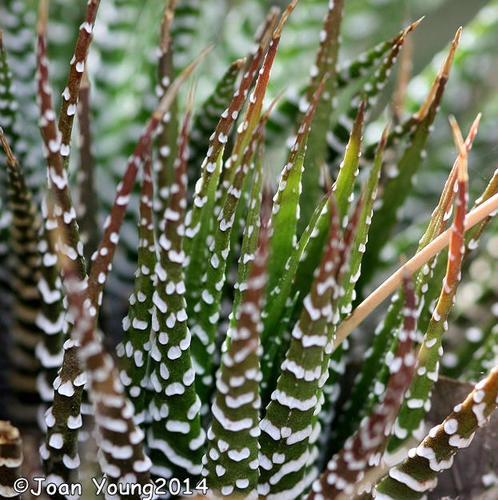
The zebra haworthia (Haworthiopsis attenuata) is a small perennial succulent in the Asphodelaceae, native to the Eastern Cape of South Africa. Its old name Haworthia attenuata is still common in garden centers, but the name accepted by POWO is Haworthiopsis attenuata (Haw.) G.D.Rowley.
Read moreZebra plant, Haworthia and Haworthiopsis attenuata
Allow a few hours of direct sun per day, preferably morning or evening.
Global distribution
The species is native to the Eastern Cape of South Africa. POWO summarizes the range as Cape Provinces and records introductions in Mexico and Spain; these records alone do not establish an invasion risk elsewhere.
- Native1
- Introduced3
- South Africa
- Central Mexico
- Southwestern Mexico
- Spain
Hexagons: sourced regions. Green dots: native range. Statuses according to POWO (Kew).
Identity
The zebra haworthia here means Haworthiopsis attenuata (Haw.) G.D.Rowley, a perennial succulent in the family Asphodelaceae. The accepted name dates from 2015, yet the older Haworthia attenuata is still widespread on nursery labels. 1 2
That double naming is the first source of confusion. Haworthia is not only a common name: it is also the former genus of this species. Haworthiopsis literally means a plant resembling Haworthia, while the epithet attenuata describes leaves that taper gradually to the tip. 3 4
Recognition
A small, almost stemless rosette is the starting point, and offsets gradually turn it into a clump. The leaves are firm, fleshy, dark green, narrow to triangular, and covered in raised white tubercles that form dots or bands. Growers describe a generally low plant: roughly 10–30 cm (4–12 in) tall depending on conditions, with individual rosettes often staying around 6–15 cm (2.5–6 in) before the clump widens. 4 5
Striping alone is a weak clue, since several succulents are sold under the zebra nickname. On H. attenuata, the tubercles show on both leaf surfaces; on Haworthiopsis fasciata, a rarer species often mistaken for it, the upper surface is usually smooth. 4
Flowers play a minor role next to the foliage. A slender stalk can reach about 40 cm (16 in) and carries small tubular flowers, white, greenish or pinkish. The fruit that follows is a capsule with no documented food value. 3 4
Useful taxonomy
POWO treats Haworthiopsis attenuata as an accepted species and places it in the Asphodelaceae, order Asparagales. The basionym is Aloe attenuata Haw., published in 1804; the 1812 combination Haworthia attenuata (Haw.) Haw. is a homotypic synonym, not the current accepted name. 1 6
The main synonyms worth knowing are:
- Aloe attenuata Haw.
- Apicra attenuata (Haw.) Willd.
- Catevala attenuata (Haw.) Kuntze
- Haworthia attenuata (Haw.) Haw.
- Haworthia pumila subsp. attenuata (Haw.) Halda
POWO also accepts three infraspecific taxa: Haworthiopsis attenuata var. attenuata, var. glabrata and var. radula. Trade names such as Enon, caespitosa or Super Clone should be read as horticultural labels, not as ranks comparable to the species. 1 4
Habitat and range
South Africa holds the entire native range. POWO sums it up as Cape Provinces; SANBI narrows it to the Eastern Cape, running from the Mbashe River to Fort Brown according to its Red List page. PlantZAfrica gives a broader horticultural description, from the Gamtoos to the Mbashe. These differences mostly reflect the level of detail, not a worldwide range. 1 7 3
Among rocks, grasses and shrubs of thicket or fynbos, the plant occupies sparsely vegetated rocky ground. Its fleshy leaves store water and the rosette stays low, which suits it to dry spells but leaves it exposed to repeated collecting. 3 7
POWO records introductions in Mexico and Spain. That record is not enough to call the species invasive anywhere else: outside its native range, it should be treated as a cultivated plant unless a more precise regional source says otherwise. 1
Life cycle and reproduction
Growth is slow and clump-forming. A mature plant produces offsets around the mother rosette; in cultivation, dividing these offsets is the simplest way to get an identical plant. Seed works too, but it is slower and rarely used at home. 4 5
Flowering comes mainly in the warm season: early summer in South African sources, late spring to summer in Northern Hemisphere horticultural sources. Plants can bloom indoors, but that is secondary: identification rests first on the rosette, the tubercles and the clumping habit. 3 4
Uses and risks
Ornament is the main use: a small pot, a bright windowsill, a succulent collection, an open dry terrarium or a frost-free rock garden. Where the climate allows, roughly USDA zones 9 to 11, the plant can live outdoors in a well-drained container; where winters bring frost, it is mostly grown indoors or in a bright, cool greenhouse. 5 4
SANBI also mentions traditional uses under the name intelezi, but these uses should not be read as a medicinal promise. The same Red List assessment rates the species Vulnerable in South Africa, mainly because of harvesting for the medicinal and horticultural trade, collection of mature plants and habitat loss. The ethical point for buyers is simple: choose nursery-propagated plants, not wild-collected ones. 7 3
For pets, the ASPCA lists Haworthia species as non-toxic to dogs and cats. Because that entry is generic rather than specific to Haworthiopsis attenuata, it should not be stretched too far: cats and dogs have no documented major toxicity, while horses and large amounts eaten still call for caution. 8 4
Varieties, look-alikes and buying
Most mix-ups pit Haworthiopsis attenuata against Haworthiopsis fasciata. Both are sold as zebra plants, but H. attenuata is far more common in cultivation and shows white ridges on both leaf surfaces. A "zebra plant" label on its own is not enough to identify the species. 4 5
Useful look-alikes include:
- Haworthiopsis fasciata, visually close but usually smoother on the upper leaf surface
- Aloe vera, a larger succulent rosette without the same tubercle bands
- Gasteria spp., sometimes mixed in with haworthias in the trade
- other plants called "zebra plant," notably some Aphelandra or Calathea with no close botanical link
Before buying, check the scientific name, the roots, the firmness of the base and where the plant was produced. A compact, well-rooted, nursery-propagated plant is a safer bet than a soft rosette, freshly pulled up or sold under a flashy name with no clear provenance. 7 4
Main sources
- Plants of the World Online / Kew, Haworthiopsis attenuata
- International Plant Names Index, Haworthiopsis attenuata
- GBIF Backbone Taxonomy, Haworthiopsis attenuata
- SANBI Red List of South African Plants, Haworthiopsis attenuata
- PlantZAfrica / SANBI, Haworthiopsis attenuata
- North Carolina Extension Gardener Plant Toolbox, Haworthiopsis attenuata
- Royal Horticultural Society, Haworthia attenuata
- ASPCA, Haworthia toxicity entry
Frequently asked questions
Is Haworthiopsis attenuata still a Haworthia?
The name accepted by POWO is Haworthiopsis attenuata. Haworthia attenuata remains a synonym and a common trade name.
How do you tell Haworthiopsis attenuata from H. fasciata?
H. attenuata carries white tubercles on both leaf surfaces; H. fasciata is usually smooth on the upper surface.
Is the plant toxic to cats and dogs?
The ASPCA lists Haworthia species as non-toxic to dogs and cats. Caution is still warranted for horses and for large amounts eaten.
Why is the rosette stretching?
A stretching rosette is often short on light. The plant holds its compact shape better in bright, filtered light.
Can this plant be collected from the wild?
No. SANBI lists the species as Vulnerable and names wild harvesting among the threats; buy nursery-propagated plants instead.
Similar plants

Botanical data compiled from reference sources (RHS, Kew Gardens, POWO). This profile is for guidance only and is not a substitute for advice from a botanist or veterinarian if you have concerns about toxicity.