
Mexican snowball (Echeveria elegans, )
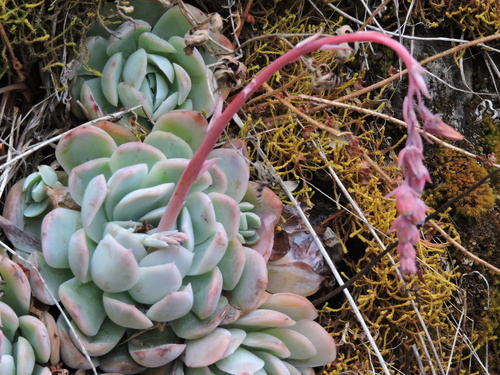
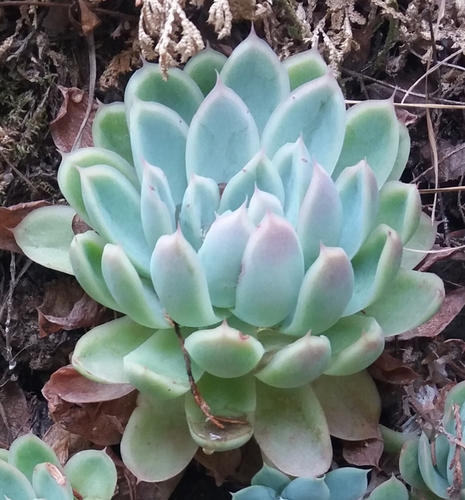
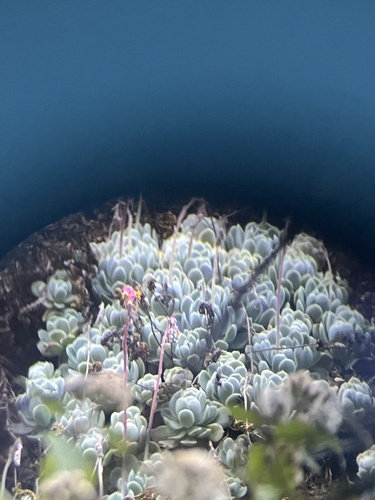
The Mexican snowball (Echeveria elegans Rose, 1905), also sold as Mexican gem or pearl echeveria, is a small perennial succulent in the stonecrop family, Crassulaceae. Its compact rosette tells most of the story, with fleshy, glaucous, almost waxy leaves that store water and, over the years, build a clump of offsets.
Read moreMexican gem, White Mexican rose and Pearl echeveria
Place in full sun, with intense direct light all day long.
Global distribution
Echeveria elegans is native to Mexico. POWO summarizes its range as northeastern Mexico to Veracruz and lists the Mexico Gulf, Mexico Northeast and Mexico Southwest regions; horticultural sources often shorten this to Mexico.
- Native3
- Northeastern Mexico
- Veracruz
- Central Gulf Mexico
Hexagons: sourced regions. Green dots: native range. Statuses according to POWO (Kew).
Identity
The Mexican snowball (Echeveria elegans) is a perennial succulent in the genus Echeveria, part of the stonecrop family, Crassulaceae. Its accepted name, Echeveria elegans Rose, was published in 1905 in North American Flora. Nurseries sell it under several English names, including Mexican gem, White Mexican rose and Pearl echeveria. 1 2
Those names mostly describe the plant's shape. Despite the "rose" in one of them, Echeveria elegans has nothing to do with roses: it is a rosette of succulent leaves. The image helps with recognizing the silhouette, but it should not hide the family, Crassulaceae, which it shares with crassulas, sedums and several kalanchoes. 3
Recognition
Look first for a low, tight rosette that is often almost geometric. The leaves are simple, entire, thick, smooth and hairless, widening toward the tip. A glaucous or pruinose coating gives them a blue-green, silvery green or whitish cast. On well-grown plants this bloom acts as both protection and color, and rubbing it off leaves lasting marks. 4 5
The leaves stay short, usually about 2.5–7.5 cm (1–3 in) long. The whole plant rarely exceeds 10 cm (4 in) in height, yet an old clump can spread to around 50 cm (20 in) thanks to its side offsets. That gap between low height and wide clump explains the cushion-like habit, quite unlike an upright succulent. 4 5
Slender, sometimes arching stalks carry the flowers above the rosette. They are tubular or lantern-shaped, pink to orange, with yellow tips. Horticultural sources place them mainly from late winter into spring, occasionally stretching into summer depending on climate and growing conditions. 5 4
Useful taxonomy
Everything hangs on the binomial Echeveria elegans Rose. POWO treats it as the accepted name and gives Echeveria perelegans A.Berger as a homotypic synonym. IPNI confirms the 1905 publication and the nomenclatural identifier urn:lsid:ipni.org:names:86934-2. 1 2
Below species level, things get harder. POWO accepts several infraspecific taxa, including var. elegans, var. hernandonis and var. tuxpanensis. Horticultural databases and aggregators may also bring up Echeveria potosina, Echeveria albicans or Echeveria simulans in different contexts. A non-specialist should keep three things apart: the accepted species name, the botanical varieties recognized by a taxonomic source, and trade labels. 1 6
The genus Echeveria adds its own confusion. Many plants sold simply as "echeveria" are hybrids, and the nickname hens and chicks is shared with Sempervivum. A compact rosette is not enough on its own: read the species name, leaf shape, flowers and label origin together. 3
Habitat and range
Taxonomic sources put Echeveria elegans in Mexico. POWO summarizes its native range as northeastern Mexico to Veracruz, listing the Mexico Gulf, Mexico Northeast and Mexico Southwest regions. Trefle and NC State likewise describe an origin in northeastern Mexico toward Veracruz. 1 4
That origin shapes the plant. This is no plant of damp woodland floors but a small succulent of free-draining subtropical ground, built for strong light, mineral soils and dry spells. In USDA zones 9 to 11 it can live outdoors in a frost-free rock garden; where winters bring frost, it is mostly grown in pots, shallow bowls or a dry sunroom. 5 4
None of the references consulted describe the species as invasive in parts of temperate Europe, where it is known only as a cultivated ornamental.
Life cycle, flowering and propagation
Growth is slow and keeps to the rosette form. With age the plant produces offsets around the base of the mother rosette, and those small rosettes are what earned it the nickname hens and chicks. A mature clump is therefore not one giant rosette but a colony of neighboring ones. 4
Flowers appear once the plant has stored enough energy. The stalks carry small pink blooms with yellow tips, often in late winter or spring. Do not mistake flowering for a rosette stretching from lack of light: a flower stalk rises from the rosette and bears buds, whereas an etiolated plant lengthens its stem and spaces out its leaves. 5
Propagation is mostly by dividing offsets or by leaf cuttings. Both rely on callusing: freshly cut succulent tissue must dry before it goes onto a very free-draining mix. In water or soggy potting soil, the fleshy reserves that protect the plant become an entry point for rot. 4 5
Uses and risks
Grown chiefly for ornament, it suits a bright pot, a windowsill, a dry sunroom, a frost-free rock garden or a mixed succulent planting. Its graphic appeal comes from its low height, a rosette that reads clearly at a glance and a glaucous color that shifts with the light. 5 4
For pets, the sources are reassuring, though worth stating precisely. The ASPCA lists Echeveria elegans as non-toxic to dogs, cats and horses. That does not make the plant edible for people, nor a large helping advisable: no reliable food source was found, and Echeveria elegans should stay an ornamental, not something to eat. 7
In cultivation the usual trouble is not toxicity but mechanics and plant health: overwatering, compacted mix, cold combined with wet, mealybugs tucked between the leaves, and scorch after a sudden move into sun. These belong to care guides; here they mainly show why the plant is built as a water store. 4 5
Varieties, buying and look-alikes
NC State reports Alba, Hyaliana, Raspberry and Super Clone as horticultural names. They describe selections or cultivated forms, not separate species, so a garden center label should be read as a commercial pointer until it is tied to a verifiable botanical rank. 4
Other succulent rosettes cause most mix-ups. Sempervivum shares the hens and chicks nickname, but it is often hardier and does not behave quite like Echeveria. Other Echeveria and hybrids, such as forms of E. secunda, E. derenbergii or hybrids sold under color names, can also resemble young E. elegans. 3 6
When buying, the best clues are simple: a low, tight rosette, smooth pruinose leaves, a plant that is not waterlogged, no mealybugs in the center, and a label that clearly says Echeveria elegans rather than just "succulent mix." For propagation, choose a healthy rosette or offset over a damaged leaf that has already gone soft. 4 5
Main sources
- Plants of the World Online / Kew, Echeveria elegans Rose
- International Plant Names Index, Echeveria elegans Rose
- GBIF Backbone Taxonomy, Echeveria elegans Rose
- Royal Horticultural Society, Echeveria elegans
- North Carolina Extension Gardener Plant Toolbox, Echeveria elegans
- North Carolina Extension Gardener Plant Toolbox, genus Echeveria
- ASPCA, Chickens and Hens, Echeveria elegans
Frequently asked questions
Is Echeveria elegans toxic to cats and dogs?
The ASPCA lists Echeveria elegans as non-toxic to dogs, cats and horses. That does not make it food, and a pet that eats a large amount of any ornamental plant is still worth watching.
Why is my rosette stretching?
A rosette that loses its tight shape is usually looking for more light. Increase exposure gradually, since a plant raised in shade can scorch if moved straight into full sun.
Where does Echeveria elegans come from?
Taxonomic sources place it in Mexico, from the northeast of the country toward Veracruz. Horticultural sources often just say Mexico, which is correct but less precise.
Are Mexican snowball and hens and chicks the same plant?
Both names can refer to Echeveria elegans, but hens and chicks is also used for other succulents. The scientific name remains the reliable reference.
Does Echeveria elegans flower indoors?
A mature rosette in very bright light can flower, depending on the energy it has stored, the season and a drier rest period. The flowers are usually pink with yellow tips.
Similar plants
Botanical data compiled from reference sources (RHS, Kew Gardens, POWO). This profile is for guidance only and is not a substitute for advice from a botanist or veterinarian if you have concerns about toxicity.