
Treatment Plans
Scale insect treatment
Insecticidal soap, alcohol, or oil: which natural treatment suits each type of scale insect, what dose to use, and how many applications it takes.
Scale insect treatment depends on the type of insect, not the plant. A white, cottony clump (mealybugs) responds to alcohol; a small shell, either flat (armored scale) or domed (soft scale), needs scraping off, followed by treatment when the crawlers emerge. If you are unsure which type you have, the scale insect guide explains two simple identification checks.
Here is the protocol for getting rid of scale insects: which product, what dose, how many applications, and when it is better to discard the plant. A single application is never enough: eggs sheltered under the mother hatch after treatment1.
Which treatment suits each type?
No product controls every type. UC IPM emphasizes that you need to identify the scale family to know whether treatment is justified, which treatment to use, and when1. The table compares methods by type.
| Method | Mealybugs | Armored scale | Soft scale | Risk to the plant |
|---|---|---|---|---|
| Alcohol on a cotton swab | Good | Not evaluated | Not evaluated | Possible leaf burn: test first |
| Scraping with a fingernail or brush | Good for a small infestation | Good for a small infestation | Good for a small infestation | None if the bark is unharmed |
| Insecticidal soap | Young insects only | Crawlers | Crawlers | Some plants are sensitive |
| Horticultural oil | Young insects only | Good at the crawler stage | Good at the crawler stage | Never during high heat or freezing weather |
| Beneficial insects (lady beetles, tiny wasps) | Good in a greenhouse or sunroom | Depends on the species | Depends on the species | None |
Table sources: UC IPM for alcohol and hand removal of mealybugs2, oil and beneficial insects1, Clemson for soap3, and the RHS for scraping off shells4. UC IPM recommends alcohol only for mealybugs. None of the sources consulted evaluates it for armored or soft scale, hence “not evaluated.”
Mealybugs: start with alcohol
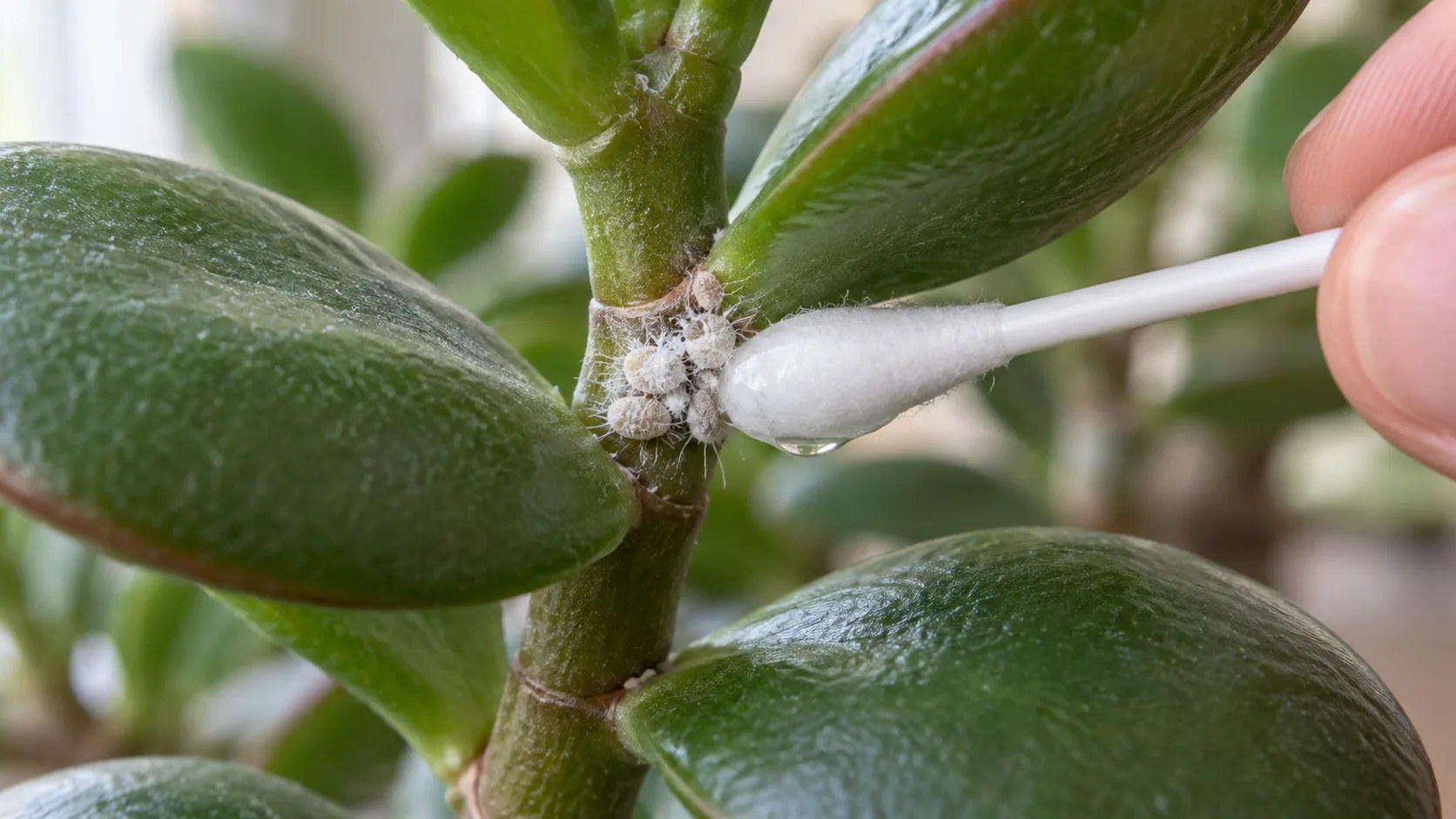
Mealybug wax repels most contact products, and the insect hides in crevices. For a small houseplant infestation, UC IPM therefore recommends dabbing each cluster with alcohol on a cotton swab2.
Armored and soft scale: scrape, then target crawlers
The shell protects the adult. Scrape off visible shells, then apply horticultural oil when crawlers appear, before they develop their protective covering1. The RHS warns that hand removal is not always enough for a large population4. UC IPM also stresses that armored scale requires complete foliage coverage, because it resists products better than other scales1.
Natural treatments and their doses
Each dose below comes from its source, without improvised rounding. Always mix in a clean sprayer and test on one leaf one to two days before treating the whole plant25.
| Product | Concentration | Amount for 1 liter (about 1.06 US qt) | Use | Source |
|---|---|---|---|---|
| Alcohol, dabbed on | No more than 70% | Undiluted if the alcohol is 70% | Cotton swab on each cluster | UC IPM2 |
| Alcohol, sprayed | 10 to 25% alcohol | About 150 to 350 ml (5.1 to 11.8 US fl oz) of 70% alcohol, topped up with water | Widespread infestation | UC IPM2 |
| Labeled insecticidal soap | 1 to 2% | 10 to 20 ml (about 0.34 to 0.68 US fl oz), or the label dose | Crawlers, young mealybugs | Clemson3 |
| Black soap | Varies by brand | The label dose, after testing on one leaf | Crawlers, young mealybugs | CSU5 |
| Horticultural oil (white oil) | Follow the label | Follow the label | Crawlers of armored and soft scale | UC IPM1 |
UC IPM specifies isopropyl alcohol, available at pharmacies and drugstores2. The volume in the second row is a simple calculation: 150 ml (5.1 US fl oz) of 70% alcohol provides about 10% alcohol in one liter (1.06 US qt), and 350 ml (11.8 US fl oz) provides about 25%.
Commercial insecticidal soap contains potassium salts of fatty acids5, the same family as potassium-based black soap. The 1 to 2% dose applies to this labeled soap3, not to black soap, whose concentration varies by brand. Colorado State University also notes that homemade mixtures have not been tested like labeled products, and advises against dishwashing liquid, whose detergents damage plants5. Choose a soap sold as an insecticide, with a dose on the label.
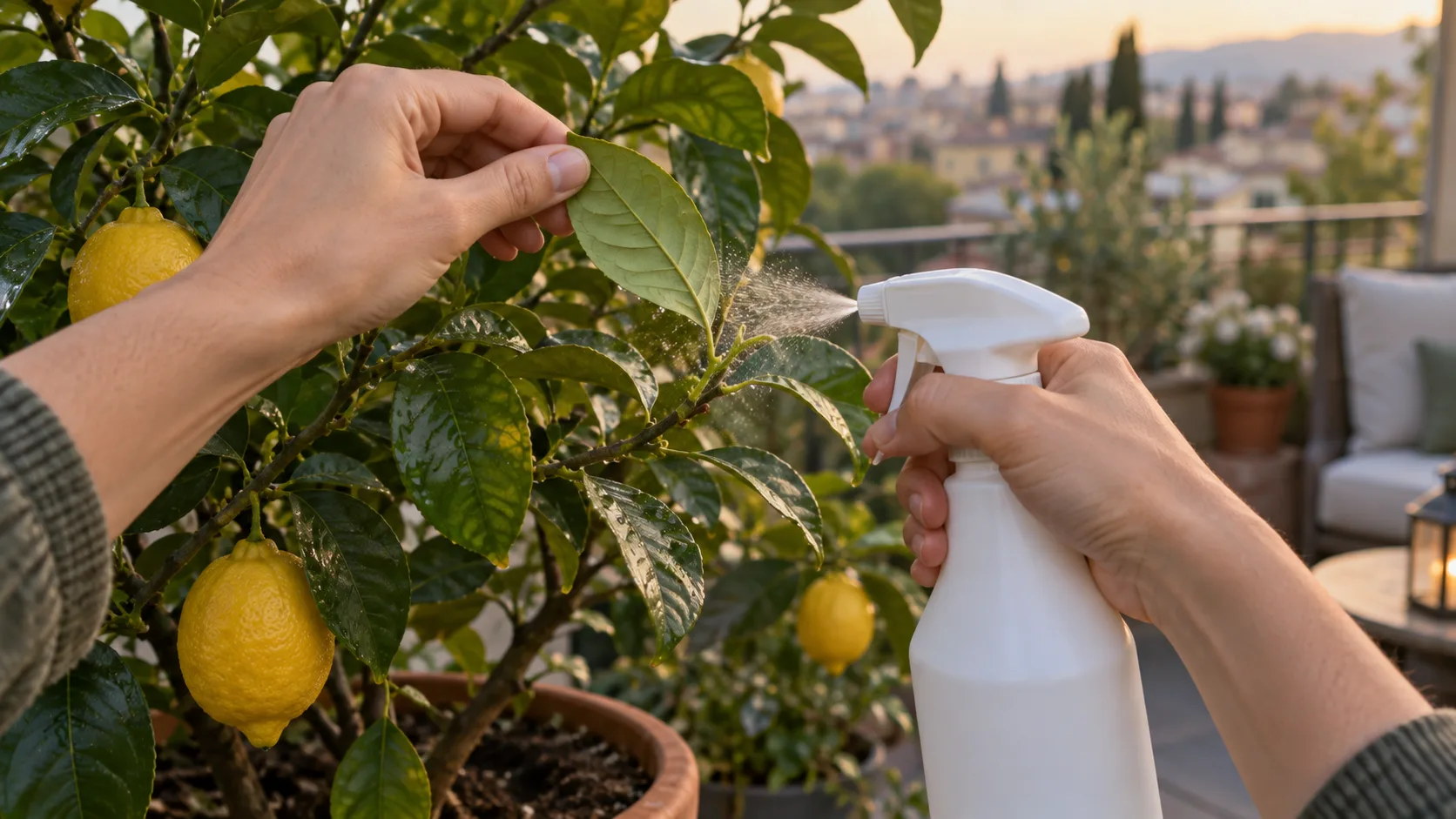
Clemson lists azaleas, begonias, fuchsias, geraniums, and impatiens among plants more sensitive to soap3. For these plants, testing first is essential.
Cleaning with a cotton swab
For a few small clusters, hand removal is enough and costs nothing. Once more than a few leaves are involved, the number of insects makes this impractical and spraying takes over.
- Test the alcohol on one leaf and wait one to two days2.
- Isolate the plant during treatment: crawlers move between plants.
- Dab each cluster with an alcohol-soaked cotton swab, including leaf undersides, leaf axils, and stems2.
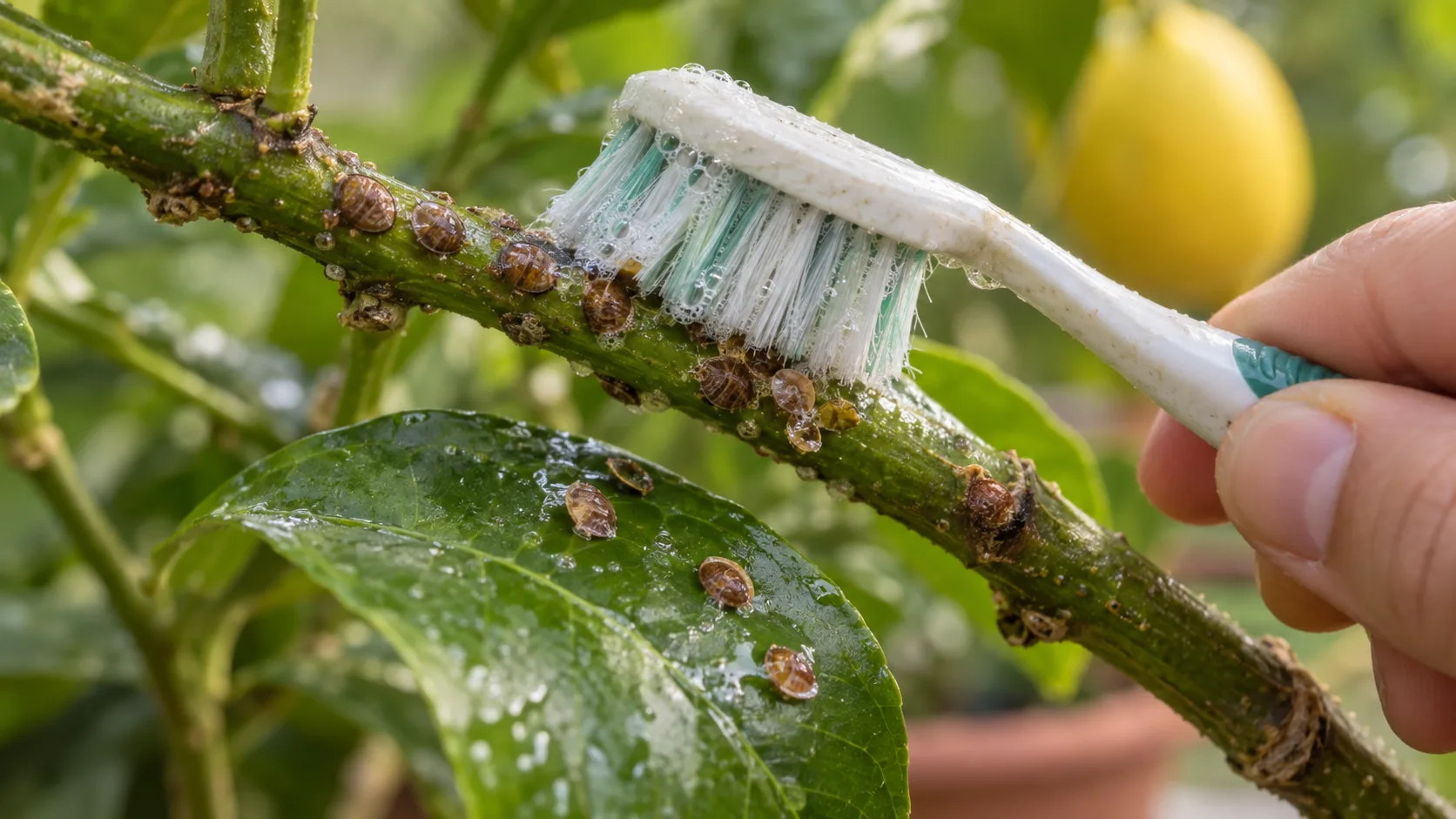
- Scrape off the shells of armored and soft scale with a fingernail or soft brush4.
- Rinse the foliage to remove honeydew and sooty mold, following the guides to rinsing plant leaves and cleaning off honeydew.
- Repeat weekly until nothing reappears2.
Why scrape? An armored scale's cover stays in place even after the insect dies, and shelters the eggs. Removing it exposes the eggs to the next treatment and shows what is actually still alive.
Mealybugs indoors
A home gives mealybugs everything they need: steady warmth and no predators. All life stages coexist year-round2. Three situations need a different approach.
- Sturdy plants (ficus, palms, monstera): a strong stream of water dislodges exposed colonies; repeat every few days2. Protect the potting mix before showering the plant.
- Cacti and succulents: clusters hide between spines and at the crown. A cotton swab reaches places a sprayer misses. UC IPM lists cacti and jade plants among the most frequently affected houseplants2.
- Root mealybugs: some species live in the potting mix and only become visible when the plant is removed from its pot, as white, waxy patches on the roots. They are even harder to eliminate than foliage mealybugs, and UC IPM recommends promptly discarding affected plants before they infest others2.
The mealybug guide describes the signs and the plants most often affected.
How many repeat applications?
Expect one application a week, sometimes two, until inspections find nothing left. Contact products have no residual effect: they kill only what they wet5. Crawlers hatching the next day escape the previous day's treatment. Clemson and Colorado State University recommend repeating soap every 4 to 7 days against scale crawlers35. UC IPM recommends repeating alcohol weekly until the infestation ends2.
Target crawler emergence
Outdoors, crawlers emerge over a short period. To find out when, UC IPM suggests wrapping double-sided tape around a few infested twigs and changing it weekly: crawlers stick as tiny yellow or orange dots. Treat after peak catches, when numbers begin to fall1. For olive trees, France Olive places the first black scale treatment at the start of hatching, in July, in its French growing context6. INRAE describes three generations a year of armored scale on oleander, with the first crawlers in March and April in the conditions it covers7. These dates are regional references, not a calendar for every climate. Each emergence is dated in the guide to oleander scale insects.
Signs that treatment can stop
Crush a few scale insects: a living one releases liquid; a dead one stays dry. UC IPM recommends this check before every new application. If most are dead or have a small round hole, showing that a tiny wasp parasitized them, you can stop treatment and monitor1. Empty shells remain attached for a long time: they prove nothing.
Questionable remedies
Several widely shared recipes harm the plant more than the insect.
| Remedy | Verdict | Why |
|---|---|---|
| White vinegar | No | No source recommends it against scale insects; acetic acid is sold as a contact herbicide8 |
| Dishwashing liquid | No | Its detergents can injure the plant; homemade mixtures are not tested5 |
| Undiluted 90% alcohol | No | UC IPM limits alcohol to 70% and sometimes recommends further dilution2 |
| Neem oil | Only a labeled product | Action is limited to young stages2; in France, azadirachtin, neem oil's active ingredient, is approved only in plant protection products listed by Anses9, never as a homemade recipe |
| Systemic insecticide (imidacloprid) | Banned in France | A neonicotinoid banned since September 1, 2018, because of its toxicity to pollinators10; ineffective against armored scale in any case1 |
Doubling the dose does not work faster: Clemson warns that concentrations above the label dose can seriously harm the plant3.
Biological control
Scale insects have many natural enemies, which UC IPM considers sufficient in many outdoor situations to keep populations low1. Choose a beneficial organism for the type of scale insect.
- Mealybug destroyer (Cryptolaemus montrouzieri): an Australian lady beetle whose adults and larvae eat scale insects11. It is sensitive to cold and is released mainly in greenhouses and sunrooms, when egg sacs are abundant, because it needs them to reproduce2. Its white, wax-covered larva looks like a large mealybug: do not crush it.

- Tiny parasitoid wasps: they lay eggs in the scale insect, which dies with an exit hole in its body1. The wasp sold for citrus mealybugs attacks only that species2.
- Black lady beetle, 2 mm (about 0.08 in) long (Chilocorus nigritus): used against armored scale on greenhouse orchids12.
- Nematode (Steinernema feltiae): offered against soft scale, and best reserved for a real problem13.
- Vedalia beetle (Rodolia cardinalis): the long-established enemy of cottony cushion scale14.
Keep ants away first: they attack beneficial insects. UC IPM recommends a sticky band over a protective trunk wrap, or baits near nests1, as explained in installing an insect barrier.
Save the plant or discard it?
Discarding a heavily infested houseplant can be the right choice. UC IPM is direct: when an infestation becomes severe, discarding the plant is better than treating it repeatedly2. It also recommends replacing a species that repeatedly develops scale infestations1.
Pruning offers a middle option. Cut off the most heavily colonized shoots when only a few are involved1, following the sanitation pruning guide, then resume treatment on the remaining plant. A rare or long-kept plant may justify the effort; an ordinary plant covered in colonies puts the others at risk.
If you keep the plant, check the pot, stake, and saucer too: UC IPM recommends discarding any support that still carries egg sacs2. The emergency repotting guide explains how to replace the potting mix without damaging roots.
Frequently asked questions
Le savon noir tue-t-il les cochenilles ?
It can kill the crawlers and young mealybugs it wets, because soaps work only by contact and have no residual effect5. Adult armored scale is protected by its shell and needs scraping first. The 1 to 2% dose, 10 to 20 ml per liter (about 0.34 to 0.68 US fl oz per 1.06 US qt), applies to a labeled insecticidal soap, repeated every 4 to 7 days3. Black soap varies by brand and has not been tested as an insecticide5: follow its label and test on one leaf first.
Quel est le meilleur traitement contre la cochenille ?
Quel remède de grand-mère contre les cochenilles ?
An alcohol-soaked cotton swab remains the best-supported home method: UC IPM recommends it for small mealybug infestations on houseplants2. White vinegar, although often suggested, is not recommended by any source: its acetic acid is sold as a contact herbicide8. Dishwashing liquid can injure the plant5.
Comment fabriquer un produit naturel contre les cochenilles ?
The best-documented homemade mixture is diluted alcohol: UC IPM uses a spray containing 10 to 25% alcohol, or about 150 to 350 ml (5.1 to 11.8 US fl oz) of 70% alcohol topped up with water to one liter (1.06 US qt), after a leaf test one to two days beforehand2. For soap, Colorado State University notes that homemade recipes have not been tested like labeled products and advises against dishwashing liquid5: a 1 to 2% insecticidal soap remains safer3.
L'alcool à 70° abîme-t-il la plante ?
Comment se débarrasser définitivement des cochenilles ?
By following treatment through to the end, then preventing reinfestation. Treat weekly according to type, and crush a few scale insects before each application: stop when they stay dry1. Then inspect every new plant, check pots and stakes, keep ants away, and avoid excessive nitrogen21. The scale insect guide explains these preventive steps.
Pourquoi les cochenilles reviennent-elles après le traitement ?
Peut-on utiliser des prédateurs naturels à l'intérieur ?
Yes, especially in a sunroom or a large collection. The lady beetle Cryptolaemus montrouzieri can be released in greenhouses and indoors against mealybugs, provided egg sacs are abundant2. For one or two plants, a cotton swab is simpler.