
Orchid diseases and pests: recognizing the signs
Sick orchid: find the cause from the symptoms
A declining moth orchid (Phalaenopsis) more often suffers from a cultivation mistake than disease, with watering first among suspects. Of true diseases, bacterial brown spot is most common; rots show water-soaked patches, scale insects and spider mites leave deposits. Viruses cannot be cured.
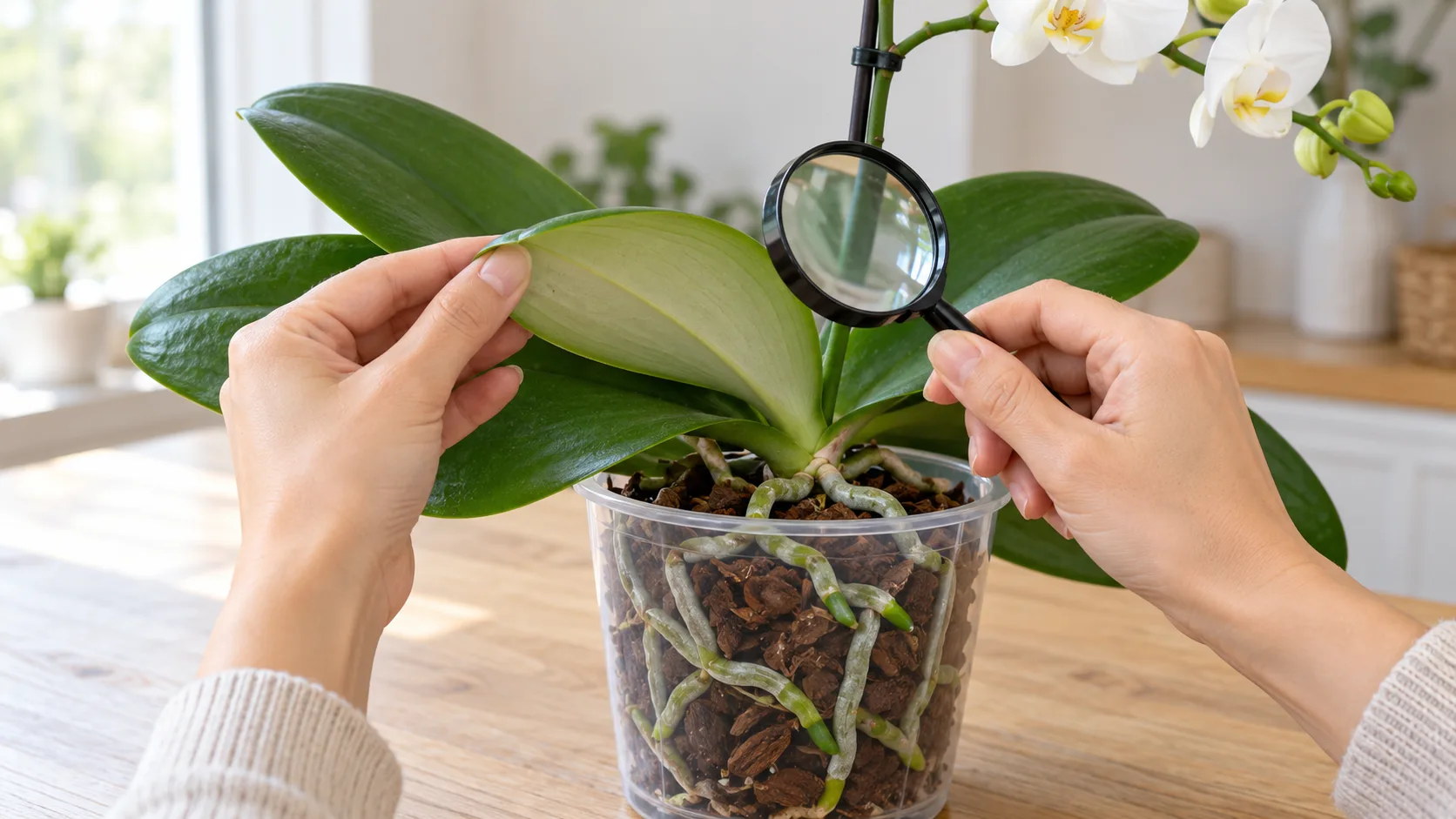
Diagnosis in one table
A declining orchid is more likely to suffer from cultivation mistakes than disease. Sue Bottom of the American Orchid Society estimates that cultivation errors probably cause more damage than pests and diseases1. Before any treatment, inspect moth orchid (Phalaenopsis) roots: in waterlogged medium, they rot2.
The table starts with what you see, then points to the section covering the cause.
| What you see | Likely cause | Where to read more |
|---|---|---|
| Water-soaked patch spreading within hours, foul smell | Bacterial soft rot3 | Bacteria |
| Small water-soaked spots turning brown, black and sunken | Bacterial brown spot3 | Bacteria |
| Soft blackish spot on a young leaf, releasing water when pressed | Black rot4 | Black rot |
| Brown, soft roots, plant wilting despite watering | Roots rotted in saturated medium2 | Root rot |
| Small brown, black or gray flower spots | Botrytis5 | Botrytis |
| White cottony clumps in crevices and joints | Mealybugs6 | Scale insects |
| Small brown shells along veins | Armored scale insects7 | Scale insects |
| Fine silky webs, pale-stippled leaves | Spider mites8 | Mites and thrips |
| Damaged buds, deformed flowers, black dots | Thrips9 | Mites and thrips |
| Irregular yellow or dead patches, mottled flowers | Virus10 | Viruses |
| Black patches appearing suddenly on a sunlit leaf | Sunburn1 | Yellow leaves |
Une feuille qui jaunit sans tache n'est pas forcément malade : yellow orchid leaves ont leurs propres causes, de la vieille feuille qui s'en va au manque d'engrais.
Bacterial rot: the weeping spot
A water-soaked spot spreading within hours is urgent. The American Orchid Society describes saturated leaf spots spreading through the plant, with a foul smell; in moth orchids, the entire plant may rot in 2 to 3 days3. Bacteria enter through injuries, and the genus long called Erwinia is now Pectobacterium3.

Bacterial brown spot is the most common moth orchid disease1. Small water-soaked spots appear anywhere on leaves, turn brown or black and become sunken; it predominates in hot weather3. The Connecticut experiment station considers it very serious in this genus11.
- Isolate the plant at the first spot3.
- Cut affected tissue with a sterile blade around 2.5 cm (1 in) below the affected area1.
- Pour hydrogen peroxide on the wound, as Sue Bottom does1.
- Disinfect the area: weeping fluid carries bacteria3; the Connecticut station disinfects equipment with 10% bleach solution or 70% alcohol11.
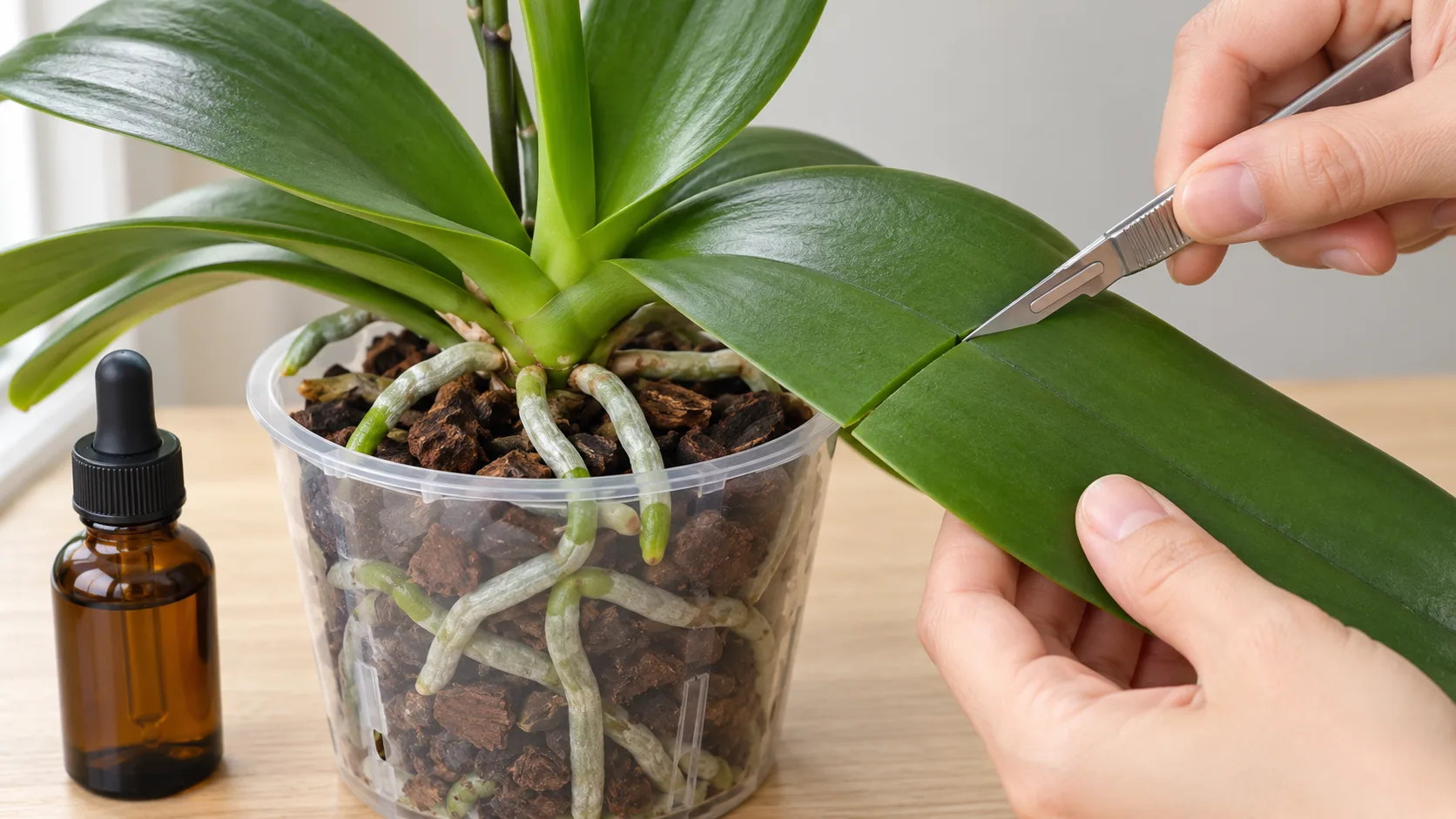
Water left in leaf crevices encourages bacteria. If water collects in the crown, Sue Bottom adds a few drops of hydrogen peroxide1. AOS discourages overhead watering and misting, recommending protection before and after damp weather and cold snaps3.
Le bain qui ne laisse pas d'eau dans le cœur est détaillé dans la page watering an orchid selon le substrat et la saison.
Black rot and rotten roots
A soft blackish patch on a young leaf signals black rot. Two soil organisms cause it, Pythium ultimum and Phytophthora cactorum; patches, sometimes ringed yellow, release water when pressed, then move down toward roots4. They travel in water: splashes from neighboring plants, contaminated pots, medium or water4.
On a moth orchid, remove the affected leaf portion, or whole leaf if necessary, before rot reaches the crown, using a sterile blade and a small margin of healthy tissue. AOS considers ground cinnamon an excellent fungicide for the wound, recommending isolation and leaves that dry quickly in moving air4.
Roots rot in saturated medium2. The RHS lists oversized pots among causes: excess medium stays wet12. Healthy roots are firm; dead ones brown, soft or hollow, and should be cut away12. See root rot and emergency repotting.
Écorce neuve, pot à la bonne taille et tri des racines : repotting an orchid se fait dès que de nouvelles racines pointent.
Flower spots: Botrytis
Small brown, black or gray flower spots indicate Botrytis5. It overwinters on plant debris and spreads spores in cool, damp spring or fall weather; it thrives at 18 to 23 °C (64 to 73 °F) on wet flowers or with humidity of at least 92%5.
An established spot cannot disappear. Remove and discard all affected flowers, keeping air constantly moving around plants5. AOS reports some hobbyists claiming success with half a teaspoon of baking soda in around a liter (1.1 US quarts) of water, sprayed onto flowers5. For gray mold on other plants, see gray mold and treating gray mold.
Mealybugs and armored scale
White fluff at joints or small brown shells on veins are scale insects from two families. Mealybugs attach to tender shoots and hide in crevices and joints; they weaken plants and leave sticky honeydew supporting sooty mold6.
Armored scales include brown scale, commonest indoors, and Boisduval scale, whose cottony male resembles a mealybug. Inspect midribs, other veins and leaf edges7.
The two AOS pages differ on alcohol. Against armored scale it uses isopropyl alcohol only, wiped or sprayed; eggs remain beneath female shells even after death, requiring another pass against young crawlers7. Against mealybugs it considers alcohol of limited effectiveness, and capable of removing protective leaf wax6.
In both cases isolate the plant, remove insects, then spray insecticidal soap. Allow 2 to 3 treatments, 10 to 16 days apart against armored scale7, 3 to 4 a few days apart against mealybugs6. Full protocols are in eliminating mealybugs and eliminating scale insects.
Spider mites and thrips
Spider mites spin fine silky webs and leave pale stippling on leaves8. They multiply in hot, dry weather, often attacking indoor moth orchids1; at room temperature, a full cycle may take just five days8. Insecticidal soap or predatory mites, in 3 to 4 applications a few days apart8: see eliminating spider mites.
Flat mites, or false spider mites, make no webs: they feed on upper leaf surfaces, leaving tiny pits1.

Thrips target buds and deform flowers; black droppings and varnished streaks betray them9. Resistant to most insecticides, they are managed with predatory mites (Amblyseius cucumeris) released a week apart; soap only partly works, and the medium where they pupate also needs treatment9. See eradicating thrips.
Viruses: no treatment
No treatment cures a virus-infected orchid10. The two most important are Cymbidium mosaic virus and Odontoglossum ringspot virus10.
Leaves develop irregular yellowish or dead lesions, sometimes yellow streaks; in moth orchids, downward leaf curling is less common. Flowers may develop dead patches or color breaks, and many infected plants show nothing10.
Viruses travel on hands and tools, especially during division, repotting and cutting. Disinfect blades between plants: five minutes in commercial bleach diluted to 10%, a few seconds in a flame after alcohol, or a new razor blade per plant. An infected plant is isolated or, better, destroyed10.
Hampe, feuilles fanées, racines mortes : la coupe sans risque est détaillée dans pruning an orchid avec la désinfection de la lame.
Prevention: air, water and quarantine
Circulating air, no standing water and suspect plants kept apart. AOS wants air always moving around plants against fungal and bacterial diseases, and no water in the crown, which rots2. Avoid overhead watering and misting3, and isolate infested plants at the first signs7.
Turn leaves over at each watering: the RHS notes that the sooner a pest is spotted, the easier it is to eliminate12.
Add your orchid: Floralens reminds you when to inspect leaves and repot, season by season (Pro mode). Get reminders
Frequently asked questions
How do you get rid of scale insects on orchids?
How do you treat a sick orchid?
Why put baking soda on orchids?
Against Botrytis spots on flowers: AOS reports some hobbyists claiming success with half a teaspoon of baking soda in around a liter (1.1 US quarts) of water, sprayed on flowers. Established spots do not disappear: remove affected flowers5.
How can you save a dying orchid?
Unpot and inspect roots: brown, soft roots have rotted in saturated medium2. Remove them, then repot in the smallest pot fitting remaining roots. For nearly rootless plants, AOS recommends fairly dry medium, a plastic bag held above foliage and a shaded position until roots restart, more slowly as days shorten, late September to January in the AOS source’s seasonal example; use local light and growth to interpret those months13.