
Orchid pruning after flowering: where to cut the spike
Pruning orchids: spikes, leaves and roots
Prune moth orchids (Phalaenopsis) after flowering: cut green spikes just above the second node below faded flowers, dry spikes at the base. Remove faded leaves and dead roots through the year, never aerial roots. Disinfect blades between plants to avoid spreading viruses.
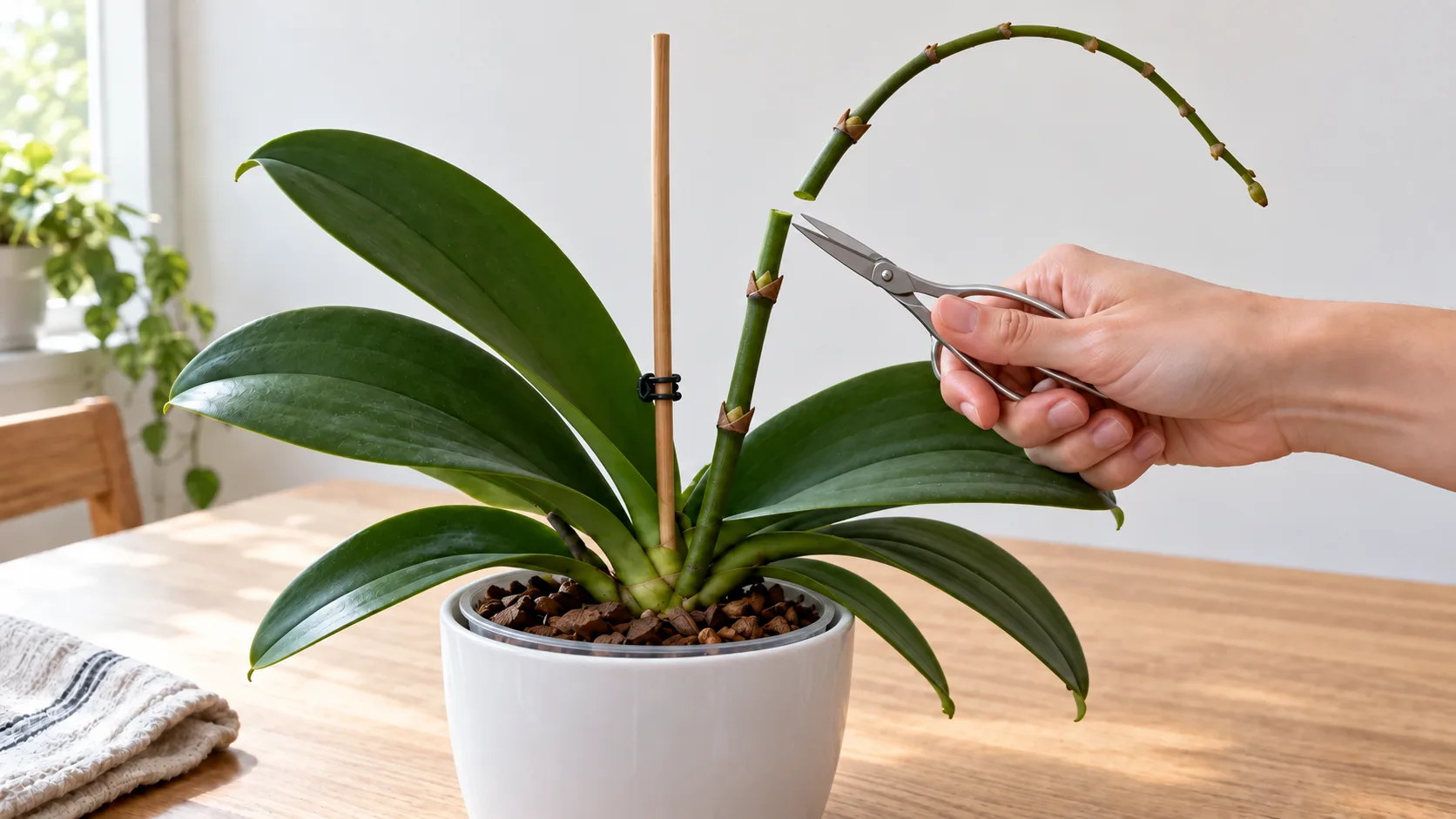
When should you prune an orchid?
After flowering, once the last flower falls. This is the only timed task: the RHS cuts spikes when all flowers have fallen1. Other work follows the plant's condition throughout the year:
- Main pruning
- After floweringSpent flower spike that is still green · just above the second nodeSource: Royal Horticultural Society
- Main pruning
- After floweringFlower spike cut back level with the leaves · stronger flowering in less than a yearSource: American Orchid Society
- Remove damaged growth
- When repottingDead rootsSource: Royal Horticultural Society
- Remove damaged growth
- At any timeLeaf affected by rot · before rot reaches the crownSource: American Orchid Society
- Autumn cleanup
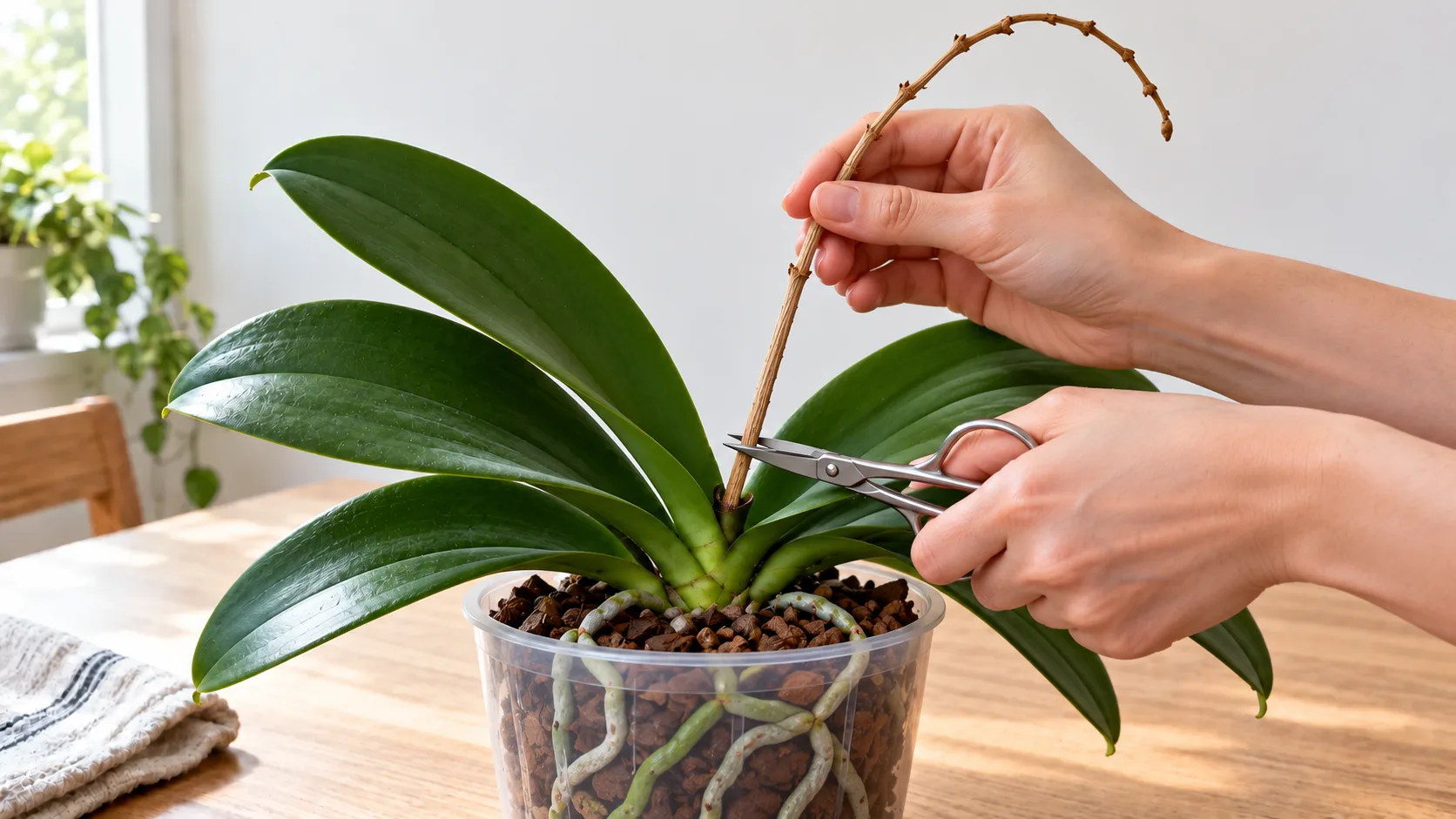
- At any timeDry flower spike, yellowed leaf · cut at the base of the plantSource: University of Maryland Extension
- Avoid
- After floweringGreen flower spike on a novelty hybrid · it flowers again from the tip of the spikeSource: American Orchid Society
- cut dry, brown or yellowed spikes at the base once dry2;
- remove fading leaves as they begin to fade1;
- cut dead roots at repotting, possible in any season while roots are active with green tips1.
Moth orchids (Phalaenopsis) have no branches to thin or shape. Pruning means removing spent parts, leaving aerial roots untouched2.
Pour qu'une nouvelle hampe parte après la coupe, la plante a besoin de quelques semaines de journées plus fraîches : encouraging an orchid to flower again explique le déclencheur.
Where to cut spikes after flowering
Three choices, depending on the plant and your aim. Spikes have nodes, small swellings below flowers. Used nodes have scales lifted away from the stem; usable nodes have scales flat against it3.
| Where to cut | Expected result | Source |
|---|---|---|
| Just above the second node below faded flowers, about 1 cm (0.4 in) above it | A secondary flowering branch in 8–12 weeks according to the AOS | RHS1, Maryland2, AOS4 |
| At leaf level | Stronger flowering with larger flowers in under a year | AOS4 |
| Nowhere: leave the spike whole | A green spike may continue growing and flower again | Muséum5 |
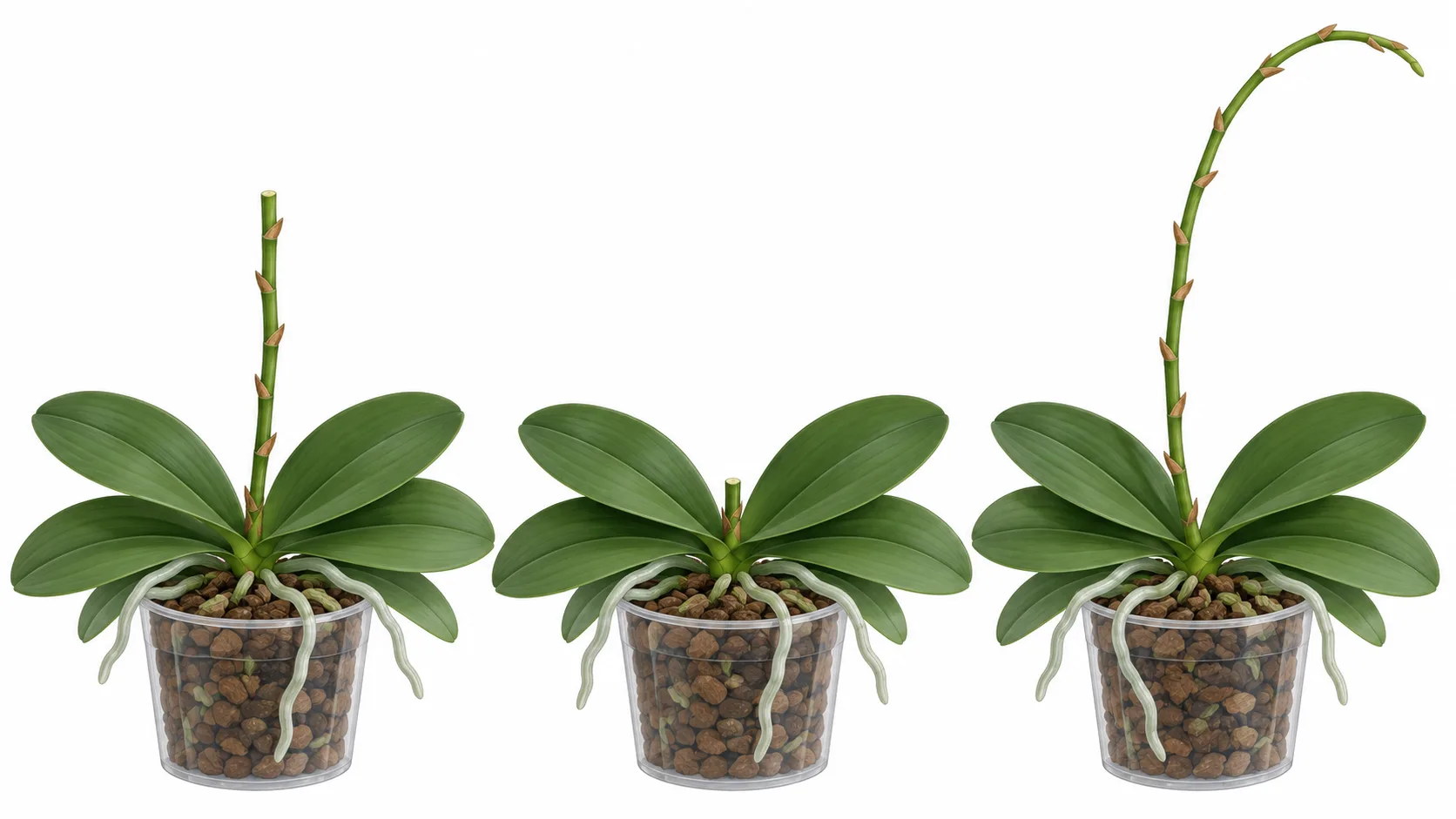
Repeat flowering has a cost. The American Orchid Society warns it may tire the plant, often producing smaller, weaker flowers; it recommends this only for vigorous plants and often prefers allowing recovery3.
If no usable nodes remain, cut as low as possible. Otherwise cut above the second node but below any dry or brown section3. One exception: novelty
hybrids with star-shaped flowers and short spikes flower again from the same stem tip; do not cut while green3.
Faded leaves and dry spikes: cut at the base
Cut old yellowed leaves and dry spikes at the plant's base2. The RHS removes old leaves as soon as they start fading1.
A soft blackish leaf releasing water when pressed is different: rot needs prompt removal. On moth orchids, the AOS removes affected tissue or the entire leaf before rot reaches the crown, with a small margin of healthy tissue, then dusts the wound with cinnamon6.
Avant de couper, distinguez la vieille feuille qui s'en va d'un signal d'alarme : yellow orchid leaves se lisent selon leur place et leur texture.
Taches détrempées, pourriture noire, insectes : orchid diseases se reconnaissent symptôme par symptôme.
Dead roots and aerial roots
Cut dead roots at repotting; never cut aerial roots. The RHS removes brown, shriveled, soft or hollow roots, then shortens healthy roots to about 12 cm (4.7 in); healthy roots are full, firm and silvery white1. The Muséum likewise removes dried roots when renewing substrate5.
Aerial roots extending beyond pots are normal: University of Maryland Extension insists they should not be cut2. The RHS advises against burying them because they would rot beneath substrate1.
Tri des racines, écorce neuve et pot à la bonne taille : repotting an orchid se fait quand de nouvelles racines pointent.
Disinfect blades between plants
A clean blade for each plant: cuts transmit viruses. Hands and tools are the main transmission route, and no treatment cures a virus-infected orchid7. The American Orchid Society disinfects tools between plants by one of these methods7:
- Five minutes in a 10% commercial bleach solution.
- A few seconds in flame, after alcohol treatment.
- One hour at 132 °C (270 °F) in an oven.
- A new razor blade per plant, discarded afterwards.
Stephen Batchelor's AOS bulletin calls for a clean cut: a neat wound dusted with fungicide resists infection better than a ragged one8. Powdered cinnamon acts as fungicide on small wounds6.
A keiki on the spike: wait for roots
If a spike node produces a keiki, do not cut the stem. The plantlet feeds from its parent until it has several good roots1. Batchelor separates it at 2.5–5 cm (1–2 in) root length, with sterilized pruning shears8.
Détacher le keiki, le rempoter, ou en provoquer un : propagating an orchid détaille ce qui marche et ce qui ne marche pas.
Add your orchid: Floralens reminds you when to cut spikes and repot, according to flowering in Pro mode. Get reminders
Frequently asked questions
Where should I cut an orchid stem after flowering?
How do I cut an orchid so it grows again?
Leave two nodes on the spike: one generally flowers within 8–12 weeks. For stronger flowering the following year, instead cut at leaf level4.