
How to prune monstera: when, where to cut and what to keep
How to prune monstera: when, where to cut and what to keep
You do not prune a monstera (Monstera deliciosa) like a garden shrub. It does not branch in response to cutting: each cut serves to limit its spread, remove dead material or take a cutting.
Three reasons to prune, none simply to shorten it
Prune a monstera to keep its spread under control, remove dead material or propagate the plant. Never to force it to branch like a shrub.
The difference lies in its structure. It is a single-stemmed vine that advances node by node, fastening itself to a support. It has no framework to balance, no dead wood to renew and no crown to reshape. Cutting back a rose stimulates dormant buds all along its length; cutting a monstera wakes, at most, one or two nodes just below the wound.
That means pruning remains optional. A well-supported plant can go years untouched apart from removing a spent leaf.
When to prune
From early spring into early summer, through late June in the northern-hemisphere setting of the source guide. During renewed active growth, the wound dries in two or three days and the node below the cut often starts growing within a month. Follow your local growing season elsewhere.
- Main pruning
- In springSource: NC State Extension
- Remove damaged growth
- At any timeRotten leaf or soft stemSource: Floralens guide
- Avoid
- In winterSource: Floralens guide
A cut still works in autumn, but the response is slow. Avoid midwinter: healing takes longer, the plant does not compensate for lost foliage and a cutting taken then takes twice as long to root.
One case overrides the season: remove a rotten leaf or soft stem immediately, whether it is December or May. Decomposing tissue will not heal by waiting for spring.
Exactly where to cut
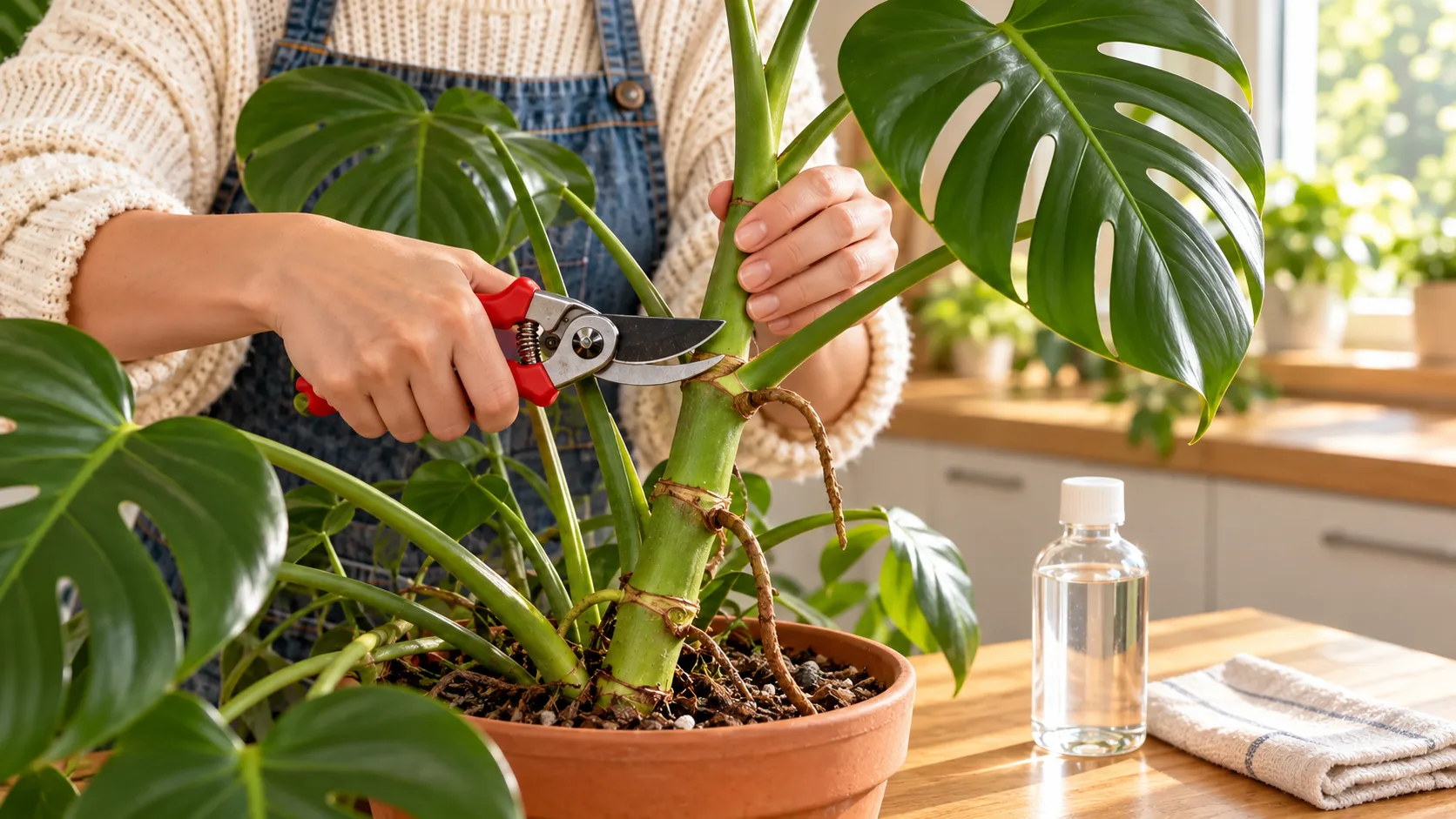
Always just above a node, about one centimeter (0.4 in) above it. The node is the swelling on the stem where a leaf stalk and an aerial root emerge.
This is not arbitrary. The node contains tissue capable of new growth; the internode, the smooth section between two swellings, does not. Cutting in the middle of an internode leaves a bare section above the last living node: it dries, blackens for several centimeters (a few inches) and has to be cut back later.
An adult monstera has a thick, fibrous stem: pruning shears work better than scissors, which crush the fibers instead of slicing through them.
Tools and hygiene
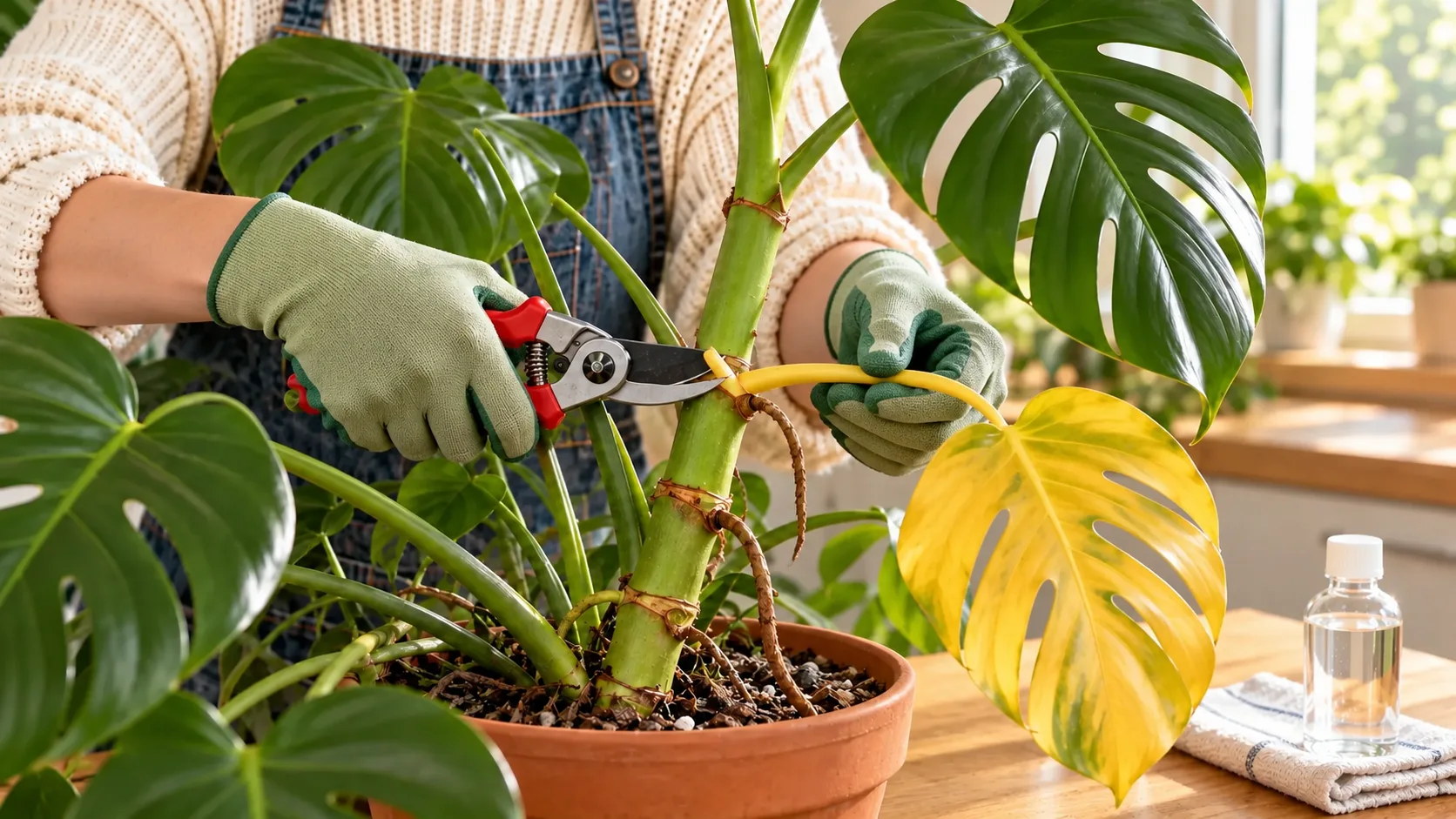
Clean pruning shears, disinfected with 70% alcohol before each cut, and gloves.
There are two reasons not to skip these steps. First, a dirty blade carries bacteria from plant to plant and turns a clean cut into an entry point. Second, the sap. Monstera belongs to the Araceae family, whose tissues contain needle-like calcium oxalate crystals. Sap that beads on the cut irritates skin and mucous membranes.
Which leaves to remove
Yellow, dry or torn leaves. Cut the leaf stalk at its base, one centimeter (about 0.4 in) from the stem.
A completely yellow leaf will not turn green again: the plant has already reclaimed its reserves. Leaving it in place adds nothing and occupies a well-lit position. A dry leaf or one with browned edges is removed in the same way.
The exact technique matters more than you might think: do not pull the stalk off, or you will tear a strip from the stem. Cut it short and leave the stub to dry; it will drop off by itself.
A leaf that is still green, even with holes or few splits, remains productive. If your monstera produces small leaves without fenestrations, the problem is light or support, not a lack of pruning: providing support encourages large split leaves, not the shears.
An oversized plant: top it and take a cutting
Cut the main stem just above a node at a height that suits you. This is topping, and it is the only real response to a giant monstera reaching the ceiling.
What happens next is predictable. The part left in the pot regrows from the node nearest the cut, often with two shoots instead of one, filling it out lower down. The top you have removed carries one or more nodes: it roots readily in water or potting mix, following the method in the propagation guide.
Anticipate two points. The cut stem can take four to eight weeks to show any new growth, without cause for concern. And if you cut very low, leave at least two or three leaf-bearing nodes on the base: a bare stump regrows, but slowly.
Aerial roots
Do not cut them off automatically. These brown cords emerging from nodes anchor the plant and absorb water. They let monstera climb tree trunks in its native habitat.
There are three options, in this order:
- Guide them towards the support, laying them against the moss or coir. They attach within a few weeks and feed the plant directly.
- Push them into the potting mix if they hang low enough. They then become ordinary feeding roots.
- Cut off one or two, only if they trail on the floor and are genuinely in the way. Cut close to the stem without cutting into the node.
What you cannot do is strip them all away: the plant loses its anchorage and climbing ability, then compensates by producing new aerial roots in the same places.
Roots inside the pot
Only trim them when repotting, and only the soft roots. A healthy root is firm and pale, from white to beige; untangle it by hand without cutting.
A brown root that feels soft or hollow when pressed is dead: cut it with clean shears until you reach firm tissue. A root spiraling tightly around the root ball can be scored vertically to encourage outward growth.
The limit is no more than a quarter of the root system removed at once. Beyond that, the remaining foliage is no longer adequately supplied and the plant drops leaves for weeks.
What pruning will not do
It will not turn a bare-stemmed monstera into a bushy plant. Stems bare for 40 cm (about 16 in), with a few leaves at the top, result from low light or a missing support. Cutting above the bare section does not make leaves grow beneath it.
Nor does it speed growth. A pruned monstera starts again with less leaf area than before and needs a few weeks to regain its rhythm.
The only real increase in fullness comes from topping, which wakes lower nodes, and planting the resulting cutting in the same pot as the parent plant. Two stems in one pot give a volume that pruning alone will never produce.
Frequently asked questions
When should you prune a monstera?
From early spring into early summer, through late June in the northern-hemisphere conditions of this guide, while growth is resuming. The wound then closes in a few days and new growth follows. In midwinter, healing takes longer and the cut remains an entry point for rot, with no growth benefit in return.
How do you prune a monstera that has become too big?
Top it: cut the main stem just above a node at the height you want. The remaining part will regrow from that node or the one below, and the removed top becomes a cutting if it has a node. Never cut midway through an internode: the bare section above the node dries out and blackens.
Can you cut off a monstera leaf?
Yes, without harming the plant, provided you cut the leaf stalk at its base, one centimeter (about 0.4 in) from the stem. Remove yellow, dry or torn leaves first. An intact green leaf still feeds the plant: removing it for appearance alone slows growth.
Should you cut off a monstera’s aerial roots?
Not routinely. They provide anchorage and absorb water: it is better to guide them towards a support or into the pot. You can remove one or two that trail on the floor without troubling the plant, but removing all of them takes away its support and ability to climb.
Can you trim a monstera’s roots inside its pot?
Only when repotting, and only roots that are soft, brown or hollow. Firm, pale roots are healthy and need only untangling by hand. Removing more than a quarter of the root system at once leaves the plant out of balance with its foliage.
Does pruning make a monstera bushier?
Not like a shrub. Monstera grows along a single stem and does not produce branches in response to pruning. It regrows from one or two buds below the cut, slightly filling out the lower plant without producing the dense regrowth of a cut-back shrub.