
When to prune olive trees and how to shape the canopy
Pruning an olive tree: when and how to open the canopy
Prune olive trees in local spring once all frost risk has passed, March to May in the Alpes-Maritimes source’s French calendar. Two figures guide the work: never more than 30% of foliage annually, and 3 to 5 main branches around an open center. Flowers form on last year’s wood: thin more than you shorten.
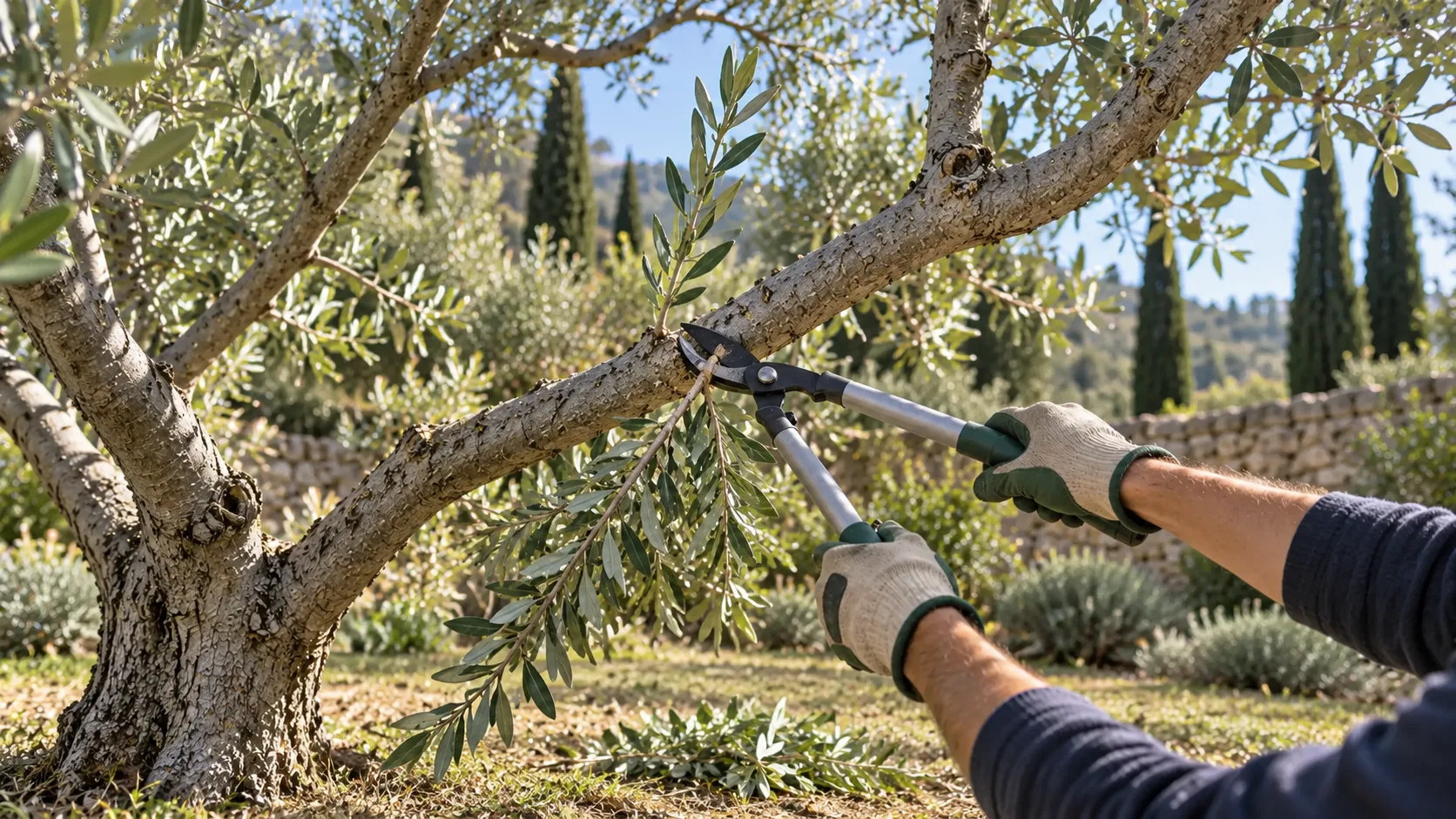
When should you prune an olive tree?
In local spring, once all frost risk has passed, March to May in the Alpes-Maritimes source’s French calendar: this is the window given by the Alpes-Maritimes Chamber of Agriculture, which notes that freshly pruned trees are cold-sensitive 1. France Olive also places annual pruning in early spring 2, as does the RHS 3.
- Main pruning
- March to Mayonce all risk of frost has passedSource: Chambre d'agriculture des Alpes-Maritimes
- Remove damaged growth
- July and AugustOlive tree with bacterial disease · in warm, dry weatherSource: UC Statewide IPM Program
- Avoid
- November and DecemberDuring harvestSource: Jardins de France (SNHF)
- Flowers form on
- Last year's woodSource: France Olive
- Maximum amount to remove
- 30% of the foliageSource: France Olive
| Conditions | January | February | March | April | May | June | July | August | September | October | November | December |
|---|---|---|---|---|---|---|---|---|---|---|---|---|
| Main pruning | no pruning | no pruning | Main pruning | Main pruning | Main pruning | no pruning | no pruning | no pruning | no pruning | no pruning | no pruning | no pruning |
| Olive tree with bacterial disease | no pruning | no pruning | no pruning | no pruning | no pruning | no pruning | Remove damaged growth | Remove damaged growth | no pruning | no pruning | no pruning | no pruning |
| During harvest | no pruning | no pruning | no pruning | no pruning | no pruning | no pruning | no pruning | no pruning | no pruning | no pruning | Avoid | Avoid |
Waiting for growth has another reason: when vegetation restarts, flower buds become distinguishable from growth buds, so you know what you are cutting 4. The International Olive Council (IOC) gives a wider window, in winter, between harvest and budbreak, delaying it where winters are cold 5.
Avoid three times, each for a specific reason:
- Too early in frost-prone areas. Pruned trees restart sooner than untouched trees, exposing young growth to spring frost 6. Cutting just before cold also encourages ice formation in cells near the wound 5. Waiting lets pruning respond to any frost damage 6.
- During harvest, November and December in the French source’s seasonal example: the following year's flower induction is underway 4.
- After budbreak: the tree has already mobilized winter reserves from roots and large branches, and cutting weakens it 5. Avoid major pruning in extreme heat too 1.
Rainy autumns and winters add a risk: olive knot infects trees from fall to late spring through rain and pruning tools 7. Prune an already affected olive separately, in hot, dry summer weather, and last 7; the University of California management program specifies July and August 8.
How much should you remove annually?
Never more than 30% of foliage in annual pruning, says France Olive, maintaining a good balance of leaves and wood 2. Jardins de France, the SNHF journal, sets the limit at a third of leaf area and rejects severe pruning except during training 4.
Sources differ more on frequency. France Olive considers annual pruning essential against peacock spot because it circulates air through foliage 9, noting that alternate-year pruning sustains leaf fungi through poor ventilation 10. IOC-reported trials give another perspective: yields were markedly better with light pruning than moderate or heavy pruning. Moderate pruning reduced yield when annual, but worked well every two or three years 5. The same chapter warns that the longer the cycle, the more wood must be removed at once 5.
The approaches share one point: for a garden olive, light pruning each spring meets both France Olive's airflow requirement and the moderation measured by IOC.
Read the wood before cutting
Olive flowers form on one-year-old wood, in leaf axils 11. A shoot bears only once: Jardins de France states that a shoot that has fruited will never fruit again
, recommending cutting it back to a younger branch 4. The University of Florida puts it differently: olive never fruits twice at the same place on a stem, hence its need for new shoots annually 12.
Two clues can be read on shoots, again from Jardins de France 4:
- A small black mark in a leaf axil: the scar of a harvested olive's fruit stalk. That shoot has already borne.
- Rounded buds, like tiny cauliflower florets, indicate flowers; pointed buds produce wood. Keep two or three growth shoots per secondary limb.
The most productive shoots are around 25 cm (10 in) long; those from 15 to 50 cm (6 to 20 in) remain effective 5. Shortening all last year's growth means cutting off the next crop: thin far more than you shorten.
Where to cut: above a replacement shoot
Just above a vigorous shoot that will take over: this is the basic olive cut. IOC shortens exhausted fruiting branches above vigorous shoots that eventually replace them 5. France Olive similarly cuts old, bare, hanging shoots back to new growth on the arch 2.
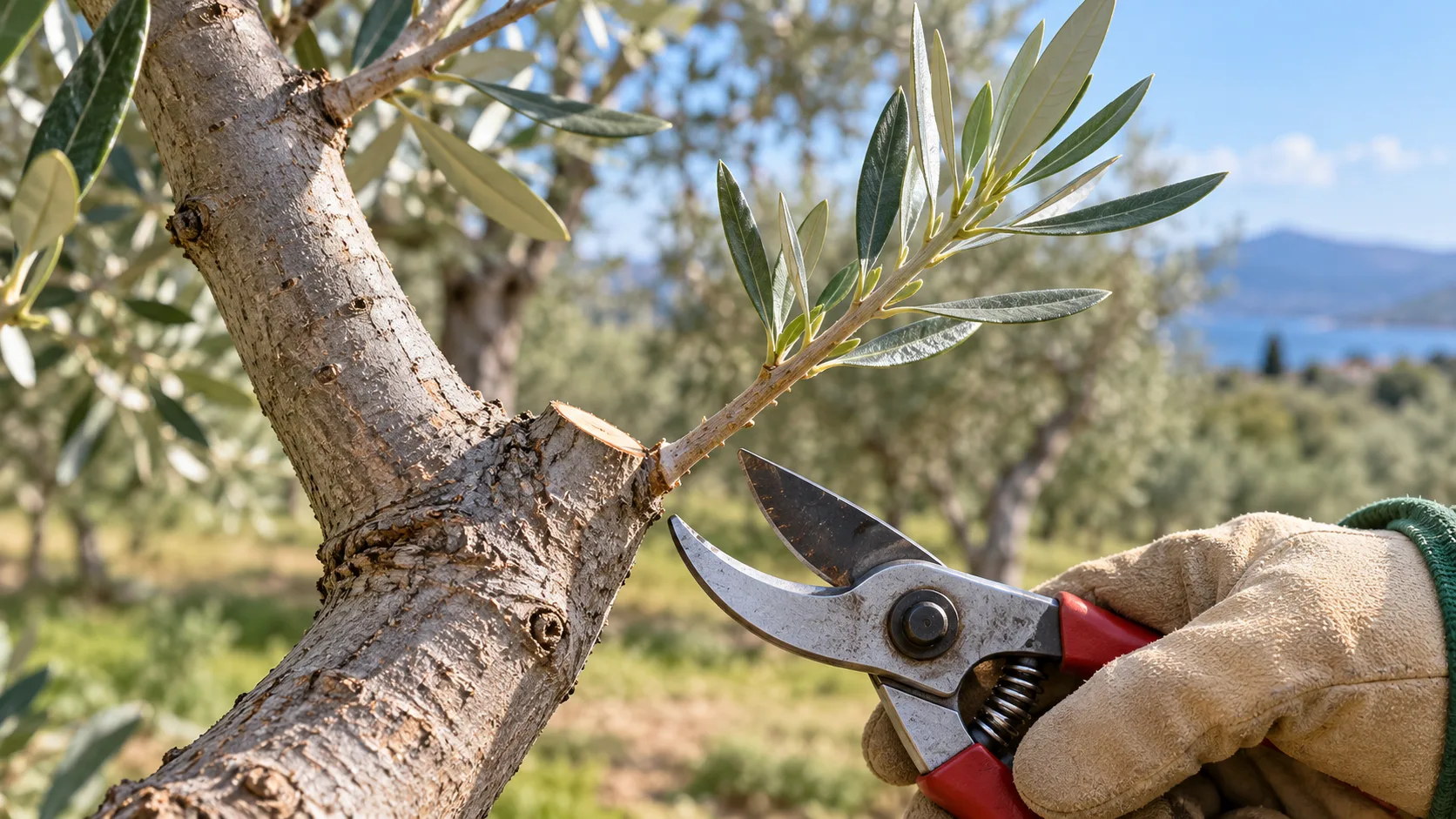
- At an angle, with a sharp tool, allowing water to drain and the wound to close 5.
- Without cutting into the supporting branch or leaving a stub, aiding healing according to IOC 5. The Alpes-Maritimes Chamber of Agriculture instead leaves a short stub as long as the cut's radius 1: both practices exist.
- Outwards: adjust height by finishing above a branch facing away from the center 4.
A large branch
For thick branches, the RHS uses two stages, an undercut followed by a cut from above, preventing weight from tearing bark 13. Make the final cut just beyond the branch collar, never flush with the trunk: this is the tree's protective, healing zone 13. For thinning, cut back to the trunk, a larger branch, or a side branch at least a third of its diameter 13.
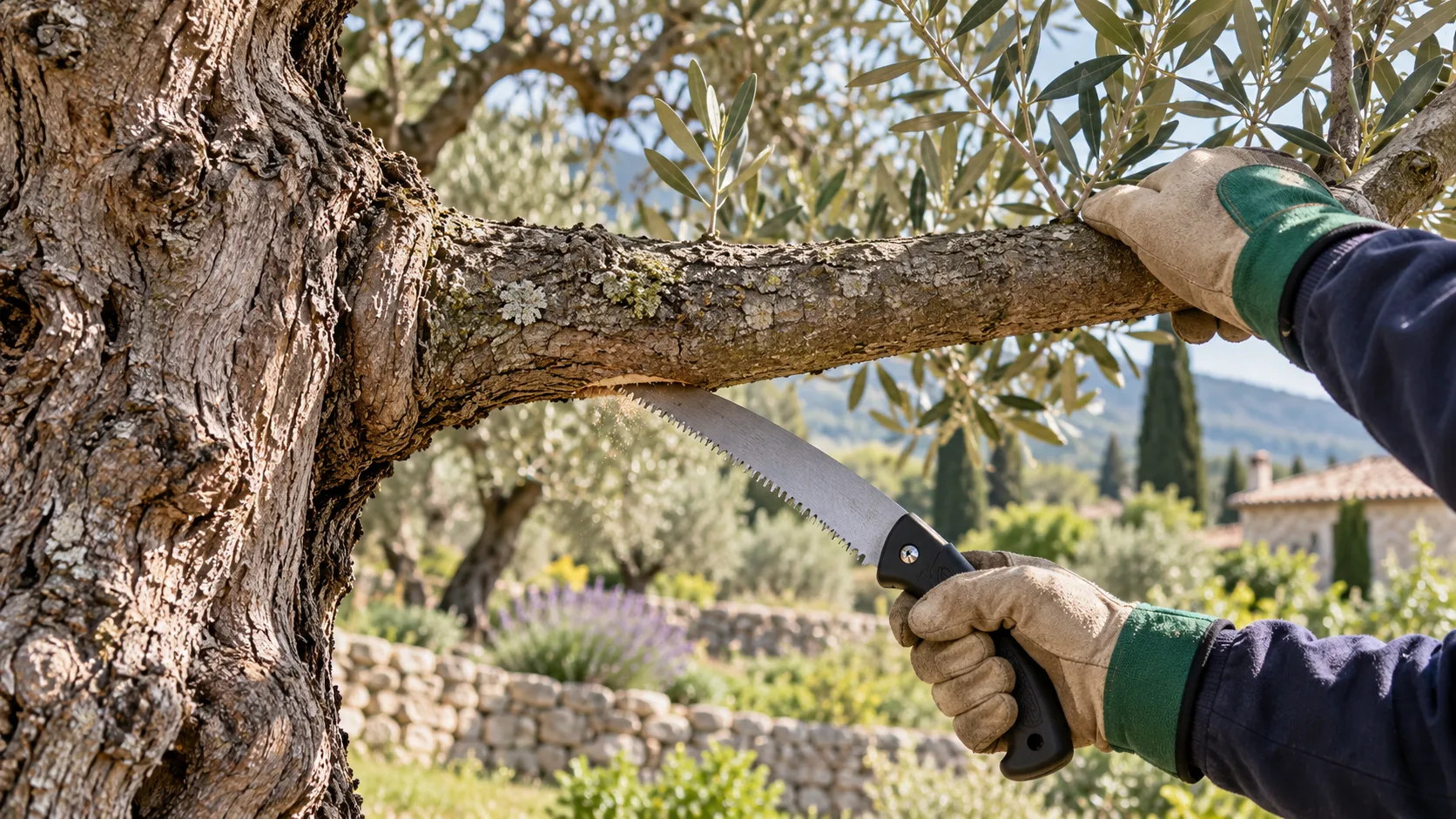
Wound dressings divide sources. France Olive recommends healing paint on large cuts in orchards exposed to olive knot 7, and IOC considers a coating useful on very large wounds 5. The RHS uses none: dressings do not protect against disease and even seem to slow healing 13 14.
Pruning a mature olive, step by step
Jardins de France reduces pruning of a trained olive to three actions, IOC to five; their order overlaps 4 5.
- Large cuts first, with a saw or power pruner. Keep 3 to 5 main limbs evenly distributed, with the trunk as the central axis of a symmetrical outline 2.
- Open the center. Remove watershoots from the center and tops of main limbs: this makes the light well 2. IOC leaves a few weak shoots to shade the interior 5.
- Set the height. Shorten overly tall branches evenly 2, leaving no vigorous shoot at a branch tip that would drive it upwards 5.
- Improve airflow. Remove upright, crossing, obstructive and duplicate shoots:
a place for every shoot
1. - Renew shoots that have fruited, cutting back to younger branching. Jardins de France does not require this annually, but it is the longest and most skilled task 4.
- Remove basal suckers at their attachment 5. IOC’s seasonal example allows removal from August, without waiting for winter; follow local growth and season 5.
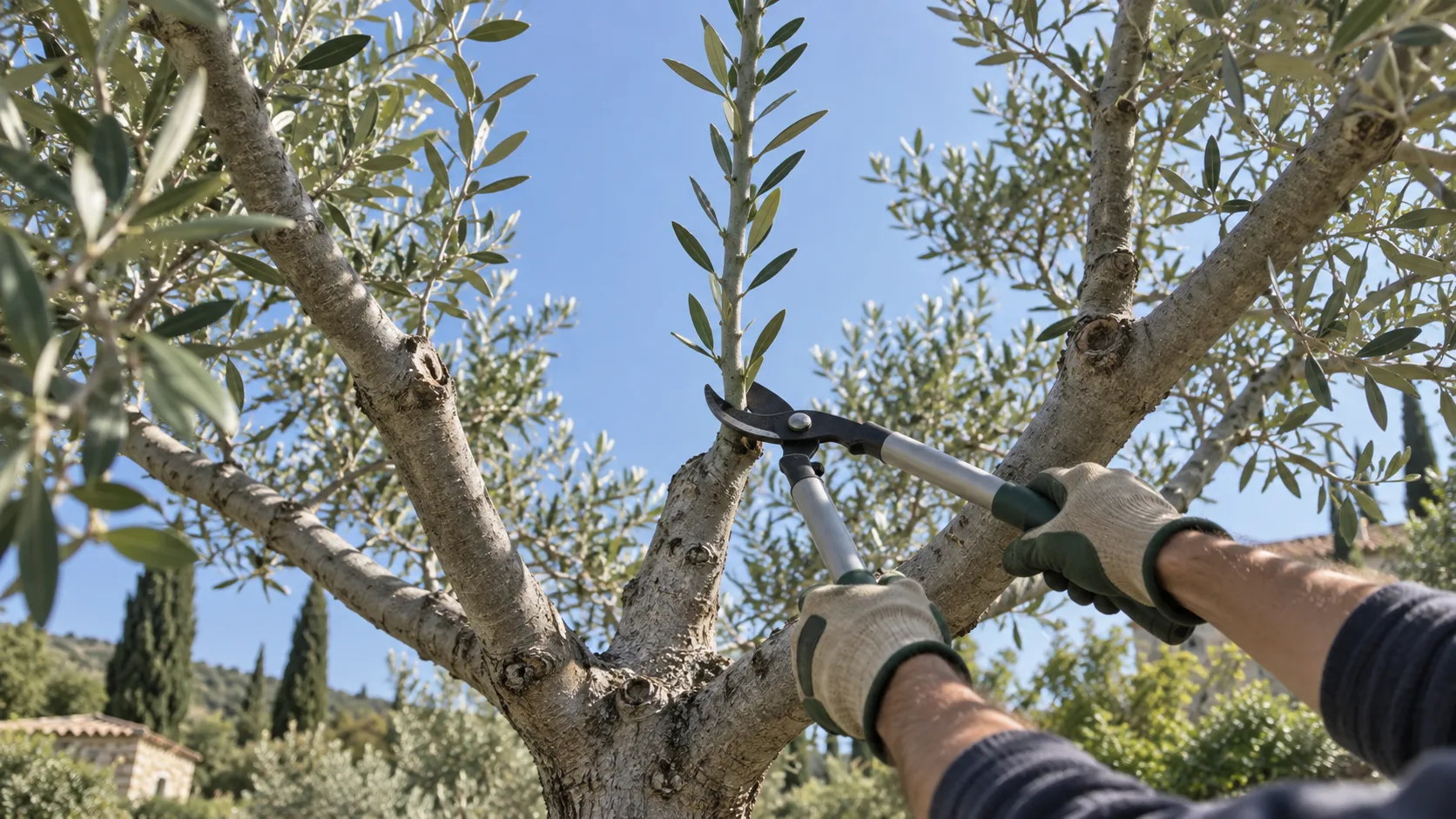
One limit applies throughout: do not strip the upper sides of main limbs bare. Bark suddenly exposed to full sun can scorch 2, and exposed wood ages prematurely 1.
Training a young olive
Minimal pruning in early years is the shared rule, because hard pruning boosts vigor and delays fruiting 5. The training calendar from France Olive and IOC:
| When | Action |
|---|---|
| At planting | Clear the lowest 20 centimeters (8 in), without cutting too close to the trunk; an overly tall plant may be cut to 1.2 m (4 ft) to initiate future main limbs 15 |
| Years 1 and 2 | Control only shoots along the trunk and at its base 5; light pruning, limited to branches in the lower third 15 |
| Years 2 and 3 | Allow free growth, then choose main limbs 5; spread them while flexible and prune lightly a year later 5 |
| Seasons 4 and 5 | Correct shape and remove surplus main limbs 5 |
Three rules accompany the calendar. Keep the central leader, otherwise cropping may be delayed 15. Remove downward-facing branches over 2 cm (0.8 in) in diameter, which have no future 15. Do not choose two main limbs arising at the same point: they tend to break 5.
Trunk height depends on use. France Olive clears 60 to 80 cm (24 to 31 in) below the first main limbs 15; IOC trains orchard vase shapes on 1 to 1.2 m (3.3 to 4 ft) trunks for mechanical harvest 5. Sources also differ on pinching: unnecessary for France Olive 15, used by IOC to initiate main limbs 5.
Lowering an over-tall olive
Gradually, cutting each large branch just above a preselected side branch 5. Shorten secondary branches more strongly the higher they sit; a tree rising through several forks is cut above the first, keeping 3 to 4 main limbs to rebuild the canopy 5.
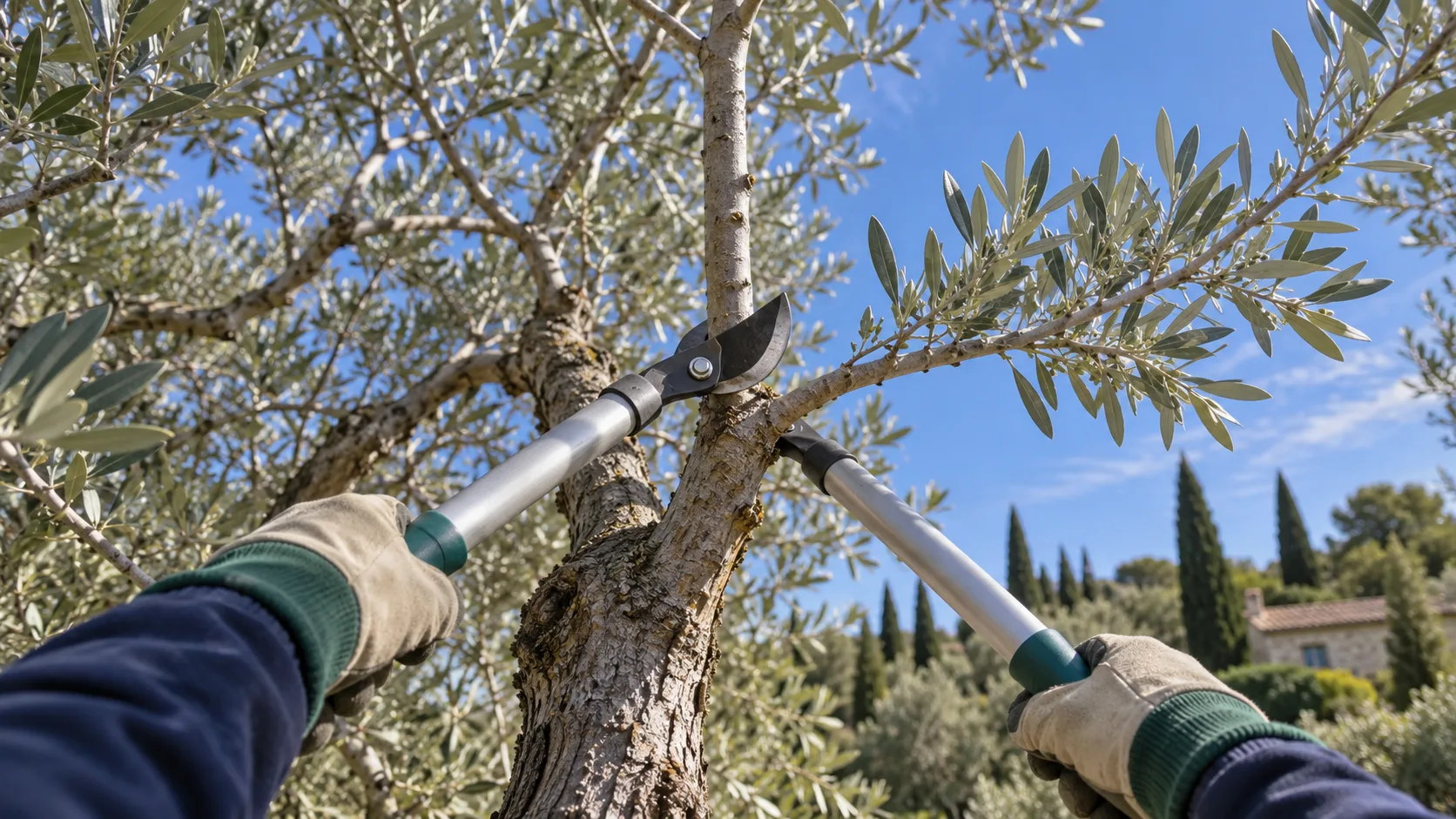
Olive tolerates cuts into old wood thanks to many adventitious buds at its base and on branches 5. The University of Florida confirms its response to radical pruning, warning that it reduces flowering and olives 12.
The trap is cutting everything in one year: regrowth becomes juvenile and takes 4 to 5 years to bear 5. IOC describes two gentler methods. One treats one branch at a time, waiting for regrowth to fruit before cutting the next. The other leaves part of the crown unpruned, calming new growth and limiting crop loss 5.
A safety guide applies to every tree: if branches are thicker than your wrist or work requires prolonged ladder use, the RHS recommends an arborist 14.
A potted olive
To maintain a potted olive's size, the RHS shortens main-limb tips annually, above good replacement shoots 3. Under glass, this containment pruning happens in spring 16. Otherwise follow in-ground rules: one-year-old wood, limited foliage removal and an open center.
Diamètre du pot, terre, arrosage d'été et abri d'hiver : growing an olive tree in a pot demande des gestes que la pleine terre ignore.
Ball, cloud or tiered shapes?
Neither France Olive, IOC nor RHS describes a method for pruning olives into balls, clouds or tiers. Jardins de France even advises rejecting so-called cloud pruning 4. IOC explains the logic: the further a shape departs from natural habit, the more severe cutting it needs and the less it produces 5.
For small evergreen trees with regular shapes generally, rather than olive specifically, the RHS uses overall trimming in spring or summer, annually or every other year 14.
After frost: wait before cutting
Scratch the bark and inspect the wood color: green beneath means wait for growth; brown means cut back to just above the green part 6. IOC adds a test: a branch with detached bark sounds hollow when tapped 5. What follows depends on the tree's signs.
| What you see | Action |
|---|---|
| Less than 20 to 25% leaf loss | Barely visible effect: normal pruning is enough 5 |
| Greater leaf loss, healthy bark | Remove frozen shoots and thin before budbreak 5 |
| Split bark on one- or two-year-old wood | Cut back to main limbs; restarting buds confirm what lives, in late April in IOC’s seasonal example 5 |
| All leaves lost, bark intact | Wait for regrowth to see what lives, then prune, in May in IOC’s seasonal example 5 |
| Split bark on main limbs and trunk | Cut the tree back around ten centimeters (4 in) below ground level to trigger suckers 5 |
Leaves fall around −6 or −7 °C (21 or 19 °F) when petioles freeze, long before branches die 5. In subsequent seasons, France Olive removes basal suckers the following summer, unless they are the tree's only growth, then roughly every other watershoot in the crown the next spring, to improve airflow 6.
Pour éviter d'en arriver là, voile, paillage et local hors gel : overwintering an olive tree se décide selon le pot et la région.
Tools and hygiene
IOC prefers bypass pruning shears to anvil types: cuts are cleaner and do not crush wood. Long-handled loppers cut up to 5 cm (2 in) diameter, a handsaw up to 7 to 10 cm (2.8 to 4 in), while chainsaws are reserved for rejuvenation and very large branches 5. The Chamber of Agriculture reminds us that good pruning first protects the person pruning
: gloves, eye protection and care on ladders 1.
Blades carry disease between trees, and each pruning wound is an entry point 17. Against olive knot, France Olive sets four rules 7:
- No pruning in wet weather, or when rain is forecast in following days.
- Disinfect tools between trees in 10% bleach solution.
- Diseased trees last.
- No muddy shoes in the tree: mud brings bacteria directly to wounds.
The University of California goes further when rain-time pruning is unavoidable: brush blades and dip in 10 to 20% bleach solution before every cut 17. Olive knot galls are shown in plant galls, while branches drying suddenly in spring suggest Verticillium wilt, whose affected parts are also pruned last with disinfected tools 18. The reasoning is detailed in sanitation pruning.
Pour chaque maladie, le cycle et le moment d'intervenir : olive diseases se jouent avant les pluies.
What to do with cut branches
No garden bonfires. In France, burning your garden waste at home is prohibited, outdoors or in an incinerator, with a €750 fine; only the prefect may grant exceptional permission to eradicate an epidemic 19.
- Healthy wood can be shredded on site but not buried 7: shredded, it makes mulch.
- Wood affected by olive knot is burned in professional orchards, or composted if the heap gets hot enough 7; in gardens, it therefore goes to a waste collection center or a compost heap reaching high temperatures.
- Freshly cut wood attracts a small bark beetle that lays eggs there: IOC asks for storage far from olive trees 5.
Spring shoots are not the best cuttings: the RHS propagates olive in summer, using semi-ripe wood 16.
Prélèvement, substrat et reprise : taking olive cuttings se prépare dès le début de l'été.
Mistakes that cost a crop
Pruning during harvest, November or December in the French source’s seasonal example, while the next flowering is being prepared 4.
Shortening all one-year-old shoots: these carry flowers 11.
Removing more than 30% of foliage in one season 2, or rejuvenating everything at once, costing 4 to 5 years without olives 5.
Pruning a young tree hard, or removing its central leader: fruiting is delayed 5 15.
Pruning in wet weather, the best entry point for olive knot 7.
Pruning is only one annual task: watering, feeding, frost and disease are covered in the olive care guide, and the olive encyclopedia profile (Olea europaea) details botany and varieties.
Frequently asked questions
Can you prune an olive tree in September?
Not for structural pruning in the sources’ seasonal setting, where September is late summer. Follow local dormancy, budbreak and frost risk. None of the selected sources places it in September: France Olive and RHS specify early spring, IOC winter before budbreak. Two late-summer exceptions are removing basal suckers, possible from August in IOC’s seasonal example, and pruning olive-knot-affected trees in dry weather. Later, fall starts the season when olive knot spreads through tools, and cutting before cold increases frost sensitivity 5 7.
Can you leave an olive tree unpruned?
Yes, it lives, but becomes large and dense, its center bare, and carries more olives than it can feed: fruit stays small and alternate bearing worsens 5. Jardins de France sums it up: an unpruned olive prunes itself
, with less abundant, more alternating crops 4. France Olive considers annual pruning essential against peacock spot 9.
When should you prune an olive tree hard?
How do you give an olive tree a good shape?
Should you apply wound dressing to olive pruning cuts?
Sources disagree. France Olive recommends healing paint on large cuts in orchards exposed to olive knot 7, and IOC finds a coating useful on very large wounds 5. RHS uses none, considering dressings ineffective against disease and detrimental to healing 14. None requires dressing on a small, clean, angled, stub-free cut.