
Growing olive trees in containers: year-round care
Growing an olive tree in a pot
An olive tree can live for decades in a pot, provided you accept what the container changes: soil that dries in a few summer days, roots exposed to winter cold, and potting mix that wears out. Container, soil and winter shelter decide almost everything.
Yes, olive trees (Olea europaea) can grow in pots for decades, and the Royal Horticultural Society even considers them better suited to a large container than garden soil in a cool climate: outdoors in summer sunshine, brought into frost-free shelter for winter1. A pot gives mobility. In return it removes two protections the ground provides effortlessly: soil dries much faster, and roots feel cold before foliage does2.
Can it stay in a pot all its life?
Yes, because it grows slowly. The RHS gives a mature height of 4 to 8 m (13 to 26 ft), taking 20 to 50 years to reach it; NC State gives up to 9 m (30 ft) in the ground and classifies growth as slow34. In a pot, those figures do not apply: root volume limits the crown, and a restricted rootball slows growth by itself5.

To maintain the outline, the RHS recommends shortening main branches every year in early spring, cutting above a replacement shoot1. A terrace olive thus keeps its size for years without losing its habit. The principle applies to most container shrubs, and plant pruning explains it species by species.
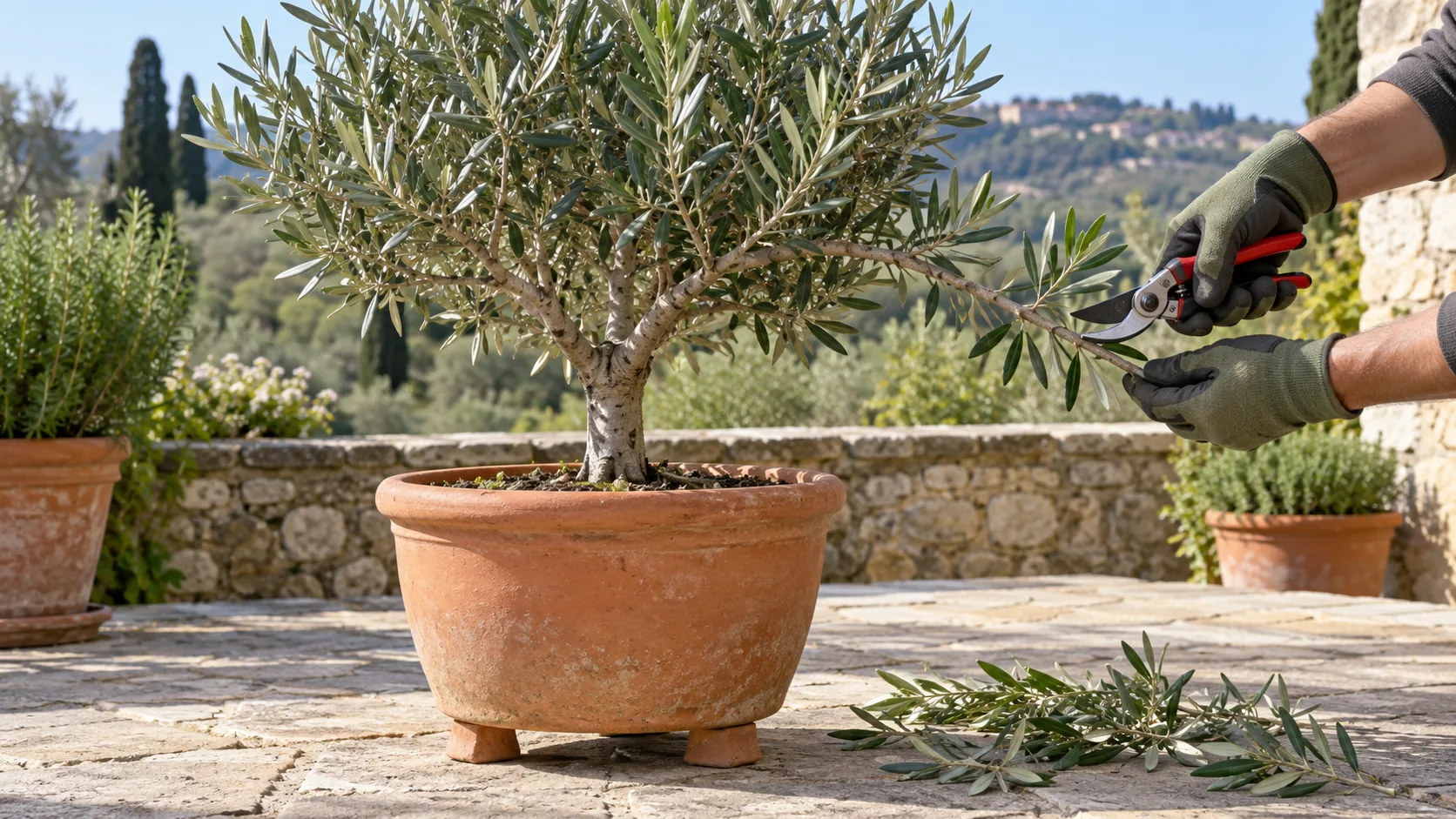
La coupe se place toujours au-dessus d'un départ vigoureux, jamais au milieu d'une branche nue : pruning an olive tree suit cette seule règle de position.
In return, potting mix decomposes and its level falls over the years5. Care shared by potted and in-ground trees, from pruning to disease, is covered in olive tree care; this page focuses on what the pot changes.
Which pot should you choose for an olive tree?
The RHS specifies a 30 to 35 cm (12 to 14 in) pot, or one wide enough to accommodate the roots comfortably1. That figure is for a young plant; an older tree moves up in stages when repotted. Drainage holes in the base are essential, whatever the material2.
| Material | What it changes | Watch point |
|---|---|---|
| Unglazed terracotta | Porous, dries quickly | May crack in winter: choose frost-proof pottery |
| Plastic | Lightweight, dries more slowly | Degrades in sunlight over the years |
| Metal | Unaffected by frost, long-lasting | Heats quickly in summer, becomes very cold in winter |
| Wood (half-barrel) | Traditional for fruit trees | Eventually rots: line with a bag pierced for drainage |
For terracotta, the RHS makes a useful distinction: prefer frost-proof pottery to merely “frost-resistant” pottery2. Metal withstands frost but transmits everything: summer sun and winter nights alike reach the roots, July and January respectively in the source’s seasonal example2.
Think about wind too. An olive carries a dense crown on a slender trunk, and a tall, narrow pot tips easily: a broad-based container in shelter avoids a fall2.
Variety matters as much as the pot. NC State describes 'Little Ollie' as compact and rounded, and 'Swan Hill' as flowerless and fruitless, leaving no olives on paving4. Fruiting varieties in the olive botanical profile, such as Arbequina and Picholine, fruit better with two varieties, as explained in choosing an olive variety4.
What soil does a potted olive need?
Olive wants mineral, gritty soil rather than light potting mix. The RHS recommends a gritty loam-based mix1; for growing under cover, its profile specifies John Innes No. 3 with added coarse sand3. In French garden centers, the equivalent is Mediterranean-plant potting mix mixed with loam and river sand. Chalk does not bother it: the RHS lists chalk among suitable soils3.
The mix
- Loam-based potting mix
- Grit
A layer of clay pebbles or gravel at the bottom does not improve drainage. Soil specialists have measured this for almost a century: water only moves from fine soil into coarse material once the fine soil is saturated6. The layer therefore creates a perched water table just beneath the roots, the opposite of the intended result. A uniform mix throughout, clear holes: that is where drainage happens.
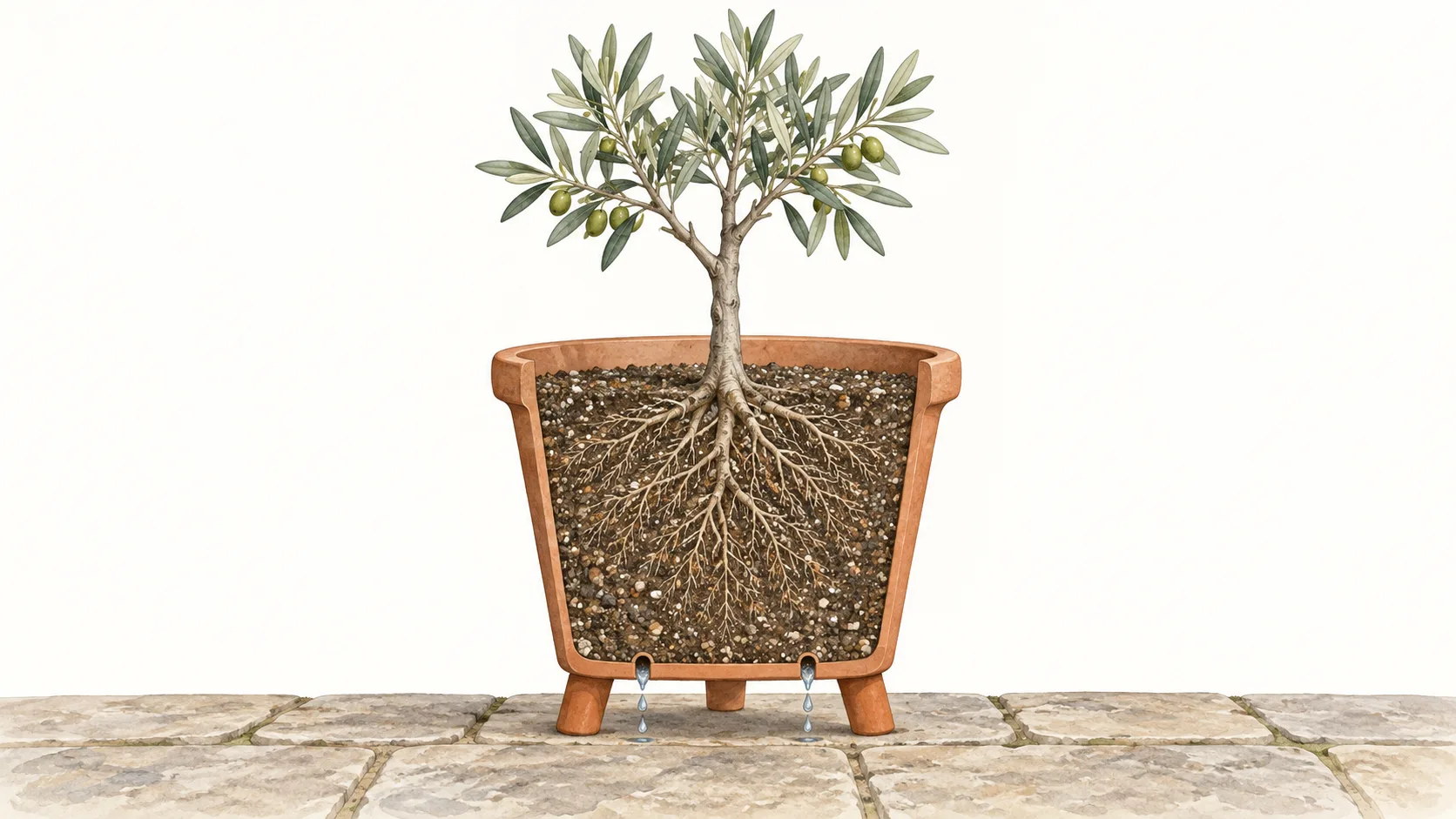
The effective drainage step happens beneath the pot. The RHS asks for pot feet to raise it so excess water can escape1. Olive growers put it another way: olive likes water that passes through, not water that stays
, and standing water can kill it by depriving roots of air7.
When and how should you plant an olive in a pot?
In local spring, outside frosty periods. In its French seasonal setting, France Olive places planting between and , depending on area, since a newly planted tree is vulnerable to frost below −6 °C (21 °F) during its first months9. For pots, make two choices before filling: pot feet and the final position, since a large full tub cannot be moved. The RHS also asks for slow-release fertilizer granules mixed into the potting mix1.
Planting itself, from untangling the rootball to watering it in, follows the same steps as repotting plants5.
Then place it in sun, sheltered from wind, ideally against a south-facing wall in the RHS’s UK growing context: this is the position it gives for olive3. To surround it on the same terrace, other plants for a south-facing position tolerate that sunshine readily.
Watering a potted olive through the seasons
A potted olive loses the advantage of deep soil. NC State calls it drought-tolerant once established, but a pot offers no reserve to draw on4. Its small, silvery foliage still places it among plants the RHS leaves longer between waterings8.
68 cL every 9 days
Water thoroughly as soon as the soil is dry down to one-third of the pot’s height
Check once a week; never water if frost is forecast
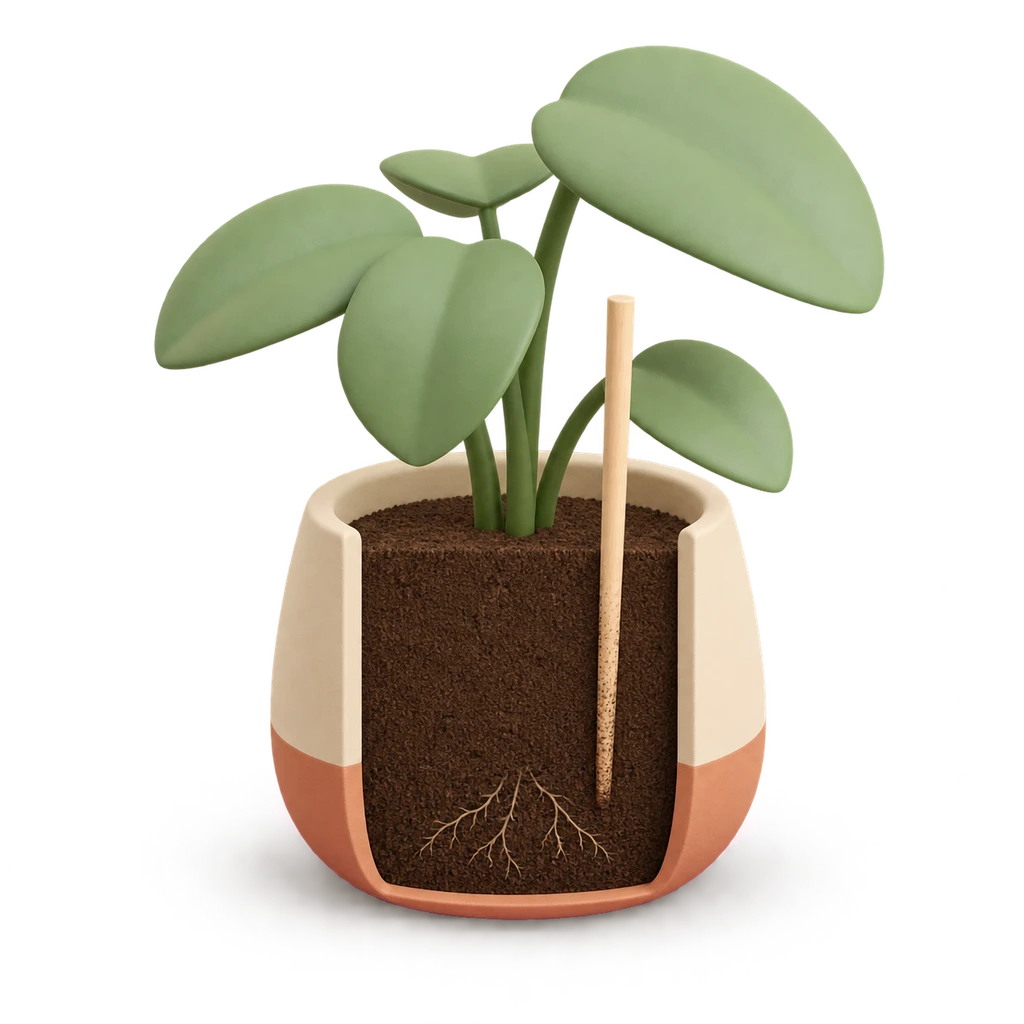
Potting mix dry to 15% of the pot height: still moist
The finger test
In a pot, push your finger one-third of the way down the pot: if it is dry at that depth, water; if it is still moist, wait.
There is no fixed frequency, only a test. Push a finger a third of the way down the pot: dry there means water; still moist means wait8. This is the general rule for watering plants in pots. A summer shower only wets the top few centimeters: test after rain too.
Water slowly, in one session: fill to the rim, let it soak in, repeat, and stop as soon as water appears at the holes. Water early in the morning or in the evening, onto soil rather than foliage8. In the RHS’s UK aspect example, a terracotta pot facing south or west in hot, windy weather dries far faster than a large north-facing pot8.
In winter, watering becomes rare but does not stop. An evergreen can be thirsty in dry, windy weather, especially under cover where rain cannot reach it: check once a week, and never water when frost is forecast10.
Leaves yellowing then falling while soil stays wet signal the opposite of thirst: root suffocation7. Overwatering details the signs, and yellow leaves helps rule out other causes.
Feeding a potted olive
Each thorough watering carries some nutrients out through the holes8.
- Fertilizer
- BalancedOrganic soil amendment, slow-release, liquidSource: France Olive
- Feeding
- During active growthBalanced liquid fertiliser · in a potSource: Royal Horticultural Society
- No fertilizer
- In winterfrom late summer to mid-spring · in a potSource: Royal Horticultural Society
- No fertilizer
- In autumnNo nitrogen · an autumn application increases vulnerability to frostSource: France Olive
- Frequency
- Once a month during growthin a potSource: Royal Horticultural Society
- Avoid
- Excess nitrogen, exceeding the dose on the label, fresh manureSource: France Olive
For a shrub permanently in a tub, the RHS uses controlled-release fertilizer, applied at planting, top-dressing or repotting10. If olives are the aim, it adds monthly balanced liquid feed during growth1.
The French profile’s calendar for its source climate puts the window from to , with none in winter: follow active growth locally. In its UK seasonal context, the RHS suspends feeding after late summer until mid-spring10. A deficiency or, conversely, excessive salts in potting mix can be identified using the pages grouped under plant fertilizers.
Un excès d'azote donne des pousses molles et peu de fleurs : feeding an olive tree se choisit selon qu'on veut des feuilles ou des fruits.
Protecting a potted olive in winter
The tree is hardy; its rootball much less so: in a pot, roots die around −6 °C (21 °F), while leaves tolerate around −12 °C (10 °F)11. Bring it into a frost-free, bright, cool room, or leave it outdoors tight against a wall, branches fleeced, on pot feet and sheltered from prolonged rain110.
- Bring indoors
- Before the first frostsFrost-free room · in a potSource: Royal Horticultural Society
- Move back outside
- After the last frostsin a potSource: Royal Horticultural Society
- Protect
- In winterThick winter fleece · provides about 2 °C (about 4 °F) of extra protection · in a potSource: Royal Horticultural Society
- Protect
- In winterPots grouped against a wall · saucers removed, sheltered from prolonged rain · in a potSource: Royal Horticultural Society
- Protect
- Before the first frostsGrass kept short at the base · dense grass cover intensifies the cold · in the groundSource: France Olive
- Light
- A bright roomSource: Royal Horticultural Society
- Winter watering
- Check once a weeknever water if frost is forecastSource: Royal Horticultural Society
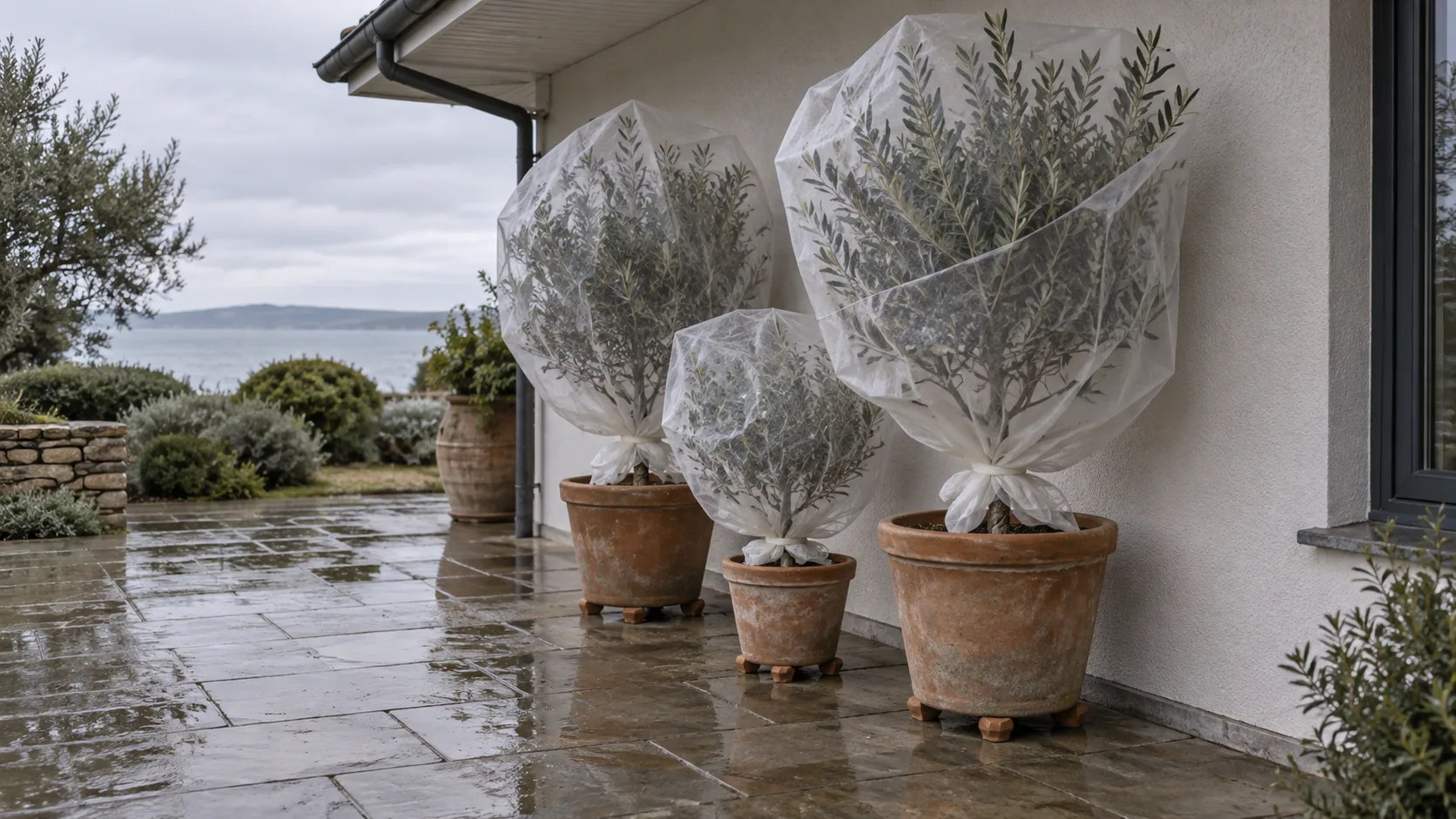
Entre la véranda, le garage et le mur sud, chaque abri a ses limites : overwintering an olive tree se décide selon la température la plus basse de votre hiver.
Repotting or top-dressing a potted olive
Repot an olive every few years, rather than every spring, preferably in spring as growth resumes5. The size rule is strict: the new pot should be no more than a third larger; below 25 cm (10 in) diameter, aim for 2.5 to 5 cm (1 to 2 in) extra, no more5. An oversized pot holds soil no roots are drinking from, and that is where rot develops.
- When to repot
- In springwhen growth resumes, not every year · in a potSource: Royal Horticultural Society
- Pot diameter
- 30 to 35 cmYoung plantSource: Royal Horticultural Society
Once a pot becomes too large to move, two options avoid changing containers. First: root pruning, removing up to 15% of the rootball every few years5.
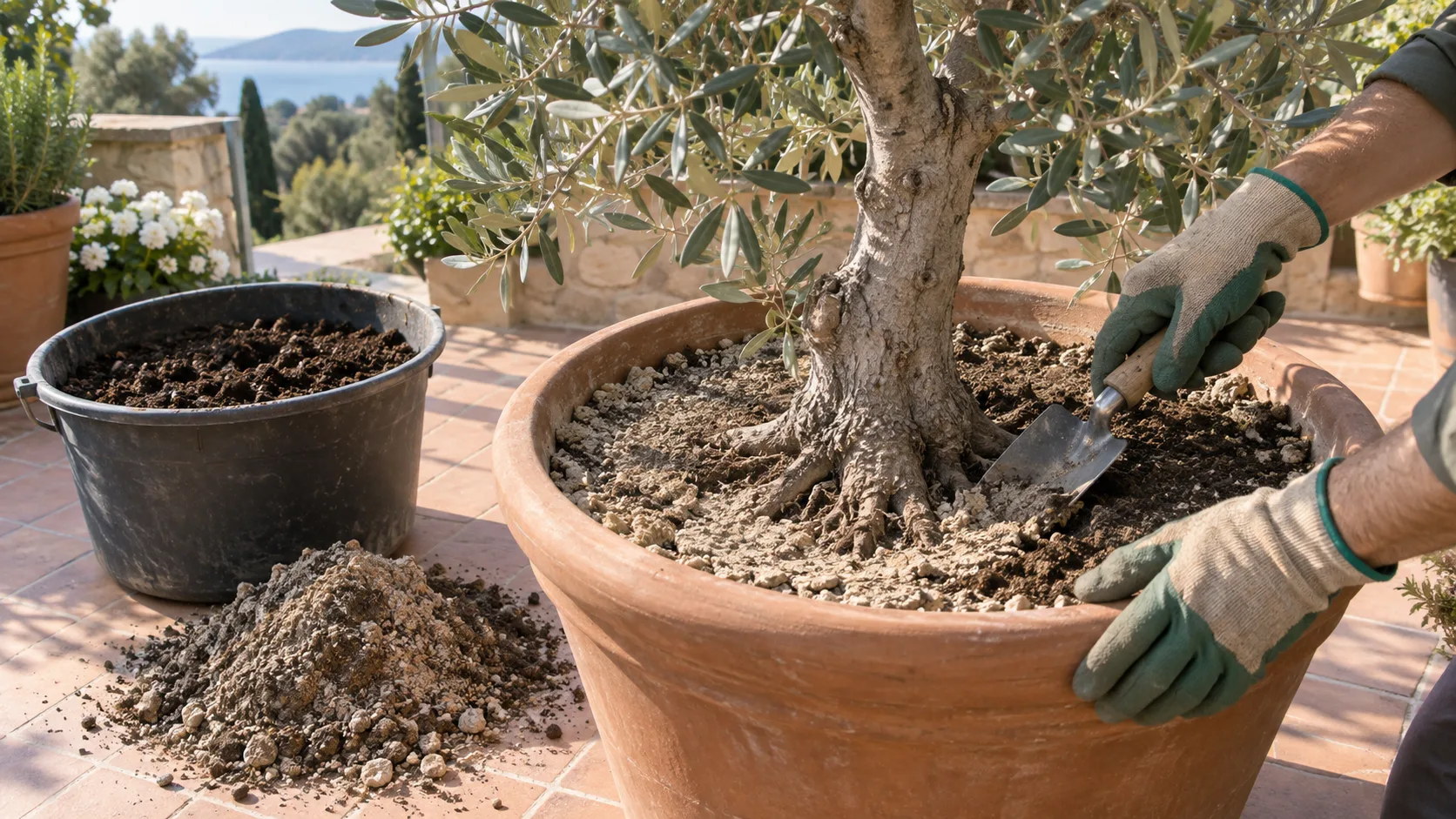
The gentler second option is top-dressing: removing old soil from the top and sides of the rootball and replacing it with fresh mix5. In years without repotting, this maintains the reserve; refreshing potting mix explains the method.
Frequently asked questions
What are the drawbacks of a potted olive tree?
Three manageable constraints: summer watering, because a pot's reserve is small; protecting roots from winter frost; and renewing depleted soil. NC State also notes scale insects and root rot as possible problems4.
Can a potted olive stay outdoors in winter?
How long can an olive tree live in a pot?
Decades, provided soil is renewed and the rootball protected from frost. Olive grows slowly: the RHS allows 20 to 50 years to reach mature size3, and France Olive places adulthood in the ground between 35 and 150 years, sometimes several centuries depending on care12. In pots, repotting, top-dressing5 and root freezing around −6 °C (21 °F)11 are the main deciding factors.
How can I tell if a potted olive needs water?
The most reliable test is a finger: dry soil a third of the way down means watering is needed8. Weight helps too. A pot easily lifted the day after hot weather has already used its reserve. If the rootball has dried right through, water stress describes signs and recovery.
Why is my potted olive losing its leaves?
Does a potted olive need sun?
Yes, in full sun, sheltered from wind, ideally near a south-facing wall in the RHS’s UK growing context3. In shade it grows poorly and flowers little.