
Olive tree cuttings: when and how to take them
Olive cuttings: semi-ripe wood, July to September in the RHS calendar
Take olive (Olea europaea) cuttings when current-year shoots have hardened bases and flexible tips, July to September in the RHS’s UK seasonal calendar. A 10 to 15 cm (4 to 6 in) cutting cut below a leaf and kept under humid cover in sandy mix reproduces the variety exactly, whereas a seedling differs from its parent. Success depends strongly on variety: some root almost universally, others almost never.
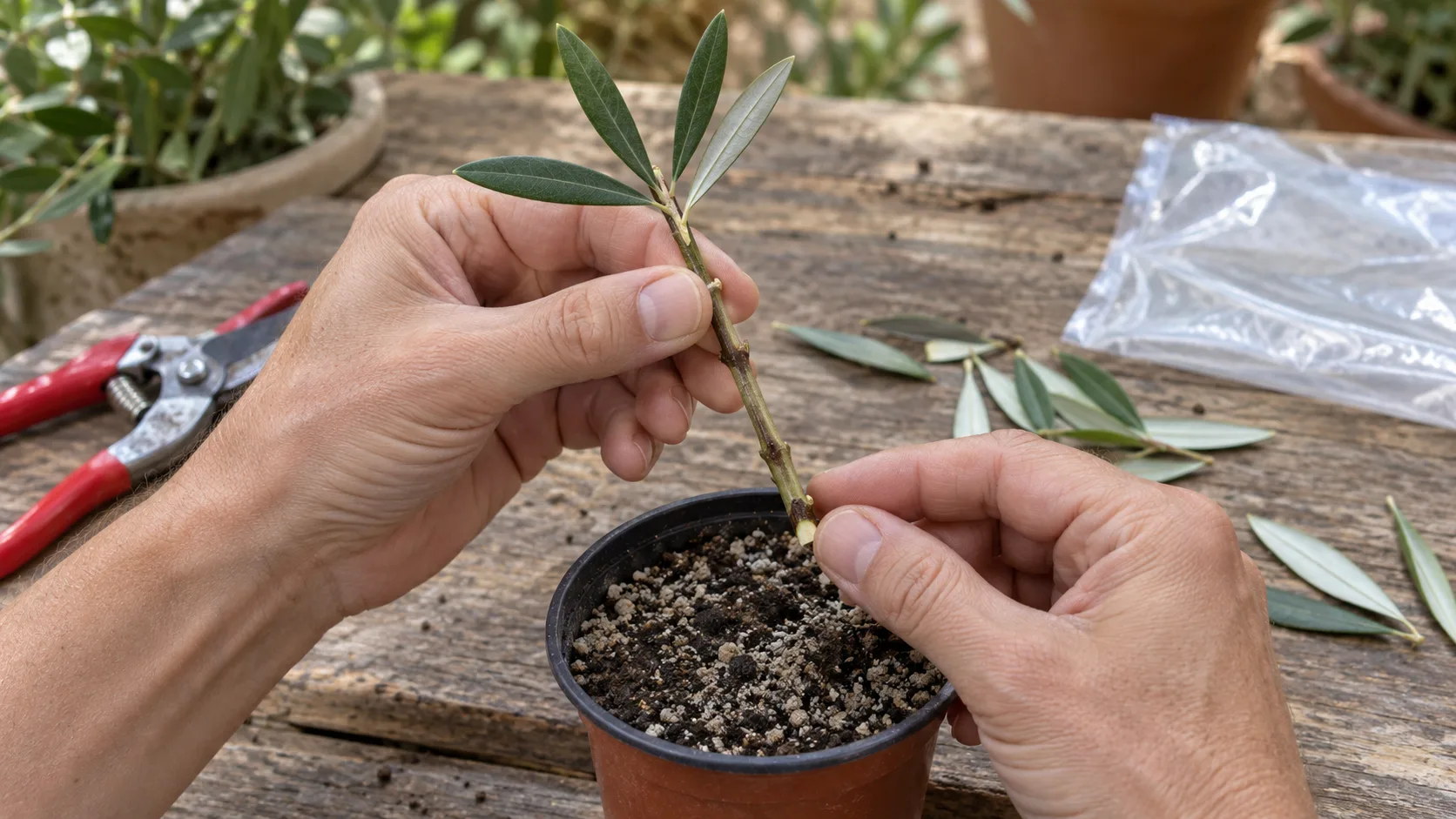
When should you take olive cuttings?
When current-year wood is semi-ripe: July to September in the RHS’s UK calendar. The RHS lists olive among trees propagated by semi-ripe cuttings in summer1, and its cutting guide places this stage from to : the shoot base is firm, the tip still soft2.
- Semi-ripe cutting
- July to SeptemberCurrent season’s shoot · firm at the base, with a tip that is still flexibleSource: Royal Horticultural Society
- Sowing seed
- In springat 13–15 °C (55–59 °F)Source: Royal Horticultural Society
| Conditions | January | February | March | April | May | June | July | August | September | October | November | December |
|---|---|---|---|---|---|---|---|---|---|---|---|---|
| Current season’s shoot | no propagation | no propagation | no propagation | no propagation | no propagation | no propagation | Semi-ripe cutting | Semi-ripe cutting | Semi-ripe cutting | no propagation | no propagation | no propagation |
Before midsummer the shoot is still softwood; after mid-fall the wood has hardened, and hardwood cuttings take over2. Summer cuttings generally need no bottom heat, whereas fall cuttings root faster in a heated propagator2.
Why cuttings rather than seed? France Olive includes woody and semi-herbaceous cuttings among cloning techniques preserving cultivars exactly3: the resulting olive bears the same olives as its parent.
Which shoot should you take for an olive cutting?
A healthy current-year shoot, preferably horizontal, with closely spaced leaves. The RHS rejects damaged, diseased or atypical wood and over-vigorous growth2. On olive, this excludes long, widely spaced central watershoots in favor of side shoots with short internodes.
- When: morning, to avoid wilting2.
- How: sharp pruning shears, then shoots straight into a plastic bag, in shade or the fridge in very hot weather2.
- Deadline: pot up cuttings within 12 hours2.
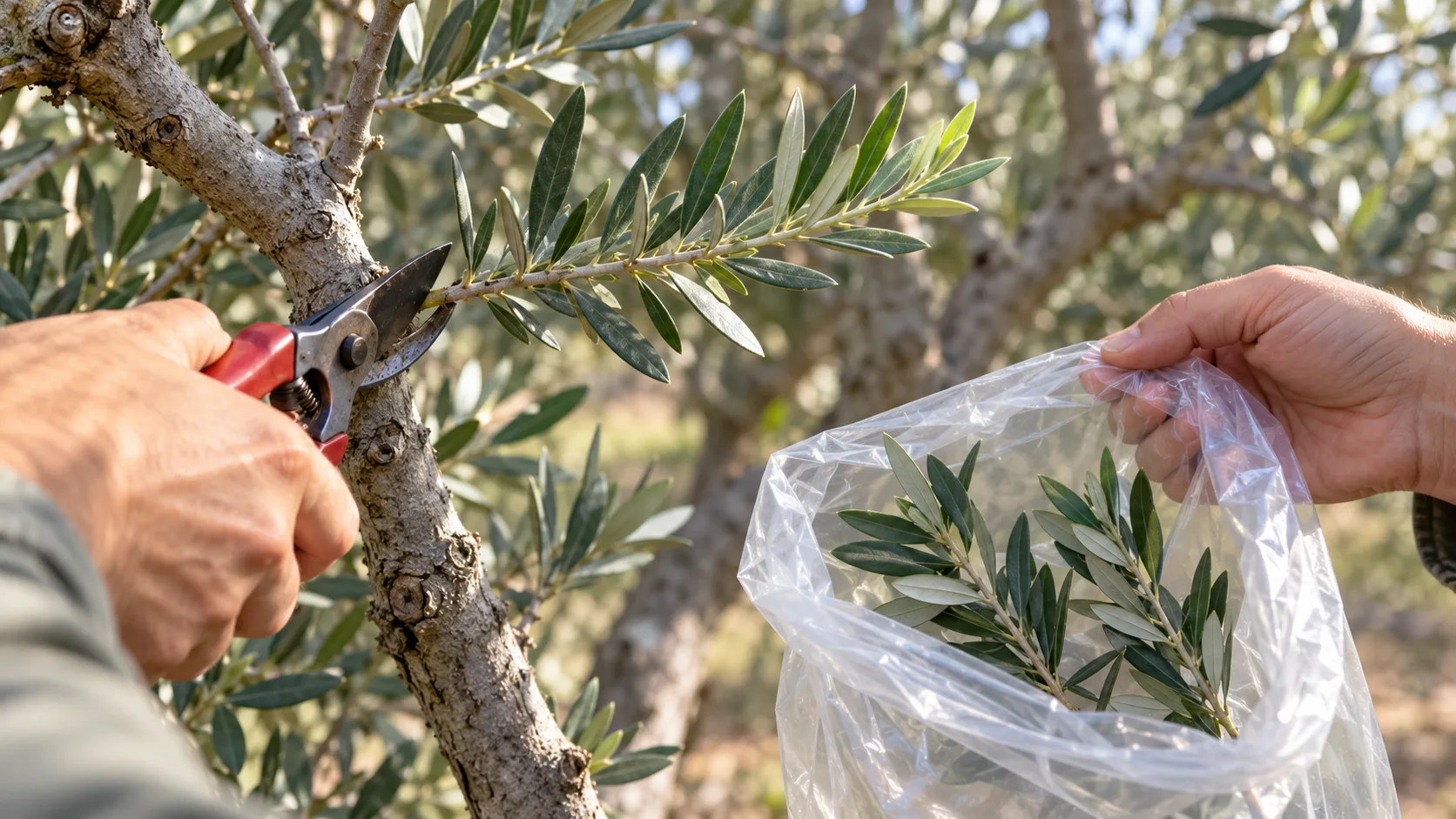
Les rameaux à bouturer naissent de la taille de printemps : pruning an olive tree sans retirer plus de 30 % du feuillage.
Taking olive cuttings, step by step
A 10 to 15 cm (4 to 6 in) cutting, four leaves, half potting mix and half sand, and humid air. These are the RHS steps for semi-ripe cuttings2.
- Trim the cutting to 10 to 15 cm (4 to 6 in), just below a node, where roots will emerge2.
- Remove lower leaves and the soft tip. Usually four leaves remain2.
- Wound the base for difficult varieties: remove a thin strip of bark 2.5 cm (1 in) long from one side2.
- Insert into equal parts free-draining peat-free potting mix and coarse sand, water and let drain2.
- Cover with a plastic bag or place in a propagator, warm and bright but without direct sun2.
- Keep the mix moist, removing excess condensation and any dead or diseased cuttings2.
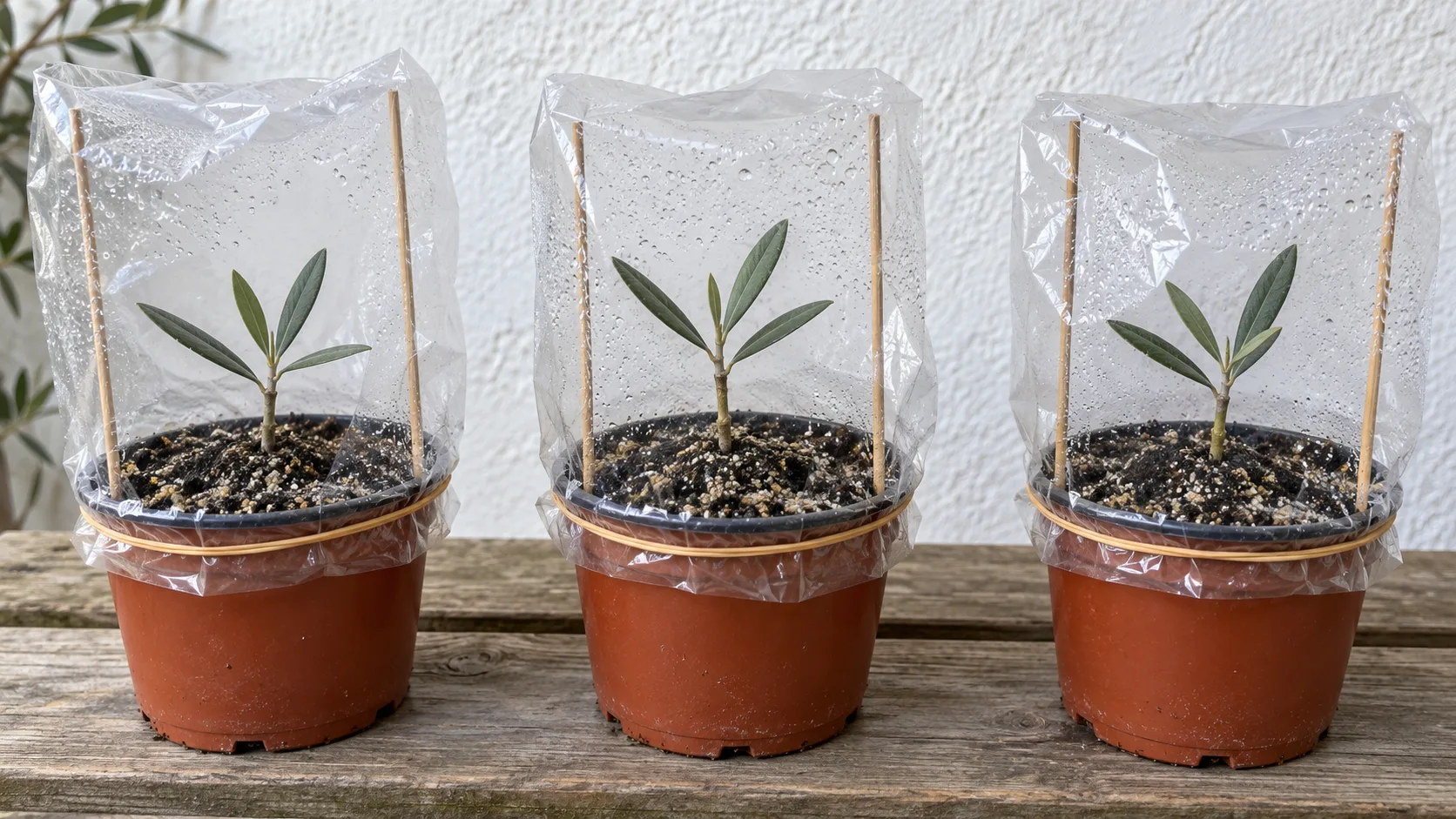
Watch the leaves. In a trial under mist, cuttings losing the most leaves rooted least4: a cutting keeping its leaves is on the right track. A cutting inserted directly into the ground beneath a cold frame may not have proper roots until late the following spring2.
Rooting hormone: useful for olive?
For difficult-to-root varieties, yes. In trials, olive cutting bases are dipped in an auxin, indolebutyric acid (IBA), before going under mist. Studied doses range from 2,000 to 4,000 mg per liter (0.27 to 0.53 oz per US gallon)54.
Effects vary by variety. Arbequina's best rooting rate came in summer with IBA at 2,000 ppm; for Kalamata, no hormone exceeded a few per cent5. An Iranian trial on two varieties even found IBA alone produced little rooting, requiring combination with another substance, putrescine, for satisfactory results6.
Medium matters too: in the first trial all three varieties rooted better in an organic medium than in peat and perlite5.
Not all varieties root successfully
Variety matters more than technique. France Olive includes propagation ability among distinguishing olive characteristics7, and trials quantify it:
| Variety | Rooted cuttings, at best | Rooting ability |
|---|---|---|
| Arbequina | up to 96% | Easy5 |
| Mastoidis | up to 60% | Moderate5 |
| Kalamata | 2 to 5% | Very difficult5 |
Another study attributes poor rooting in Kalamon to leaf drop from its cuttings4. If yours is a difficult variety, take many cuttings to keep a few, or use grafting.
Sowing an olive stone
A stone germinates, but does not reproduce the variety. It results from fertilization between two different trees: seed does not preserve the cultivar, and is mainly used to produce rootstocks3. The RHS recommends sowing in spring, at 13-15 °C (55-59 °F)1.
A seed-grown olive remains fruitless for a long time: juvenile growth before cropping lasts 1 to 7 years3. For a tree producing good olives, a cutting or subsequently grafted seedling is preferable.
Basal swellings and grafting: other propagation methods
France Olive lists three other techniques, all true to cultivar3:
- dividing basal woody swellings;
- grafting, often onto seed-grown rootstocks;
- micropropagation, reserved for laboratories.
After rooting: harden off, then pot up
A cutting rooted under cover must adjust to open air before potting up. The RHS allows two to three weeks of hardening off, outdoors by day and sheltered at night, or in a cold frame opened during the day2. Only then does each cutting move to its own pot.
Pour la suite, du premier pot au grand bac : growing an olive tree in a pot demande un contenant à la taille des racines.
Un jeune plant craint le froid bien plus qu'un arbre adulte : overwintering an olive tree commence dès le premier hiver.
Your cutting has rooted? Add it to Floralens: the app reminds you about watering and feeding, season by season (Pro mode). Get reminders
Frequently asked questions
When and how should you take olive cuttings?
How do you take a stem cutting?
Take a current-year stem in the morning, put it straight in a bag and pot it up within 12 hours2. Trim just below a node, remove lower leaves and the tip, then keep under humid cover until rooted.