
How to propagate oleander: cuttings and air layering
Oleander cuttings: a shoot tip in a glass of water
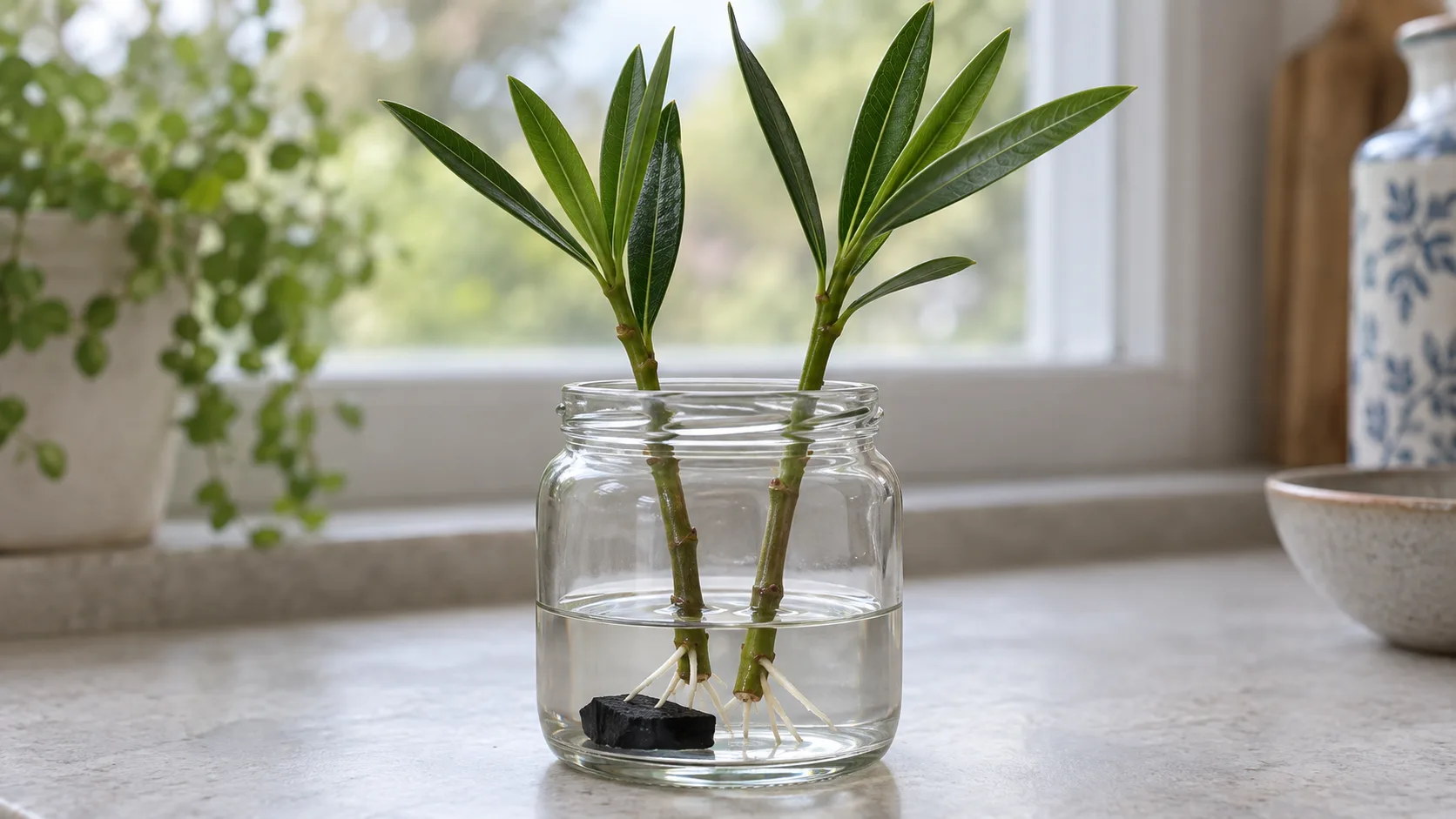
Oleander roots so easily that a glass of water is enough: a vigorous, bud-free shoot tip taken during active growth forms roots in three to four weeks. The LWG’s Bavarian calendar gives June to September as its example. Pot it up once roots reach 1–2 cm (0.4–0.8 in); the young plant faithfully reproduces the parent’s color.
When to take oleander cuttings
During active growth: June to September in the Bavarian source’s calendar. Bavaria's Gartenakademie gives this as the most reliable period, while noting cuttings also root at other times of year1. Warmth does the rest: summer cuttings root in a glass of water in a warm place out of direct sun.
- Softwood cutting
- In springYoung shoots, rooted in soil · in a light soil kept very moistSource: Société nationale d'horticulture de France
- Semi-ripe cutting
- June to SeptemberShoot tip without flower buds · roots in 3 to 4 weeks · roots well in waterSource: Bayerische Gartenakademie (LWG)
- Air layering
- In springSource: Royal Horticultural Society
- Sowing seed
- In springSource: Royal Horticultural Society
| Conditions | January | February | March | April | May | June | July | August | September | October | November | December |
|---|---|---|---|---|---|---|---|---|---|---|---|---|
| Shoot tip without flower buds | no propagation | no propagation | no propagation | no propagation | no propagation | Semi-ripe cutting | Semi-ripe cutting | Semi-ripe cutting | Semi-ripe cutting | no propagation | no propagation | no propagation |
Timing varies by method. The SNHF takes young spring shoots in light soil kept very moist2; the RHS lists oleander (Nerium oleander) for semi-ripe cuttings, air layering or seed sowing in spring3. NC State's Plant Toolbox also recommends stem cuttings4.
Late cuttings have a limitation: young cuttings potted on before midsummer can develop enough roots for winter; otherwise the RHS advises waiting until spring to pot on5. In that source-climate example, a September cutting therefore spends its first winter sheltered in a small pot. Follow local growth and winter conditions when timing the move.
Choosing a vigorous, bud-free shoot tip
Take a vigorous shoot tip without flowers or buds. This is the LWG criterion1; the RHS states more generally that non-flowering shoots root more easily5. Flowering stems spend reserves on flowers; vegetative stems retain them for roots.
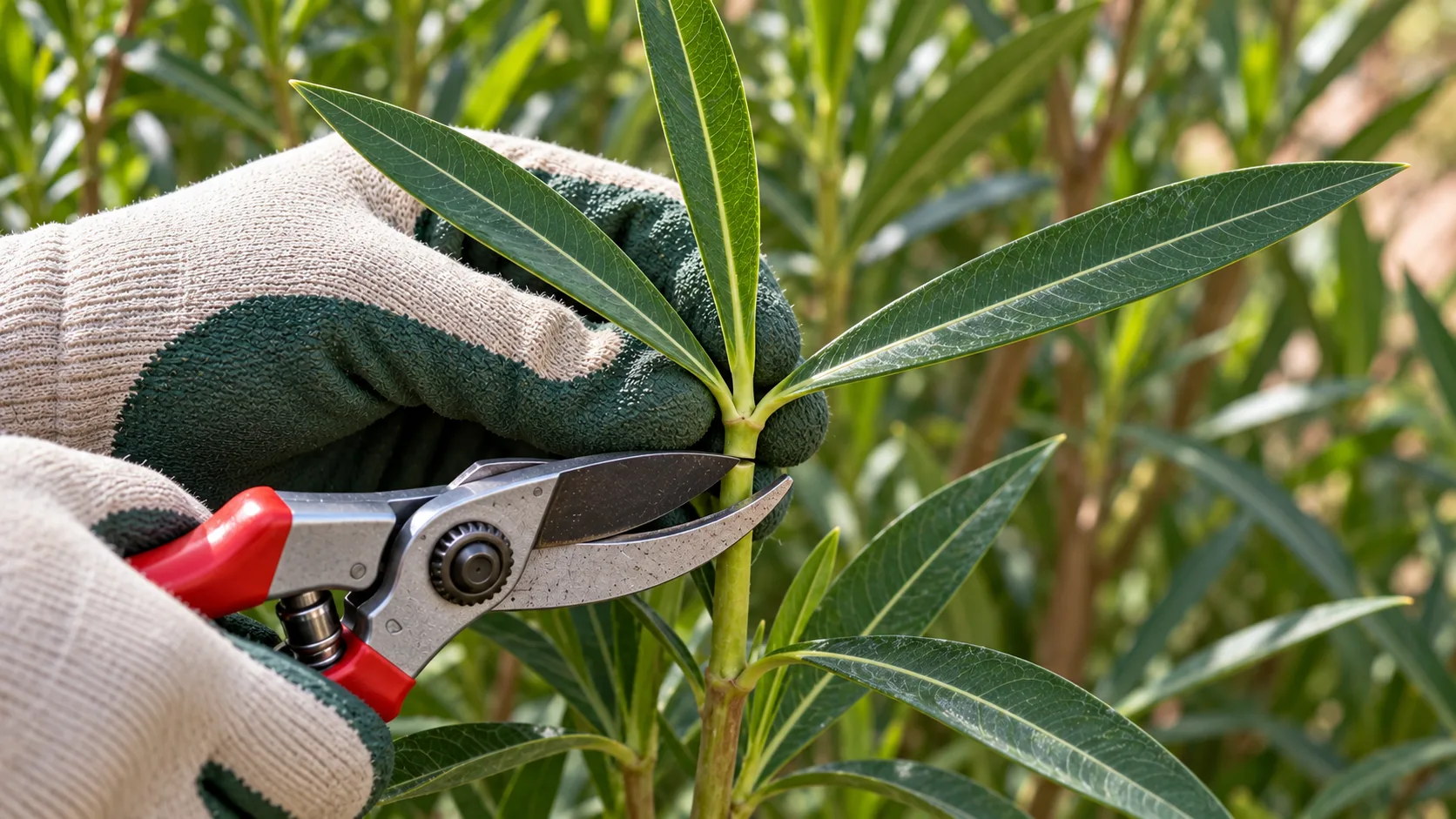
The RHS cuts semi-ripe cuttings 10–15 cm (4–6 in) long, just below a node, from healthy current-season growth, avoiding damaged or unusually vigorous wood6. Oleander leaves grow in whorls, several at one node7: cut just below one.
Pour les enfants et les animaux qui fréquentent le coin bouture, oleander toxicity détaille les symptômes et les premiers gestes.
Rooting oleander in water, step by step
This is oleander's most successful method. The SNHF says cut twigs root even without care
with their bases in water2. Five steps:
- Cut the shoot tip with a clean knife or pruning shears1, just below a node.
- Remove lower leaves that would sit in water, keeping a tuft at the tip. The RHS generally leaves four leaves on semi-ripe cuttings6.
- Stand the base in 2–5 cm (0.8–2 in) of water, no deeper1. A piece of charcoal in the glass prevents water spoiling2.
- Keep the glass warm, in bright shade: the LWG specifies warmth and shade1; the SNHF specifies ventilation, out of sun2.
- Wait three to four weeks, the usual time before roots appear1.
Pot up when roots reach 1–2 cm (0.4–0.8 in)1, without waiting for a long tangle. Water-grown roots are more brittle and easily damaged during transplanting, warns New Mexico State University8: longer roots mean more to break.
Cuttings in potting mix under cover
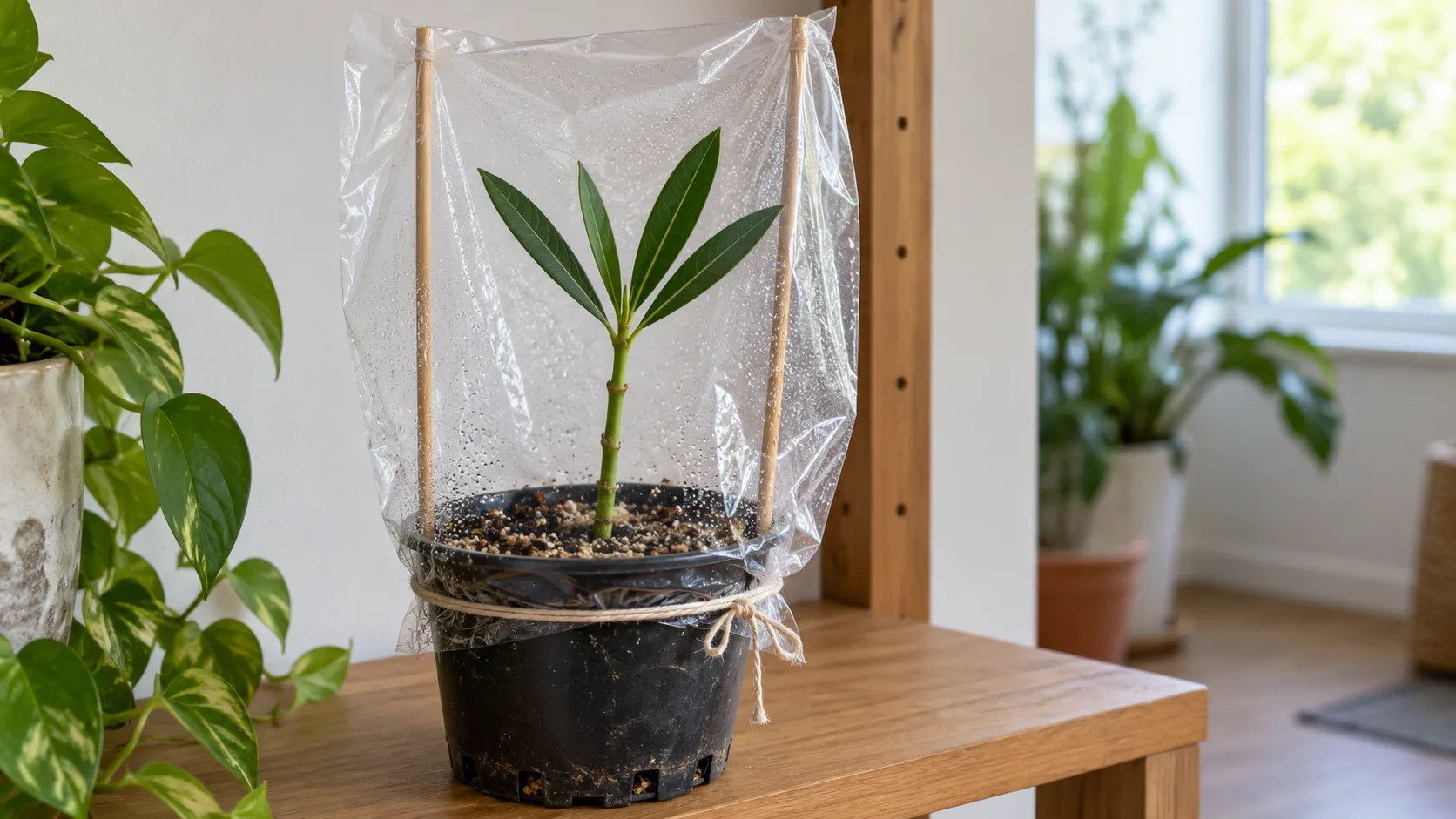
Cuttings in potting mix need a miniature greenhouse, but produce roots ready for potting. For young spring shoots, the SNHF specifies light soil kept very moist2. The RHS semi-ripe recipe is half peat-free potting mix, half coarse sand in a pot with drainage holes6.
- Insert the cutting base, keeping leaves well above the substrate, and firm around it.
- Cover with a plastic bag or propagator in a warm, bright place without direct sun6. Sun cooks cuttings under plastic: light must stay indirect8.
- Keep the substrate moist and remove excess condensation6.
- Ventilate gradually as growth resumes: pierce the bag, then open it8. Harden rooted sheltered cuttings off for two to three weeks before potting on6.
Rooting hormone is optional: oleander roots without it, but New Mexico State University calls it extra insurance and recommends several cuttings, since success is not 100%8.
Potting on and the first winter
A small pot, loam-based potting mix and a few days in shade. Under glass, the RHS specifies peat-free loam-based potting mix in full light3. Handle water-grown roots gently: they snap easily8.
Repot young plants annually, compared with every three to five years for older specimens1. Pinching young oleander tips produces bushier growth but delays first flowering1: a choice between shape and flowers.
In winter, treat the cutting like a potted oleander: a bright, well-ventilated room at 4–8 °C (39–46 °F)1. Keep it inside until spring, then put it out after frost.
Les années suivantes, repotting oleander se fait au printemps, dans un pot à peine plus large.
Pour le local, la lumière et l'arrosage d'hiver, overwintering oleander suit les mêmes règles qu'un adulte.
Air layering and seeds: two other methods
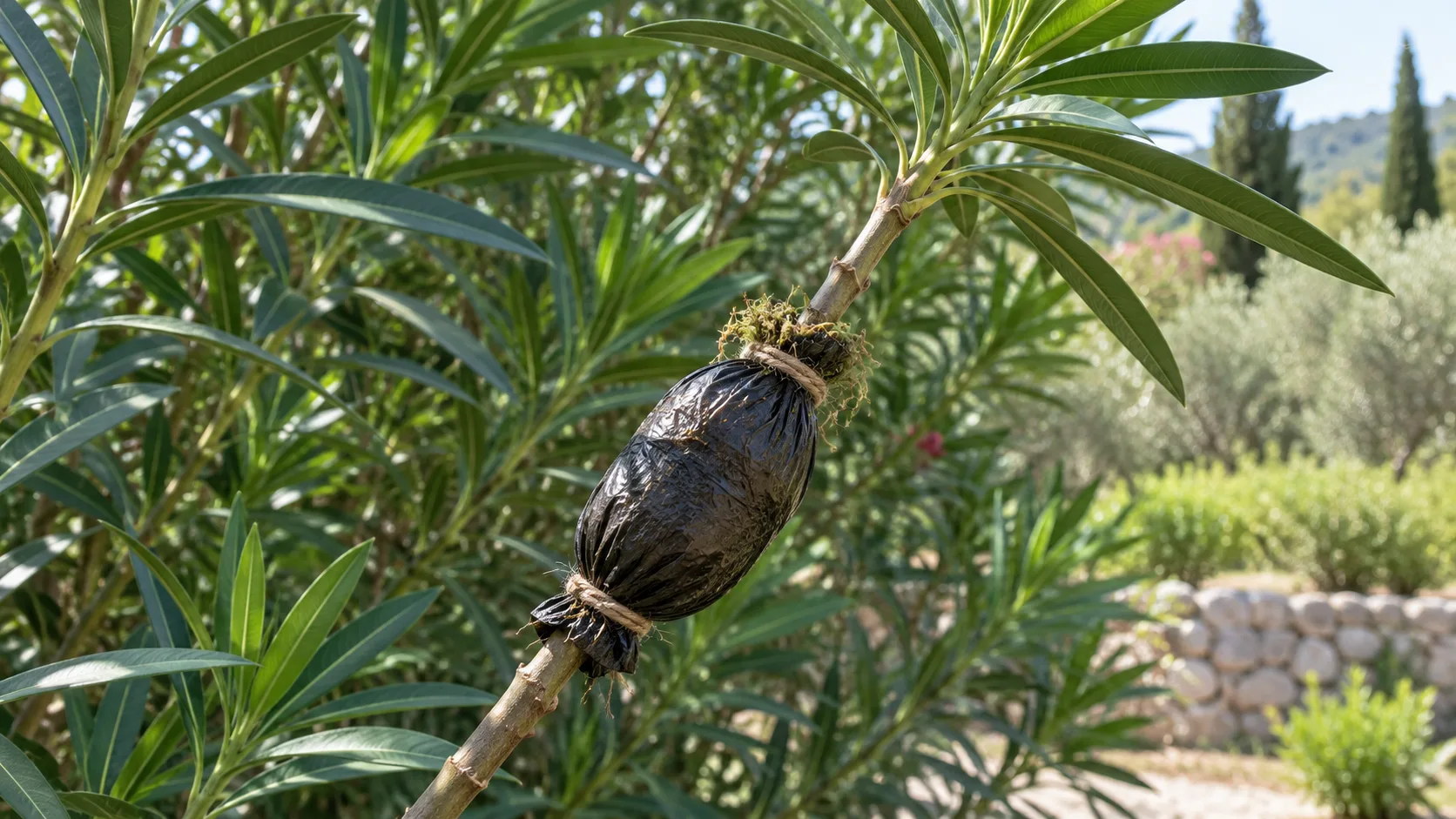
Air layering suits a thick branch you do not want to lose. The RHS lists it for oleander in spring3. Its general method9:
- Choose a straight, healthy one- or two-year-old stem; clear leaves and side shoots over 30 cm (12 in).
- Make a 2.5 cm (1 in) cut through a bud, tucking moist sphagnum beneath the flap.
- Wrap in black plastic, closed below, filled with 7.5–10 cm (3–4 in) of moist sphagnum, then closed above.
- Leave for up to a year; when roots grow through the moss, cut just below the wrap and pot up without removing moss.
Seed sowing is slowest and least true to type: the LWG recommends cuttings for plants matching the variety and color1. Seeds form in pods up to 15 cm (6 in) long after pollination by long-tongued butterflies1.
Why cuttings rot or fail to root
Most failures have a visible cause. This table matches symptoms to actions.
| What you see | Likely cause | Action |
|---|---|---|
| Cloudy water, black soft stem base | Spoiling water2 | Cut above black tissue; use clean water and charcoal in the glass |
| Scorched leaves, collapsed cutting | Direct sun on glass or under bag8 | Bright shade, warmth and ventilation |
| No roots after six weeks | Flowering shoot or cold cutting51 | Take a new bud-free tip cutting and keep warm |
| Potting mix cutting drying out | Air too dry8 | Plastic bag or propagator, gradual ventilation |
| Roots break when potted | Water-grown roots too long and fragile8 | Pot up at 1–2 cm (0.4–0.8 in), supporting roots from below |
Une fois le plant formé, potted oleander demande un bac à sa taille et un hiver à l'abri.
Unsure about an oleander variety in a neighbor's garden? Photograph a flower: Floralens identifies the species before you take a cutting.
Frequently asked questions
How do I grow new oleander plants?
From cuttings: a bud-free shoot tip taken during active growth, June to September in the LWG’s Bavarian example, standing in 2–5 cm (0.8–2 in) of water, warm and shaded. Roots appear in three to four weeks; pot up at 1–2 cm (0.4–0.8 in) long1.
When is the best time to take oleander cuttings?
How long do oleander cuttings take to root?
Can I root oleander cuttings directly in potting mix?
Do coffee grounds help oleander cuttings?
No. Coffee grounds mainly supply nitrogen and have variable pH: put them in compost, never a cutting's glass or pot10.