
When to prune oleander and how to cut it back
Pruning oleander: when and how
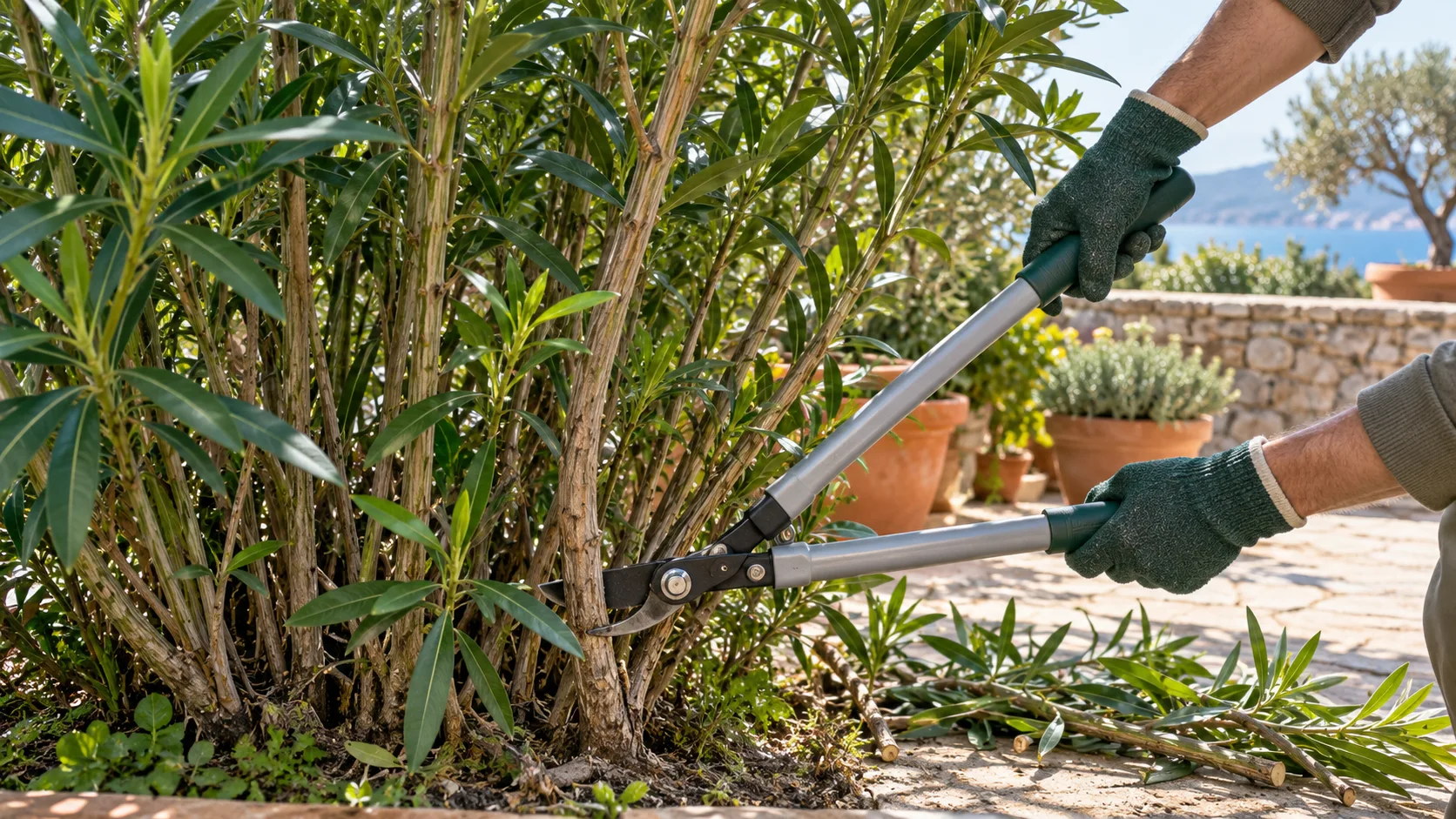
Prune oleander in early spring after frost, never in fall for plants in the ground. It flowers on current-season shoots: thin out old stems without shortening all the others. The whole plant is toxic: wear gloves and never burn the waste.
When should you prune oleander?
Early spring, after local frost risk has passed: in its French growing context, the SNHF places maintenance and cleaning cuts here 1; its journal Jardins de France advises against fall pruning, which stimulates young shoots that winter frost will scorch 2. American extension sources give the same timing for a botanical reason: oleander flowers in summer on new shoots 3.
- Main pruning
- Early springafter the frosts · in the groundSource: Jardins de France (SNHF)
- Main pruning
- After floweringThinning · or just before bringing it under cover · in a potSource: Bayerische Gartenakademie (LWG)
- Light pruning
- After floweringnever after early autumnSource: NC State Extension Gardener Plant Toolbox
- Avoid
- In autumnin the groundSource: Jardins de France (SNHF)
- Flowers form on
- The current year's growthSource: Clemson Cooperative Extension
- Maximum amount to remove
- One third of the shootsSource: Société nationale d'horticulture de France
A second, lighter window exists: after flowering, gentle pruning improves shape, but NC State advises stopping at the start of fall to preserve next year's buds 4. Clemson pinches stem tips after flowers fade to encourage branching, avoiding late cuts whose regrowth cannot harden before frost 3.
Pots change the schedule. Bavaria's Gartenakademie (LWG) thins container oleander after flowering or just before winter shelter, where regrowth avoids frost 5. The RHS allows size-control pruning in late winter for oleanders overwintered under glass 6.
None of these sources treats southern France separately, and two recommendations conflict there. Flowering in southern France runs April to November 1: post-flowering pruning would fall in fall, which Jardins de France excludes for ground-grown oleander 2. In the ground, spring remains the only window without a stated objection.
How flowering works, and what pruning costs
Oleander flowers in clusters at shoot tips 1, on current-season growth 4; botanically, a terminal cyme 4. The LWG adds a detail affecting pruning: clusters still in bud in fall resume flowering the next year 5.
Hence its rule for oversized plants: do not simply shorten every stem, removing those waiting clusters 5. Bright winter shelter works the other way: the brighter the room, the more buds form 5.
Remove faded flowers to extend flowering 3. Single varieties shed them themselves; doubles retain them 3. Cut spent flowers, never cluster tips still bearing buds. The following capsules reach 15 cm (6 in) 5 and are as toxic as the rest of the plant 7; the oleander care guide covers pods.
Where to cut: at the base of old stems
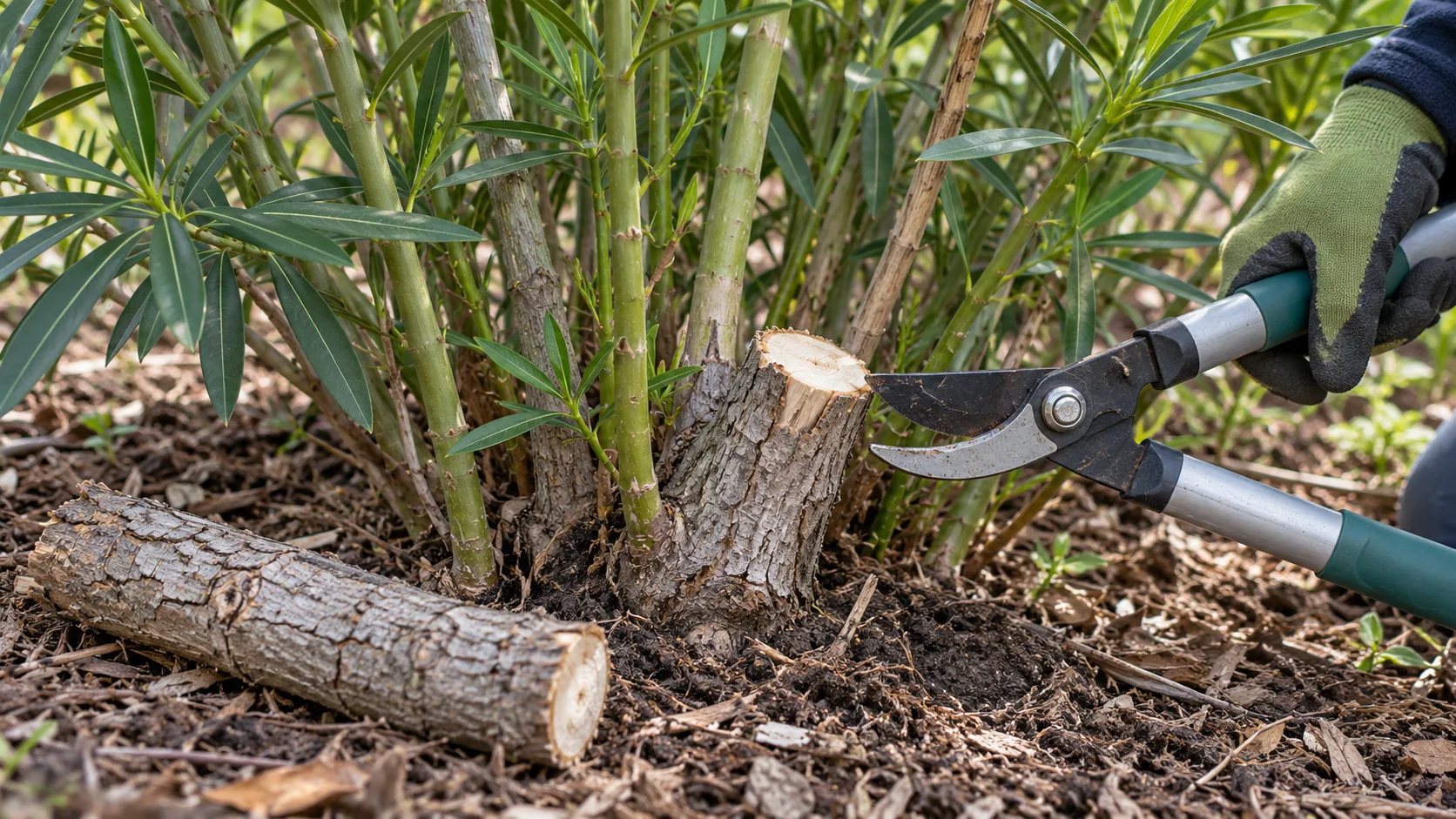
Thin rather than shorten: every few years, the LWG cuts the longest, oldest stems back into old wood 5. In containers, the SNHF renews shrubs by removing the oldest branches at the base every two years, along with weak ones 1. For height control, it limits cutting to one-third of shoots 1; for evergreens, the RHS targets about one-third of old wood overall 8.
Follow the RHS evergreen sequence 8:
- Dead, diseased or damaged wood first.
- The oldest stems, cut at the base or into old wood, only some each time.
- Crowded or poorly positioned branches.
- Retained stems, shortened if needed just above outward-facing buds at varied heights: the University of Arizona uses this to produce outward branching 9.
Never use hedge trimmers
Oleander responds poorly to shearing. University of Arizona photographs show repeated shearing removes buds and flowers and leaves the shrub bare inside 9. In its natural form it flowers spring to fall in the Arizona desert 9.
It therefore suits an informal hedge, rather than a tightly clipped one 9. The same university warns that repeated cuts at one level eventually create broom-like tufts of small shoots and holes in foliage 10.
Rejuvenating an oversized oleander
It tolerates hard pruning 6, including spring removal of frozen or overgrown wood 3. Sources disagree on cutting height and frequency.
| Method | Action and consequence |
|---|---|
| Spread over 3–4 years | Remove one-third to one-quarter of the oldest branches annually 9 |
| Evergreen renewal | Cut one-third to one-half of stems to ground level in year one; shorten others by one-third 8 |
| Half the old branches | Remove half or more at the base, then thin regrowth a few weeks later 9 |
| Cut back to 50 cm (20 in) | Cut all stems to 50 cm (20 in) above ground; little or no flowering that year 1 |
| Cut back to 30–45 cm (12–18 in) | Cut all stems to 30–45 cm (12–18 in) in late winter or early spring; in midsummer remove half the regrowth and shorten the rest at varied heights; the canopy is renewed by fall 9 |
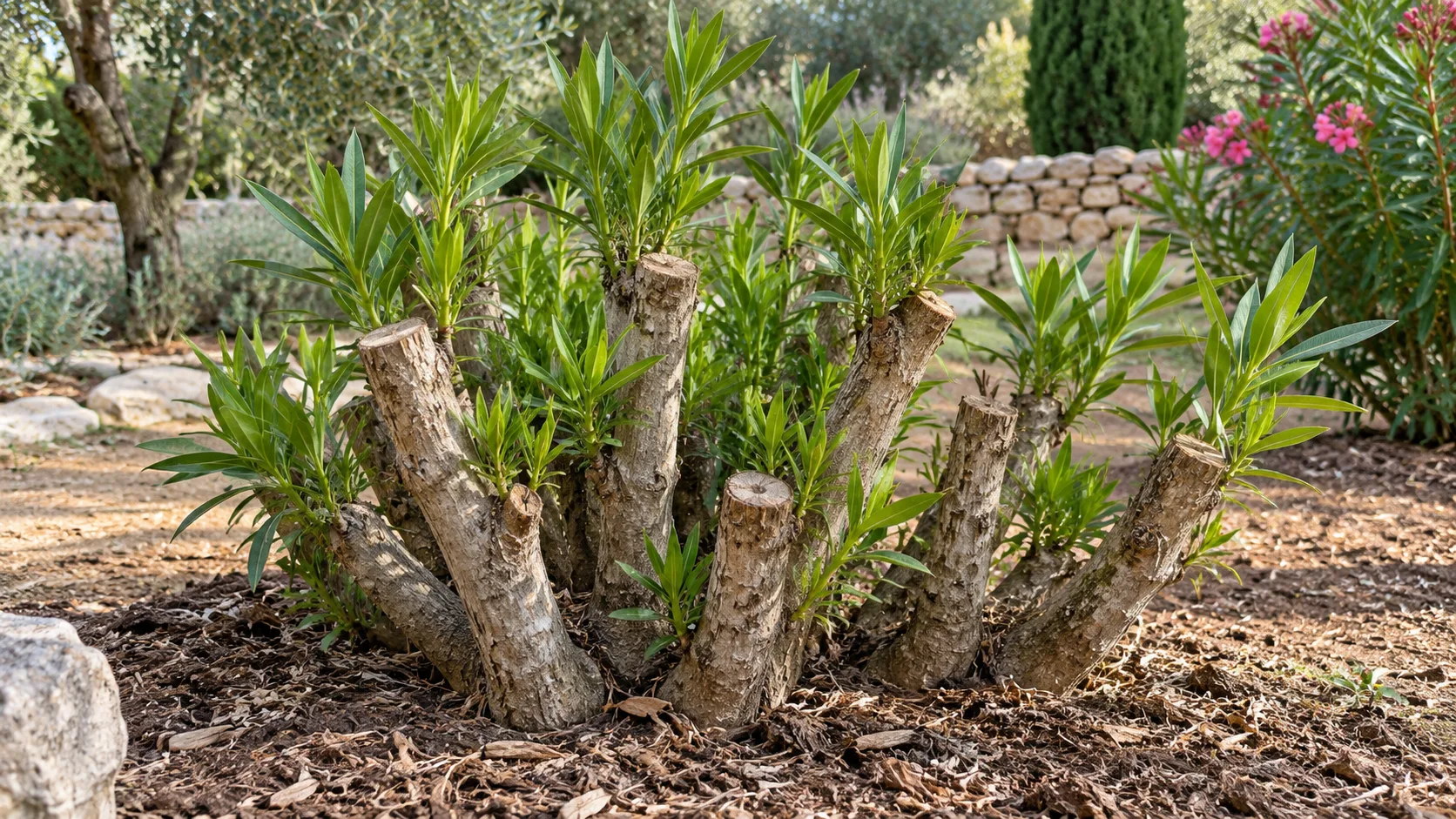
One source goes further: Arizona extension cuts oleander to ground level every 5–7 years 10. After renovation, the RHS applies general fertilizer, mulches the base and avoids water stress the following season 8.
Choosing the right mature size best avoids these cuts. Jardins de France notes that large oleanders in small spaces need frequent pruning, and every pruning is traumatic and can admit disease 2. Dwarf varieties such as 'Petite Pink' stay around 0.90–1.20 m (3–4 ft) with light pruning 3.
Potted oleander
Pruning is optional, says the LWG, though older plants often outgrow their space 5. Renewal schedules differ: every two years for the SNHF 1, every few years for the LWG 5, and every 3–4 years into old wood for Saxony's Gartenakademie 11.
Pinching young shoot tips makes denser growth, but pinching delays first flowering 5.
Training oleander as a standard
Pruning keeps oleander shrubby or turns it into a small tree 3–5.5 m (10–18 ft) tall 12. Nurseries train a short trunk and sell it as a standard oleander 13. Start young, selecting a straight leader early 9; Clemson also trains multi-trunked small trees 3.
One maintenance step matters: remove suckers from the base 12. They divert energy and reduce flowering; pull them off young and soft 13. Single-trunk oleanders produce many, needing very frequent removal 9.
After frost
Cut frozen, dead wood back after winter 4, to 50 cm (20 in) above ground if needed 1; established oleanders quickly regrow from the base 3. If fungi colonize weakened wood, Clemson removes affected branches until no discolored tissue remains in the cut 3.
Le test de l'écorce et le délai avant d'arracher un pied gelé sont détaillés dans overwintering oleander .
Gloves, tools and hygiene
Long-handled loppers or a saw suffice for dead or diseased wood 8, provided they are clean and sharp 10.
Blades spread disease too. Bacterial knot enters fresh wounds, including pruning cuts and frost cracks, spreading through rain, hands and tools 15. The University of California program gives three rules 15:
- Prune in dry weather, when bacteria are inactive.
- Disinfect blades before every cut in a 10–20% bleach solution.
- Keep diseased stems away from other host plants, including olives.
Timely removal of diseased shoots can save a plant 5. Lighter pruning also helps against aphids: fewer tender shoots mean less food 16. Sector-by-sector drying is different: pruning does not halt scorch from Xylella fastidiosa 17; in France, control is mandatory, with infected plants uprooted and destroyed 18.
Pour reconnaître chaque maladie avant de sortir le sécateur, voir oleander diseases .
What to do with cut branches
Never burn them. Smoke is harmful and may cause severe reactions 6 3 4. In France, burning garden waste at home is also prohibited, with a €750 fine 19.
Keep them away from animals. Poisoning follows chewed leaves, licking sap and even smoke inhalation; animals more often eat dried leaves than bitter fresh ones 7. For horses, RESPE asks owners to take all pruning waste to a waste collection center, never throwing it into paddocks 20.
Spring offcuts fall outside the LWG's best cutting period in its Bavarian calendar, June to September, using vigorous bud-free shoot tips 5. The oleander care guide gives the full method.
Pour prélever en été plutôt qu'au sécateur de printemps, taking oleander cuttings se fait dans un verre d'eau, au chaud et à l'ombre.
Symptômes, animaux concernés et premiers gestes : oleander toxicity sont détaillés à part.
Mistakes that cost flowers
Shortening all stems to the same height, removing waiting flower clusters 5.
Fall pruning in the ground: young shoots freeze 2 and next year's buds go with the cut 4.
Using hedge trimmers, removing buds and flowers 9.
Leaving suckers on standard oleanders, reducing flowering 13.
Pruning in rain with an undisinfected blade, allowing bacterial knot in 15.
Pruning is one part of yearly care: watering, fertilizer, frost and varieties are covered in the oleander care guide; the oleander encyclopedia profile (Nerium oleander) covers botany.
Frequently asked questions
Which month should I prune oleander?
No French source gives a month: the SNHF says early spring after frost 1 2. The only month-based guidance is from the RHS for evergreens generally in the UK: April–May, just before growth starts, once frost risk passes 8. Spring comes earlier in mild regions: the end of frost, rather than the calendar, gives the signal.
Can I prune oleander in September?
Not in the ground in the sources’ fall pruning context. September belongs to that seasonal example; use local frost and growth conditions to identify fall. NC State advises against pruning after the start of fall to preserve next year's buds 4; Clemson warns late regrowth cannot harden before frost 3; Jardins de France excludes fall 2. For pots, the LWG allows thinning just before winter shelter, without shortening every stem 5.
Does oleander need pruning every year?
How do I prune an oleander that is too tall?
Without topping every stem: remove the longest and oldest at the base or into old wood 5, at most one-third of shoots 1, in spring after frost. For badly overgrown shrubs, remove one-third to one-quarter of the oldest branches yearly over 3–4 years 9; cutting all stems to 50 cm (20 in) is faster, at the cost of little or no flowering that year 1.