
When to prune roses: timing and cuts by rose type
Pruning roses: timing by rose type
Prune repeat-flowering roses in late winter as growth resumes: February in mild areas and March in colder ones in the sources' Northern Hemisphere calendar. Once-flowering climbers, ramblers, and old roses are pruned after flowering, in July or August in that setting. Use local growth and flowering to time the work. Rose type determines the remaining details: timing, cutting height, and number of buds.
When should you prune a rose?
Do the main pruning in late winter, as growth resumes: February in mild regions, March in cold ones in the sources' Northern Hemisphere calendar. The SNHF gives February or March depending on the region, after a light fall cutback 1; the RHS advises waiting until March in the coldest areas 2. Elsewhere, follow local temperature and growth rather than these months alone.
- Main pruning
- February and MarchRepeat-flowering bush and shrub rosesSource: Société Nationale d'Horticulture de France
- Main pruning
- December to FebruaryRepeat-flowering climberSource: Royal Horticultural Society
- Main pruning
- July and AugustOnce-flowering roses and ramblers · after floweringSource: Société Nationale d'Horticulture de France
- Light pruning
- In summerSpent flowers on repeat-flowering roses · stop from October in the source’s temperate Northern Hemisphere calendarSource: University of Illinois Extension
- Autumn cleanup
- In autumnCutting back overlong stemsSource: Société Nationale d'Horticulture de France
- Flowers form on
- Last year's or the current year's wood, depending on the typeSource: University of Illinois Extension
| Conditions | January | February | March | April | May | June | July | August | September | October | November | December |
|---|---|---|---|---|---|---|---|---|---|---|---|---|
| Repeat-flowering bush and shrub roses | no pruning | Main pruning | Main pruning | no pruning | no pruning | no pruning | no pruning | no pruning | no pruning | no pruning | no pruning | no pruning |
| Repeat-flowering climber | Main pruning | Main pruning | no pruning | no pruning | no pruning | no pruning | no pruning | no pruning | no pruning | no pruning | no pruning | Main pruning |
| Once-flowering roses and ramblers | no pruning | no pruning | no pruning | no pruning | no pruning | no pruning | Main pruning | Main pruning | no pruning | no pruning | no pruning | no pruning |
This timing applies to repeat-flowering roses for a botanical reason. A repeat-flowering rose produces its best blooms on the current year's wood: shoots that grow after pruning carry summer flowers 3. Old roses flowering only once, in May-June in the source calendar, bloom on last year's wood. Pruning them in March removes that year's flower buds; prune after flowering, in July or August in that calendar 3 4. Locally, keep the same sequence relative to flowering.
A growth cue can help: the University of Illinois reports that many rose growers wait for forsythia to open its yellow flowers before taking out their shears 3. Repeat-flowering climbers are an exception: the RHS prunes them from December to February in its UK dormant-season calendar 5.
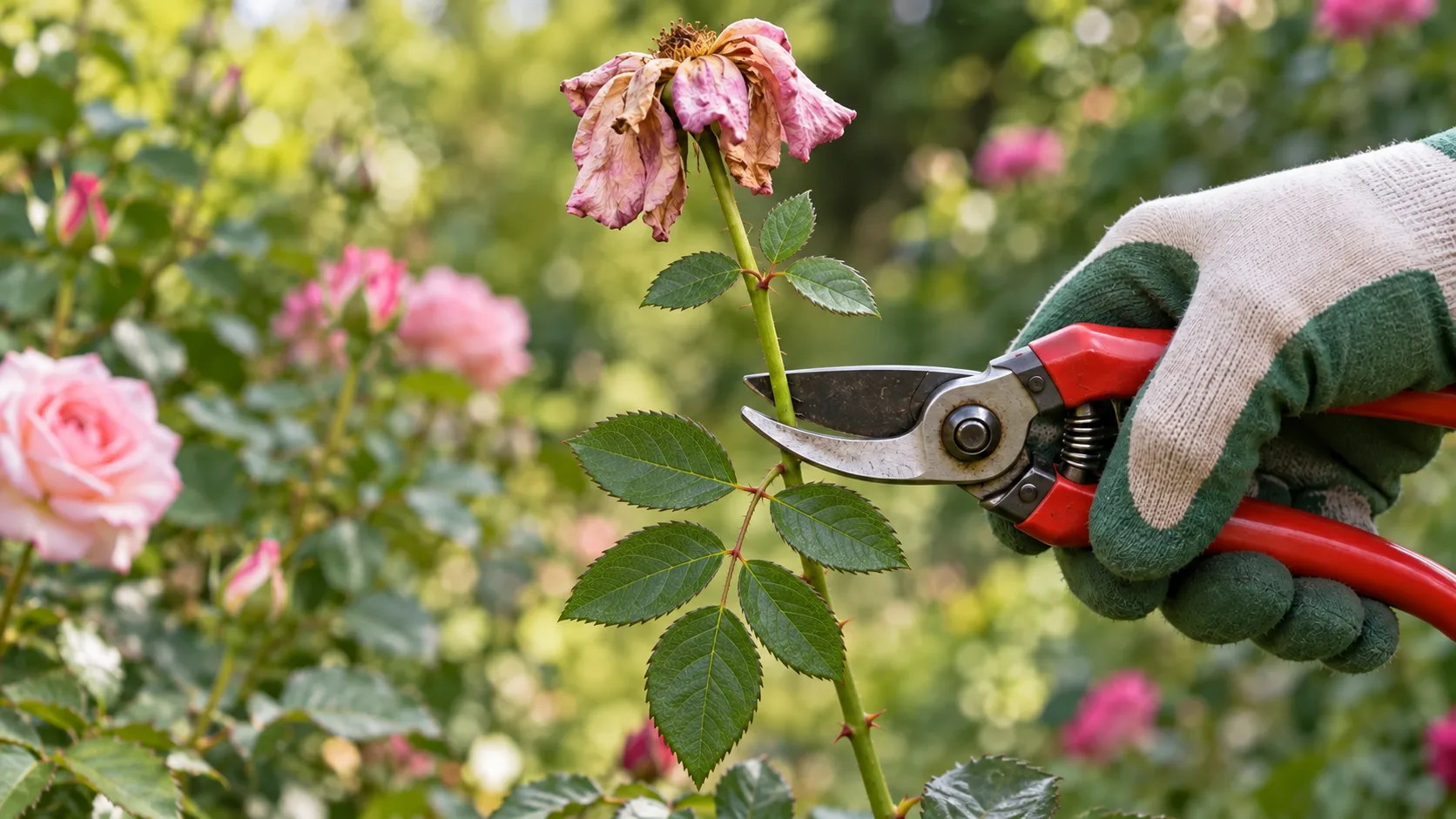
In summer, deadhead repeat-flowering roses above a leaf with five leaflets, above an outward-facing bud 1 3. Stop from October in the source calendar, allowing wood to harden before winter 3; use approaching local winter as the guide. Stop as early as midsummer on varieties with attractive hips, such as rugosa rose (Rosa rugosa): thrushes and blackbirds feed on them in winter 6.
Which type of rose do you have?
Two questions identify the group: does it flower once or repeatedly? And what is its habit: bush, climber, shrub, or small rose? The RHS divides its advice into six guides, one per group 7. This table brings them together with SNHF guidance.
| Rose type | Flowering | When to prune | How much to remove |
|---|---|---|---|
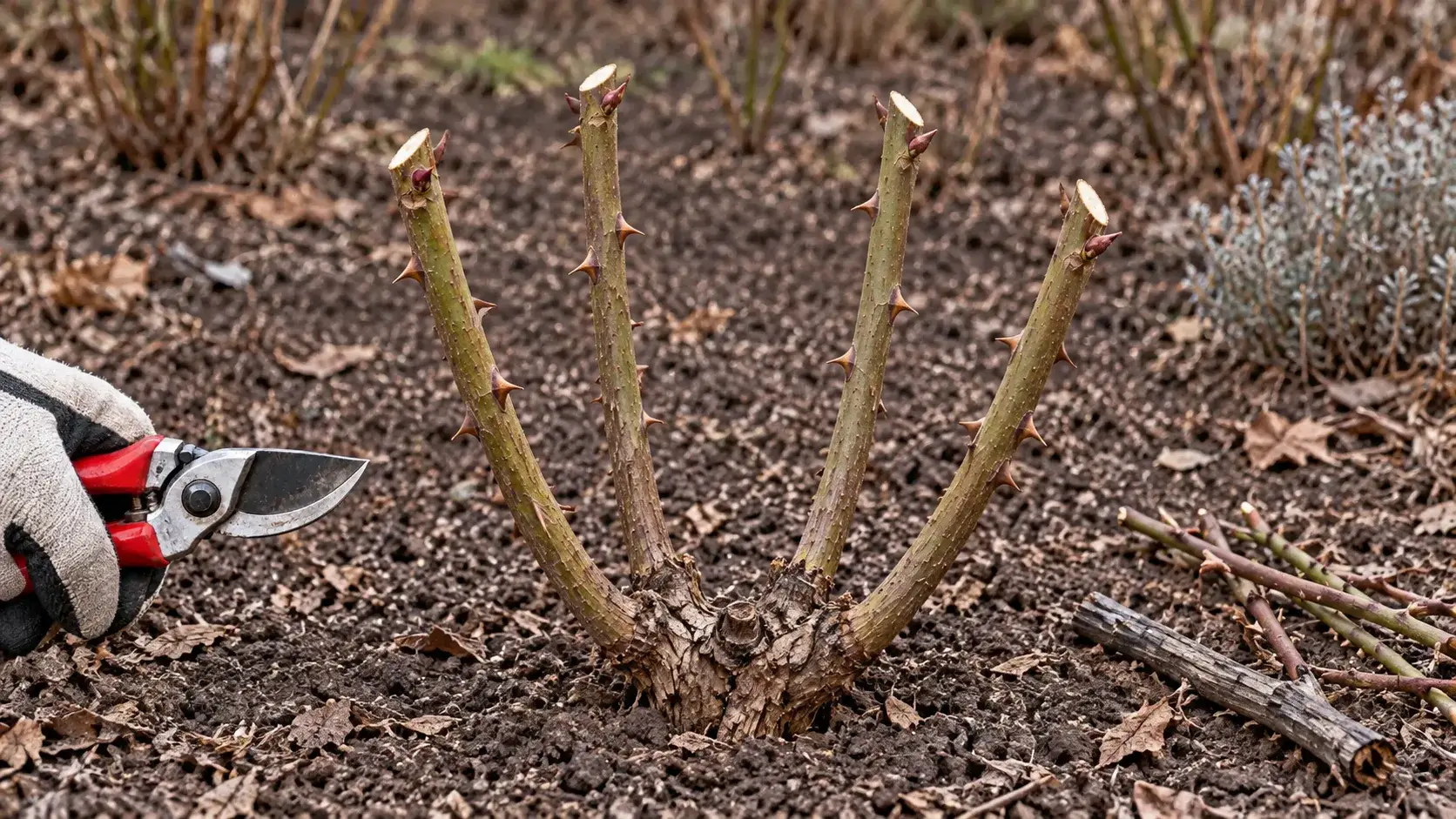
| Large-flowered bush rose (hybrid tea) | Repeat-flowering in three flushes from summer to late fall | February-March in the source calendar; local late winter | Strong stems to 4-6 buds, 10-15 cm (4-6 in) above ground; weak stems to 2-4 buds, 5-10 cm (2-4 in) 2 |
| Cluster-flowered bush rose (floribunda) | Continuous repeat flowering from summer to late fall | February-March in the source calendar; local late winter | Strong stems to 25-30 cm (10-12 in) above ground; weak stems shorter 2 |
| Standard rose | As for the variety grafted at the top | February-March in the source calendar; local late winter | 20-30 cm (8-12 in) above the graft, 7 to 9 branches forming a cup 1 |
| Repeat-flowering climber | June to October in the source climate | December to February in the RHS's UK calendar; local dormancy 5 | Shorten flowered shoots by two-thirds 5, or to 2-3 buds 1 |
| Once-flowering climber or rambler | Once, in May-June in the source climate | July-August in the source calendar, after local flowering 1 | Remove one in three old stems at the base; shorten sideshoots by two-thirds 8 |
| Repeat-flowering shrub (English, Bourbon, Portland, China rose) | Repeat-flowering | February-March in the source calendar; local late winter | Reduce strong shoots by no more than one-third; English roses by 30 to 50% 4 |
| Once-flowering old or species rose (French rose, white rose, Damask rose, cabbage rose) | Once, in May-June in the source climate | July-August in the source calendar, after local flowering | Light pruning: dead wood and one or two old central branches 4 |
| Miniature and patio | Repeat-flowering | February-March in the source calendar; local late winter | Reduce main stems by one-third 9 |
| Groundcover | Variable: many flower only once, in summer 10 | Late winter; shorten sideshoots of trailing groundcovers after flowering 10 | Little pruning: reduce strong shoots by one-third, sideshoots to 2-3 buds; rejuvenate to 10 cm (4 in) above ground 10 |
Two qualifications help avoid mistakes. Repeat-flowering old roses (Bourbon, Portland, hybrid perpetuals) bloom on both new and old wood: prune them before flowering, and more firmly 3. One species can also fit different rows: the repeat-flowering autumn Damask rose is pruned more like a repeat-flowering shrub, as the Damask rose profile explains.
Hard pruning or light pruning?
The number of buds left on each stem sets the intensity. Hard pruning leaves only 2 to 4 buds; lighter pruning leaves 5 to 7. The RHS cuts hybrid teas low for strong shoots, leaving floribundas longer to retain their mass of flowers 2. The instinct to do the opposite can mislead: the weaker the rose, the harder the pruning. The SNHF leaves 3 or 4 buds on a weak rose and 5 to 7 on a vigorous one 1.
A rose with no label
Prune an inherited or unlabeled rose cautiously in February or March in the RHS's UK calendar, at the equivalent local late-winter growth stage 7. If it has long, arching stems and needs support, it is a climber or rambler: remove one or two of the oldest stems, with gray, flaky bark, at ground level. If it is a bush, remove one or two stems at the base, then shorten the others by one-third to one-half.
The following season's response helps identify it: vigorous, flowering regrowth suggests a hybrid tea or floribunda, while less vigorous growth suggests a shrub rose 7.
Where to cut: above a bud
A bud is where the next shoot begins, so position the cut accordingly. The RHS gives three pointers 7:
- No more than 5 mm (0.2 in) above the bud. The SNHF illustrates two mistakes: cutting too close to the bud or too far away 1.
- Make a sloping cut, descending away from the bud so water does not collect on it.
- Choose an outward-facing bud to open the center. On a spreading rose, a few cuts above inward-facing buds help make the shape more upright.
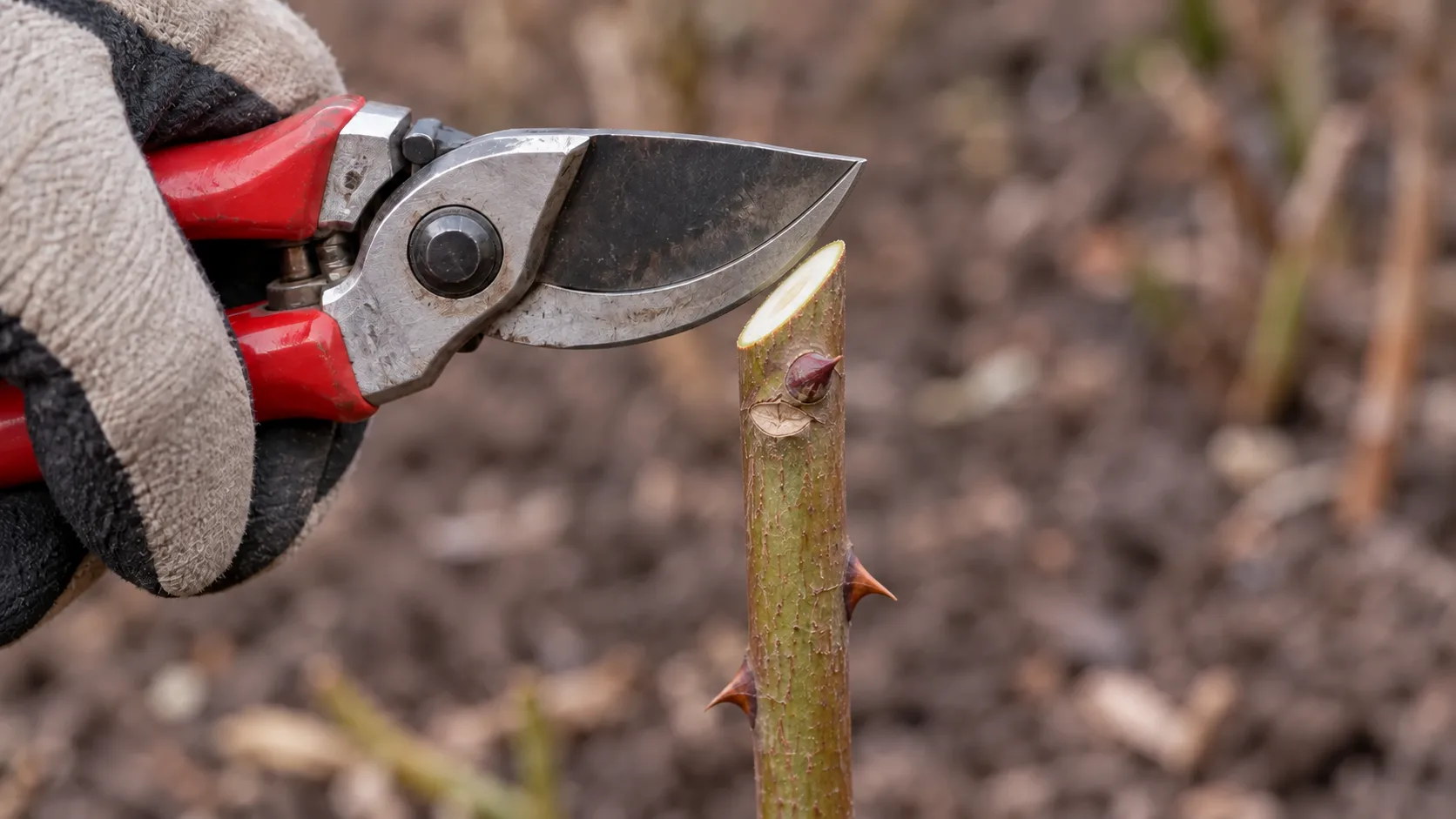
The University of Illinois specifies about 45 degrees, 6 mm (0.24 in) above the bud 3. If a stem has blackened from the tip, cut back to healthy white pith 7.

Pruning a bush rose step by step
Order matters: remove what must go first, choose the framework next, and shorten last.
- Remove dead and diseased wood, at the base or back to healthy tissue: wrinkled, dark brown, or black stems 3.
- Remove stems thinner than a pencil and those that cross or rub 3.
- Keep 3 to 5 vigorous stems, evenly spaced around the base, with an open center for airflow 3.
- Cut those stems back to the height appropriate for the type, above an outward-facing bud.
- Pull off suckers at their origin on the root rather than cutting them, which would encourage several more 3 1. They come from the rootstock, often multiflora rose (Rosa multiflora) or a dog rose lineage (Rosa canina).
- Feed and mulch as local spring growth begins: rose fertilizer and compost around the base 7. Mulch also keeps soil cool and moist during regrowth.
Le choix de l'engrais et son calendrier font l'objet d'un guide à part : which fertilizer to use for roses, and when .
The SNHF describes pruning intensity by bud count; the RHS uses centimeters, and its figures show the differences between types.
While pruning, the RHS recommends watching for rose aphids and sawflies 2: aphids gather on new growth, while sawfly larvae chew leaves. The aphid and sawfly pages help identify them.
Climbing roses: pruning in two stages
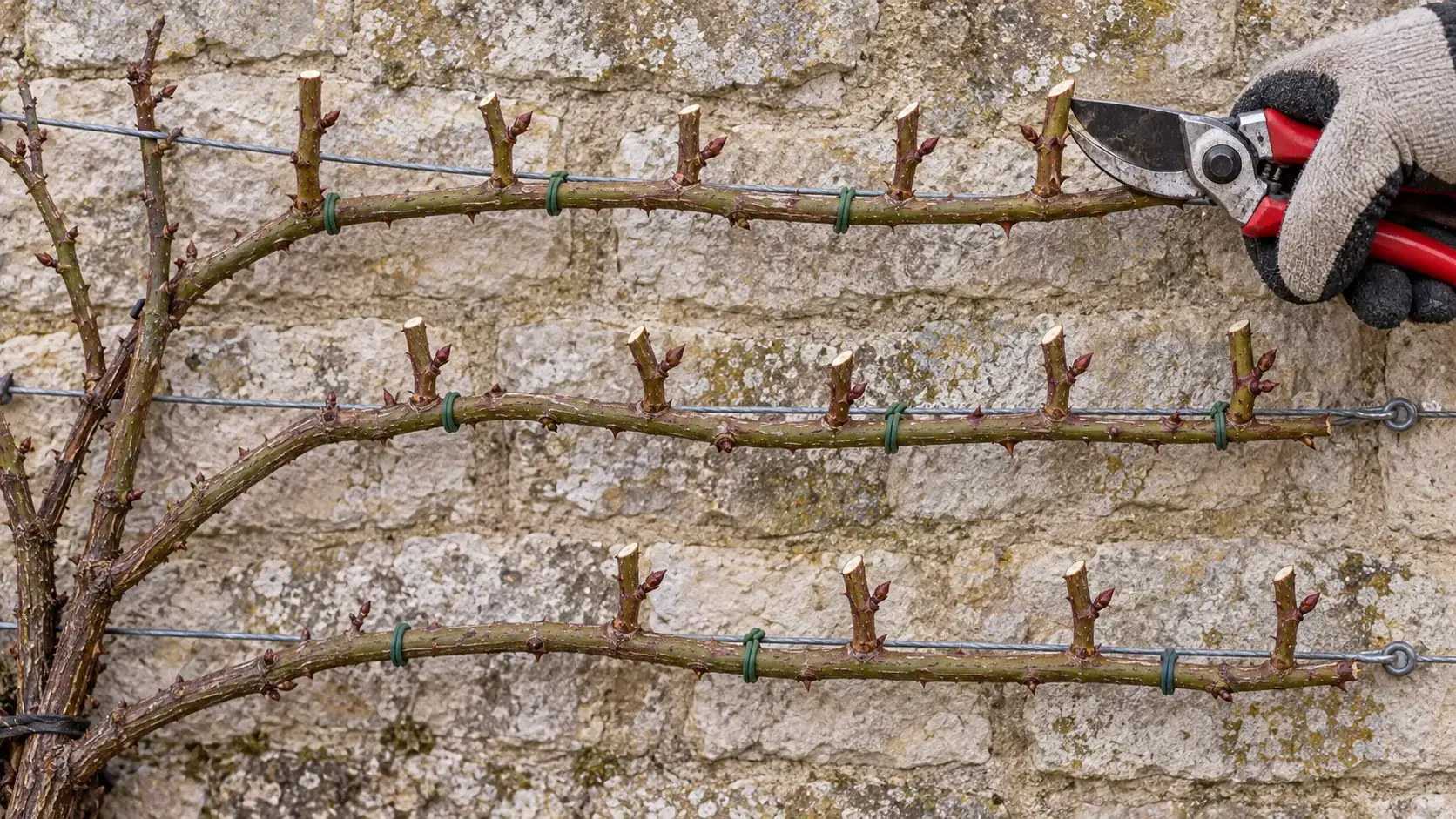
A climbing rose cannot attach itself: you must train it. All its pruning follows one principle: a horizontal branch develops flowering sideshoots 3. The RHS puts the first wire 45 cm (18 in) above ground, then spaces wires every 30 cm (12 in) 5.
First, the framework. In the early years, fan out long stems and tie them as flat as possible. Cut very little except dead wood; pinch a stem that is slow to branch back to the first strong bud 5.
Second, the sideshoots. For repeat-flowering climbers, the RHS does maintenance pruning from December to February in its UK dormant-season calendar 5: tie in new stems, then shorten flowered shoots by two-thirds, or to 2 or 3 buds according to the SNHF 1. The University of Illinois gives the retained length as 8 to 15 cm (3 to 6 in) per sideshoot 3. In fall, tie in or shorten long, flexible shoots so wind does not tear them away 5. Follow local dormancy elsewhere.
A rambler or once-flowering climber follows a different schedule. It flowers once, in May-June in the source calendar, and is pruned immediately afterward, in July-August 1: remove one in three old stems at the base. If space is short, replace all flowered stems with young ones tied into their places 8. Use local flowering to set the timing.
Rejuvenating an old, overly tall rose
A rose reaching two meters (6.5 ft) with flowers perched above bare stems needs renewal; the method depends on its type. For a hybrid tea or floribunda, normal late-winter pruning restores control. At Wisley, the RHS removes all three-year-old wood from hybrid teas and sometimes cuts a few old floribunda stems to a few centimeters (roughly an inch or two) above ground to restart growth from the base 2.
For a repeat-flowering shrub, the University of Illinois describes the one-third method, used each spring: remove one-third of the oldest stems at the base, retaining one-third of the youngest shoots from the previous season to replace them. This renews the rose continually while keeping enough mature wood to flower 3.
For an overgrown climber, the RHS suggests stronger renovation during local dormancy, between late fall and late winter: remove some old branches at ground level, keep no more than six young stems, saw off old stubs that collect water, then shorten tips by one-third to one-half 5. In the following spring, add rose fertilizer and 5 cm (2 in) of compost around the base.
Some roses are rejuvenated all at once at long intervals. The SNHF leaves shrubs flowering on last year's wood, such as 'Ferdy', almost unpruned for 3 or 4 years, then cuts them very hard in the 5th year, sacrificing one flowering season. Groundcover roses receive the same hard treatment every 4 to 5 years 1.
Take care with a climber or rambler reduced to one old, thick stem: cut hard, it may never regrow. The RHS recommends shortening it by only one-third to one-half 7.
Tools and hygiene
Sharp pruning shears make clean cuts; for thick stems, use loppers or a pruning saw to avoid crushing the wood 7. Prickles make gloves essential 2.
Blades can spread disease between plants. The SNHF calls for disinfecting shears before pruning 1, and Clemson Extension gives a dip of 1 part bleach to 9 parts water after each diseased rose 11. That is the source's stated recipe, without an established safety or effectiveness guarantee here.
For marsonia and powdery mildew, Clemson recommends collecting fallen leaves under roses in fall, or winter for black spot, along with the mulch holding them 11. The SNHF sends them to a waste collection facility rather than home compost 12. See black spots on leaves, powdery mildew, and rust for symptoms, and sanitation pruning for the method.
Pour traiter ce que la taille n'a pas suffi à enrayer, voir rose diseases and their treatments .
What to do with prunings
Healthy, pencil-thick stems with ripened wood make good cuttings: the RHS takes hardwood cuttings from midfall to late winter, overlapping the pruning season where these are the dormant months 6. Other prunings can go to compost, except diseased wood.
La méthode pas à pas, du prélèvement à l'enracinement, est dans taking rose cuttings .
Mistakes that cost a season of flowers
Pruning a once-flowering rose in March in the source climate. Its May-June buds go with last year's wood, as described above 3. The same problem occurs before local flowering elsewhere. Unsure of the type? Watch it flower for a season first.
Cutting a shrub rose or climber to the ground. The SNHF is clear: a shrub rose should not be cut to 5 or 7 buds like a bush rose 1.
Doing the main pruning in fall. For bushes and shrubs, wait until growth resumes in late winter; only repeat-flowering climbers are pruned from December in the RHS's UK calendar 5. Clemson makes the point about cankers entering wounds: prune living stems in spring rather than fall 11. Follow equivalent local growth stages.
Cutting above an inward-facing bud. Shoots grow into the center, which the RHS wants open 7; see the cutting guidance above.
Premier suspect, l'ombre : sunlight for roses demande au moins 4 heures de soleil direct.
Pruning is only one part of the year: find light, soil, watering, and planting in the rose care guide. For other garden shrubs, pruning ornamental shrubs gives timing by species, while the rose encyclopedia profile (Rosa) covers botany and cultivars.
Frequently asked questions
Can I prune roses in May?
Not for the main pruning in the source's Northern Hemisphere calendar: by May, repeat-flowering roses already carry their first buds, and hard pruning would remove them. Limit work to dead wood, suckers, and spent flowers. Once-flowering roses bloom in May-June there, so pruning waits until July-August 1. Elsewhere, follow local buds and flowering rather than these months.
Should I deadhead roses?
Yes for repeat-flowering roses: without deadheading, many form hips and stop flowering. Remove spent blooms about once a week 6, above a five-leaflet leaf and an outward-facing bud 1 3. Stop from October in the source calendar, allowing wood to harden before winter 3, or from midsummer for roses with attractive hips 6. Time the winter cutoff to local conditions.
Should I prune roses in fall?
Can I prune a rose very hard?
How can I keep a rose flowering all summer?
For a repeat-flowering rose, combine three steps. Deadhead about once a week, or it may form hips and stop flowering. Add fertilizer after the first flush, as well as the spring feed. And provide at least 4 hours of sun daily 6. A once-flowering rose will not repeat, whatever care you give it.
Should I prune a rose in its planting year?
How can I tell whether my climbing rose is a rambler?
Watch flowering. A climber flowers repeatedly through much of summer and into fall; a rambler flowers once, generally around June in the RHS's UK climate, at the corresponding local flowering stage elsewhere 5. Another clue: hard pruning produces long, vigorous, flowerless shoots on a rambler, but shorter, flowering shoots on a climber 7.