
Diseases
Gray mold (Botrytis)
Soft, gray rot covering flowers and fruit.
Gray mold is a disease caused by the fungus Botrytis cinerea, which breaks down plant tissue into a soft, watery rot. It develops in cool, humid conditions, mainly entering through faded flowers or small wounds and destroying the plant's reproductive structures. Untreated infection spreads quickly, producing masses of gray spores and causing flowers and fruit to drop; it can also reach the stems.
Signs to check
- A gray, powdery, fuzzy coating on affected areas.
- Initially wet-looking brown patches on petals or fruit.
- Damage focused on flowers, especially faded ones, buds, and fruit.
- Rapid decay and softening of tissue that collapses when touched.
What you may notice
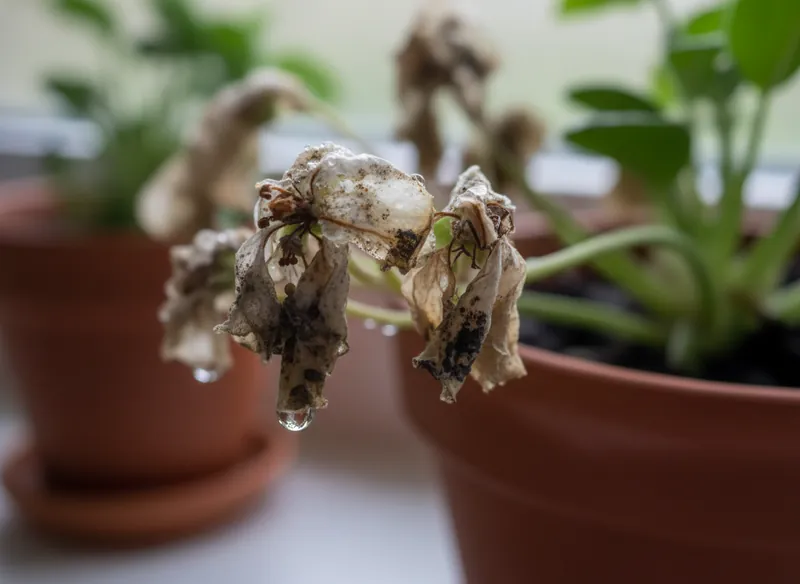
- Flower rot · Flowers or flower buds develop soft brown patches that expand and make them fall apart when touched.
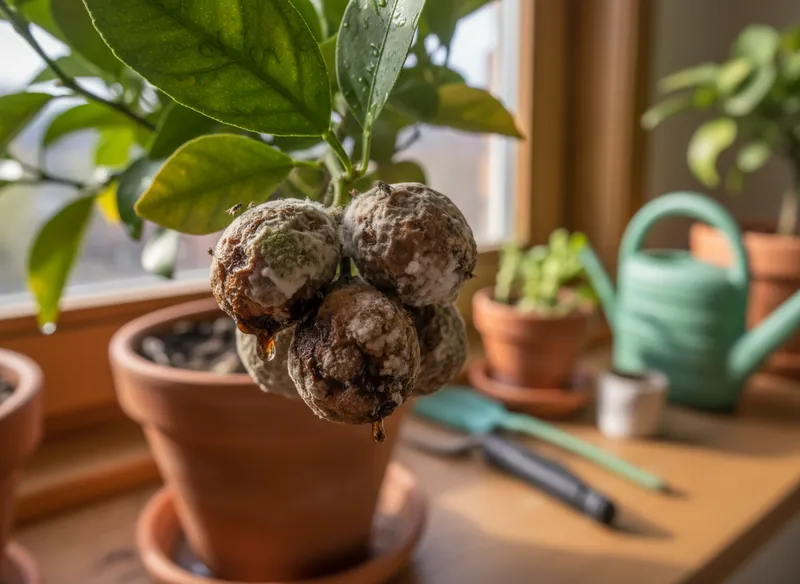
- Fruit rot · Soft, discolored, often sunken areas appear on fruit and may become moldy.
What to do now
Treat Botrytis (gray mold)
- Immediately isolate the diseased plant. Botrytis is highly contagious and spreads on air currents.
- Use clean scissors or pruners. Disinfect the blades with 70% alcohol before and after every cut.
- Cut away all affected parts. Remove at least 2 to 3 cm (about 0.8 to 1.2 in) of healthy tissue below the infected area to ensure all the fungus is removed.
- Discard cut plant material in the trash, never in compost, to avoid spreading spores.
- Increase air circulation around the plant. Move it somewhere airier or use a small fan on low speed for a few hours a day.
- Prepare a homemade fungicide solution: mix 5 mL (about 1 US tsp) of baking soda and 2.5 mL (about 1/2 US tsp) of black soap into 1 liter (about 1.06 US qt) of water. Spray the whole plant, focusing on cut areas.
- Reduce watering. Let the potting mix dry more between waterings to lower humidity around the plant.
Prevention
- Water directly at the base, never over the foliage.
- Ensure good air circulation between plants; do not crowd them.
- Immediately remove faded flowers and dead leaves.
- Inspect plants once a week, especially in cool, humid weather.