
Diseases
Anthracnose
Brown or black spots, often sunken and surrounded by a halo.
Anthracnose is a disease caused by fungi that attack plant tissues, causing necrotic lesions. The pathogen develops in warm, humid conditions and spreads through splashing water, killing plant cells to feed on them. Without intervention, spots enlarge and may merge, causing significant leaf drop and weakening the whole plant.
Signs to check
- Round or irregular beige to black spots with a clearly defined dark edge.
- The centers of older spots often become paler and may look hollow or sunken.
- Tiny black dots (the fungus's fruiting bodies) may appear in the centers of lesions.
- Lesions frequently appear along veins or around leaf edges.
What you may notice
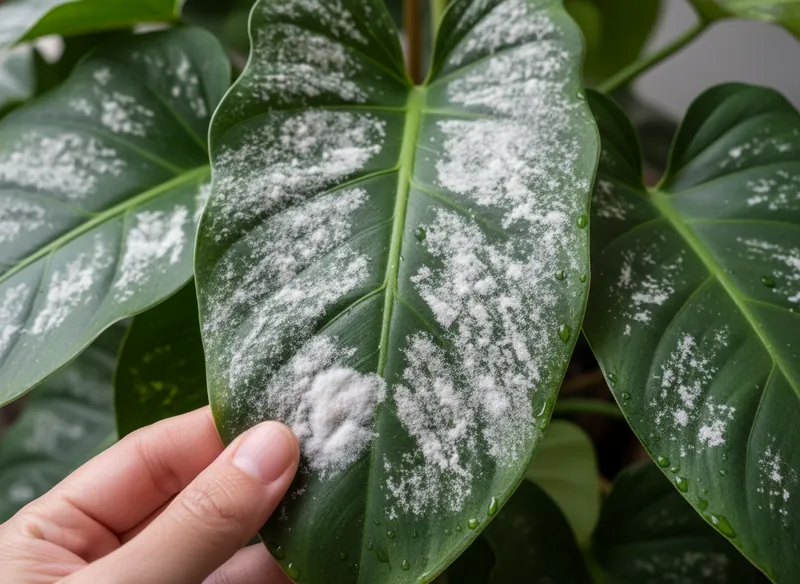
- White cottony growth · A white cottony or felt-like clump, mainly on leaf undersides or in leaf axils.
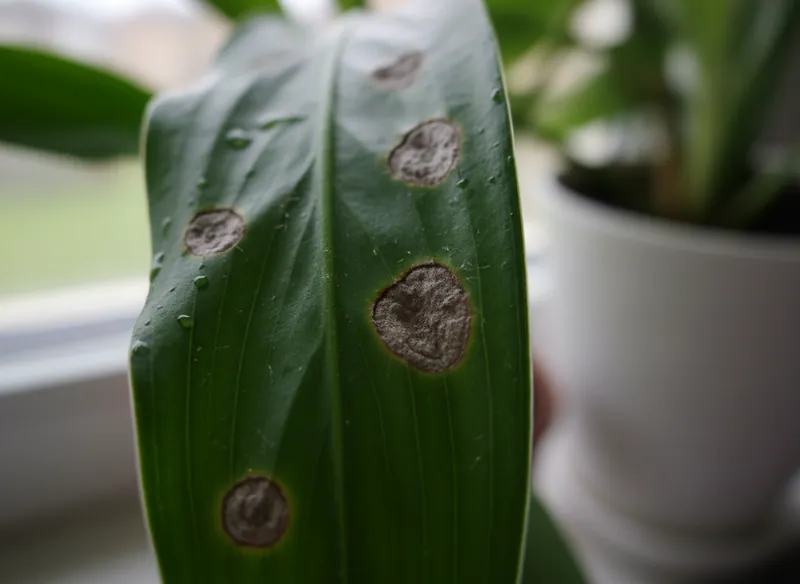
- Dry grayish spots · Small dry, discolored, grayish to beige spots appear on leaf surfaces, sometimes slightly sunken or surrounded by a halo.
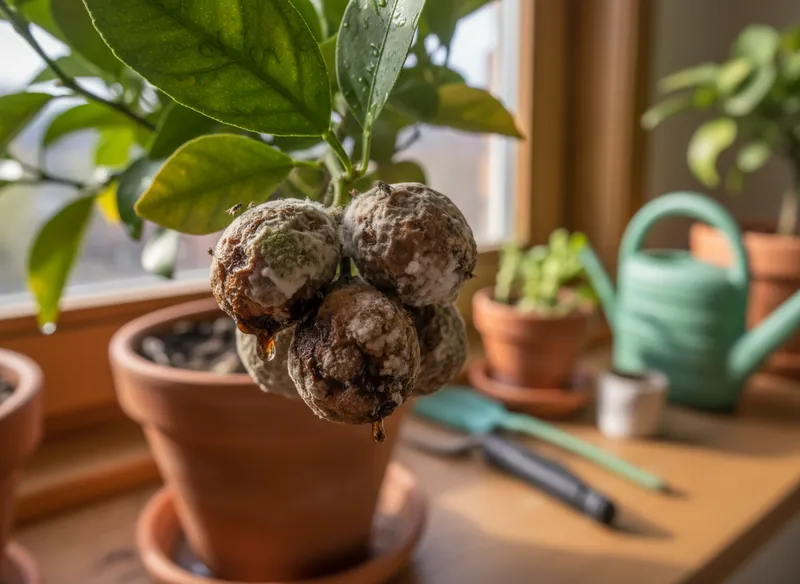
- Fruit rot · Soft, discolored and often sunken areas appear on fruit and may become covered in mold.
- Angular leaf spots · Wet-looking spots appear on leaves, their polygonal shape sharply bounded by the veins.
- Brown leaf spots · Circular or irregular brown spots appear on leaf surfaces, sometimes surrounded by a yellow halo.
- Spots with a yellow halo · Circular spots, often brown or black in the center, are surrounded by a distinct yellow halo on the leaves.
- Large black spot · A black spot more than one centimeter (about 0.4 in) across develops on a leaf, often surrounded by a yellow halo.
- Diffuse yellow patches · Yellow to pale green discolored areas appear on leaves with blurred, undefined edges.
- Gray spots with dark edges · Spots with pale gray or beige centers form on leaves, surrounded by a distinct dark brown border.
- Small brown dots · Numerous small brown or black dots, less than 2 mm (about 0.08 in) across, are scattered over leaf surfaces.
- Small black dots · Numerous pinhead-sized black dots are scattered over the upper or lower leaf surfaces.
- Shot holes in leaves · Small circular leaf spots dry out and fall away, leaving clean holes that give a sieve-like appearance.
- Stem spots · Abnormally colored marks of varying shapes and sizes appear on the plant's stems.
- Leaf rot · Brownish to black, wet-looking, soft areas appear and gradually spread across the leaf blade.
- Dry brown leaf edges · Brown, brittle drying develops along leaf edges or tips and progresses towards the center.
What to do now
Stop leaf spots
- Isolate the infected plant immediately to prevent spores spreading to other plants.
- Use clean pruning shears or scissors to cut off every spotted leaf. Put them in the trash, never in the compost.
- Disinfect your cutting tool with 70% alcohol or diluted bleach between every cut to avoid transmitting the disease.
- Improve air circulation around the plant. Move it away from other plants or a wall.
- Change your watering technique: water only the potting mix, at the base of the plant, without wetting the foliage.
- To protect the remaining healthy leaves, spray a sulfur-based fungicide, a gentle, effective option indoors. Apply it in the evening, out of direct sunlight.
Prevention
- Always water at the base of the plant, never over the foliage.
- Encourage good ventilation by spacing plants sufficiently far apart.
- Always remove dead or yellowed leaves from the potting mix surface.
- Inspect foliage once a week to act at the first signs.