
Diseases
Shot hole disease
Small brown spots drop out, leaving clean-edged holes in leaves.
Shot hole disease is caused by a fungus that creates small areas of dead cells (necrosis) on leaves. In response, the plant isolates the infected tissue, which eventually dries and falls out, leaving characteristic holes that make the leaf look as though it was hit by birdshot. Severe infection reduces the plant's ability to photosynthesize and can cause premature leaf drop and general weakening.
Signs to check
- Small, round, reddish to purplish spots, 2–5 mm (about 0.08–0.2 in) across.
- Spot centers turn brown or gray, then detach and fall out.
- Clean, round, shot-like holes form, often bordered by a thin purple halo.
- The most severely affected leaves turn yellow and may fall prematurely.
What you may see
- Leaves riddled with holes · Small, round spots on leaves dry out and fall away, leaving clean-edged holes with a sieve-like appearance.
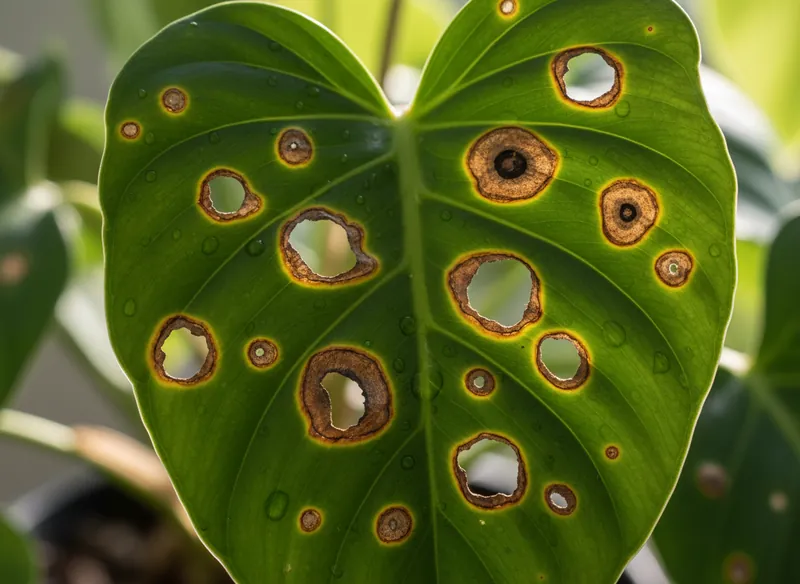
- Clean-edged holes in leaves · Round or oval perforations with clean edges appear in the leaf blade, with no discoloration around them.

What to do now
Stop leaf spots
- Isolate the infected plant immediately to prevent spores from spreading to other plants.
- Use clean pruning shears or scissors to cut off all spotted leaves. Put them in the trash, never in the compost.
- Disinfect your cutting tool with 70% alcohol or diluted bleach between cuts to avoid transmitting the disease.
- Improve air circulation around the plant. Move it away from other plants or a wall.
- Change your watering technique: water only the potting mix, at the base of the plant, without wetting the foliage.
- To protect the remaining healthy leaves, spray a sulfur-based fungicide, a gentle, effective option for indoor use. Apply it in the evening, away from direct sun.
Prevention
- Always water at the base of the plant, never over the foliage.
- Encourage good ventilation by spacing plants sufficiently apart.
- Always remove dead or yellowed leaves from the surface of the potting mix.
- Inspect foliage once a week to act at the first signs.