
Diseases
Angular bacterial leaf spot
Oily, angular spots bounded by leaf veins.
Angular leaf spot is a bacterial infection that destroys leaf tissues from within. Bacteria enter through natural leaf pores (stomata) and multiply, producing oily or water-soaked lesions that block photosynthesis. Without intervention, spots enlarge, turn brown and black, then dry out, causing premature leaf drop and seriously weakening the plant.
Signs to check
- Clearly polygonal spots whose edges are bounded by leaf veins.
- Spots initially look water-soaked, oily or translucent.
- Color changes from dark green to brown-black or gray as lesions dry.
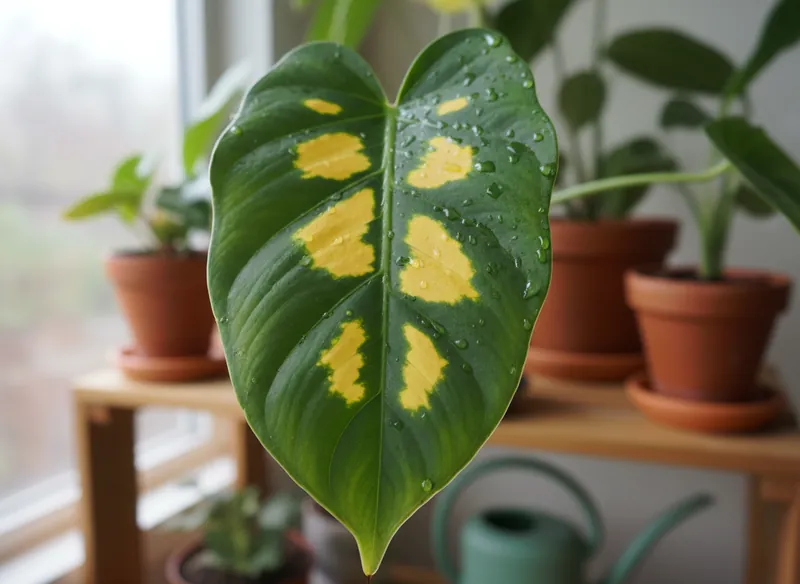
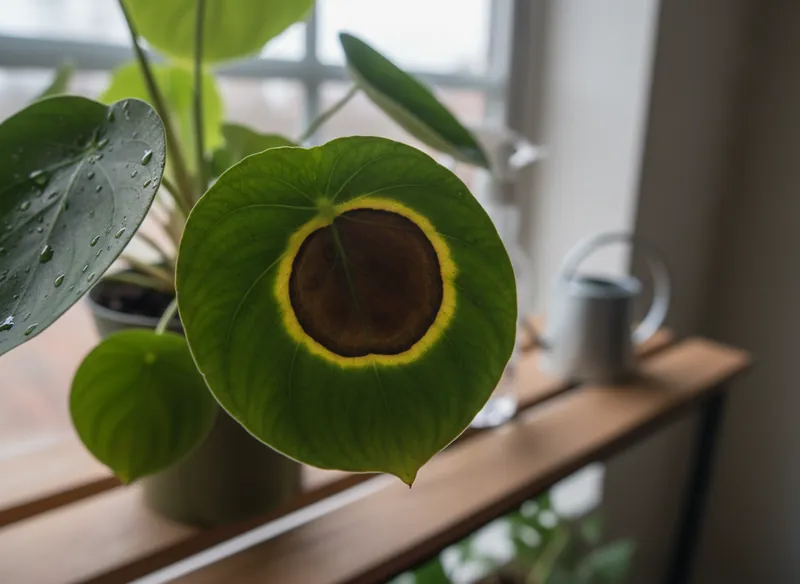
- A pale yellow halo frequently surrounds older spots.
- The centers of old spots may break down and fall out, leaving holes in the leaf.
What you may notice
- Angular leaf spots · Wet-looking spots appear on leaves, their polygonal shape sharply bounded by the veins.
- Spots with a yellow halo · Circular spots, often brown or black in the center, are surrounded by a distinct yellow halo on the leaves.
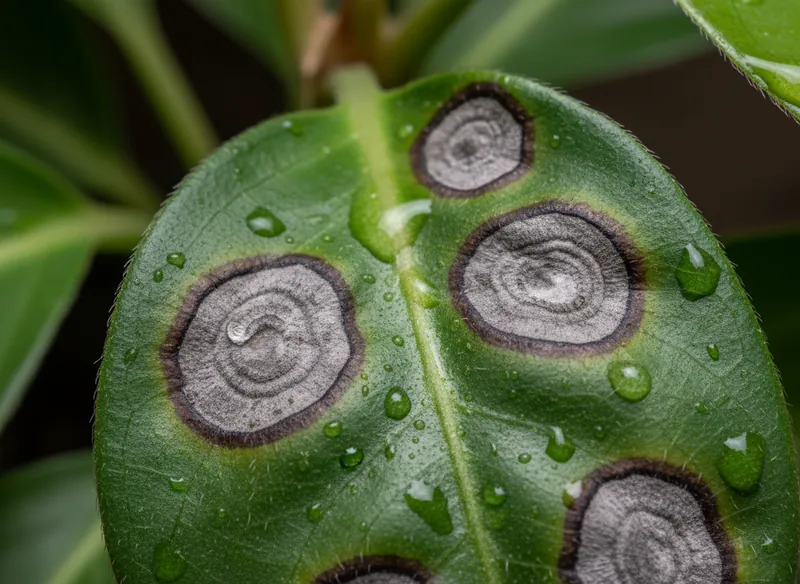
- Gray spots with dark edges · Spots with pale gray or beige centers form on leaves, surrounded by a distinct dark brown border.
- Stem spots · Abnormally colored marks of varying shapes and sizes appear on the plant's stems.
What to do now
Stop bacterial leaf spot
- Isolate the infected plant immediately to prevent spread to your other plants.
- Cut off and discard every spotted leaf. Use pruning shears or scissors sterilized with alcohol between every cut to avoid spreading bacteria.
- Change your watering technique: water the potting mix directly at the base of the plant. Avoid wetting the foliage at all costs.
- Ensure good air circulation around the plant by spacing it away from others. Good airflow helps leaves dry quickly.
- Apply a copper-based bactericide, following the manufacturer's instructions carefully. This protects healthy leaves; it does not cure leaves already affected.
- Stop all misting. Spraying water on leaves creates ideal conditions for bacterial growth.
- Watch the plant closely over the following weeks and remove any new suspicious leaf as soon as it appears.
Prevention
- Always water at the base of the plant, never over the foliage.
- Ensure good air circulation between plants so they dry quickly.
- Immediately remove dead or damaged leaves from the pot and the potting mix surface.
- Disinfect pruning tools with alcohol before and after every use.