
Rose diseases: identification and care
Sick rose: identify the problem by its symptoms
A sick rose almost always has one of three foliage fungi, black spot, powdery mildew, or rust, or an insect problem, most often aphids. Texture helps distinguish them: a black spot with fringed edges, a white powdery coating, or an orange pustule beneath a leaf. Prevention matters more than treatment. The French source also cites France's 2019 restrictions on synthetic garden fungicides; that is a France-specific claim, not a statement of your local law.
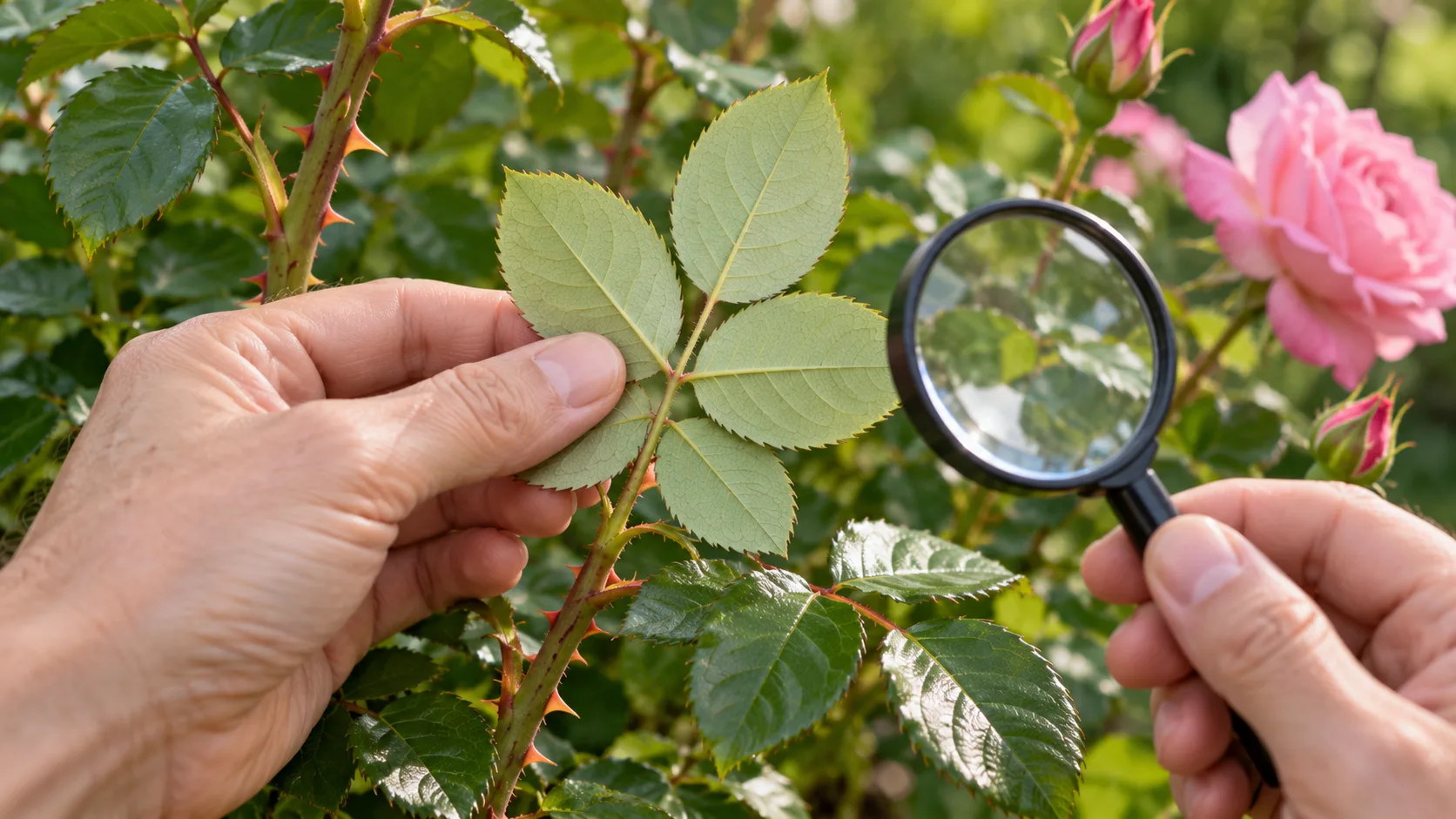
Diagnosis at a glance
Look at the symptom's position, then run a finger over it. A black spot that does not rub off points to a fungus within the leaf; a white coating that powders your fingers suggests powdery mildew; orange dust underneath indicates rust; a sticky leaf suggests a sap-feeding insect. Roses (Rosa) have only a few common enemies, but these can look similar from a distance.
| What you see | Likely cause | Read more |
|---|---|---|
| Black or purplish spots with fringed edges; leaves yellow, then fall | Black spot disease | Black spot |
| White powder on young leaves, stems, and buds | Powdery mildew | Powdery mildew |
| Yellow spots above, orange pustules below, turning black in late summer | Rust | Rust |
| Buds stay closed, petals stick together, then gray fuzz develops | Flower balling, gray mold | Buds |
| Green or pink colonies on buds, sticky leaves | Aphids | Insects |
| Leaflets rolled into tubes, spring to early summer | Leaf-rolling sawfly | Insects |
| Leaves mottled with pale speckles, white shed skins beneath | Rose leafhopper | Insects |
| Stem tips turn brown and dry out | Shoot dieback | Prevention |
A yellow leaf without spots or insects needs a different assessment: watering, soil, and nutrient deficiency.
Quand le feuillage jaunit sans la moindre tache : yellow rose leaves ont leurs propres causes, du sol calcaire à l'eau qui stagne.
A symptom that fits none of these rows? Photograph the leaf: Floralens identifies the problem and suggests an appropriate action.
Black spot: the most serious disease
Purplish-black spots spreading quickly across the upper leaf surface, followed by yellowing and leaf drop, indicate black spot, called marsonia in French (Diplocarpon rosae). The RHS considers it the most serious rose disease: a badly affected plant loses almost all its leaves and much of its vigor. Small, black, scabby lesions can also mark young stems1.

The life cycle explains the precautions. The fungus overwinters on fallen leaves and in young stems. In spring, rain splashes spores onto lower leaves: they germinate and enter the leaf within 48 hours, with new fruiting structures 9 to 15 days later. Disease then persists from May to September in the French source climate, depending on weather2. Jardiner Autrement sees the first spots in early summer in rainy weather3. Elsewhere, monitor local leaf growth, rain, and temperature rather than those months alone.
Steps that slow the disease:
- Collect fallen leaves in fall, or bury them under mulch at least 5 cm (2 in) deep, applied from November to February in the RHS's UK winter calendar1. Follow the equivalent dormant season locally.
- Prune out stem lesions in spring, before leaves emerge1.
- Water at the base and avoid evening watering that leaves foliage wet overnight3.
- Remove the first affected leaves as soon as symptoms appear3.
The RHS warns that these steps delay disease more than prevent it: spores also arrive in wind-driven rain1. Variety resistance needs the same caution: advertised resistance rarely lasts more than a few years as new strains emerge, while species roses are little affected1. Some reassurance: the disease rarely kills its host and its effect remains mainly cosmetic2.
See symptom photographs under large black patches.
Powdery mildew: a white coating
White powder on leaves and young shoots, curled leaves, and buds that will not open indicate powdery mildew (Podosphaera pannosa). The coating also spreads over stems, often around prickles, flower stalks, and petals4.

It behaves differently from the other diseases. Wet leaves are not required: powdery mildew benefits from humid, still air and periodically dry soil. Poorly ventilated climbers pressed against walls suffer most4. Clemson gives ideal conditions of 21 to 27 °C (70 to 81 °F), with humid nights and dry days; a film of water on a leaf can actually hinder infection5.
The sources disagree about season. The RHS calls it a disease of dry summers4, while Jardiner Autrement mainly sees it in spring and fall, considering summer too hot6. Their shared conditions matter more than a universal calendar: cool, humid nights followed by warm days.
Recommended steps, in order:
- Full sun and airflow: give the plant space, prune to open its center, and avoid crowding4.
- Keep soil from drying out: water regularly during dry spells and mulch4.
- Avoid excess nitrogen, which produces tender, vulnerable shoots4.
- Cut affected shoots at the first spots: Jardiner Autrement stresses this timing6.
See treating powdery mildew for the steps.
Rust: orange pustules under leaves
Angular yellow spots above and orange, powdery pustules below indicate rust (Phragmidium mucronatum). The pustules brown, then turn black in late summer, and heavy infection causes leaf drop78. In spring, the first patches sometimes appear on young stems, distorted and covered in orange spores8.

The fungus needs liquid water on the leaf for at least 2 hours and temperatures of 18 to 20 °C (64 to 68 °F)7. It overwinters in fallen leaves and young shoots.
The RHS considers it the least serious of the three common diseases, with most infections too light to justify treatment8. Cut out spring infections as soon as you see them, collect leaves in fall, and replace the variety if the same plant develops rust year after year8. See treating rust.
Buds that rot without opening
Buds that stay closed, with outer petals stuck into a papery shell, then turn moldy are showing flower balling. The RHS explains the weather sequence: cool rain saturates petals, then sun dries and sticks them together. Double-flowered roses with thin petals are most vulnerable, especially during wet, shaded spring and summer conditions9.
The real danger follows: a rotten bud develops gray mold, which spreads to other flowers. Remove balled buds promptly9. Clemson places botrytis activity at 17 to 22 °C (63 to 72 °F) in wet weather and recommends discarding spent flowers and fallen leaves5.
No product corrects this disorder: use an open site, pruning that improves airflow, watering directed at soil, and replace a variety affected every year9. See gray mold.
Aphids, sawflies, and leafhoppers on roses
Rose aphids (Macrosiphum rosae) are green or pink and reach 3.5 mm (0.14 in). They crowd buds and tender shoots from March to August in the RHS's UK calendar, peaking in early summer, and excrete honeydew that supports black sooty mold10. The RHS recommends tolerating small colonies, squashing patches between your fingers, and allowing lady beetles, hoverflies, and small parasitic wasps to reduce numbers in summer. Aphids often begin before their predators in spring: inspect roses early10. Elsewhere, use local growth and observed activity to time checks. See removing aphids and cleaning honeydew.
Leaf-rolling sawfly rolls leaflets into tubes from late April to early June in the RHS's UK climate, sheltering its pale green larva. Roses almost always recover: remove rolled leaves only when there are few, because removing many harms the rose more than the insect11. Monitor the equivalent local spring growth stage elsewhere. See sawflies.
Rose leafhoppers mottle upper leaf surfaces with pale speckles, especially in hot, dry weather, from May to September in the RHS's UK climate. Turn a leaf over: white nymphal shed skins remain underneath. Rose vigor rarely suffers, and the RHS recommends tolerance12. Finer mottling with tiny mites and sometimes silky webbing instead suggests spider mites, active from March to October in that source climate during hot, dry weather13. Elsewhere, follow local conditions and observed activity. See leafhoppers and spider mites.
When to watch for problems
Each problem has its season in the source climates: aphids and sawflies in spring, black spot and leafhoppers through summer, powdery mildew and rust throughout growth. The calendar below brings together the sources' published periods, month by month where supplied. These are source-climate examples; local warmth, rainfall, and growth determine actual monitoring.
| Problem | January | February | March | April | May | June | July | August | September | October | November | December |
|---|---|---|---|---|---|---|---|---|---|---|---|---|
| Black spot, leaves | nothing to report | nothing to report | nothing to report | nothing to report | watch for this | watch for this | watch for this | watch for this | watch for this | nothing to report | nothing to report | nothing to report |
| Rose aphids | nothing to report | nothing to report | watch for this | watch for this | watch for this | watch for this | watch for this | watch for this | nothing to report | nothing to report | nothing to report | nothing to report |
| Rose leaf-rolling sawfly, leaves | nothing to report | nothing to report | nothing to report | watch for this | watch for this | watch for this | nothing to report | nothing to report | nothing to report | nothing to report | nothing to report | nothing to report |
| Rose leafhopper, leaves | nothing to report | nothing to report | nothing to report | nothing to report | watch for this | watch for this | watch for this | watch for this | watch for this | nothing to report | nothing to report | nothing to report |
| Red spider mites, hot and dry summer weather, leaves | nothing to report | nothing to report | watch for this | watch for this | watch for this | watch for this | watch for this | watch for this | watch for this | watch for this | nothing to report | nothing to report |
As local spring growth begins, turn over a few leaves each week; during summer growth, check foliage after rain; in fall, collect fallen leaves before winter.
Care without pesticides: the French source's legal context
The French source states that synthetic chemical plant-protection products have been prohibited for amateur gardeners in France since January 1, 201914. It lists biocontrol, low-risk products, and products permitted in organic farming as remaining allowed there14. Its packaging instruction is to look for “Emploi autorisé au jardin”, meaning authorized for garden use3. This is the source's France-specific account, not your local law. The RHS goes further, recommending no fungicide at all for rose diseases1.
Homemade preparations deserve the same caution. The Société française des roses notes that seaweed, nettle, garlic, or comfrey decoctions and infusions are supposed to strengthen rose defenses, but this has yet to be demonstrated15. Jardiner Autrement reaches the same conclusion for nettle or horsetail liquids against powdery mildew6.
Protection starts before local spring growth:
- A cleanup pruning in November or December in the SFR's French calendar removes about one-third of shoot length, including diseased leaves that could reinfect the rose in spring15. Elsewhere, match this to local dormancy.
- Cut dead wood as soon as it appears, cleanly above a healthy bud16. Clemson gives 1 part bleach to 9 parts water for blade disinfection5; this is its stated recipe without a proven safety or effectiveness guarantee here.
- Space plants apart so foliage dries quickly after rain7.
- Do not plant a new rose where an old one grew: the Société française des roses considers the site unsuitable for 7 to 8 years15.
Le meilleur moment pour éliminer le bois malade est aussi celui de la taille : pruning a rose se fait en fin d'hiver pour la plupart des types.
Une eau versée au pied, le matin, protège mieux qu'un traitement : watering a rose sans mouiller les feuilles limite les trois champignons.
Add your rose: Floralens reminds you when to watch for black spot and aphids, season by season (Pro mode). Get reminders
Frequently asked questions
How do I treat rose diseases?
Identify the disease first: fringed black spots, powdery mildew's white coating, or rust's orange pustules. Remove affected leaves at the first symptoms, water at the base, and collect fallen leaves in fall3. The French source states that since 2019 only biocontrol, low-risk, or organic-approved products remain permitted for amateur garden use in France14. That statement is specific to France.
What disease causes black spots on rose leaves?
Black spot, called marsonia in French, caused by Diplocarpon rosae. Purplish-black spots spread quickly, leaves yellow and fall, and small black lesions can also mark young stems1. It persists from May to September in the French source climate, depending on weather2. Monitor the corresponding local wet growing conditions elsewhere.