
Why are my rose leaves turning yellow? Causes and solutions
Yellow leaves on roses: finding the cause
A yellowing rose most often has black spot, which makes spotted leaves yellow and fall, chalky soil that limits iron uptake, or a watering problem. Where yellow appears usually helps distinguish the cause: around black spots, between green veins, on older lower leaves, or all over at once. In climates with fall dormancy, yellowing is normal as the rose sheds its leaves.
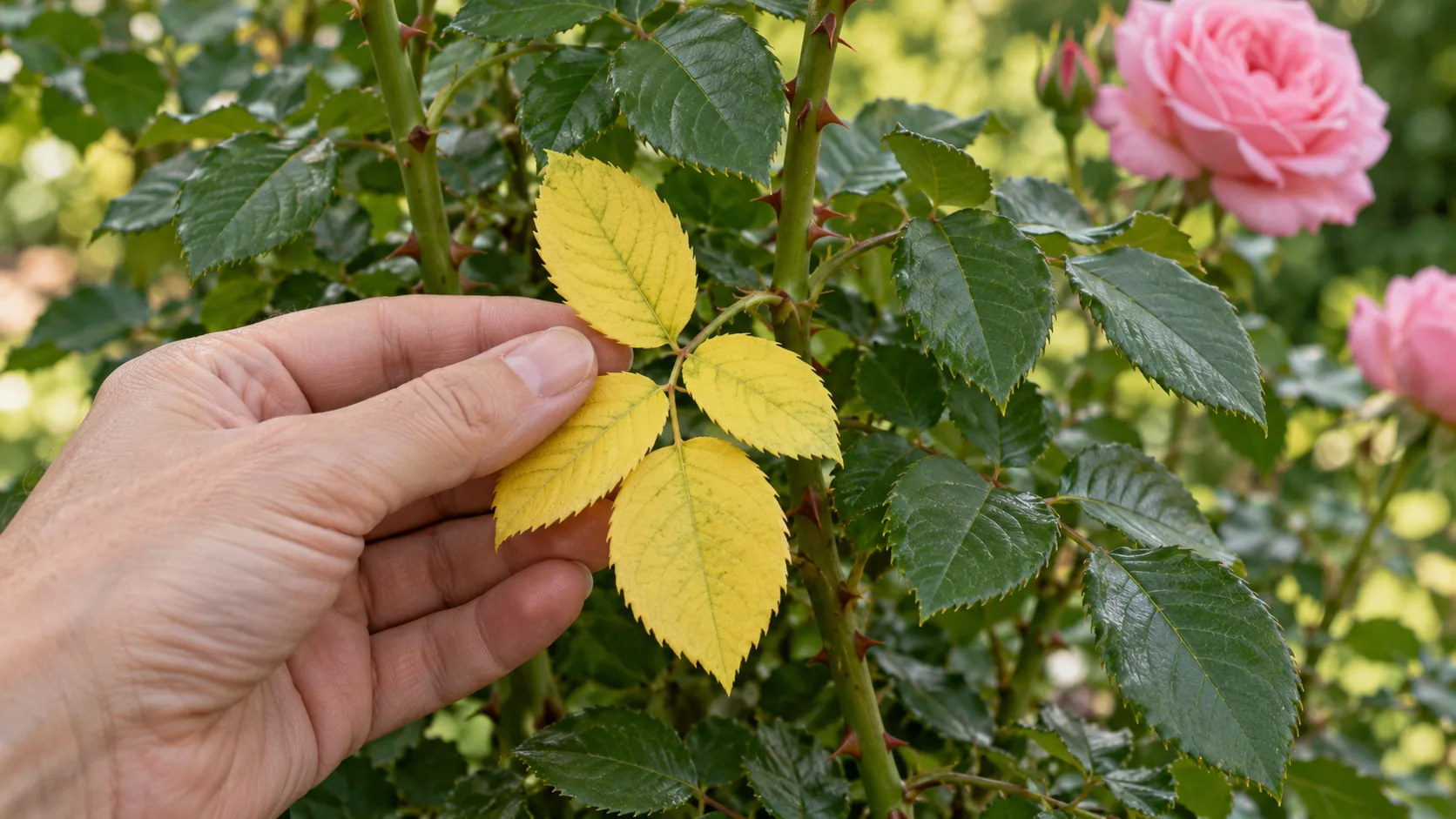
Yellowing causes: a quick guide
Look at where the leaf turns yellow before applying any treatment. A rose (Rosa) can yellow for very different reasons. The Royal Horticultural Society (RHS) emphasizes that the position of yellowing on the leaf and the plant helps guide diagnosis much more than the color alone1.
| Problem | January | February | March | April | May | June | July | August | September | October | November | December |
|---|---|---|---|---|---|---|---|---|---|---|---|---|
| Black spot, leaves | nothing to report | nothing to report | nothing to report | nothing to report | watch for this | watch for this | watch for this | watch for this | watch for this | nothing to report | nothing to report | nothing to report |
| What you see | Likely cause | Read more |
|---|---|---|
| Leaves yellow around black spots and fall in summer | Black spot disease | Black spot |
| Young yellow leaves with green veins | Iron deficiency, often in chalky soil | Chlorosis |
| Older lower leaves yellow first, with slow growth | Low nitrogen, or low manganese and magnesium | Nutrient deficiency |
| General yellowing and wilting in wet soil | Oxygen-starved roots | Water |
| Leaves droop, then yellow in dry weather | Too little water | Water |
| Pale speckles on leaves, shed skins or webbing underneath | Leafhoppers or spider mites | Insects |
| All foliage yellows and falls during local fall dormancy | Normal leaf drop in a deciduous shrub | Fall |
Unsure? Photograph both sides of a leaf: Floralens identifies the cause and suggests the appropriate action.
Yellow around black spots: a fungus
Purplish-black spots, yellowing around them, then leaf drop indicate black spot, the most serious rose disease according to the RHS (Diplocarpon rosae). Affected leaves often fall while the rest of the plant looks healthy, sometimes without yellowing; a badly affected rose can lose almost all its leaves2. Clemson describes round spots up to about 1.3 cm (0.5 in) across with a yellow halo, and roses bare by midsummer after a warm, wet spring3.
This is the leading cause of a rose yellowing and dropping leaves in summer. Remove affected leaves, collect fallen ones, and water at the base2.
Cycle, période à risque et prévention : rose diseases se préviennent surtout avant le printemps.
Yellow between green veins: chalky soil
Young leaves turn yellow while their veins stay green: the rose lacks iron. The RHS describes interveinal yellowing as typical of iron, manganese, or magnesium deficiencies, noting that iron deficiency affects the youngest leaves first1. In chalky soil, roots cannot absorb iron and manganese even when they are present1.

Roses prefer rich, well-drained, acidic to neutral soil4. In very chalky ground, chlorosis returns each year. Check drainage too: waterlogged roots stop taking up nutrients5. See correcting iron deficiency and yellow leaves with green veins for the steps.
Older leaves yellow first: nutrient deficiency
General yellowing starting on lower leaves, with slower growth, signals low nitrogen. The RHS distinguishes the symptoms: nitrogen deficiency affects older leaves first; manganese and magnesium deficiencies also affect older leaves, between their veins. Low potassium mainly shows along leaf edges1. An unfed container rose can soon reach this point.
Do not add fertilizer blindly, though: excess nitrogen produces a very green rose with few flowers6. See nitrogen deficiency.
Pour nourrir sans excès, au jardin comme en pot : fertilizing roses se donne deux fois par an en pleine terre.
Too much or too little water
Waterlogged roots cause yellowing that can resemble a lack of water. The RHS describes interveinal yellowing, a plant that wilts in wet soil, and bluish-black roots with a sour smell5. In summer, almost no plant survives long with oxygen-starved roots5. Empty container saucers and check drainage holes. See overwatering.
Too little water first shows as drooping buds and leaves: the RHS recommends watering without delay7. In the garden, it favors deep, less frequent watering that moistens soil 15 cm (6 in) down, rather than a daily trickle87. See underwatering.
Quantité, rythme et signes de soif : watering roses se règle sur le sol et la saison.
Pale speckles that yellow a leaf: an insect
A leaf mottled with pale speckles that eventually looks washed out often has sap-feeding insects. Rose leafhoppers mottle upper leaf surfaces from May to September in the RHS's UK climate, especially in hot, dry weather; their nymphs leave white shed skins underneath. Rose vigor is rarely affected9. Elsewhere, use local warmth and observed insect activity rather than those months alone.

Finer mottling with tiny greenish-yellow mites and sometimes silky webbing points to spider mites. In hot, dry weather, leaves can lose color, dry out, and fall10. Turn the leaf over and inspect it with a magnifying glass before deciding. See leafhoppers and spider mites.
Fall: normal leaf drop
A rose is a deciduous shrub: where cool fall weather brings dormancy, its leaves yellow and fall. NC State describes it as woody, deciduous, and perennial4. This yellowing affects the foliage together as the first cool nights arrive and needs no treatment.
Take the opportunity to collect fallen leaves, especially after black spot: the fungus overwinters on them2.
Should you remove yellow leaves?
Yes, if they have black spots: removing them at the first symptoms slows disease2. Where practical, the RHS even recommends removing diseased leaves still on the plant in winter2.
There is no need if yellowing comes from soil, watering, or nutrient deficiency: cutting leaves off does not solve the problem. Correct the cause; new leaves will show the improvement.
Add your rose: Floralens alerts you to diseases to watch for and reminds you to water in dry weather (Pro mode). Get reminders
Frequently asked questions
Why are my rose's leaves turning yellow and falling off?
Can yellow rose leaves mean too much water?
Can a yellow leaf turn green again?
Rarely: a leaf yellowed by disease or a long-standing deficiency stays yellow. Once you correct the cause, new leaves emerge green. Remove black-spotted leaves to slow disease2.
How do I help a rose with yellowing between the veins?
This is most often iron deficiency because roots cannot absorb iron in chalky soil1. Roses prefer acidic to neutral soil4. Check drainage, then follow the steps for correcting iron deficiency.