
How often to water roses: timing and amounts
Watering roses: the right amount at the right time
An established garden rose needs watering only in dry summer conditions, but thoroughly: 20 to 30 liters per square meter (0.5 to 0.7 US gal per sq ft) every 10 to 15 days, or one large watering can per plant no more than once a week. Water at the base, preferably in the morning, never over the leaves. Pots change the picture: in hot weather, a rose may need water daily.
How often should you water a rose?
An established rose in the ground needs water only in dry summer conditions, but plenty at once. The Société française des roses (SFR) recommends thorough watering every 10 to 15 days: 20 to 30 liters per square meter (0.5 to 0.7 US gal per sq ft) when hot, dry weather lasts several weeks1. Rose roots reach deep, down to 1 meter (3.3 ft), making the plant fairly drought-resistant2.
10 L every 30 days
20 to 30 L per m² every 10 to 15 days
5 to 10 L per plant Weekly maximum: one
Every day
| Task | January | February | March | April | May | June | July | August | September | October | November | December |
|---|---|---|---|---|---|---|---|---|---|---|---|---|
| Watering | reduced | reduced | reduced | moderate | moderate | high | high | high | moderate | moderate | reduced | reduced |
| Growth | resting | resting | active | active | strong | strong | strong | strong | active | active | resting | resting |
| Feeding | no | no | yes | yes | yes | yes | yes | no | no | no | no | no |
| Repotting | no | favorable window | favorable window | favorable window | no | no | no | no | no | favorable window | favorable window | no |
The Royal Horticultural Society (RHS) gives an amount per plant: 5 to 10 liters (1.3 to 2.6 US gal), or a large watering can, no more than once a week in dry midsummer conditions3. Yet it rejects fixed routines: watering once a week should not become a rule; soil conditions should decide4.
Why water deeply and less often? One thorough watering encourages roots downward, while a daily trickle keeps them near the surface3. Water slowly until the soil is moist 15 cm (6 in) deep4.
A newly planted rose is an exception: water regularly, especially in summer, during its first few years while the roots establish3.
How can you tell if a rose needs water?
Drooping buds or leaves mean water is needed without delay. This is the RHS's warning sign3. Better to act before it appears: growth suffers as soon as the plant wilts5.
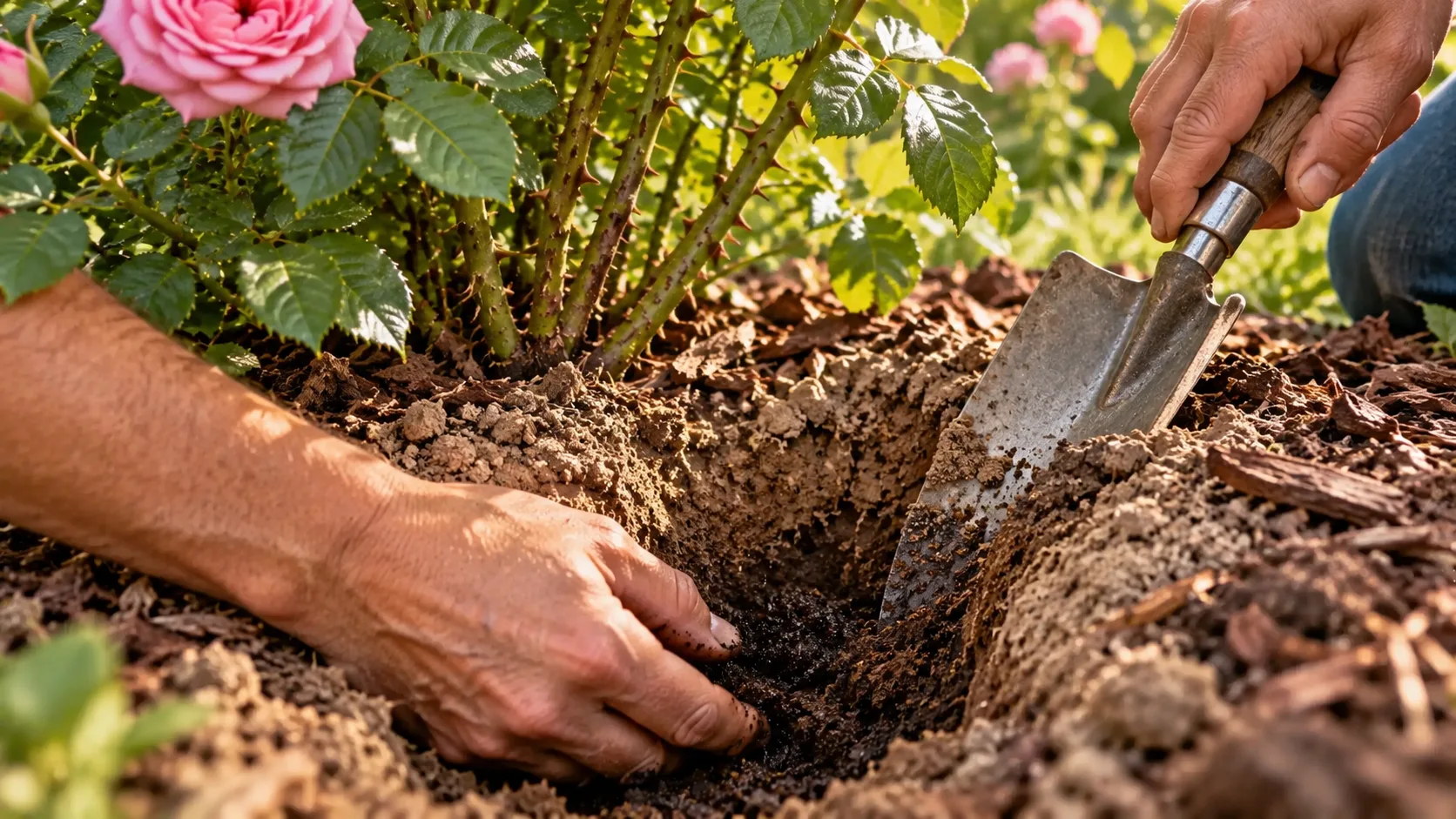
To catch dryness earlier, dig with a trowel beside the plant. If the soil is dry 15 cm (6 in) down, it is time to water4. In a pot, check closer to the surface: water when the mix is dry 2 or 3 cm (about 1 in) down4.
How to water: at the base, keeping leaves dry
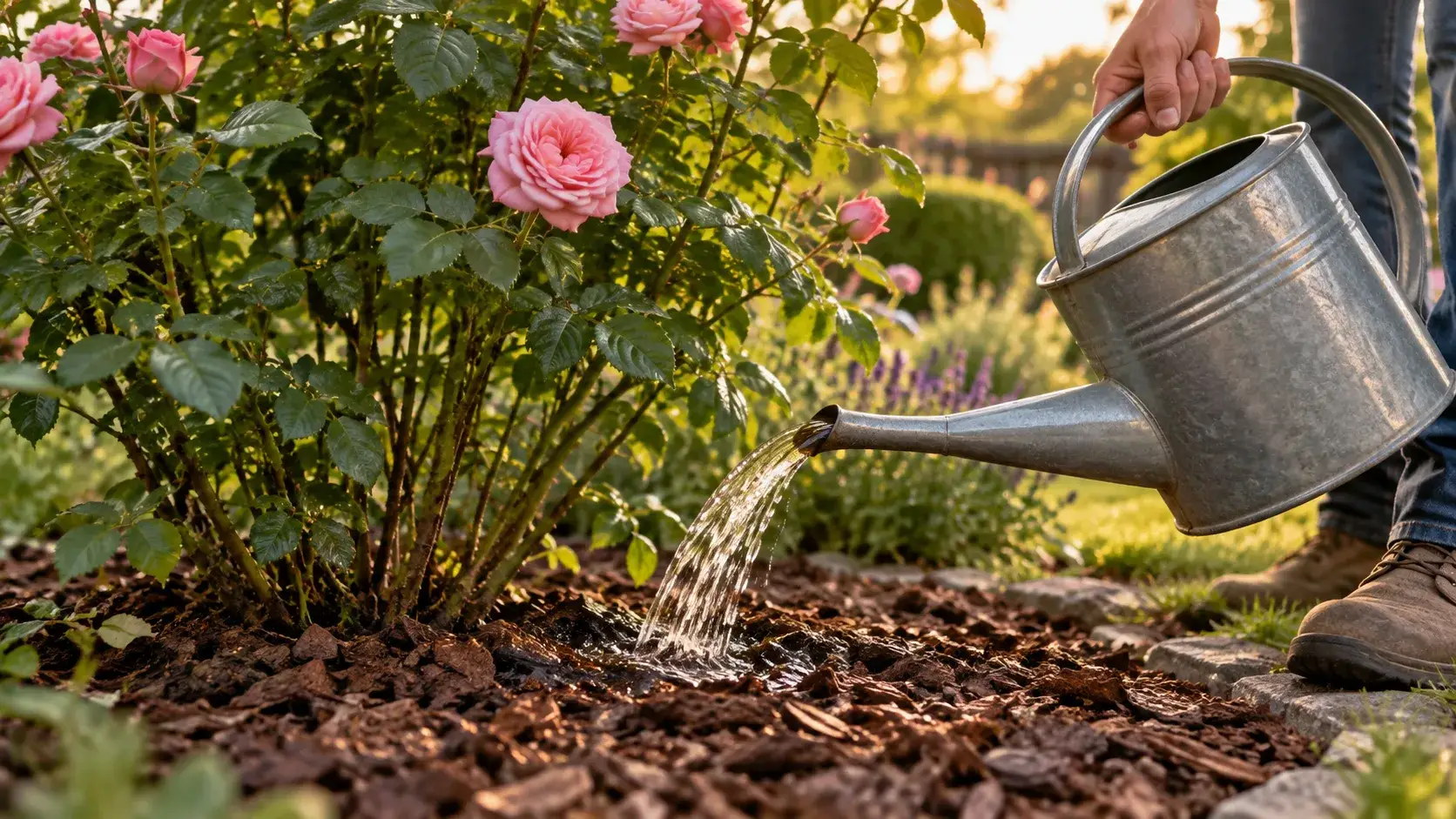
Water the base, never the foliage. The SFR recommends this to limit fungal diseases1, and the RHS directs water onto the soil, avoiding leaves and flowers3.
A watering can is the most economical and precise tool; use a hose sparingly, and remember that a sprinkler is among the least efficient options4. The SFR recognizes one exception: a rose growing in a lawn you want to keep green, where sprinkling once or twice a week remains the only option1.
Collect rainwater in a tank: the RHS treats mains water as a last resort4.
Un feuillage qui reste mouillé ouvre la porte aux champignons : rose diseases commencent souvent par un mauvais arrosage.
Morning or evening?
Preferably morning. The RHS considers it the best time: less evaporation, and water available to the plant throughout the day. Evening is acceptable, but leaves that stay wet all night encourage disease4. Jardiner Autrement also advises against evening watering to reduce black spot6.
The sources do not fully agree. To prevent buds from rotting into tight balls, the RHS instead recommends watering in the evening, directing water onto the soil to avoid the hottest hours7. Their common advice is never over the leaves, never in full sun. Powdery mildew is a separate case: in dry weather, wetting foliage in midmorning may actually slow it8.
A potted rose needs more water
In a pot, the water reserve is limited to a few liters of mix. In hot weather, a patio rose may need water every day, without ever standing in water3. The RHS checks containers daily in hot or windy weather and twice daily in a heat wave5.
A saucer helps during summer droughts; remove it during the dormant winter. Grouped pots shade each other, reducing water needs5.
Profondeur du pot, terreau et hiver : growing roses in pots demande un suivi plus serré qu'au jardin.
Mulching to retain water
A 5 cm (2 in) mulch layer limits evaporation and prevents annual weeds from growing. In its French calendar, the SFR applies it from May and removes it in late September or early October, leaving behind the portion already broken down into humus1. The RHS instead mulches from late fall to late winter, at least 5 cm (2 in) deep3. These source-climate examples are not universal months; match the timing to local moisture, temperature, and growth. See mulching to retain moisture.
Too much or too little water: the signs
Too little water makes buds and leaves droop3. Too much can look similar: oxygen-starved roots cause yellowing between leaf veins, and the plant wilts as though thirsty even in wet soil. Roots turn bluish black and smell sour9. Always feel the soil before watering a wilting plant. See underwatering and overwatering.

Quand le feuillage jaunit sans tache : yellow rose leaves viennent souvent d'une eau mal dosée.
Should you water in winter?
In the garden, almost never during a cool, dormant winter: the RHS reserves watering established roses for dry midsummer periods3. In a pot, a dormant plant needs very little water, and you should never water when frost is forecast5. Remove saucers too, since they hold water against the roots5.
Add your rose: Floralens reminds you when to water, according to the season and whether you grow it in the garden or a pot (Pro mode). Get reminders