
How to water a moth orchid: timing and methods
Watering orchids
Water a moth orchid when the roots visible through its pot lose their clear green color and begin turning gray: in practice, a ten-minute soak every seven to ten days, slightly less often in winter. Water quality matters as much as timing: lukewarm, low in minerals, never softened. Ice cubes do not kill it under the studied conditions, but they do not water it any better.
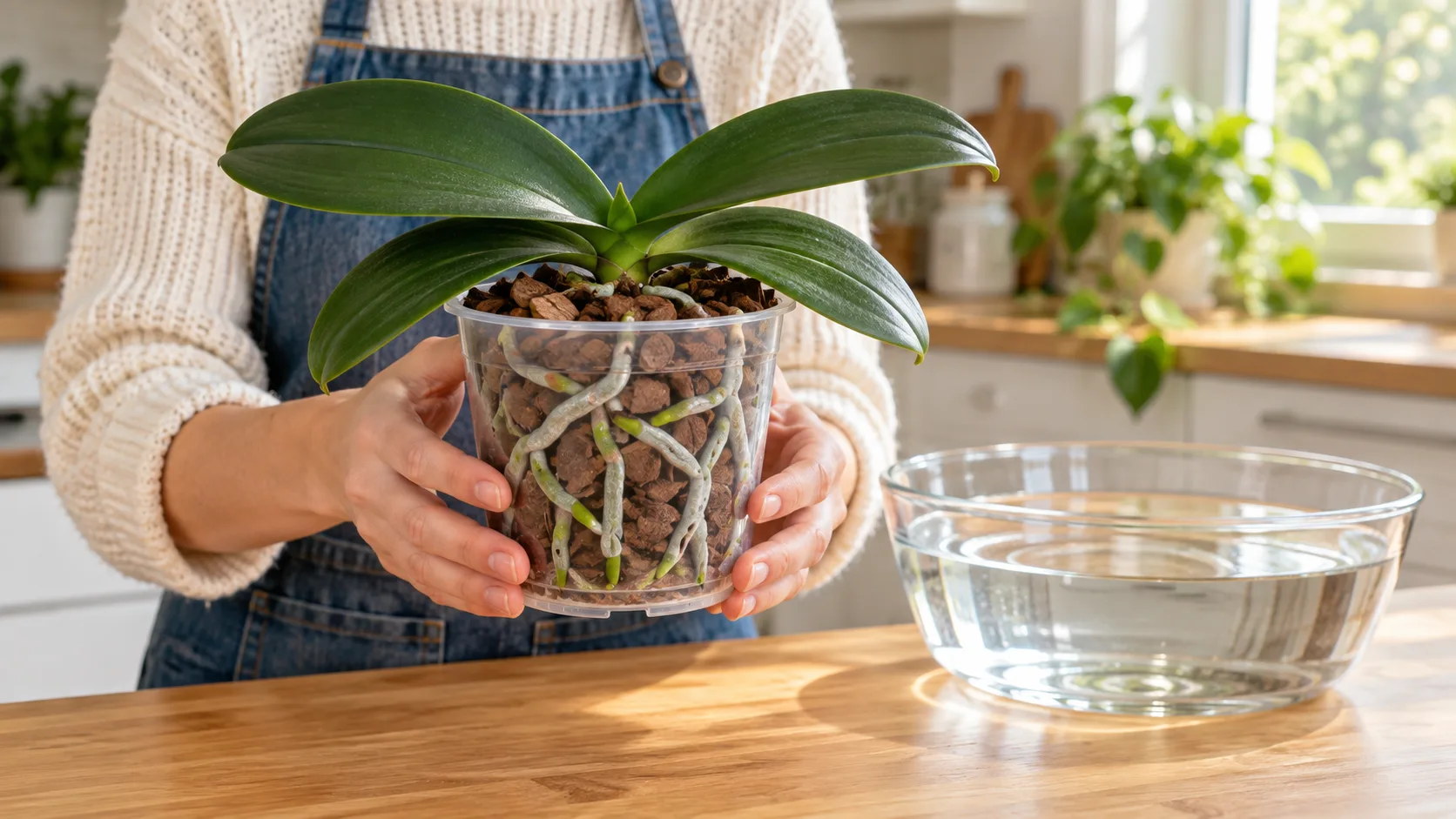
When to water an orchid: read its roots
Water when the roots visible through the pot lose their clear green color and begin turning gray. The Ohio State University team describes the signal: a well-watered root is green, while a drying root takes on a silvery sheen.1 Soaking restores the color: University of Maryland Extension notes that silvery or white aerial roots turn pale green once they have received enough water.2 No schedule replaces this visual check.

The color comes from the velamen, the spongy covering around each root. A moth orchid (Phalaenopsis) has no storage organ apart from its leaves: water thoroughly, then wait until the medium is almost dry, never completely dry.3 The RHS puts it another way: never let roots dry out completely, and never leave the pot standing in water.4
The Muséum sets the threshold slightly earlier. In its advice, roots in the medium, inside the pot, should stay greenish: Do not wait until they turn white or even grayish before watering.
5 Between these readings, take the cautious approach: the first gray signals a soak, and a distinctly silvery color already suggests a slight delay.
Make sure you check the right roots. Aerial roots extending beyond the pot dry much faster than roots inside it: they turn gray earlier and overstate the plant's thirst. Rely first on roots within the pot. Do not bury or cut off aerial roots.4
| Roots inside the pot | Meaning | Action |
|---|---|---|
| Clearly green and plump | Well-watered plant 1 | Wait and check again in two or three days |
| Fading green, starting to turn gray | Medium nearing dryness 15 | Soak the pot |
| Distinctly silver-gray or dull white | Watering overdue 5 | Soak promptly, then shorten the interval |
| Brown or beige and soft | Dead roots 1 | Unpot, trim, and replace the bark |
| Covered in a white, threadlike mat | Decaying medium; the mat repels water 6 | Repot in fresh bark |

A second cue supports the first: the pot's weight. Lift it just after soaking, then a few days later; after three or four cycles, you learn how a thirsty pot feels. This is why the RHS recommends a clear pot: you can see whether bark below the surface is still moist.4
Reading roots this way applies to epiphytes. For a plant in potting soil, use your finger, as with watering a monstera and watering houseplants generally; for an orchid, use your eyes. The moth orchid's origins and botany explain its branch-clinging way of life.
How often should you water an orchid?
About once a week from spring to fall, slightly less in winter, according to the RHS, adjusted to local light, temperature, and growth.4 The Muséum averages one soak every ten days, while the University of Maryland considers more than once a week usually unnecessary at household temperatures.52
17 cL every 11 days
About every 7 days
A little less often than in summer
About every 10 days
| Task | January | February | March | April | May | June | July | August | September | October | November | December |
|---|---|---|---|---|---|---|---|---|---|---|---|---|
| Watering | reduced | reduced | moderate | moderate | high | high | high | high | moderate | moderate | reduced | reduced |
| Growth | resting | active | active | strong | strong | strong | strong | strong | active | active | active | resting |
| Feeding | yes | yes | yes | yes | yes | yes | yes | yes | yes | no | no | yes |
| Repotting | no | no | favorable window | favorable window | favorable window | no | no | no | favorable window | no | no | no |
The American Orchid Society gives the extremes: every two days at the height of a hot, dry summer, every ten days in a cool greenhouse in winter.3 Between these extremes, conditions in your room set the pace.
The medium dries more slowly in winter
The same society notes that overwatering is less about volume than a medium that does not dry quickly enough: watering too often or too heavily, insufficient airflow or light, or overly humid air.7 The short December days in the French source's winter setting slow everything down. When your local light and growth slow, reduce watering slightly, as the RHS advises4, and let the roots guide you.
Keep watering regular during flowering
A flowering orchid uses more water: the American Orchid Society notes that orchids need the most water while blooming, and flower longevity depends on it.7 Consistency matters as much as quantity. A pot left dry too long, or kept sodden, causes bud drop: the plant draws water from its buds to survive.8
Le rythme d'arrosage ne relance pas la hampe à lui seul. Ce qui va trigger flowering tient surtout à quelques semaines de journées plus fraîches.
Bark and sphagnum need different intervals
An orchid planted in sphagnum moss stays moist much longer than one in pine bark. Since overwatering means a medium that fails to dry7, space out soaks and rely even more on root color and pot weight. Bark more than two years old compacts and starts retaining water too: that signals repotting.4
Just after purchase or repotting
After repotting, the RHS recommends thorough watering to wet the entire root ball, followed by complete drainage.4 If many rotten roots had to be removed, water lightly afterward while the plant grows replacements.6
Quand l'écorce se délite ou retient l'eau trop longtemps, il est temps de repot an orchid dans un substrat neuf.
How to water an orchid: a ten-minute soak
Soak the pot for ten minutes in a basin of room-temperature water reaching pot height, then let it drain completely. The Muséum's gardeners call this soaking method bassinage.5 The Muséum advises against watering from above to avoid wetting the plant's crown.
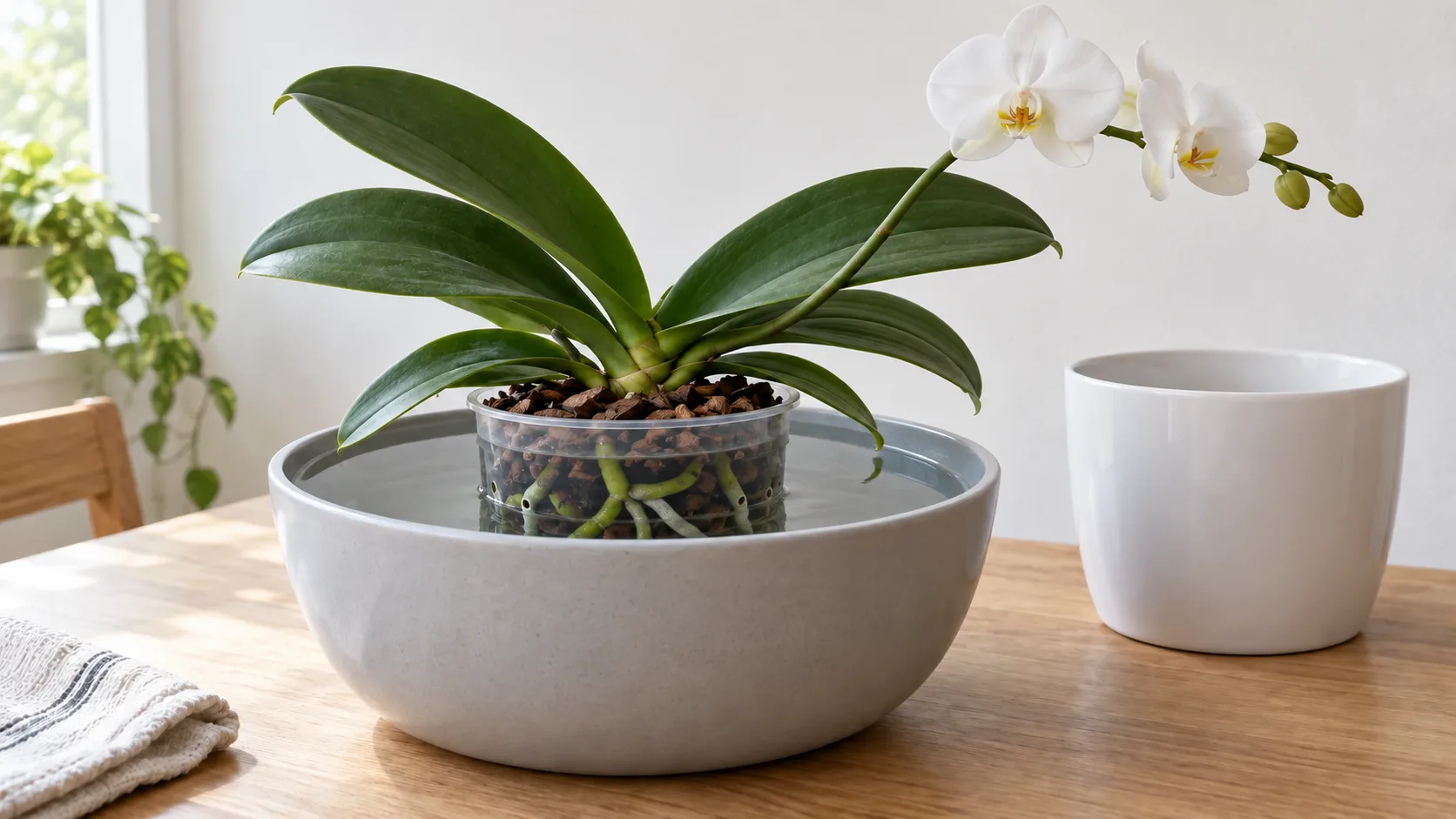
Bottom watering
A water bath, or soak, is what the Muséum calls bassinage: water rises from below without wetting the crown of the plant.
- Take the nursery pot out of its decorative outer pot.
- Place it in a basin with water up to the height of the pot.
- Leave it to soak for 10 minutes.
- Let it drain thoroughly before putting the pot back.
How much water? No measurement is needed: the soak gives the bark as much as it can hold, and drainage removes the excess. That is the advantage over guessing with a glass of water.
Water in the morning, keeping the crown dry
Water in the morning so leaves dry before night.3 Late watering on an evening when temperatures fall can cause edema: the plant absorbs more water than its leaves release, producing watery blisters.6
Comparing other watering methods
| Method | How | Assessment |
|---|---|---|
| Soaking | 10 minutes with water at pot height, then drain 5 | The reference method: wets the whole root ball while keeping the crown dry |
| Lukewarm running water | 3 or 4 passes under the faucet over 10 minutes 2 | Equally effective, convenient for several pots |
| Watering can | Water from above, then empty the saucer 4 | Possible if you aim at bark rather than leaves |
| Misting | Fine droplets on leaves and aerial roots | Supplemental humidity, not a substitute for watering 2 |
| Ice cubes | Three ice cubes a week on the bark 1 | No harm found in bark under the study conditions, with no advantage: see below |
Orchids in glass vessels or closed decorative pots
The risk in a vase or decorative pot without drainage holes is water pooling beneath the roots. The RHS is firm: never let the plant stand in water.4 Even the ice-cube researchers advise emptying water left in the decorative pot to avoid root damage.1
The same rule applies in a glass vase: water, let the bark absorb moisture, then tip the vase while holding the plant to drain all excess water. Roots kept permanently submerged almost always end in root rot.
The American Orchid Society describes one exception: fine bark in a mesh pot placed inside a larger pot standing in about 1.3 cm (0.5 in) of water. The bark draws water upward by capillary action while the open mesh lets roots breathe.3 The key is fine bark that wicks water without drowning the roots.
What water should you use for orchids?
Lukewarm water low in dissolved minerals: rainwater remains the best choice.4 In their forests, orchids receive rain, mist, and dew containing only 10–25 mg of dissolved solids per liter (about 38–95 mg/US gal). Hard water, with a much greater mineral load, can dull the plant's appearance and impair its functioning.9
Temperature matters too. Cold water damages tissues like a cold spell: sunken lesions, spots, and collapsed tissue.6 The Muséum recommends room-temperature water and suggests collecting rainwater in a simple container by the window.5
| Water | Assessment | Reason |
|---|---|---|
| Rainwater | Best | Close to what the plant receives in nature 49 |
| Reverse-osmosis or demineralized water | Very good with suitable fertilizer | Almost pure, with nothing to buffer pH 9 |
| Naturally soft tap water | Suitable | At room temperature, never cold 6 |
| Hard tap water | Limit its use | Resists a fall in the bark's pH 10 |
| Softened water | Avoid | A softener replaces hardness minerals with sodium, which is toxic to the plant 9 |
Reverse-osmosis water is the most widely used by orchid growers because it is inexpensive.9 Its purity has a drawback: it supplies almost no calcium or magnesium10, hence fertilizer formulated for such pure water. If your home has a water softener, use water that bypasses it, or rainwater.
L'eau du bain sert aussi à porter l'engrais : choosing orchid fertilizer dépend de la dureté de votre eau.
A French example: municipal water results
In France, tap water is often hard; the relevant number for an orchid appears in municipal water-test results. Hardness is expressed in French degrees (°f): one degree represents 10 mg of calcium carbonate per liter (about 38 mg/US gal).11
For an orchid, the most useful line is TAC, or alkalinity. Sue Bottom of the St. Augustine Orchid Society divides water into three groups: below 60 mg/L (about 227 mg/US gal), or 6 °f, for rainwater and reverse-osmosis water; 60–150 mg/L (about 227–568 mg/US gal) for moderate alkalinity, which public supplies may provide; and above 150 mg/L (about 568 mg/US gal), or 15 °f, for highly alkaline water, common in wells drilled into limestone.10
Floralens calculated the median results for France's twelve most populous municipalities, using a year's official sample results published by Eaufrance.12
Seven of these twelve cities exceed 15 °f. Paris has median TAC of 20.7 °f and total hardness of 26.1 °f; farther west, Brest falls to 6.4 °f.12 Highly alkaline water resists a fall in pot pH, and its calcium remains poorly available until the medium becomes acidic again.10 Moth orchids need a slightly acidic medium, between pH 5.5 and 6.5.
Finding a French municipality's result: France's Ministry of Health publishes official tap-water monitoring results by municipality.13 Look for titre alcalimétrique complet (total alkalinity) and titre hydrotimétrique (total hardness). The following interpretation uses Sue Bottom's classes; these French measurements are not a claim about your local water supply:
- TAC below 15 °f: tap water is suitable when brought to room temperature.
- Above 15 °f: Sue Bottom recommends an acid-reacting fertilizer, with nitrogen mainly from ammonium, to neutralize some alkalinity.10 For soaking, the Muséum and RHS prefer low-hardness water anyway, ideally rainwater.54
- In every case: use plain water without fertilizer every fourth watering to flush salts accumulating in the bark.4 For an already crusted pot, see flushing salts from the medium; signs of excess salts have their own page.
Ice cubes: what the study actually measured
Three ice cubes a week did not kill orchids grown in bark, but did not water them better than soaking. Ice cubes were already used for plants at trade shows without water access; the instruction came from Ohio producer Green Circle Growers, which sells orchids with a three-cubes-per-week recommendation. Ohio State University and the University of Georgia tested it on 48 orchids, over four to six months, against the same quantity of room-temperature water.114
The result: the same flowering duration and the same leaf and root health.114 The team also measured the temperatures experienced by the plants.
The bark fell to 11–13 °C (52–55 °F), then returned to 21 °C (70 °F) five hours later. An aerial root touching ice dropped to about 4 °C (39 °F), while root fragments showed damage only at −7 °C (19 °F).1 In this trial, ice cooled the roots without freezing them.
The trial has limits explicitly stated by the authors: it applies only to bark, to flowering plants, and the dose of three cubes must be adjusted to variety, light, and room temperature.1 The American Orchid Society still recommends room-temperature water and lists ice cubes among causes of chilling damage.6
The takeaway: if you already use ice cubes and the roots are green, there is no urgency. Place cubes on the bark, away from leaves, and empty the decorative pot. But a fixed dose, unchanged between July and January in the French source's contrasting seasons, conflicts with thorough watering followed by a medium that nearly dries3. Adjust to your local light and temperature; soaking, which adapts to what the bark holds, remains the simplest method to get right.
Too much water or too little: reading the leaves
Soft, wrinkled leaves can mean either underwatering or overwatering. The Ohio trial's authors describe a thirsty plant by its wrinkled, limp leaves1; the University of Maryland adds that overly dry air produces the same appearance.2 Rotten roots, however, absorb nothing and produce those same thin, drooping leaves.6
Sue Bottom's advice is clear: an orchid that looks dehydrated probably is, so take it out of the pot to learn why.6 Silvery, firm roots need a soak; brown, hollow roots need repotting.

| Sign | Underwatering | Overwatering |
|---|---|---|
| Leaves | Wrinkled and flexible; plump up after soaking | Thin and drooping; do not plump up |
| Roots | Silver-gray and firm | Brown, soft, and hollow when pressed |
| Bark | Light-colored and light in weight | Dark and compacted, sometimes covered with a white mat |
| Crown | Healthy | Sometimes blackened where water collected |
Each case has a page: underwatering, rescue by soaking for a severely dried plant, overwatering, and emergency repotting for drainage when bark stays sodden. Floralens also helps distinguish them: photograph the plant and the app identifies the problem and the action to take.
Une feuille qui jaunit n'annonce pas toujours une erreur d'arrosage : yellow orchid leaves ont plusieurs causes, de la vieille feuille qui s'en va au coup de soleil.
Taches aqueuses, cœur noirci, odeur : orchid diseases commencent souvent par une eau qui a stagné.
Misting does not replace watering
Misting raises air humidity; it never replaces a soak. An orchid absorbs almost all its water through its roots; less than 5% enters through leaves, according to the American Orchid Society.7 The University of Maryland considers misting insufficient in a home.2
Ambient humidity still matters: moth orchids prefer 50–70% relative humidity. The RHS allows light misting in summer, daily in hot conditions, on leaves and aerial roots while keeping the crown dry.4 Follow actual local heat rather than the calendar.
A pebble tray beneath the pot also raises nearby humidity, provided it is only partly filled with water: the pot must never sit in it.32 See raising ambient humidity and low humidity.
For the rest of the year's care, including light, growing medium, and reblooming, see the orchid care guide.
Frequently asked questions
How can I tell whether my orchid needs water?
Look at the roots through the clear pot: green roots are hydrated; as green fades toward silver, the medium is drying. 1 The Muséum advises against waiting until they turn white or grayish. 5 A pot that feels light confirms the signal. Wrinkled leaves can also result from rotten roots: when in doubt, unpot the plant. 6
How many times a week should you water an orchid?
About once a week from spring to fall according to the RHS, or one soak every ten days on average according to the Muséum, adjusted to local light, warmth, and growth. 4 5 In winter, reduce watering slightly: the American Orchid Society gives every ten days in a cool greenhouse. 3 In a heated apartment, follow the roots: water as soon as their green begins turning gray.
How much water should you give an orchid?
No need to measure: soak the pot for ten minutes in a basin of room-temperature water reaching pot height, then drain completely. 5 The bark holds what the plant needs and excess water drains away.
Should you water an orchid while it is flowering?
Can you water an orchid with tap water?
Yes, if it is low in hardness and at room temperature: the Muséum and RHS prefer low-hardness water, ideally rainwater. 5 4 Above 15 °f alkalinity (TAC, in French degrees), a threshold exceeded in the French examples of Paris, Lyon, and Bordeaux, Sue Bottom recommends an acid-reacting fertilizer to compensate. 10 12 Never use sodium-rich water from a softener. 9