
How to get an orchid to rebloom: timing and care
Getting an orchid to rebloom
A moth orchid (Phalaenopsis) restarts its spike after four to five weeks of days at no more than 25 °C (77 °F): warm days block flowering, rather than a lack of cold nights. Allow ten to thirteen weeks from a visible spike to the first flower. The commonest mistake is leaving it behind warm glass or near a radiator throughout the cooling period, in fall in the source’s seasonal growing example. Follow actual light and temperature.
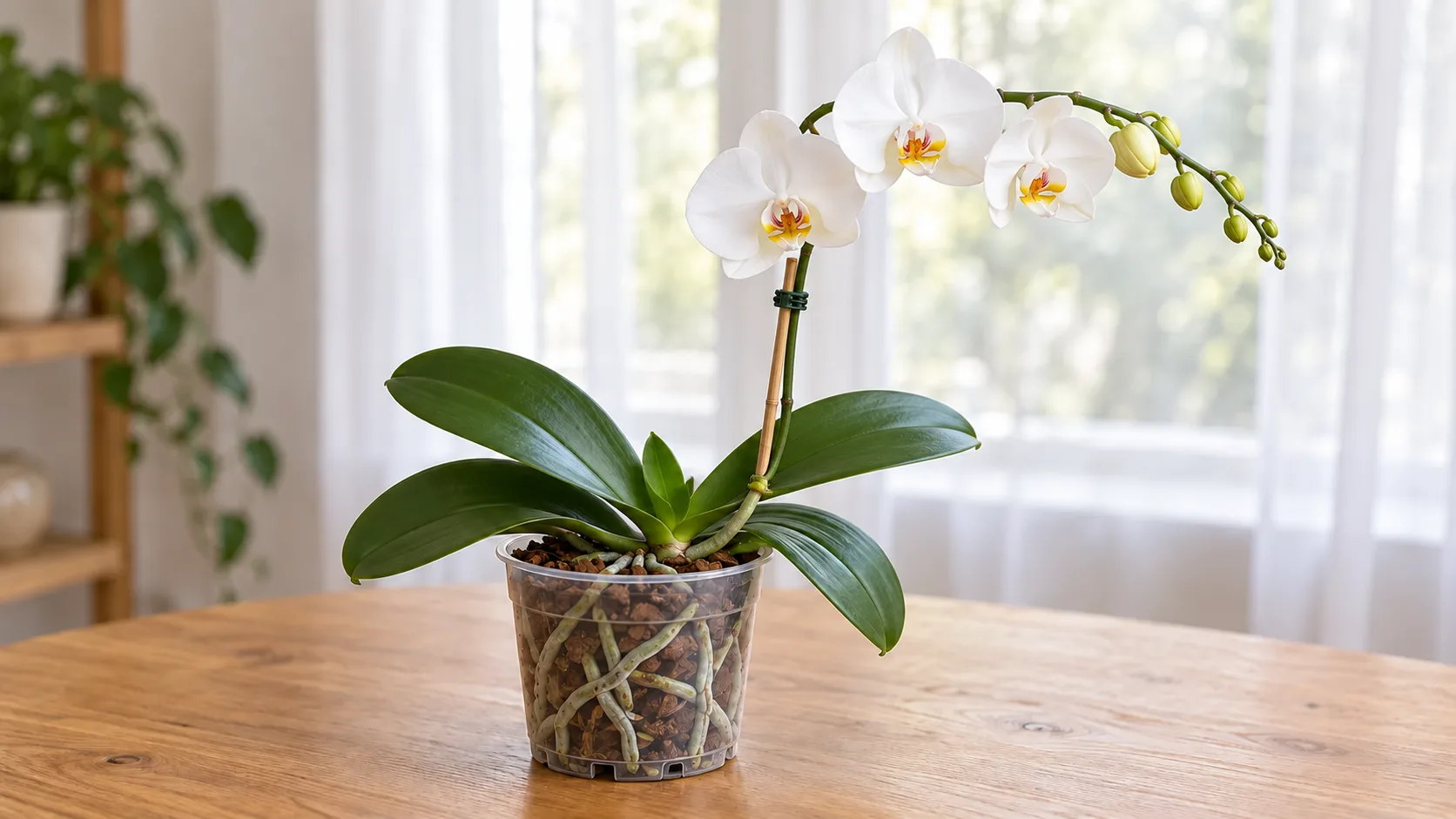
What triggers orchid flowering?
Moth orchids (Phalaenopsis) flower when days stay cool for several consecutive weeks. This switch is called flower induction. In Phalaenopsis it depends neither on day length nor a night-time cold shock, but on daytime temperature. 1
- What triggers flowering
- Cooler daysDays below 25 °C, for 4 to 5 weeksSource: American Orchid Society
- Flowering
- In winterSource: American Orchid Society
- Flowering
- In springSource: American Orchid Society
In 2006, Michigan State University researchers Matthew Blanchard and Erik Runkle grew two clones under twelve temperature regimes. After 20 weeks, at least 80% of plants had spikes at constant 14, 17, 20 or 23 °C (57, 63, 68 or 73 °F). None had spiked with days at 29 °C (84 °F), even when nights dropped to 17 °C (63 °F). 2
Their conclusion is simple: a cool night cannot compensate for a warm day, and a day-night difference is unnecessary. Growers use this both ways: keeping plants at 28 °C (82 °F) or higher prevents flowering, then moving them below 26 °C (79 °F), especially by day, initiates the flower spike. 1
Why does the cold-night trick sometimes work? An orchid moved closer to a cool fall window also experiences cooler days. The RHS recommends somewhere around 5 °C (9 °F) cooler for a month, without distinguishing day and night. 3 Behind sun-warmed glass, south-facing in the source’s growing example, around twelve hours daily at 29 °C (84 °F) block spiking, even with nights at 17 °C (63 °F). 2
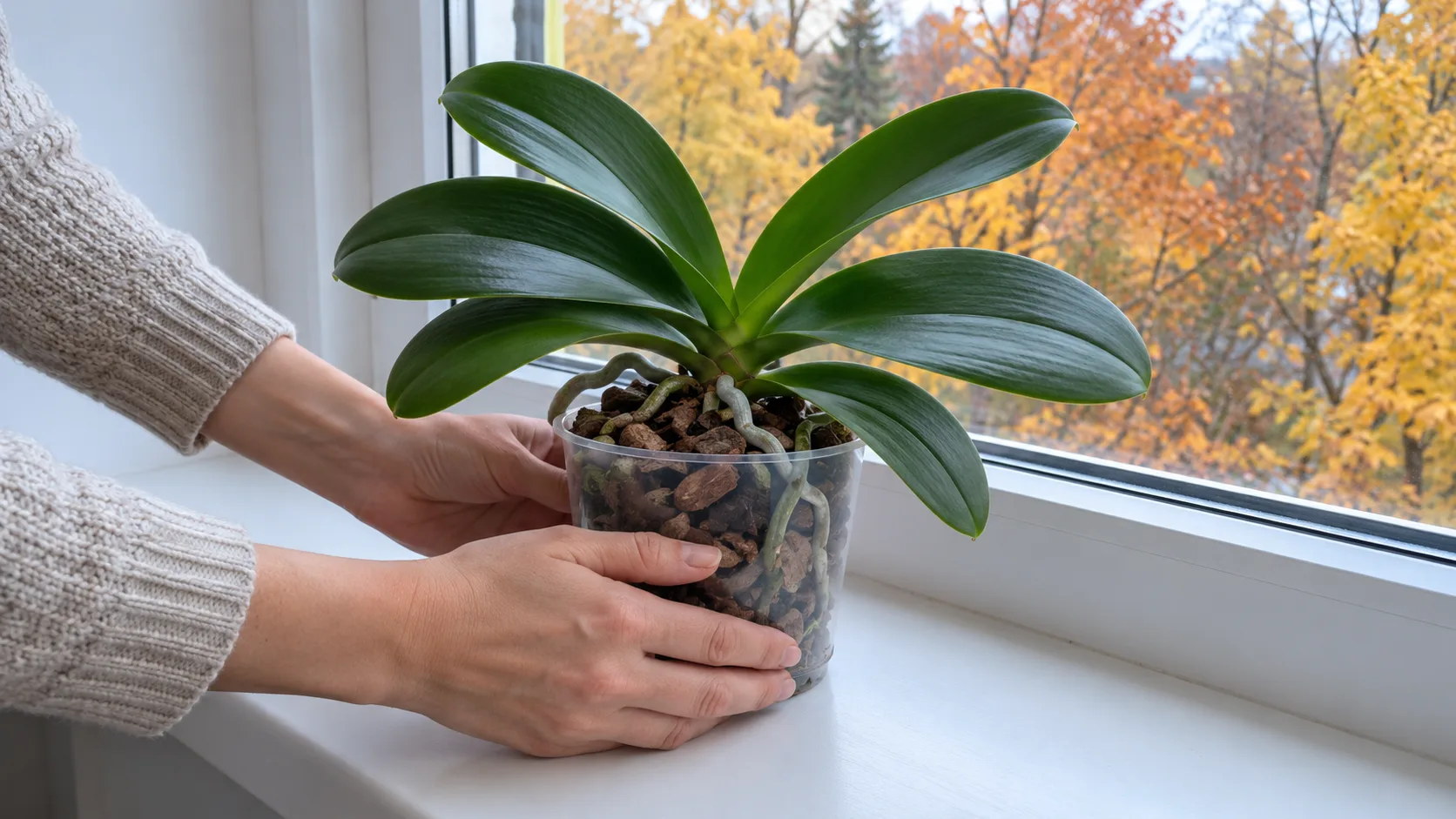
The American Orchid Society culture sheet still mentions 13 °C (55 °F) fall nights 4; trials in its own journal show that daytime matters. 1
One condition comes before temperature: maturity. The first spike almost always emerges in the axil of the fifth or sixth mature leaf; an orchid bought flowering has passed this stage. 5 Day length matters little: short days advance spiking by only 5 to 8 days. 6
Is yours a different kind of orchid?
Triggers differ by genus. Most commercial hybrids, including large white hybrids descended from the moon orchid (Phalaenopsis amabilis), follow the cool-day rule; the three orchids most often confused with them respond to another signal.
| Orchid | Trigger | Threshold |
|---|---|---|
| Moth orchid (Phalaenopsis) | Cool days for several weeks | Daytime maximum 25 °C (77 °F), 4 to 5 weeks 1 |
| Bamboo orchid (Dendrobium nobile) | Cool, dry, bright winter rest, large day-night difference | Days below 28 °C (82 °F), nights below 10 °C (50 °F), difference over 14 °C (25 °F) 5 7 |
| Cymbidium (Cymbidium) | Cold nights from fall until spring | Nights 10 to 14 °C (50 to 57 °F), days around 24 °C (75 °F) 8 |
| Oncidium (Oncidium) | Plenty of light, no chilling requirement | 1 to 5 hours of sunshine daily 9 |
The bamboo orchid's cool, dry rest is detailed in bamboo orchid care, and the genus in the Dendrobium profile. Cymbidium, tolerating much colder nights, is described in the Cymbidium profile.
Phalaenopsis origins and hybrids are presented in the moth orchid profile.
Unsure whether yours is a moth orchid? The flowering trigger differs between orchids. Scan it with Floralens: the app identifies the species and sends care reminders.
An orchid that no longer flowers: triage
An orchid that stops flowering but keeps firm leaves is not sick: it lacks a condition. The table begins with the plant's visible signs.
| What you see | Likely cause | Action |
|---|---|---|
| Firm leaves, new leaves and aerial roots, no spike for a year | Days too warm: room above 25 °C (77 °F) much of the day, south-facing glass, radiator | Four to five weeks at no more than 25 °C (77 °F) by day, ideally 20 to 23 °C (68 to 73 °F) 1 2 |
| Long, thin, dark green leaves, plant far from window | Insufficient light | East or west window, bright winter light 3 |
| Soft, wrinkled leaves, brown hollow roots in saturated bark | Roots rotted by excess water | Repot in fresh bark, remove dead roots 3 |
| Young plant, fewer than five mature leaves | Not mature enough | Wait: around half of young plants sold near flowering size bloom in year two 5; a keiki takes two to three years |
| Spike elongating without buds, or producing a keiki instead of flowers | 28 °C (82 °F) or higher while spike is under 10 cm (4 in) | Keep below 28 °C (82 °F) until buds form 1 |
| Buds yellowing and falling before opening | Draft, abrupt temperature change, ripe fruit nearby | Stop moving it, keep away from glass and fruit 10 |
The first row is by far the commonest in heated homes: the plant grows well but never flowers because its days never fall below the threshold. For damaged roots, overwatering helps catch the problem before rot.
Le rythme qui garde les racines fermes et argentées est détaillé dans la page watering an orchid selon le substrat et la saison.
Pour changer une écorce tassée sans casser les racines, voir comment repotting an orchid après la floraison.
How long until the next flowering?
From cooling to the first flower, allow 15 to 18 weeks, nearly four months, adding the two measured delays below. 4 to 5 weeks of cooler days suffice to initiate the spike; afterwards, plants tolerate 17 to 26 °C (63 to 79 °F). 1 6
In a trial reported by Wang, Tsai and Dai, plants kept 27 weeks at 30 °C (86 °F) spiked on average 38 days after cooling. 6
From visible spike to first flower, one hybrid in the AOS-published study took 72 days at 23 °C (73 °F) and 89 days at 20 °C (68 °F). The cooler it is, the longer the wait. 1
Then comes the overlooked heat delay. Just one week at 30 °C (86 °F), after one to four cool weeks, delays spiking by 9 to 23 days and flowering by 2 to 3 weeks. A radiator switched back on or an Indian summer behind glass sets the clock back. 6
In practice in France, an orchid spending October in a lightly heated room shows its spike in early November and flowers between mid-January and February, matching winter and spring flowering.

For some varieties, 25 °C (77 °F) days and 20 °C (68 °F) nights produce spikes one to two weeks earlier than 20 °C (68 °F) and 15 °C (59 °F); depending on variety and maturity, the cooler regime more often gives multiple spikes. 6
The five-step method
- Check readiness. It needs at least five or six mature, firm leaves and green or silver roots that feel full. 5 The sign: no brown, hollow roots visible through the clear pot.
- Provide bright light. An east window is ideal in the AOS’s growing context; shaded south or west also works there. Use the actual light reaching the leaves. 4 Move closer to glass in winter to support flowering. 3 The sign: medium-green leaves, neither dark and elongated nor sun-yellowed.
- Cool the days for 4 to 5 weeks. Aim for no more than 25 °C (77 °F) by day 1, ideally 20 to 23 °C (68 to 73 °F) 2, and 16 to 19 °C (61 to 66 °F) at night 3. A lightly heated bedroom in October is the French source’s seasonal example; elsewhere, use the measured room temperatures and available light to time this. The sign: a green tip in the third leaf axil from the top, more rarely the second or fourth. 1
- Keep below 28 °C (82 °F) until buds form. While a spike is under 10 cm (4 in), heat may turn it into a keiki or abort buds. Above 28 °C (82 °F), flowers are also fewer, thinner and shorter-lived. 1 The sign: clearly visible round buds along the stem.
- Stop moving it. As buds swell, abrupt temperature changes make them fall. 4 Keep the same watering rhythm, never using cold water. 10 The sign: the first flower opens 10 to 13 weeks after the spike appears.

Si la hampe a donné un keiki plutôt que des fleurs, rien n'est perdu : separating and potting a keiki donne une nouvelle plante.
After flowering: where to cut the spike
Once all flowers have fallen, cut just above the second node below faded flowers, or at the base if the spike pales and dries. 3 A healthy green spike may also stay intact: it can keep growing and produce more flowers. 11
Les trois choix de coupe, l'exception des hybrides novelty et la désinfection de la lame sont détaillés dans la page pruning an orchid after flowering avec les feuilles fanées et les racines mortes.
The end of flowering is also the best repotting time, preferably in spring, when bark starts decomposing, roughly every two years. 4 3
Buds falling before opening
Buds yellowing then falling almost always indicate a shock, not disease. Buds are an orchid's most sensitive part, and Phalaenopsis is among the most affected genera, with Cattleya and Dendrobium. 10
The American Orchid Society cites sudden temperature changes: window drafts, heating vents, the car journey from the shop. It also names too little or too much water, cold water and ethylene from ripe fruit nearby. Smoke and gas leaks have the same effect. 10
Developing buds also need humid air and fall in overly dry heated rooms. 10 For raising humidity around the pot, see low humidity.
Open flowers fading after several months simply mark the normal end of flowering. 3
Fertilizer: what helps and what does not
Fertilizer does not trigger flowering. The American Orchid Society ranks it among the least important factors: plants on a bench it shows, never fertilized and some at least 15 years old, bloom annually. 5
The AOS culture sheet allows high-phosphorus feed such as 10-30-20 when flowers are wanted. 4 It supports a plant that is already ready to flower; it never replaces the cool weeks.
Le choix du produit, la dose, le rinçage à l'eau claire et le rythme selon la saison sont détaillés dans choosing orchid fertilizer avec les signes d'un surdosage.