
Fertilizer for Phalaenopsis orchids: what to use and how often
Which orchid fertilizer, and how often?
Feed moth orchids (Phalaenopsis) little and often: orchid fertilizer at the label dose or less throughout growth, with plain water every fourth watering to flush salts. Sources differ on winter: RHS reduces feeding to a minimum, while the American Orchid Society continues at reduced strength because the plant keeps growing.
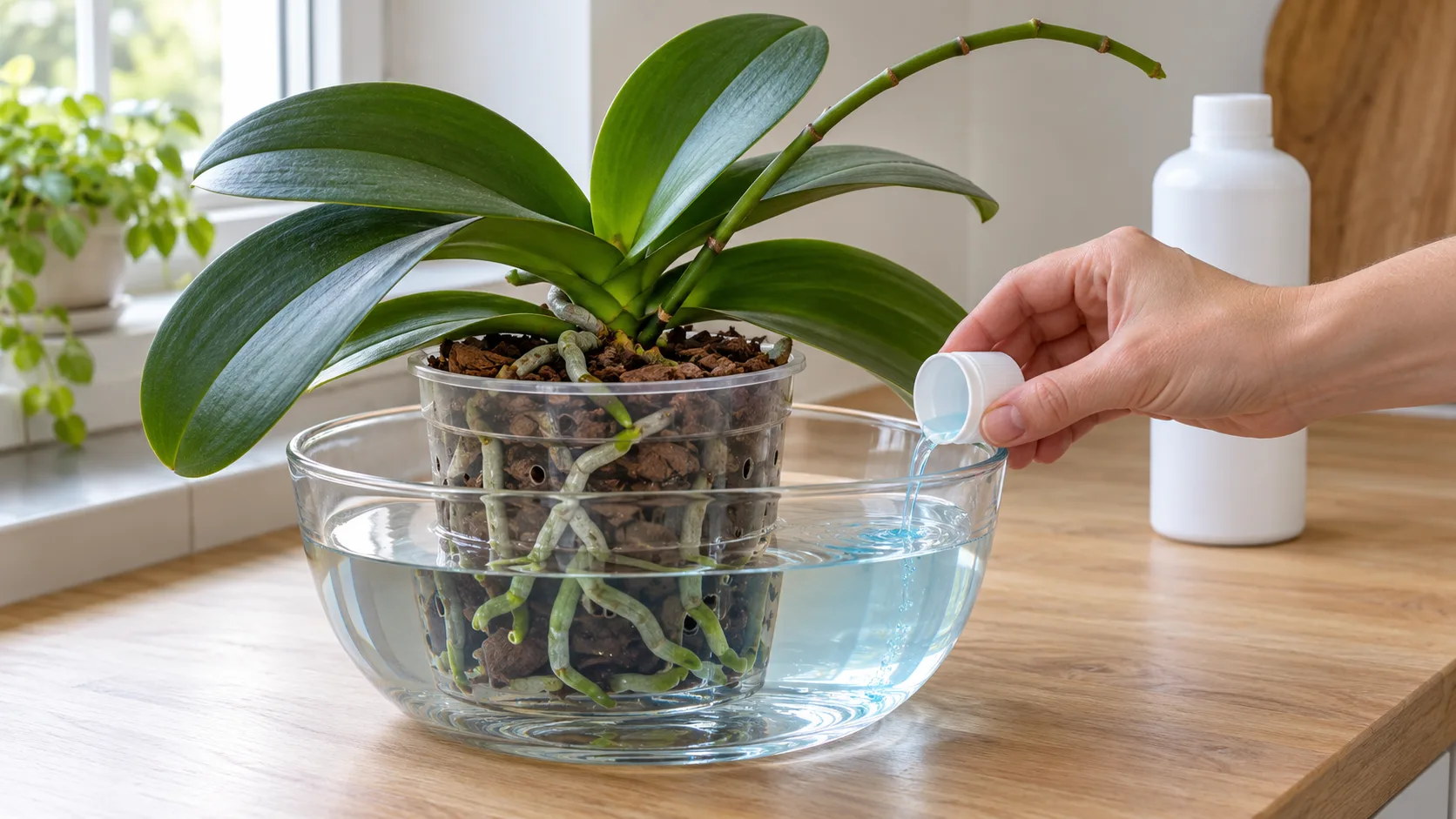
When should you fertilize an orchid?
Throughout growth: while it makes leaves, roots or a spike, it needs nutrients. The RHS recommends feeding moth orchids (Phalaenopsis) lightly but regularly during the growing season with orchid fertilizer1. University of Maryland Extension feeds plants both growing and flowering2: flowers do not interrupt feeding.
- Fertilizer
- For orchids, dilutedSource: Royal Horticultural Society
- Feeding
- During active growthSource: Royal Horticultural Society
- Feeding
- In winterAt a reduced dose · while the plant continues to growSource: American Orchid Society
- No fertilizer
- In winterfeed rarely, if at allSource: Royal Horticultural Society
- Frequency
- Twice a month, at a low dosein cool or cloudy weatherSource: American Orchid Society
- Frequency
- At quarter strength with every wateringin warm, humid weatherSource: American Orchid Society
- Frequency
- Every 7 daysHalf strengthSource: American Orchid Society
- Frequency
- Every third or fourth wateringLabel doseSource: University of Maryland Extension
- Avoid
- Exceeding the dose on the labelSource: University of Maryland Extension
Winter divides sources. RHS then feeds sparingly, if at all1, and Maryland stops during cooler, darker months2. The American Orchid Society, however, notes that moth orchids continue growing in winter and still feeds at reduced strength3.
Growth is the shared criterion. An orchid making a leaf or spike in a bright, heated room benefits from reduced feeding; an inactive plant by cold glass has no use for it.
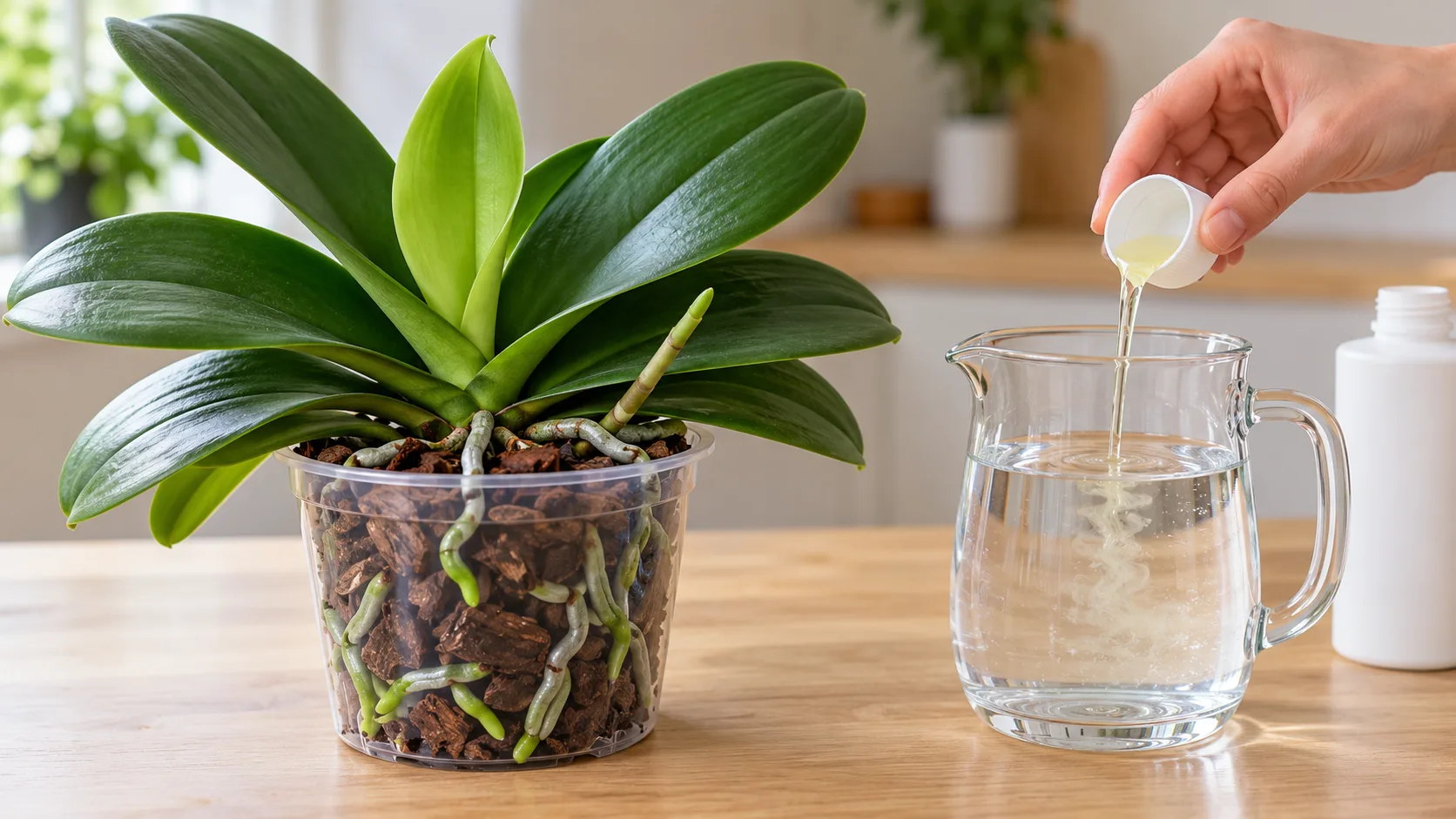
Add your orchid: Floralens reminds you when to use feed and plain water, season by season (Pro mode). Get reminders
L'engrais ne fait pas fleurir à lui seul : getting an orchid to rebloom demande d'abord quelques semaines de journées plus fraîches.
Which fertilizer for an orchid?
Balanced fertilizer or an orchid product, always diluted. The American Orchid Society novice sheet accepts any balanced orchid fertilizer, such as 20-20-204. These three numbers are the label's NPK.
Two other formulas circulate, and the first divides opinion. The AOS culture sheet proposes high-nitrogen feed such as 30-10-10 twice monthly in bark, and high-phosphorus feed such as 10-30-20 for flowering5. Sue Bottom responds in the same society's magazine that excess nitrogen speeds bark decomposition3.
| Formula | Proposed use | Reservation |
|---|---|---|
| 20-20-20, balanced | Throughout growth, half-strength weekly4 | None in the consulted sources |
| 30-10-10, high nitrogen | Twice monthly in bark5 | Speeds bark decomposition3 |
| 10-30-20, high phosphorus | To promote flowering5 | Fertilizer has little influence on flowering6 |
| 13-3-15, low phosphorus | Designed for pure, rain or reverse-osmosis water7 | Another formula, 19-4-23, supplements well water7 |
Fertilizer does not make orchids flower. Ron McHatton of the American Orchid Society ranks it among the least important flowering factors: no plant on a bench he describes has ever been fed, and the oldest are at least 15 years old6. Lack of light remains the commonest cause of failure to rebloom2.
Pour l'eau elle-même, de pluie, osmosée ou calcaire, voir comment watering an orchid selon la dureté de votre eau.
How often, and at what dose?
Little each time: the label dose is a ceiling, never a target. RHS warns that overfeeding harms rather than helps1, and Sue Bottom recommends starting at a quarter or even an eighth strength, then adjusting after a season3.
Two approaches divide frequency. Little at every watering: some growers give quarter strength each time, suited to warm, humid weather; in cool or cloudy weather, the AOS sheet drops to twice-monthly weak feeding5. Stronger, less often: Maryland feeds every third or fourth watering at label strength2. Between them, the AOS novice sheet gives half strength weekly4.
The medium also determines strength. Sphagnum and peat-based mixes hold more salts than coarse bark: AOS recommends even greater dilution3.
Le rythme des arrosages eux-mêmes, bain ou arrosoir, se règle dans la page watering an orchid selon le substrat et la saison.
Rinsing with plain water: protecting roots
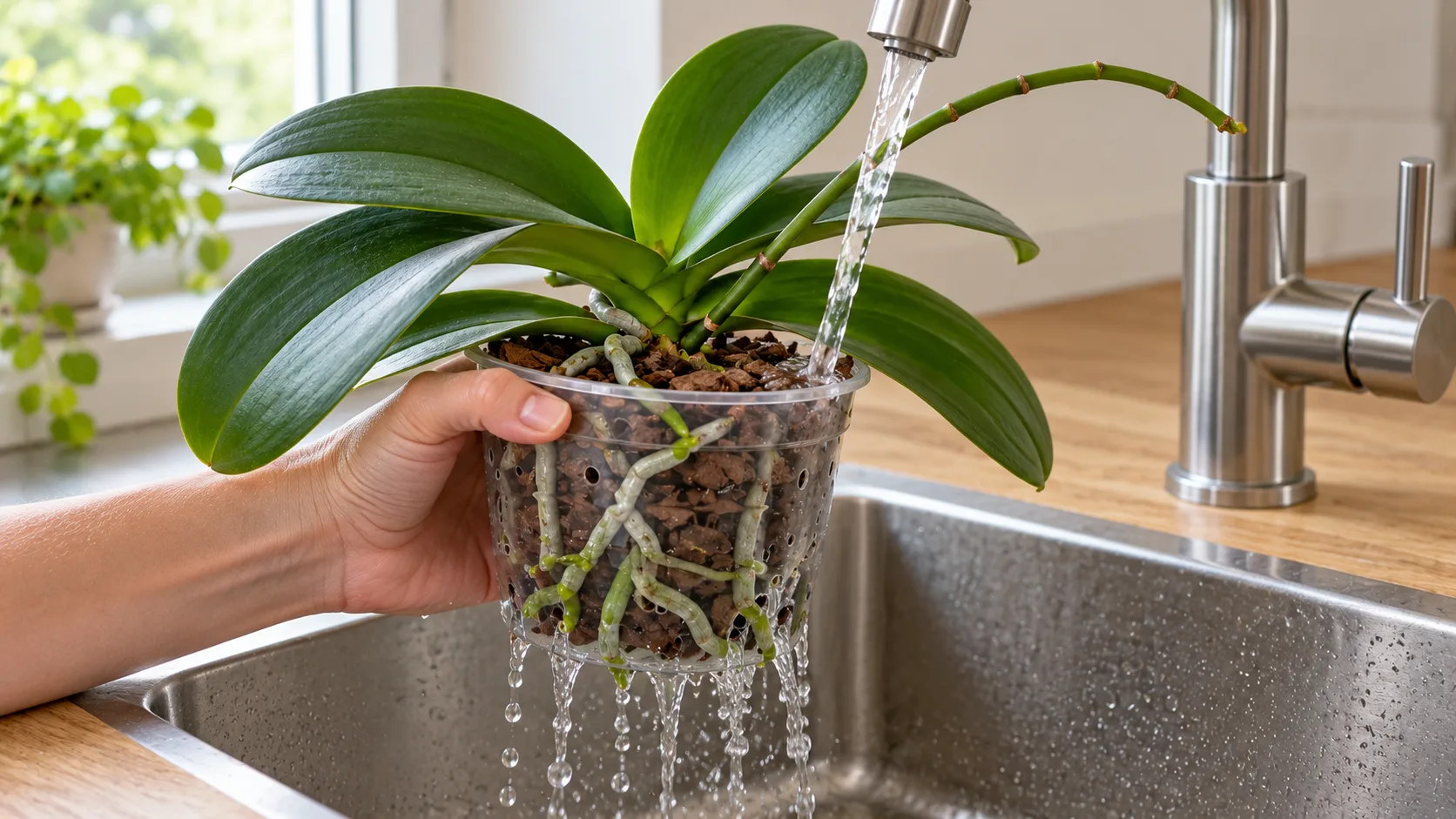
Every fourth watering, use no fertilizer. Feeding at every watering builds potentially harmful salts in the medium; RHS flushes them with plain water every fourth watering1. The AOS novice sheet rinses monthly4, while Sue Bottom alternates one feeding with one plain-water watering3.
To rinse, run water through the pot for around a minute, then let it drain completely4. This is flushing, the same action used for salt-laden medium: see flushing salts from potting mix and recognizing fertilizer burn.
Homemade orchid feed: what works and what does not help
The only truly useful homemade feed is free: plain water to rinse salts. Everything else calls for caution.
Coffee grounds do not suit a bark-filled pot. Washington State University's Linda Chalker-Scott calls their growth effects unpredictable, notes that they even inhibit some plants and compact into a layer blocking air and moisture8. Yet moth orchid roots live in air, clinging to wild tree trunks2. Grounds belong in compost at no more than 20% by volume8.
Rice water, cooking water, banana peel: we found no published moth-orchid trial. Commercial fertilizer states its concentration, allowing dilution to quarter or half strength.
Too much or too little feed: the signs
Many leaves, few flowers: Maryland sees an overfed plant growing at the expense of flowering2. Check light first, the commonest cause of failure to rebloom2, before reducing feed.
Treat excess salts with plain water, through flushing the medium, then resume at reduced strength.
Écorce neuve, pot à la bonne taille et racines à couper : repotting an orchid se fait dès que de nouvelles racines pointent.
Des feuilles anciennes qui jaunissent ensemble ont plusieurs causes possibles, toutes triées dans yellow orchid leaves cause par cause.
Frequently asked questions
Which fertilizer should you use for an orchid?
When should you fertilize an orchid?
How often should you fertilize an orchid?
Are coffee grounds good for orchids?
Which household remedy helps orchids?
Should you feed an orchid in flower?
Yes, lightly. Maryland feeds plants both growing and flowering every third or fourth watering at label strength2.