
How to grow roses from cuttings: timing and method
Taking rose cuttings: when to cut and how to root them
You can take rose cuttings at three stages of the year, determined by the wood: tender spring growth, semi-ripe summer shoots, or hardwood from leaf fall to late winter dormancy. The source gives July to September for semi-ripe shoots in its Northern Hemisphere climate; follow local wood maturity elsewhere. The method changes little, but success varies widely, so always take more cuttings than the number of plants you want.
When to take rose cuttings: the window for each wood stage
There is no single deadline, but three, one for each stage of wood maturity. Roses suit three main types of stem cutting: softwood in spring, semi-ripe in summer, and hardwood during dormancy. The RHS recommends spring softwood and hardwood for roses 1; Iowa State adds summer semi-ripe wood, considering it easiest 2. A semi-ripe shoot is taken from July to September in the RHS's UK calendar: earlier, it recommends softwood; after midfall, hardened wood enters the next category 3. Elsewhere, let local growth and wood maturity set the window.
- Softwood cutting
- April to Junerepot before midsummerSource: Royal Horticultural Society
- Semi-ripe cutting
- July to SeptemberSource: Royal Horticultural Society
- Hardwood cutting
- In winterfrom mid-autumn to late winterSource: Royal Horticultural Society
- Layering
- In springClimbers with flexible stems · or in autumn; roots within 12 monthsSource: Royal Horticultural Society
| Conditions | January | February | March | April | May | June | July | August | September | October | November | December |
|---|---|---|---|---|---|---|---|---|---|---|---|---|
| Softwood cutting | no propagation | no propagation | no propagation | Softwood cutting | Softwood cutting | Softwood cutting | no propagation | no propagation | no propagation | no propagation | no propagation | no propagation |
| Semi-ripe cutting | no propagation | no propagation | no propagation | no propagation | no propagation | no propagation | Semi-ripe cutting | Semi-ripe cutting | Semi-ripe cutting | no propagation | no propagation | no propagation |
| Cutting | Wood maturity | End of window |
|---|---|---|
| Softwood | Tender, flexible current-year tip | June in the source calendar, allowing potting before midsummer locally |
| Semi-ripe | Firm base, flexible tip | Midfall, when wood has finished hardening |
| Hardwood | Woody but still flexible current-year shoot | Just before buds begin growing |
These source-climate dates come from the RHS for softwood (April to June) 5 and hardwood (midfall to late winter) 6, and Iowa State for July-August semi-ripe cuttings 2. Follow equivalent local growth stages. The RHS sets a condition for softwood: potted before midsummer, it has time to root sufficiently for winter; later cuttings wait until the following spring for potting on 5. Hardwood is best taken just after leaf fall or just before bud break, avoiding severe frost, which the RHS places below -5 °C (23 °F) 6.
What a measured trial says about timing
The trial compares collection months: wild dog rose (Rosa canina) hardwood cuttings collected around Lake Van, Turkey, from November to February, rooted in perlite with five hormone doses from zero to 10,000 ppm 4. The best combination, November and 2,500 ppm, gave 65 to 70% rooting; the worst, February and 1,000 ppm, gave 2.5% 4.
The difference combines month and dose: the abstract cannot show which mattered more, and these wild dog roses are not your garden rose. The more modest, useful lesson is that even under the trial's best conditions, nearly one cutting in three fails 4.
Choosing a shoot: three practical signs
The calendar gives a range; the shoot shows whether it is ready. For semi-ripe cuttings, the RHS describes wood firm at the base and still soft at the tip, from a healthy current-year shoot, preferably horizontal with short internodes 3. Three hands-on checks interpret that description.

- Bending: bend the shoot between two fingers. It should resist, then spring back; if it snaps, it is too dry for a summer cutting, while a stem that crushes is still softwood.
- Color: on the lower half, bark changes from clear green to reddish brown, with that change moving upward through summer.
- Fingernail: pressed about ten centimeters (4 in) from the base, your nail slides over ready wood. If it still cuts into the bark, wait fifteen days.
These are gardening checks rather than measurements, intended to recognize the RHS's firm-base, flexible-tip stage. They also help assess bouquet roses, discussed in the FAQ below.
Taking rose cuttings step by step
This method is for summer semi-ripe cuttings, the most commonly used approach. The other two windows follow at the end of this section. You need clean, sharp pruning shears, pots with drainage holes, peat-free potting mix and coarse sand, a plastic bag or cut bottle, labels, and rooting hormone if available.

- Collect in the morning from healthy growth with clean, sharp shears, placing shoots immediately into a plastic bag in shade. The RHS recommends potting them within 12 hours 3.
- Cut the section: the RHS gives 10 to 15 cm (4 to 6 in) for semi-ripe cuttings 3. For long internodes, extend to 15 to 20 cm (6 to 8 in) to include two to three nodes. Make the bottom cut just below a node, where roots emerge 3.
- Strip the lower leaves, remove the soft tip, and keep upper leaves, generally four 3. These matter, as the hormone section explains. Remove lower prickles too; they catch on mix and fingers during potting.
- Prepare the pot: use half peat-free potting mix and half coarse sand, watered and drained 3. Insert about two-thirds of the cutting and firm against the wood with your fingers, leaving no air pockets.
- Cover and position: place a plastic bag or cover over it in bright light without direct sun. Remove excess condensation and keep the mix moist without waterlogging 3.
- Wait: bottom heat is rarely needed in summer; in fall, cuttings root faster in a heated propagator 3. Base that choice on local temperature.
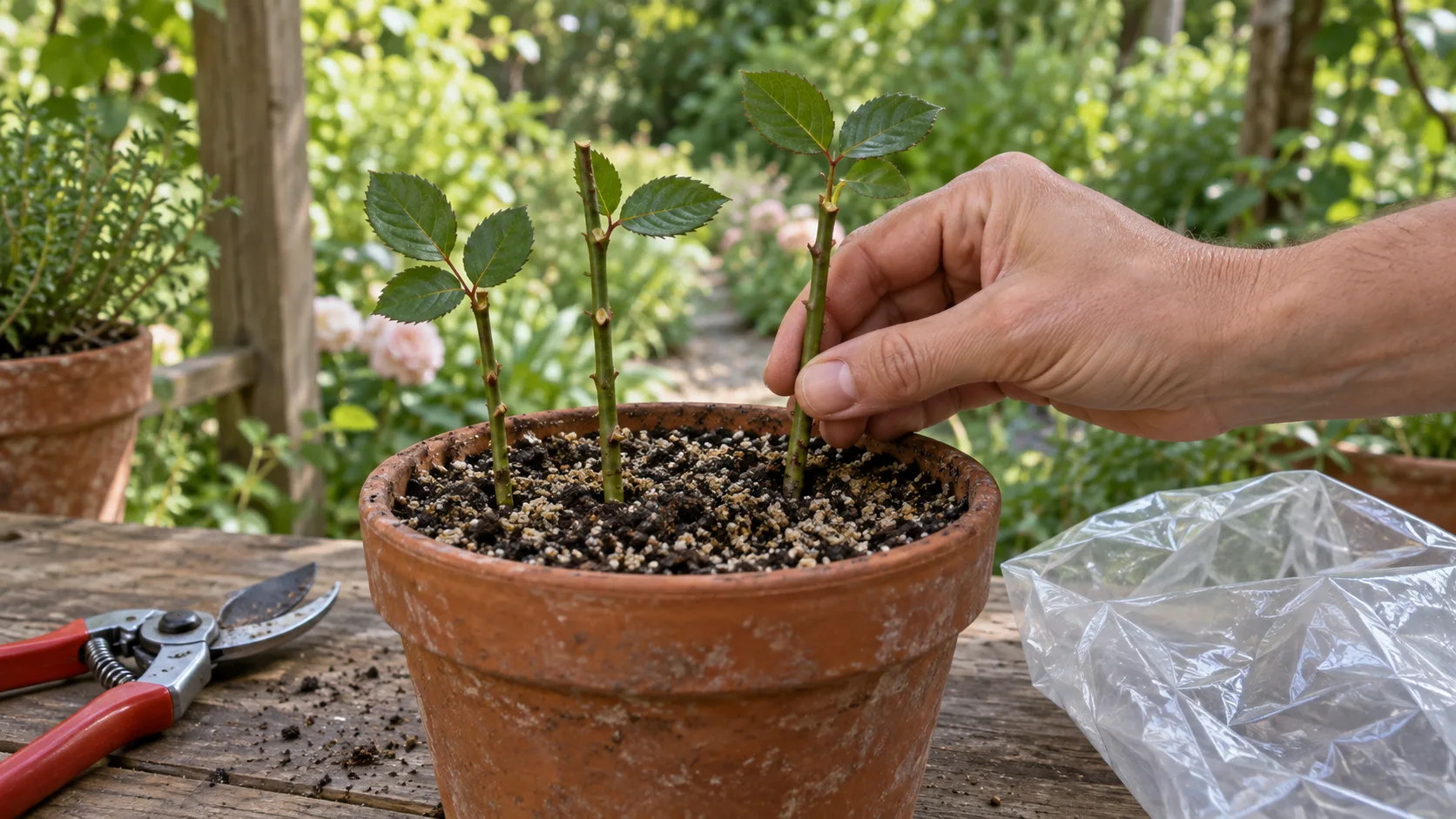
Spring: softwood cuttings
The RHS considers this the easiest method for roses: current-year stem tips collected in early to midspring, potted and rooted in about two months 1. It notes that softwood has the highest rooting potential of all stem cuttings 5. Fragility is the tradeoff: tender stems wilt quickly and rot under a cover kept too tightly closed. Ventilate daily. Then pinch the young shoot to encourage branching; plant it out after one year 1.
Winter dormancy: hardwood cuttings
Take a hardwood cutting from a vigorous current-year shoot, without its tender tip, in 15 to 30 cm (6 to 12 in) sections 6. Cut the bottom straight below a bud and the top at an angle above a bud, to shed water and identify orientation 6. Insert them outdoors in a sheltered trench with a sand bed, burying two-thirds and spacing them 10-15 cm (4-6 in) apart 6. Leave until the following fall, firming soil after frost and watering during summer drought 6. Follow local dormant and growing seasons. The slowest method also needs the least care.
With or without rooting hormone
IBA is optional for roses, but published measurements show it matters and does not work alone. In Damask rose (Rosa damascena), 17 to 20 cm (7 to 8 in) sections with at least four nodes were monitored for 70 days in a mini-greenhouse, with or without leaves, at three hormone doses 8. At 1,000 ppm, leafy cuttings rooted at 90%, defoliated ones at 48% 8. Without hormone, both stayed low: 13% with leaves and 23% without, a nonsignificant difference in the trial 8. Leaves and hormone work together; more is not better: at 10,000 ppm, leafy cuttings fell back to 65% 8.
Rooting also varies greatly by variety. For the 'Pfänder' rootstock, a dog rose selection, leafy single-node cuttings without hormone root at less than 20%; they reach 90% only with IBA plus bark wounding at the base 7. The cut-flower rose 'Tan09283', considered easy even without auxin, roots at 92-96% with continuous IBA at 1 mg/L (about 3.8 mg per US gal): first roots around 14 days, or 8 days after laser wounding aligned with the bud 7. These trials used mist at 20-23 °C (68-73 °F): they show differences between varieties, not timings for your pot.
Two practical points follow. For a difficult rose, hormone and a light basal wound work together: for difficult shrubs, the RHS recommends removing a 2.5 cm (1 in) strip of bark from one side of the base 3.
Also, take sections from the top of the shoot: in two hybrid rose cultivars (Rosa hybrida), cuttings from upper nodes produced more and longer roots than basal ones, with auxin offsetting the latter's delay 9. Willow water and honey are suggested as homemade alternatives, but none of the trials cited here tested them on roses. Do you need rooting hormone? compares them across plants.
Water, potatoes, and bottle covers
Three homemade methods often come up in gardening discussions. Only one reproduces the conditions used in the trials.
In a glass of water
Rose wood roots slowly. A section submerged for weeks lacks air at its base and often blackens or ferments before producing roots. Water-grown roots are white and brittle, adapted to liquid, and suffer when moved to soil. The cited rose trials used perlite, growing media, or mist, never a glass 4 8 7. Water works better for tender stems, as explained in rooting cuttings in water.
In a potato
The tuber is supposed to keep a cutting moist and feed it. To our knowledge, no published rose trial measures this. Physiologically, it surrounds the base with a sugary, wet, low-air medium favorable to bacteria, around wood that needs oxygen to heal. It adds a rot risk without providing auxin.
Under a cut bottle
A bottle placed over the pot creates the humid chamber the RHS makes with a plastic bag or propagator 3. It limits water loss from retained leaves, the leaves that, with hormone, raise Damask rose rooting from 48 to 90% 8. The condition is a few minutes of ventilation every day, or mold develops.

Which roses root most easily?
To our knowledge, no measured ranking by rose group has been published; the table reflects horticultural experience. Its firm basis is the wide variation between cultivars, from less than 20% to more than 90% in the trials above 7. Own-root roses that sucker can even be propagated by division, during dormancy, March to early April in Iowa State's calendar 2. Use local dormancy elsewhere.
| Group | Examples | Cutting to choose | Rooting ability |
|---|---|---|---|
| Species and old garden roses | Rugosa rose (Rosa rugosa), French rose (Rosa gallica) | Semi-ripe or hardwood | High |
| Shrubs and groundcovers | 'The Fairy' | Semi-ripe, late summer | High |
| Climbers | 'New Dawn', 'Pierre de Ronsard' | Semi-ripe sideshoot | Moderate |
| Hybrid teas and modern bush roses | 'Peace' | Semi-ripe, with hormone | Low |
For a climber, take sections from sideshoots rather than long replacement shoots, and allow longer before first flowering. The rugosa rose, French rose, and dog rose profiles cover these species roses.
An alternative for climbers: layering
For long, flexible stems, layering avoids taking a cutting: bury part of a stem without detaching it 2. The RHS makes a 2.5 to 5 cm (1 to 2 in) wound about 30 cm (12 in) from the tip, burying it in a 10 to 15 cm (4 to 6 in) trench in local spring or fall; roots form within 12 months 10. This answers how to root a branch: it remains fed by the parent throughout. It is also slower and, according to the RHS, less commonly used for roses than cuttings, and considered more difficult for an amateur gardener 1.
How to tell whether a cutting has rooted
A successful cutting opens new buds and resists a gentle tug because roots hold the mix. Green leaves alone prove nothing; they can still use the wood's reserves. Timing depends on the window: about two months for spring cuttings 1, the following spring for hardwood that first forms callus during winter 6. A semi-ripe cutting outdoors under a cold frame may not root fully until late the following spring 3. No visible change in October in the source calendar does not mean failure. Follow the corresponding local seasons.

| What you see | Likely cause | Action |
|---|---|---|
| Black, soft base | Waterlogged mix, rot | Cutting lost; reduce watering for the others |
| White surface mold | Cover never ventilated | Ventilate daily and remove fallen leaves |
| Green leaves, no resistance to a tug | Roots not yet formed | Wait; do not unpot to check |
| Sudden leaf drop | Dry air or direct sun | Close the cover again and move to bright shade |
| Buds growing, firm stem | Rooting success | Increase ventilation gradually, then transplant in local spring |
Why cuttings rot or fail to root extends this diagnosis to other plants.
Transplanting a rooted cutting
Do not rush the next stage. First harden off a greenhouse- or propagator-rooted cutting for two to three weeks, outdoors by day in a sheltered spot or under a partly opened cold frame, before repotting 3. Move it into its own pot, only slightly larger than the root ball 3. Timing depends on when it was taken and the local seasons:
- Spring cutting: potted before midsummer, it has time to root before winter; otherwise wait until next spring 5. It goes into the garden after one year and flowers in two to three years 1.
- Summer cutting: keep it in its pot through its first winter, protected from frost and especially excess water, then transplant in spring as shoots clearly start growing.
- Hardwood cutting: leave it until the following fall, then plant permanently or pot it up 6.
Pour le choix du pot et du substrat une fois la bouture enracinée, voir growing roses in pots .
If the young plant develops black spots in its first summer, see large black patches; a white coating on shoots indicates powdery mildew, covered in treating powdery mildew.
Pour prévenir ces attaques sur un plant installé, voir rose diseases .
Own-root or grafted: what a cutting changes
Many modern roses are grafted 2: the variety is joined to a rootstock, sometimes chosen, the RHS says, to control plant size 1. A cutting removes that layer, producing an own-root rose: a clone of the variety on its own roots that may behave differently from the parent plant 1. The Société Française des Roses explains what is lost: in its view, the longest-lived plants best adapted to all soils come from grafting onto selected dog rose (Rosa canina) 11.

On a grafted rose, shoots from below the graft belong to the rootstock. Pull these suckers off at their origin on the root, since cutting encourages several more 12. An own-root rose produces no rootstock suckers, because its roots have the same genetics as its flowers.
| Critère | Franc de pied (bouture) | Greffé |
|---|---|---|
| Pousses du porte-greffe | Aucune | À arracher dès qu'elles apparaissent |
| Taille et vigueur | Celles de la variété sur ses racines | Réglées en partie par le porte-greffe |
| Sols difficiles | La variété se débrouille avec ses propres racines | L'églantier sélectionné apporte son adaptation |
| Premières années | Départ plus lent, floraison en 2 à 3 ans | Plant déjà formé à l'achat |
| Après un hiver qui détruit le haut | Ce qui repart de la souche est la variété | Ce qui repart sous la greffe est le porte-greffe |
La taille qui suit, et la manière d'arracher un gourmand sur un rosier greffé, sont détaillées dans pruning a rose .
Cuttings from protected varieties: the source's legal context
In the French source's legal context, a recent variety may have a plant variety certificate. It reserves the right to produce, reproduce, sell, or market propagating material to its holder 13. The cited French law provides an exception: the right does not extend to private acts for nonprofessional or noncommercial purposes 14. Many recent roses sold in France instead have European protection from the Community Plant Variety Office, with an exception for acts done privately and for noncommercial purposes 15. These are the source's jurisdiction-specific statements, not claims about the reader's local law.
For the rest of the rose's year, including watering, pruning, and winter protection, the rose care guide brings each task together; the rose encyclopedia profile (Rosa) covers botany and cultivars.
Frequently asked questions
How can I root a rose branch, even a broken one?
Treat a broken branch as a cutting if it is a healthy current-year shoot: recut cleanly below a node and pot it within 12 hours 3. For a stem still attached, there are two options. A cutting is a 10 to 15 cm (4 to 6 in) current-year section cut below a node, stripped of lower leaves, and inserted into half potting mix, half sand under a cover 3. Layering suits long, flexible stems 2: wound and bury the branch without detaching it, and it roots within 12 months 10. It is slower and less common for roses than cuttings 1.
Can I root rose cuttings in water?
How do I take rose cuttings without rooting hormone?
It is possible: the RHS describes hormone as optional, if available, for hardwood cuttings 6. Compensate with numbers: without hormone, a difficult rootstock such as 'Pfänder' roots at less than 20% from single-node cuttings under mist 7, so take ten sections for two plants. Take them from upper shoots, which root better 9.
What is the latest time to take rose cuttings?
It depends on the wood and local seasons. The semi-ripe window ends in midfall when wood hardens 3. Hardwood takes over until late winter, just before buds begin growing, avoiding frost below -5 °C (23 °F) 6. Tender spring cuttings are best potted on before midsummer; otherwise wait until the following spring 5.
Can I propagate a rose from a bouquet?
It rarely succeeds. A stem cut days ago and kept in a vase has lost reserves and firmness: it fails the bend test and performs poorly in mix. If trying, do so the same day, with a nonflowering or spent stem, prepared as a 10 to 15 cm (4 to 6 in) semi-ripe cutting 3. For a protected variety, the source's French-law account limits the cutting to your own garden 14.