
Monstera yellow leaves: causes and solutions
Monstera yellow leaves: causes and solutions
Nine out of ten monsteras (Monstera deliciosa) with yellowing leaves are suffering from overwatering: roots deprived of oxygen stop absorbing water, and leaves turn yellow even though the pot is full of water. Distinguish the other six causes by checking which leaves are yellowing and the condition of the growing medium.
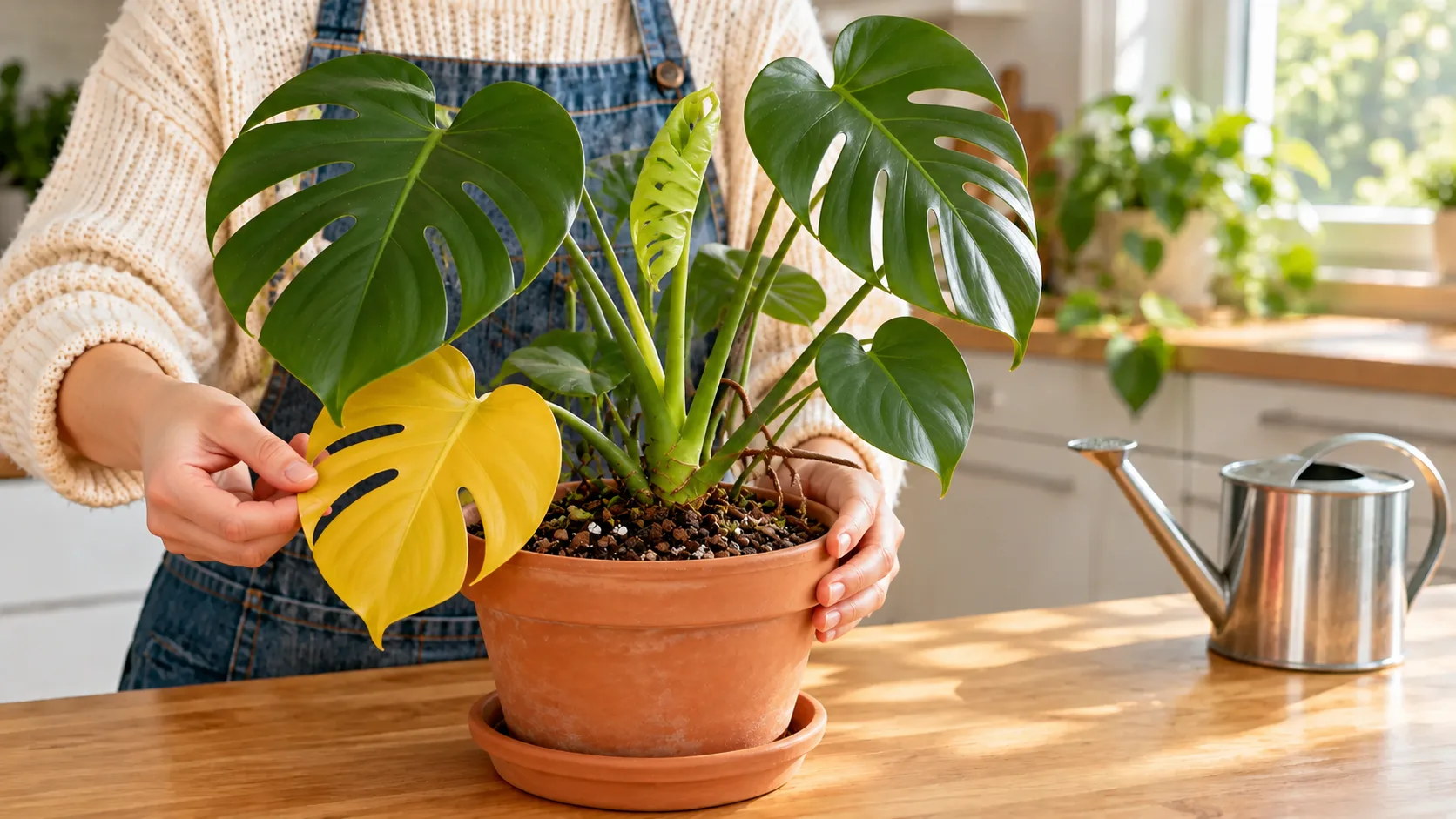
Three diagnostic questions
Which leaf is yellowing, what condition is the growing medium in, and what does the leaf blade feel like? These three answers rule out half the causes before you touch the plant.
Which leaf? A single leaf, the lowest and oldest, while the top continues growing: aging. Several leaves at once, including in the middle or at the top: a root, light or nutritional problem.
What growing medium? Push a finger 5 cm (about 2 in) into it. Still distinctly wet more than five days after watering: overwatering. Dusty and pulled away from the pot walls: underwatering.
What texture? Soft, uniformly yellow: too much water. Yellow with dry, brittle edges: drought or salts. Finely stippled yellow: a pest.

Other monstera symptoms, including brown spots, soft stems and pests, are covered separately on the monstera diseases page.
Overwatering and suffocating roots
This is by far the most common cause of yellow leaves on an indoor monstera.
Three signs distinguish it: yellowing is uniform across the entire leaf blade, the leaf is soft rather than dry, and the growing medium is still wet five to ten days after the last watering. A sour smell often rises from the pot, and small black flies hover around the potting mix.
The mechanism is surprising: the plant turns yellow from too much water in exactly the same way as from too little. Saturated growing medium drives oxygen out of its spaces, roots suffocate and die, and a dead root absorbs nothing. The leaf is short of water in the middle of a waterlogged pot.
Take these steps in order:
- Stop watering until the top 5 centimeters (about 2 in) feel dry to the touch.
- Empty the saucer immediately after every watering. A pot standing in water is the silent version of the same problem.
- Check the drainage hole: a decorative container without an outlet undoes all your efforts.
- Take the plant out of its pot if the smell persists, cut away brown, soft roots and repot in fresh, free-draining growing medium.
The right interval is explained in the monstera watering guide, and the full mechanism on the overwatering page.
Normal aging of the bottom leaves
A monstera naturally sheds its lowest leaves, and this yellowing cannot be corrected.
The pattern is clear: one leaf at a time, always the lowest and oldest, gradually yellowing over two to three weeks while the plant produces new leaves at the top. The growing medium dries normally and the other leaves are firm.
This climbing plant invests in height. Rather than wasting energy maintaining an old leaf blade now shaded by the rest of the foliage, it retrieves its nitrogen and sugars for new shoots, then lets it go. One leaf every one to two months on a growing plant is within the normal range.
Nothing needs correcting. Cut the petiole at its base when the leaf is three-quarters yellow. See the yellowing bottom leaves page for more detail.
Insufficient light
Yellowing from insufficient light is pale, gradual and affects the whole plant rather than an isolated leaf.
Accompanying signs include new leaves smaller than their predecessors and without splits, longer internodes and a plant visibly leaning towards the window. Its overall color turns light green before yellowing.
Monstera grows in tropical understory, rather than darkness. More than two meters (about 6.6 ft) from a window, the energy it receives no longer covers the upkeep of existing foliage, and it declines leaf by leaf. See insufficient light.
Move the plant to one or one and a half meters (about 3.3–4.9 ft) from a bright window, without direct midday sun, and give it a quarter-turn weekly. A side effect matters as much as the light itself: a dark position slows the drying of the growing medium, bringing two causes of yellowing together in the same pot.
Too little water
Drought-related yellowing never appears alone: it always comes with dry, brittle edges.
The pot is unusually light, the potting mix has shrunk away from the walls, leaving a gap through which water runs straight to the bottom, and leaves hang from limp petioles. Tips brown before the leaf blade turns yellow.
Rehydrate by soaking: stand the pot in a basin of lukewarm water for twenty minutes while the growing medium swells again, then let it drain completely. Water poured from above onto a shrunken root ball passes through without wetting it. See underwatering.
Nitrogen deficiency and exhausted growing medium
Nitrogen deficiency is identified by its order of appearance: old leaves turn yellow first while young leaves stay green.
Nitrogen is mobile within the plant. When supplies run short, the monstera withdraws it from old leaves to feed new growth, producing uniform yellowing that progresses upwards from the bottom across several leaves at once. Growth slows noticeably, and new leaves emerge small but well formed.
The context distinguishes it from overwatering: here the growing medium dries normally, roots are white and firm, but the potting mix has not been renewed for two years or more and water passes through without being retained.
Resume a balanced fertilizer at half strength every two to three weeks from March to September in the northern-hemisphere growing season described here, adjusting to your local active-growth period, and repot in fresh growing medium in spring. See nitrogen deficiency.
Too much fertilizer and accumulated salts
Yellowing from excess fertilizer is recognizable by the signs accompanying it: scorched tips and a whitish crust on the surface.
That crust, or the white deposit on the pot rim, consists of unabsorbed mineral salts. They raise the concentration of the soil solution until the roots can no longer draw water from it, and burn the leaf tips.
Flush the pot thoroughly with the equivalent of three times its volume in water, letting it all drain away, then stop all feeding for six to eight weeks. See fertilizer burn. A common mistake is feeding a plant yellowing from overwatering: damaged roots cannot absorb anything, and fertilizer only worsens the salt concentration.
Yellow stippling rather than uniform yellowing
If yellowing appears as a scattering of tiny dots against a green background, rather than a continuous patch, neither water nor light is responsible: these are feeding marks from sap-sucking pests. Turn the leaf over and look for fine webs around the petioles, a sign of spider mites. Other monstera pests are covered on the monstera diseases page.
Should you cut off the yellow leaf?
A yellow leaf will never turn green again: destroyed chlorophyll does not regenerate. While some green remains, however, the plant is still drawing nitrogen from it, and cutting too soon means throwing away that reserve.
Wait until it is three-quarters yellow, then cut the petiole at its base with disinfected pruning shears. The only reason to remove a leaf immediately is if it is soft and wet and would become a mold hotspot.
The real verdict comes from the next leaf. If it emerges green, firm and at least as large as the previous one, the cause has been resolved. For an overview across all species, see the yellow leaves page.
Frequently asked questions
Should I cut off a yellow monstera leaf?
Yes, but there is no rush. While the leaf retains some green, the plant is still recovering nitrogen and sugars from it: let it finish yellowing. Once it is three-quarters yellow, cut the petiole at its base with clean pruning shears. Cutting does not cure anything; it simply prevents a potential mold hotspot.
Can a yellow leaf turn green again?
No. Destroyed chlorophyll does not regenerate in an already yellow leaf blade, whatever correction you make. The real sign of recovery is the next leaf: if it emerges green, firm and normal-sized, the cause has been resolved.
My monstera is yellowing after repotting. Is that normal?
One or two yellow leaves within three weeks of repotting are a sign of transplant shock: damaged fine roots need time to resume absorption. It becomes abnormal if yellowing continues beyond a month, generally indicating an oversized pot that holds water or an overly moisture-retentive growing medium.
Why does my monstera turn yellow mainly in winter?
Where winter brings slower growth, the plant uses much less water, while watering often continues at the summer frequency. The growing medium no longer dries between waterings and the roots suffocate. Space waterings out until the top 5 cm (about 2 in) is dry, and move the plant closer to the window.
Should I worry about a single yellow leaf on my monstera?
If it is the lowest and oldest leaf, the rest of the plant is growing and the growing medium dries normally, no: this is normal leaf renewal. Simply monitor the pace. One leaf every one to two months is normal; three leaves in fifteen days is not.