
Monstera support: choosing and installing a support
Monstera support: choosing and installing a support
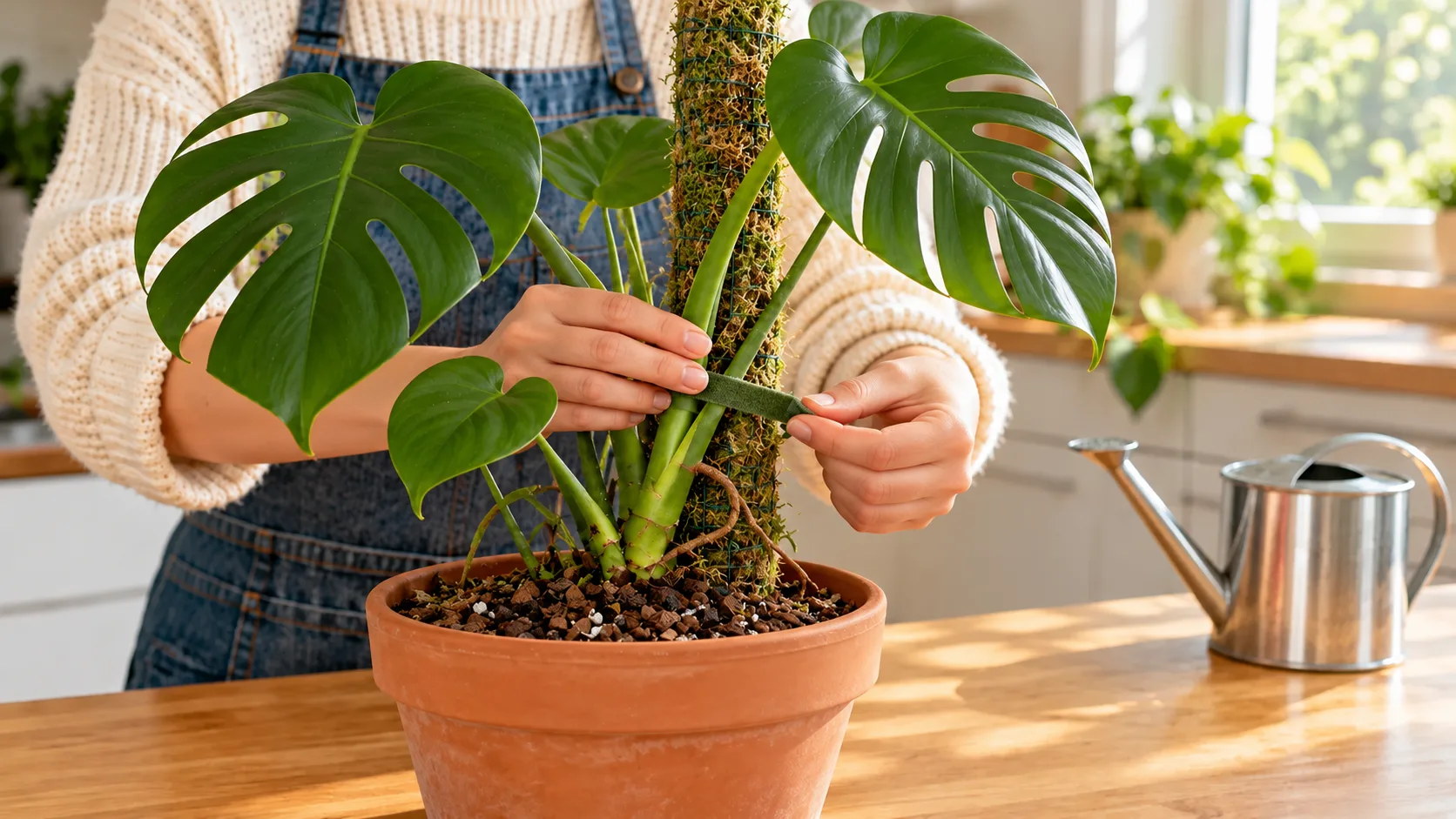
Monstera (Monstera deliciosa) is a vine, not a bush. Without a support for its aerial roots to grip, it grows horizontally and its leaves stay small, with few fenestrations: a pole is not decoration, but what triggers true adult growth.
Why a monstera needs a support
Monstera (Monstera deliciosa) is a hemiepiphytic vine: in the wild, it germinates on the ground, finds a trunk and climbs. Its entire structure is made to lean on something.
This changes how you grow the plant. A climbing stem receives the signal to enter its adult phase: internodes shorten, leaves grow larger and fenestrations appear. A horizontal stem remains juvenile, with small, solid, heart-shaped leaves.
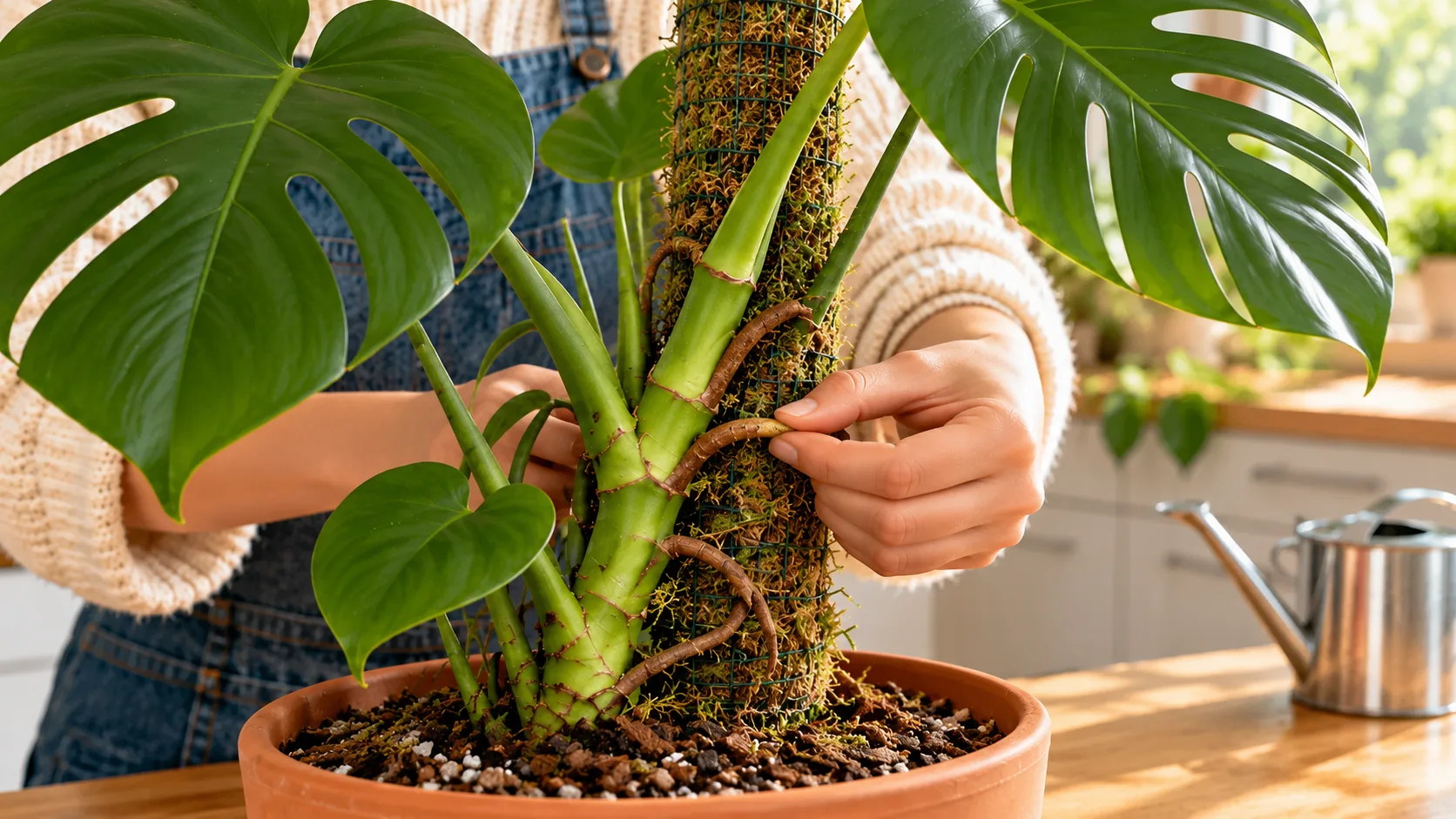
Aerial roots are central to this system. These brown cords emerging from nodes do more than seek the ground: they anchor in bark, moss or any porous, moist support and take up water there.
When to install the support
The best time is when repotting, as early in the plant's life as possible. A pole positioned in an empty pot can be secured at the bottom without damage, whereas one pushed into a full root ball inevitably passes through roots.
On a young plant with two or three leaves, the support looks oversized. That does not matter: the plant will catch up within one growing season, and you will never need to straighten a stem that has already bent. Fit the support while repotting.
On an established adult plant, this is still possible in spring, as active growth resumes locally. Position the support 3 to 5 cm (about 1.2 to 2 in) from the stem base, on the side opposite its current lean, and push gently to the bottom of the pot. Firm resistance means a large root: choose another entry point.
Which type of support to choose
The deciding question is simple: can an aerial root enter it? If not, the support holds the stem but does nothing for the leaves. Bamboo and trellises provide physical support, not a growth boost.
| Support | Recommendation | Why |
|---|---|---|
| Moss pole | Ideal | Roots can anchor, producing much larger leaves Source: Floralens guide |
| Coir pole | Suitable | Rigid and easy to find, but dries quickly Source: Floralens guide |
| Trellis | Suitable | A spreading habit, but nothing for roots to grip Source: Floralens guide |
| Straight stake | Suitable | An inexpensive temporary solution, with no effect on the leaves Source: Floralens guide |
- When to install it
- When repottingSource: Floralens guide
- Ties
- Soft tie, hook-and-loop tieSource: Floralens guide
Sphagnum requires maintenance: a moss pole needs rewetting once or twice a week and costs more. Coir sometimes has fibers packed too tightly for roots to enter. A PVC tube filled with sphagnum provides a water reservoir and can be extended by slotting sections together, but is heavier and needs making yourself.
Tie the stem without constricting it
Use soft ties and always leave a finger's width between the tie and the stem. Garden chain ties, hook-and-loop strips, strips cut from tights or foam-coated wire all work, unlike bare wire or thin string.
A monstera stem thickens quickly. A tie tightened in spring can constrict it by autumn, leaving swelling above the tie and wilting in everything above it. This is easily confused with a watering problem, when simply cutting the tie is enough.
Fasten it every 15 to 20 cm (about 6 to 8 in), choosing internodes rather than nodes. A tie around a node obstructs both the leaf stalk and aerial root emerging there.
Guide aerial roots into the support
This is the step most people skip, and the one that makes the difference to leaf size.
Find each aerial root that is still flexible, bring it against the support and hold it with a U-shaped pin or soft tie. A dry, woody root no longer bends: do not force it or it will snap. Work with young roots that are still green or pale beige.
Moisten the support first: soaked sphagnum is soft and receptive, while dry sphagnum repels the root. Within three to six weeks, the root anchors itself and becomes an extra feeding point.
Keep the pole moist
A dry sphagnum or coir pole no longer serves its purpose. Roots that had attached to it dehydrate, and the plant gains nothing from it.
Pour water slowly into the top of the pole until it begins to bead at the bottom. Do this once or twice a week during active growth and once every ten days during winter slowdown, adjusting to the local season. Fill a hollow tube directly through its top opening.
Misting alone is not enough: it wets only a millimeter (about 0.04 in) of the surface and evaporates within an hour. You can also add very dilute fertilizer, at a quarter of the usual dose, to the pole's water once a month in spring as growth resumes.
When the plant outgrows its pole
There are two responses, depending on the space available.
Extend it. Modular poles slot together; basic models can be extended by tying a second pole onto the top 20 cm (about 8 in) of the first with three attachment points. The plant keeps climbing without interruption and retains its large leaves.
Take a top cutting. Cut below a node carrying an aerial root and root the section as described in the monstera propagation guide. You get a compact plant, and the base generally regrows with two stems. The trade-off is that new leaves start smaller before regaining their size.
A monstera without a support
This is a valid choice, provided you know the outcome. Left free, the stem creeps and then trails over the sides of the pot: the familiar trailing monstera shape often sought for a high shelf or hanging pot.
In practice, leaves reach only a modest size, fenestrations remain scarce or absent and the plant takes up considerable width for little height. Aerial roots hang in the air without ever attaching.
An intermediate option is a short 40 cm (about 16 in) stake that holds the base upright while letting the upper part trail. The plant stays stable and retains a flexible shape.
Frequently asked questions
Which support should you choose for a monstera?
One that aerial roots can penetrate: sphagnum moss or coconut coir rather than smooth wood or bare plastic. Sphagnum retains water better and gives the best results in leaf size; coir is cheaper and more rigid, but dries quickly. A trellis suits a spreading shape rather than a column.
Can you grow a monstera without a support?
Yes, the plant will not die. But the stem eventually collapses under its own weight, and new leaves stay noticeably smaller, with fewer splits. This is a deliberate choice of a trailing shape, not an equivalent way of growing it.
How do you support a monstera without breaking its roots?
Ideally, install the support when repotting, in the empty pot, securing it at the bottom before putting back the root ball. On an established plant, position the support 3 to 5 cm (about 1.2 to 2 in) from the stem and push slowly: if you meet firm resistance, choose a different entry point rather than forcing it.
Should you bury monstera aerial roots in the support?
Do not force them in: lay them against the moist support and hold them with a soft tie. They anchor themselves within a few weeks, then start absorbing water and nutrients from the support.
What should you do when a monstera outgrows its pole?
There are two options: lengthen the support with a fitted extension or a second pole tied on, or take a top cutting to start a more compact plant. Extending preserves leaf size; taking a cutting resets growth but solves a ceiling-height problem.
Should you water a monstera’s pole?
Yes, if it is made of sphagnum or coir. A dry support offers nothing to aerial roots attached to it. Moisten it once or twice a week by pouring water from the top, or fill the tube if it is hollow.