
Pests
Scale insects
White, cottony clusters or small brown shells on the stems? Identify mealybugs, armored scales, and soft scales, and find out what to do.
Scale insects are small, piercing-sucking insects that attach to stems and the undersides of leaves to drink sap. They take two forms: a white, cottony cluster or a small, immobile brown shell, often accompanied by a sticky leaf. Treatment depends entirely on which form you find; the scale insect treatment explains the protocol for each type.
This page helps you identify them: whether it really is scale, which type, why it returns, and which plants it attacks. A wrong diagnosis leads to the wrong action: an alcohol-soaked cotton swab that removes a mealybug1 will not solve an armored scale problem, because its covering provides better protection from products2.
What is a scale insect?
A scale insect is a hemipteran insect in the suborder Sternorrhyncha, the same group as aphids and whiteflies. Wikipedia lists nearly 8,500 species in 21 to 24 families3. It feeds through a rostrum inserted into bark, a leaf, or fruit, and eats nothing but sap2.
The group has marked differences between the sexes. The adult female resembles a larva, shaped like a scale or covered in wax, without wings. The male has a single pair of wings and does not feed4: lacking mouthparts, it lives for only one to two days, long enough to mate3. What you see on the plant is therefore almost always females and their young.
From honeydew to sooty mold
Many species excrete excess sugar as honeydew. Sooty mold grows on this honeydew: a black fungal coating that does not penetrate the leaf but covers it like soot5. The plant then loses light as well as sap. The pages on sooty mold and cleaning off honeydew explain how to wash this coating away.
Why there are ants on the plant
A line of ants climbing a stem often signals a colony higher up. Ants collect the honeydew and, in return, drive away the scales' predators and parasites2. As long as ants stand guard, the colony grows faster.
How do you recognize scale insects?
Three signs together are almost always enough. Immobile bumps or white clusters on stems, in leaf axils, and beneath veins; a sticky leaf or one that looks shiny below the colony; then a black coating of sooty mold. Yellowing leaves, premature leaf drop, and drying shoots follow when infestation is severe2. The RHS gives a size of 1 to 6 mm (about 0.04 to 0.24 in) for most species6.

The sticky-finger test
Honeydew falls downward. Run a finger over a lower leaf: if it feels sticky, the colony is directly above. On an oleander or lemon tree, also check the ground or windowsill, which become sticky before the insect is visible. Possible causes of sticky foliage are covered on the page about sticky leaves and black deposits.
The fingernail test
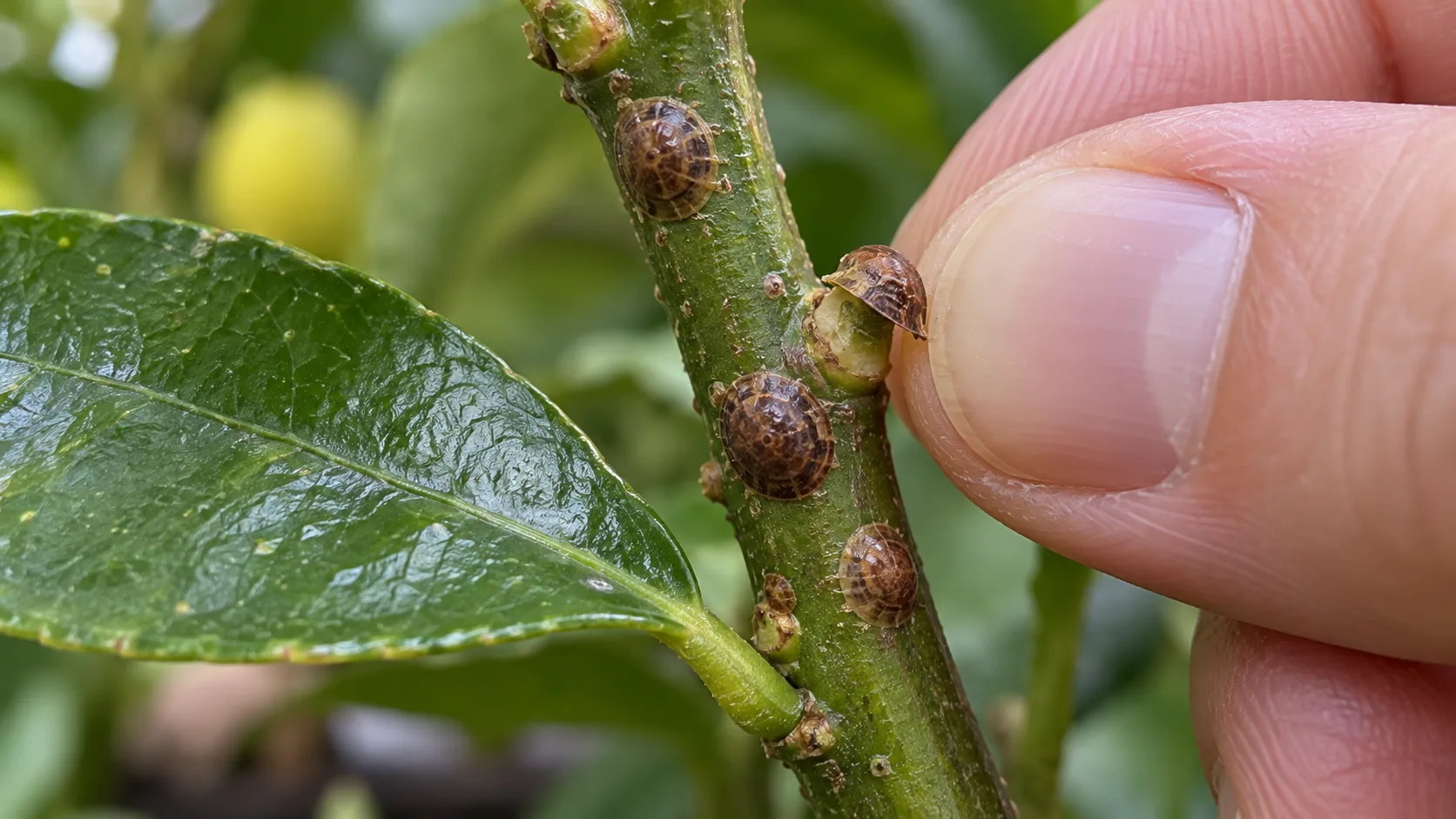
Lift a covering with your fingernail. If the cover comes off by itself, leaving a small, soft body on the plant, it is an armored scale. If the entire shell comes away with the insect, it is a soft scale2. This two-second check settles the treatment question.
Look-alikes
Several things resemble scale insects without being scales: settled whitefly nymphs, some psyllids, or the woolly aphid2. The RHS adds that the white egg masses of some scales can be mistaken for mealybugs6. White fluff without an insect underneath is more likely a white, cottony coating, while a white film on potting mix is simply surface mold.
Types of scale insects
Four types cover almost everything found indoors, on balconies, and in gardens. They can be distinguished by sight and touch, and this classification matters more than the exact species name.
| Type | Appearance | Adult size | Honeydew | What works |
|---|---|---|---|---|
| Mealybug (Pseudococcidae) | Segmented body covered in white wax, sometimes fringed with filaments | 1 to 12 mm (about 0.04 to 0.47 in) | Yes | Alcohol applied to each cluster with a cotton swab |
| Armored scale (Diaspididae) | Flat plate, with a covering that separates from the body | Less than 3 mm (about 0.12 in) | No | Scraping, followed by oil when crawlers emerge |
| Soft scale (Coccidae) | Smooth, domed shell that does not separate from the body | Up to 6 mm (about 0.24 in) | Yes, abundant | Oil or insecticidal soap on young crawlers |
| Cottony cushion scale (Icerya purchasi) | Reddish-brown body on a large, white, fluted egg sac | 5 mm (about 0.2 in) | Yes | Predatory lady beetle (biological control) |
Sizes: Wikipedia for mealybugs and cottony cushion scale78, UC IPM for armored and soft scales2. Honeydew: UC IPM for mealybugs, which often produce it1, and armored scales, which do not2; the RHS for soft scales, which excrete large quantities9, and cottony cushion scale10.
Mealybugs
Mealybugs, often described as white scale insects, form small cotton-like tufts in leaf axils, between two fruits, or at the crown. Their bodies remain soft and can still move a little, slowly1. Some species live on roots and are visible only when the plant is removed from its pot. They have their own page: mealybugs, with their signs and preferred plants.

Armored scales
An armored scale, or diaspid scale, lives beneath a small, flat plate less than 3 mm (about 0.12 in) across, often gray, white, or brown. It produces no honeydew: no sticky leaf, so one fewer warning sign2. It is the hardest type to reach because contact products reach it less effectively than other types2.

Soft scales
Soft scales, or coccid scales, are larger and domed like half a lentil. Their shell is the body wall itself. Brown soft scale (Coccus hesperidum) reaches 4 mm (about 0.16 in), with a flat, oval, pale yellow to brown body attached along leaf veins9. It excretes a great deal of honeydew, explaining the sooty mold that almost always accompanies it.

Cottony cushion scale
Cottony cushion scale (Icerya purchasi) is visible from a distance: a 5 mm (about 0.2 in) reddish-brown female resting on a large, white, ribbed egg sac8. Long confined to British greenhouses, it now lives outdoors in sheltered locations there, and the RHS recommends checking citrus, mimosas, and choisyas before buying10.

Scale insect, aphid, or whitefly?
Touch the insect lightly: if it scurries or flies away, it is not an adult scale insect. The damage looks similar because aphids and whiteflies also drink sap and also excrete honeydew2. Movement and location make the difference.
| Pest | Appearance | Where to look | Decisive clue |
|---|---|---|---|
| Scale insect | Brown shell or white, cottony cluster | Stems, leaf axils, and undersides of leaves along veins | Motionless or almost so, with no visible head or legs |
| Aphid | Small, soft, pear-shaped green, black, or yellow insect | Young shoots and buds | Dense, moving colony; winged forms |
| Whitefly | Tiny white fly | Undersides of leaves | Flies up in a cloud when the plant is shaken |
| Thrips | Elongated insect, 1 to 2 mm (about 0.04 to 0.08 in) | Leaves and flowers | Silvery patches and black specks, no honeydew |
| Spider mite | Barely visible mite | Undersides of leaves and leaf axils | Fine webs and leaves stippled with pale dots |
The most common confusion is between mealybugs and woolly aphids, both covered in white wax. UC IPM recommends looking beneath the wax before deciding1: a mealybug has an oval, segmented body, while an aphid has a pear-shaped body with long legs.
When scale insects multiply
The female lays eggs under cover, and only the newly hatched crawler is mobile. Eggs remain beneath her body or armor; some species lay them outside beneath a coating of white wax6. The young, yellow to orange in most species, walk over the plant or travel on the wind, then settle to feed within one to two days2. This crawler is the only stage when the insect has neither thick wax nor armor.
Some species do without males, and females lay eggs without mating2. Among mealybugs, a female lays 100 to 200 eggs or more in 10 to 20 days, with two to six generations a year depending on species and temperature1.
Indoors: year-round
In greenhouses and homes, scale insects reproduce without a break: the RHS notes this for orchid diaspid scales and oleander scale1112, and UC IPM for mealybugs, whose life stages coexist indoors all year1. In a heated apartment, there is no right season for treatment; there is a right interval.
Outdoors: a summer window
Outdoors, most species have only one generation a year6, and crawlers emerge over a short period. The published dates for four common species all fall between late June and September in the source regions described below.
| Scale insect | Host plants | Crawler emergence |
|---|---|---|
| European fruit lecanium (Parthenolecanium corni) | Woody trees and shrubs | Late June to July13 |
| Black scale (Saissetia oleae) | Olive, oleander, citrus14 | First crawlers in July, egg laying until mid-August15 |
| Hydrangea scale (Pulvinaria hydrangeae) | Hydrangea | Midsummer16 |
| Scurfy rose scale (Aulacaspis rosae) | Rose, sometimes bramble | August to September17 |
The RHS dates apply to the British climate, and the France Olive dates to French olive groves. On a warmer balcony, emergence may start a few weeks earlier: that is why UC IPM recommends watching for crawlers rather than following a fixed calendar2.
The plants most often affected
Each scale insect has preferred plants, and UC IPM notes that most species are highly host-specific2. The table brings together hosts for which a source names the species responsible.
| Plant | Scale insects named | Type |
|---|---|---|
| Lemon tree and citrus | Citrus mealybug, brown soft scale, cottony cushion scale1210 | Mealybug, soft scale, cottony cushion scale |
| Olive tree | Black scale, with an H-shaped ridge15 | Soft scale |
| Oleander | Oleander scale, whitish, 2 mm (about 0.08 in)12; black scale14 | Armored scale, soft scale |
| Orchid | Orchid diaspid scales11; mealybugs1 | Armored scale, mealybug |
| Ficus | Mealybugs1; brown soft scale9 | Mealybug, soft scale |
| Crassula (jade plant) and cacti | Mealybugs1 | Mealybug |
| Bay laurel | Brown soft scale9 | Soft scale |
| Hydrangea | Hydrangea scale, white egg sacs on stems16 | Soft scale (with egg sac) |
| Rose | Scurfy rose scale, white and scaly on stems17 | Armored scale |
The sources name these hosts without ranking their susceptibility: the table order is not a ranking. For monstera, the pest table on the sick monstera page shows where to look for mealybugs and brown shells. For olive and oleander, the care guides for olive and oleander detail each shrub's own calendar. The page on oleander scale insects distinguishes armor, soft shells, and white cottony clusters.
How to get rid of them by type
The right action depends on the type identified above, and the full scale insect protocol provides doses, intervals, and mistakes to avoid. By type:
- Mealybugs: remove each cluster with an alcohol-soaked cotton swab, the method UC IPM recommends for houseplants1. The wax repels most sprayed products.
- Armored scales: scrape off the plates, then target crawlers as they emerge, because adults beneath their covers resist contact products2.
- Soft scales: young crawlers are susceptible to insecticidal soap and horticultural oil182, while domed adults are much less so. Scrape off the large ones and treat the small ones.
- Cottony cushion scale: on an outdoor plant, the predatory lady beetle (Rodolia cardinalis) has controlled this scale in California orchards8.
Whatever the type, one treatment is not enough: hidden eggs hatch after treatment. Judge the course of treatment over several weeks, not by the first cleanup. A heavily infested plant also calls for a decision: UC IPM suggests discarding a severely affected houseplant rather than treating it endlessly1.
Preventing a return
Scale insects almost always enter your home on a plant. Adult mealybugs do not fly and move slowly: they arrive on a new plant, a tool, or a pot1.
- Inspect every new plant on the undersides of leaves and in leaf axils before placing it near the others, and return it to the seller if it is infested1.
- Check reused pots, stakes, and saucers: egg sacs can lodge there1.
- Measure nitrogen fertilizer carefully: excess promotes tender growth and stimulates mealybug egg laying1. The guide to feeding a houseplant provides guidance.
- Block ants' access with a sticky band placed on a sleeve around the trunk, never directly on the bark2. See also installing an insect barrier.
- Prune heavily infested shoots when only a few are involved2, following the rules for sanitation pruning.
- Rinse dusty foliage: dust interferes with scales' natural predators2. The method is explained in rinsing plant leaves.
Frequently asked questions
Where do scale insects on houseplants come from?
What causes scale insects?
Are scale insects dangerous to people, cats, or dogs?
Does white vinegar kill scale insects?
None of the sources consulted recommends it against scale insects. Acetic acid, the acid in vinegar, is sold as a contact herbicide, damaging the vegetation it touches19. It is therefore not something to spray on foliage: keep vinegar for cleaning an empty pot.
How can I tell whether scale insects are dead?
Is the red cochineal used in E120 coloring the same as the scale insects on plants?
No. Red coloring E120, or carmine, comes from the cochineal insect (Dactylopius coccus), raised on cacti in the genus Opuntia in Mexico and South America20. This is the insect most often meant by red cochineal. It does not infest ordinary houseplants and is unrelated to your plants' mealybugs or brown shells. Tiny red dots moving beneath a leaf are more likely spider mites, which are mites.