
Pests
Mealybugs
White cottony clusters in leaf axils? Identify mealybugs, their damage, and their favorite plants before treating them.
A mealybug is a small sap-feeding insect covered in protective white, cottony wax. By sucking sap, it deprives the plant of resources and excretes sticky honeydew on which the black fungus sooty mold grows. To remove it, follow the scale insect treatment guide, which includes a section on mealybugs.
An uncontrolled infestation yellows leaves, slows growth, and can kill the plant. Stationary brown shells belong to other scale insects, described in the scale insect guide.
Signs to check
- White cottony or powdery-looking clusters, 2 to 5 mm (about 0.08 to 0.2 in) across.
- Frequent locations include leaf-stem junctions, or axils, and leaf undersides.
- A sticky substance on leaves: honeydew.
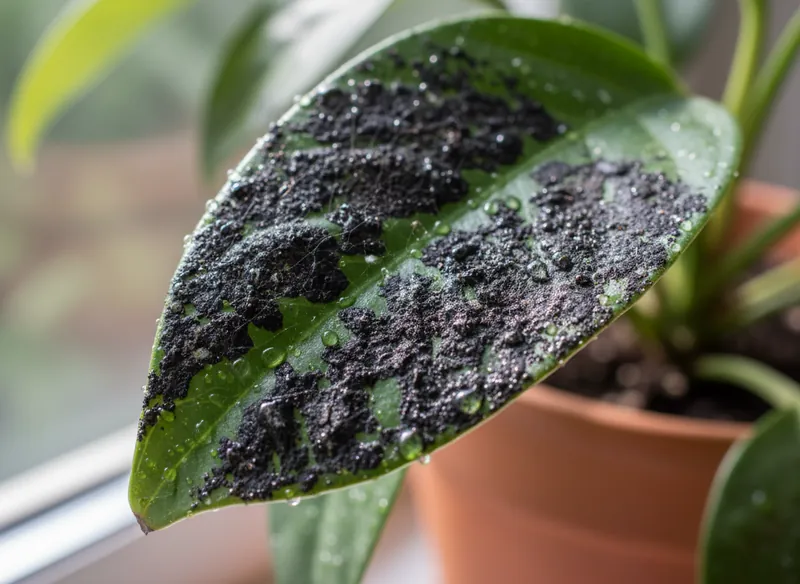
- Possible black, soot-like coating, or sooty mold, growing on honeydew.
What you may notice
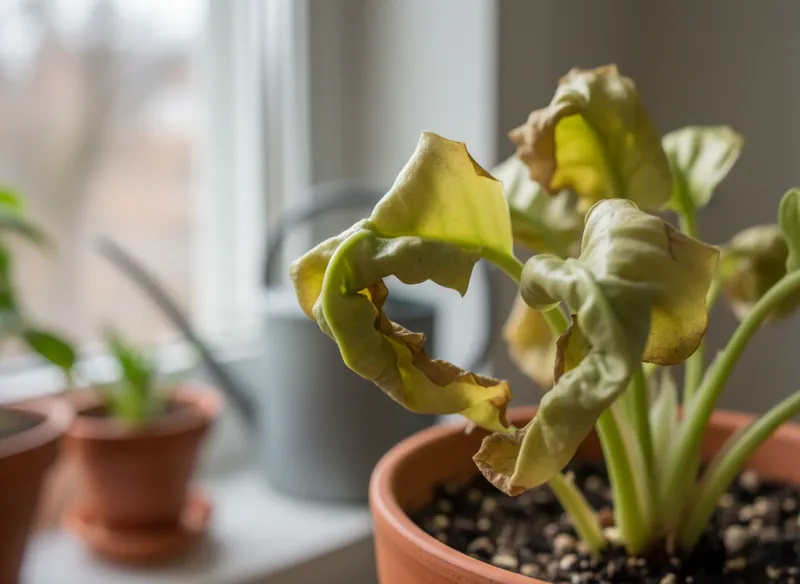
- Deformed or twisted leaves · Leaves grow abnormally, appearing curled, blistered, twisted, or unusually small.
- Black coating (sooty mold) · A dry, black, powdery, soot-like coating forms on leaves and stems.
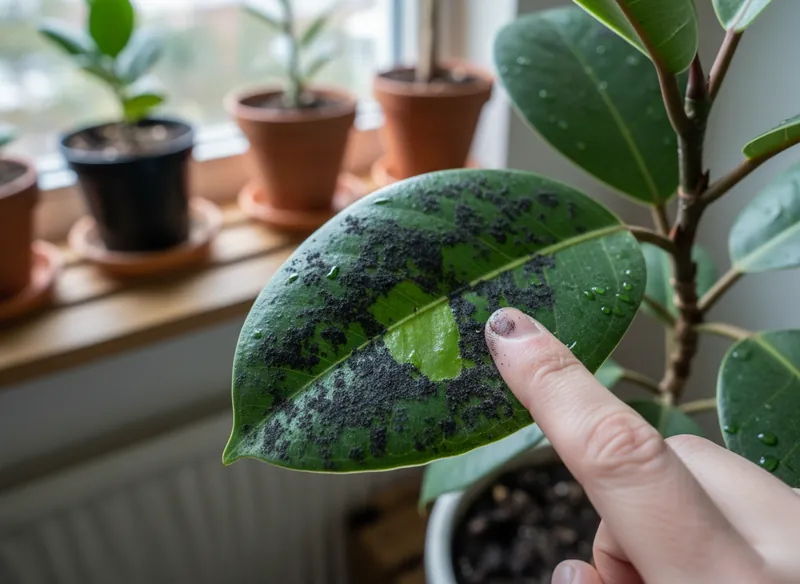
- Black sooty deposit · A black, powdery, soot-like layer develops on stems and sometimes leaves.
- White cottony specks · Small white cottony clusters appear on leaves, often grouped near veins or stems.
What to do now
Scale insect treatment
- Immediately isolate the infested plant to prevent spread. Nymphs are very mobile.
- Remove as many visible mealybugs as possible with a cotton swab or cloth soaked in 70% alcohol or soapy water.
- Thoroughly shower the foliage with lukewarm water to dislodge remaining insects and wash off honeydew.
- Prepare a natural insecticidal solution: mix 15 mL (about 1 US tbsp) of liquid black soap and 15 mL (about 1 US tbsp) of vegetable oil, such as canola or olive oil, into 1 liter (about 1.06 US qt) of water.
- Spray the solution over the whole plant, focusing on leaf undersides and stems. Oil suffocates the insects, and soap helps dissolve their waxy covering.
- Repeat spraying every 7 days for at least 4 weeks. This schedule eliminates new generations hatching from eggs.
Prevention
- Carefully inspect every new plant before bringing it into your home.
- Always quarantine new plants for 3 to 4 weeks.
- Examine plants once a week, looking under leaves and at stem junctions.
- Avoid excessive nitrogen fertilizer, which encourages tender foliage attractive to mealybugs.