
Pests
Sawfly larvae
Caterpillar-like larvae that chew scalloped notches in leaf edges.
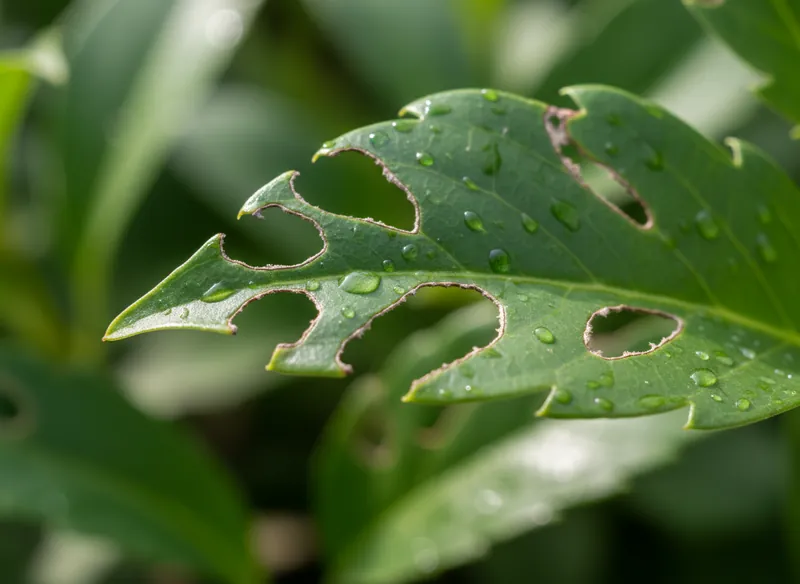
Sawfly larvae resemble caterpillars and develop into insects that look like small wasps. These very voracious larvae feed on leaf tissue, often in groups, starting at the leaf edge and cutting it in a characteristic pattern. An uncontrolled infestation leads to rapid, extensive defoliation, weakening the plant and stopping its growth.
Signs to check
- Leaf edges chewed into curved, scalloped notches, sometimes leaving only the midrib.
- Caterpillar-like larvae 1 to 2 cm (about 0.4 to 0.8 in) long, often green or yellowish.
- Larvae rear up into an 'S' shape when disturbed.
- No slime trails, as left by slugs, or silk threads, as produced by some caterpillars.
What you may see
- Scalloped notches in leaf edges · Leaf edges have neat, regular semicircular cutouts, as though punched out along the margin.
What to do now
Get rid of sawfly larvae
- Remove all visible larvae by hand. Wear gloves if you prefer, but they are harmless to touch. Crush them or drown them in soapy water.
- Use a strong stream of water to dislodge remaining larvae, especially those that are hard to reach.
- Soap sprays are generally ineffective against sawfly larvae. If treatment is still needed, choose a product whose label covers the plant and sawflies, and follow its dilution and repeat-use directions.
- Always test the product on a small leaf 24 hours before treating the whole plant to avoid burning it.
- Cut off and discard the most affected leaves, where eggs may still be present.
Prevention
- Inspect the undersides of leaves once or twice a week from spring through fall.
- Lightly hoe the soil surface in fall to expose overwintering pupae to cold, where winters are cold, and to predators.
- Encourage biodiversity: birds, spiders, and some wasps are natural predators of sawflies.