
Groupe d'hybrides
Fragrant orchids: at a glance
Phalaenopsis
A fragrant moth orchid almost always descends from Phalaenopsis violacea or P. bellina. Care resembles other moth orchids, with three differences: more light and warmth, no fall cold spell, and spikes left uncut while green. Smell the flowers in daytime, close to the lip.
- Summer flowering, without a cold spell
- What changes

What changes
Summer flowering, without a cold spell
Their flowering does not depend on cold: they often bloom in your local summer, encouraged by warmth and bright light. There is no need to give them the autumn cooling used for large hybrids.6
A subtle scent, depending on the species
The scent is subtle, never heady, and absent from most mass-market hybrids. P. violacea, P. bellina, P. amboinensis and P. lueddemanniana are fragrant, as are some of their hybrids.1
P. violacea: scent from 10 am to 4 pm
Smell the flowers during the day: in P. violacea, scent release peaks between 10 am and 4 pm, becomes undetectable around midnight and reaches its maximum around the fifth day after a flower opens.2
Fragrant orchids: at a glance
A scented moth orchid almost always descends from a few identified species, especially Phalaenopsis violacea and P. bellina. The American Orchid Society lists P. violacea, P. bellina, P. amboinensis, P. schilleriana and P. lueddemanniana as fragrant, noting that only some hybrids inherit scent.1 P. bellina and P. violacea are the usual parents: around 730 hybrids from one or the other were registered with the Royal Horticultural Society when a study was published.2

| Feature | Fragrant orchids |
|---|---|
| Botanical name | Phalaenopsis species and hybrids, mainly from P. violacea and P. bellina 2 |
| Fragrant species | P. violacea, P. bellina, P. amboinensis, P. lueddemanniana, P. schilleriana 1 |
| Scent | Delicate, never overpowering 1; spicy in P. violacea, sweet in P. bellina 3 |
| Scent peak | Daytime, around the fifth day after opening 24 |
| Flowers | Waxy, brightly colored 5; 5 to 7.5 cm (2 to 3 in) in P. violacea 3 |
| Flowering | Often summer, without chilling; year-round on large plants 6 |
| Toxicity | Non-toxic to cats and dogs 7 |
What scent, and when to smell it
The two species smell different: P. violacea is distinctly spicy, while P. bellina recalls candy, and the latter may be the genus's most fragrant species.3 The scent comprises monoterpenes, mainly linalool and geraniol.2 P. equestris, parent of mini multiflora orchids, emits none: it is unscented.8
Timing matters. In P. violacea, emission rises from 4 am, peaks between 10 am and 4 pm and becomes undetectable at midnight.2 In fragrant hybrid 'Chanel', the peak is 9 to 11 am, and the lip smells strongest.4 Scent builds until the fifth day after opening, then declines; a faded flower has no scent.4
What light does a fragrant orchid need?
More light than a classic white orchid, never direct sun. Species in this group flower in response to warmth and bright light,6 and the American Orchid Society notes almost year-round flowering if light suffices.9 An east window remains ideal; south or west works behind a sheer curtain.9

At 1 m from the window: bright light
Distance from the window
Move the plant around the room: for phalaenopsis, the recommended zone is 0,5 to 1,5 m from the glass. Light levels fall very quickly with distance.
Light also regulates scent itself. In the Taiwanese P. violacea study, flowers in continuous darkness emitted much less, and white light produced more scent than blue or red alone.2 A dark corner therefore costs flowers and fragrance. Acclimatize gradually in spring: sudden sun leaves black patches on upper leaves.10
Watering fragrant orchids: more warmth, more soaking
The Museum's soaking method, simply more often than in a cool room. Stand the pot in a basin with water to pot height for ten minutes, then drain fully.11 A warmer, brighter plant loses more water through leaves and medium: heat and light shorten watering intervals.12
17 cL every 11 days
About every 7 days
A little less often than in summer
About every 10 days
Like all moth orchids, it has no storage organ apart from leaves: soak just before the medium dries, in the morning, so leaves dry before night.9 Keep water out of the rosette's crown: standing water starts rot.10
Humidity and temperature: warmth, no cold shock
Nights above 15 °C (59 °F) year-round, days at 24 to 29 °C (75 to 84 °F), and 50 to 80% humidity.9 Parent species in subgenus Polychilos come from hot, humid habitats.5 Laboratories measuring scent grew them at 30 °C (86 °F) by day, 25 to 28 °C (77 to 82 °F) at night and 80% humidity or more.28 A living room does not reach these figures, but the direction is clear: the warmest, brightest place at home.
Flowering does not depend on cold. Large white hybrids wait for cooler fall nights to initiate spikes; this group often flowers in summer, driven by warmth.6 A cool balcony in October, the French source’s fall-cooling example, serves no purpose for this group. Judge by the plant’s actual warmth and light. Avoid abrupt temperature changes, which drop buds.9 A damp gravel tray raises humidity if the pot does not touch water.9
Medium and repotting for fragrant orchids
A porous bark mix renewed every one to three years.9 Spring just after flowering is the right time; repot a large, nearly continuously flowering plant when roots are active, with visible green tips.913
Use the same method as for all moth orchids: remove old bark, cut brown or hollow roots, use a barely larger clear pot.13 One group-specific detail: protect old green spikes during repotting; they will flower again.14
Propagating fragrant orchids: keikis and seed
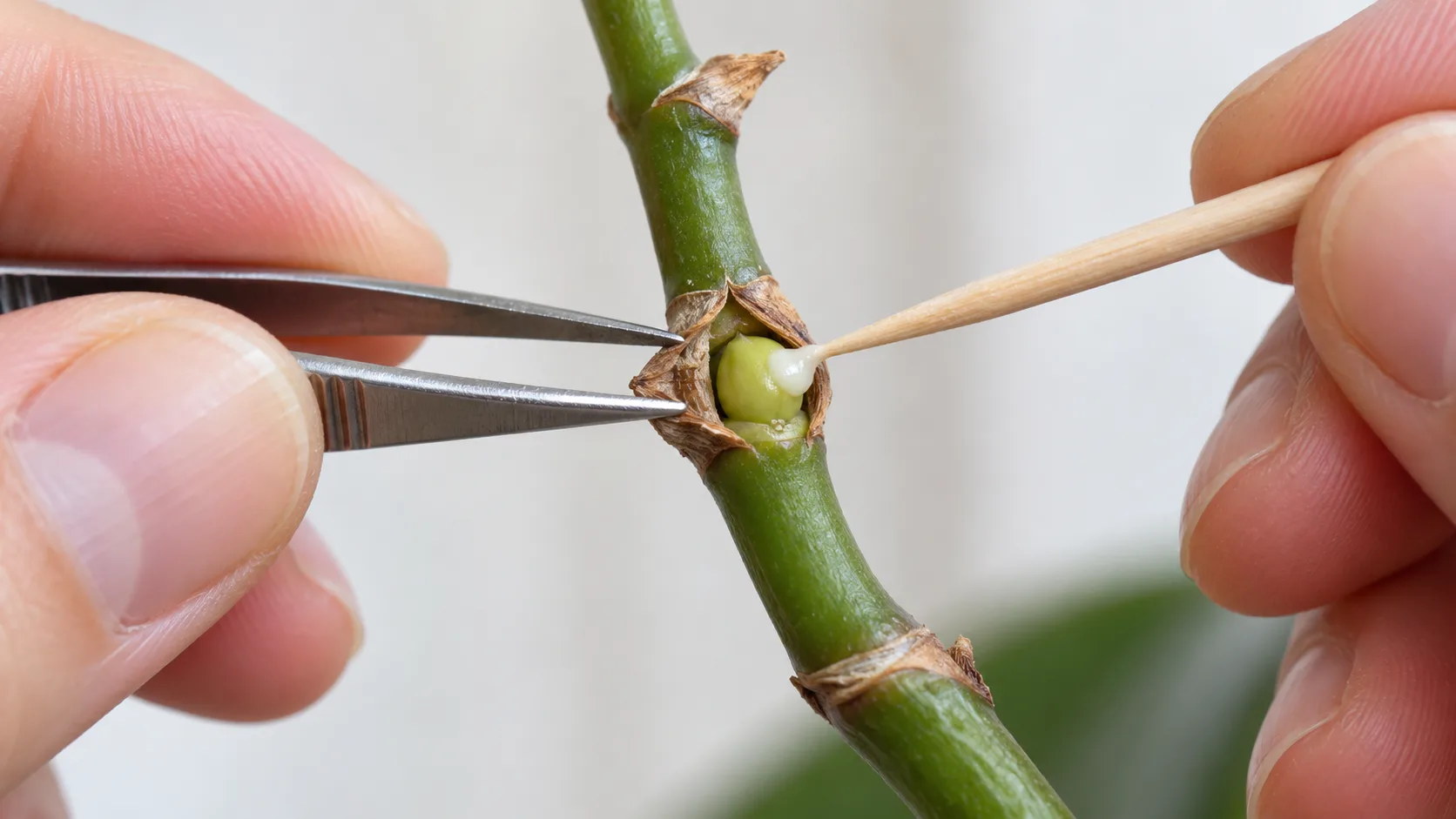
Use a keiki, a plantlet at a spike node, detached once it has several roots.13 Keiki paste on a node sometimes induces one in six to eight weeks.13
Scent is not guaranteed to pass on: only some hybrids of fragrant species inherit it.1 Seedlings from one cross always vary, while a mericlone reproduces the original almost exactly.15 For a specific scent, buy in flower, after smelling it.
Feeding, spikes and summer flowering
Regular diluted feed while warm, and no cutting green spikes. In warm, humid weather, some growers feed quarter strength at every watering; in cool or cloudy conditions, twice monthly suffices.9 RHS flushes with plain water every fourth watering.13
Do not cut the spike after flowering. These star-flowered orchids, with short, sometimes branched spikes, rebloom at the same spike tip and on its branches: leave it until brown.14 In P. violacea, two to five or more flowers open successively on a short, stout spike.3 On mature plants, this may continue all year.6
Fragrant orchid problems: diagnosis
The commonest issue is not disease: it is a flower with no scent. The table matches signs, likeliest causes and actions.
| Symptom | Likely cause | What to do |
|---|---|---|
| Open flower with no scent | Hybrid without fragrant ancestry, commonest in mass retail 1 | Check the label for violacea or bellina parents |
| No scent in the evening | Daytime emission, absent around midnight 2 | Smell between 9 am and 4 pm |
| Scent weakening after a week | Peak on day five, declining afterwards 4 | Nothing: later flowers take over |
| Weak scent in a dark corner | Insufficient light 2 | Move closer to a window without direct sun |
| No flowers for a year | Insufficient warmth or light 6 | A brighter, warmer place without cold shocks |
| No flowers after spike pruning | Green spike cut, though it reblooms at its tip 14 | Cut only brown spikes |
| Black spots on upper leaves | Sunburn after moving 10 | Move back from glass, acclimatize gradually |
| Blackened crown, central leaf comes loose | Water left in the rosette 10 | Tilt to empty the crown, soak in the morning |
Noses differ too: American Orchid Society's Ken Slump notes that one person enjoys a scent another does not notice.1

Fragrant orchid care calendar
Mainly summer flowering, no fall cooling, brightest winter position. The rhythm follows warmth and light, not cold.6
| Task | January | February | March | April | May | June | July | August | September | October | November | December |
|---|---|---|---|---|---|---|---|---|---|---|---|---|
| Watering | reduced | reduced | moderate | moderate | high | high | high | high | moderate | moderate | reduced | reduced |
| Growth | resting | active | active | strong | strong | strong | strong | strong | active | active | active | resting |
| Feeding | yes | yes | yes | yes | yes | yes | yes | yes | yes | no | no | yes |
| Repotting | no | no | favorable window | favorable window | favorable window | no | no | no | favorable window | no | no | no |
- Spring: repot if bark breaks down, resume feeding, gradually introduce brighter light.
- Summer: peak flowering, more frequent soaking, diluted feed, never midday sun.
- Fall: keep warm, nights above 15 °C (59 °F), green spikes intact.
- Winter: brightest window, less frequent soaking, no radiator or draft.
Frequently asked questions
Which orchids are fragrant?
Among moth orchids, mainly Phalaenopsis violacea, P. bellina, P. amboinensis, P. lueddemanniana and P. schilleriana, plus some hybrids 1. Most mass-retail hybrids have no scent.
Why does my orchid have no scent?
When does a fragrant orchid smell strongest?
What does Phalaenopsis bellina smell like?
How long does a flower remain fragrant?
A few days at full strength. In hybrid 'Chanel', scent rises until day five after opening, declines until day ten and disappears as the flower fades 4.
Should you cut a fragrant orchid’s spike?
No, while green. These orchids rebloom at the same spike tip; cut only once brown 14.
Does a fragrant orchid need cold to rebloom?
No. Unlike large white hybrids, it flowers with warmth and bright light, often in summer 6. Fall cooling described for large standard hybrids does not help it.
How do you recognize a fragrant orchid when buying?
Is a fragrant orchid poisonous to cats?
No. The ASPCA lists moth orchids as non-toxic to cats, dogs and horses 7.
For shared care, see the moth orchid guide; P. schilleriana, also fragrant but dependent on cool nights for flowering6, has its own page.
Other varieties

Groupe d'hybrides
Compact hybrids 15–20 cm (about 6–8 in) tall in small pots, or multiflora hybrids with very numerous medium-sized flowers on branched spikes.

Espèce botanique
A botanical species with large white flowers, from which most commercially sold white hybrids descend.

Espèce botanique
A Philippine species with grey-mottled foliage and long, branched spikes of pink flowers with a light rose scent.

Groupe d'hybrides
Grexes with large, rounded white, pink or striped flowers, sold at garden centres.