
Espèce botanique
Phalaenopsis schilleriana: at a glance
Phalaenopsis schilleriana, the Luzon moth orchid with silver-mottled leaves and fragrant pink flowers, needs similar soaking and light to commercial hybrids. Temperature is decisive: cooler nights, in fall in the source’s seasonal growing example, are needed for flowering, yet it is the least cold-tolerant species in its group. Time care by actual light, warmth and growth.
- Flower spike 90–120 cm (about 35–47 in) long
- What changes

What changes
Phalaenopsis schilleriana: at a glance
Phalaenopsis schilleriana grows wild only on Luzon in the Philippines.1 Described by Reichenbach the younger in , it is an epiphyte of humid tropical forests,1 at 200 to 450 m (656 to 1,476 ft) altitude.2 According to Kew's extinction-risk predictions, it may be threatened.1
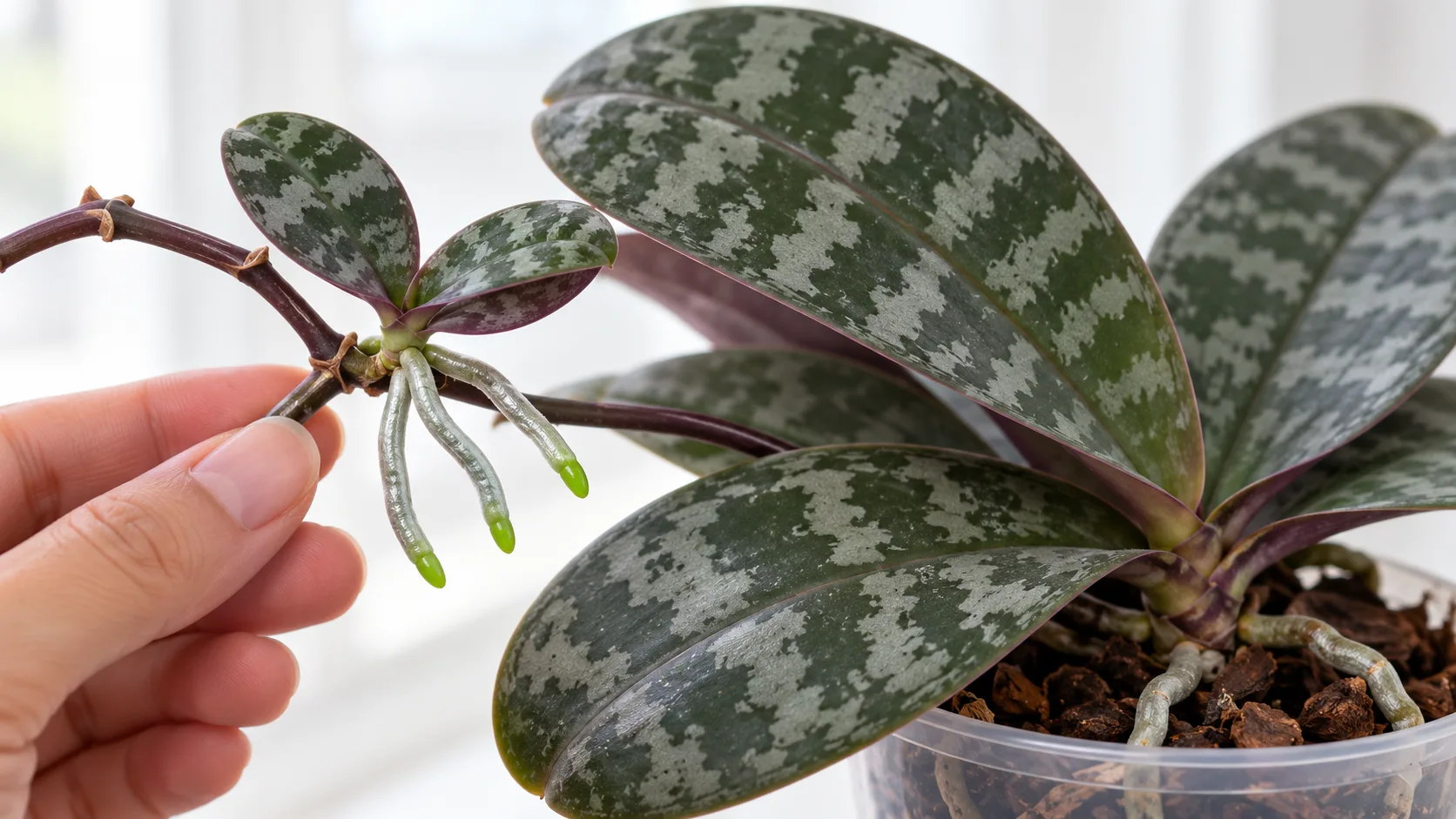
Recognize it even without flowers. Dark green leaves are mottled silvery gray above and flushed purple below, up to 45 cm (18 in) long.3 The American Orchid Society describes few, mottled, cross-banded leaves.4

| Feature | Phalaenopsis schilleriana |
|---|---|
| Status | Botanical species, Reichenbach the younger, 1 |
| Native range | Endemic to the Philippines (Luzon) 1 |
| Leaves | Dark green mottled silver, purple beneath, 45 cm by 5 to 7 cm (18 by 2 to 2.8 in) 3 |
| Flowers | Pink, 5 to 9 cm (2 to 3.5 in), purple or yellow lip 3 |
| Scent | Light rose fragrance in most flowers 5 |
| Spike | Loosely branched, 90 cm to 1.2 m (3 to 4 ft), up to 250 flowers 43 |
| Flowering | Winter and spring in the sources’ seasonal growing example 34 |
| Weak point | Least cold-tolerant in its group 6 |
| Toxicity | Non-toxic to cats, dogs and horses 7 |
Pink flowers have spots at the lip base; an unspotted form is named immaculata.5 The species is widely used in hybridization4 and has received around thirty awards from the American Orchid Society.5 There is no dedicated encyclopedia profile yet: it appears among species in the moth orchid encyclopedia profile.
What light does Phalaenopsis schilleriana need?
Slightly more than a hybrid, never direct sun. The genus's rule is a shaded, sun-free position; schilleriana's banded foliage tolerates slightly brighter light, especially near a fan.5 RHS specifies partial shade facing east or west.3

At 1 m from the window: bright light
Distance from the window
Move the plant around the room: for phalaenopsis, the recommended zone is 0,5 to 1,5 m from the glass. Light levels fall very quickly with distance.
Foliage is its attraction outside flowering,5 and scorched leaves cannot repair themselves. Black patches on upper surfaces just after moving indicate sunburn.8 Move closer to glass in winter as days shorten and further away in summer.9
Watering Phalaenopsis schilleriana: generous summer soaking, less in winter
Regular, abundant watering during warm seasons, reduced in winter.2 Use the Museum's soaking method: ten minutes in a basin, then full drainage.10 Let medium become almost dry before the next soak.11
17 cL every 11 days
About every 7 days
A little less often than in summer
About every 10 days
Its flat roots2 have velamen like hybrids: silvery gray means thirsty; green means hydrated.9 Water in the morning and empty water from the rosette center.11 Mounted plants dry faster and need more frequent soaking than potted ones.12
Humidity and temperature: a narrow window
18 to 30 °C (64 to 86 °F), with 60 to 80% humidity.2 Below 15 °C (59 °F) at night, schilleriana suffers more than relatives: leaves redden, yellow, then fall.6 Greg Allikas notes plants surviving 5 to 9 °C (41 to 48 °F) nights, but advises staying above 15 °C (59 °F) to keep them healthy.5
Yet flowering needs cooling. Like P. amabilis and P. aphrodite, it initiates spikes only after temperatures drop,6 with fall nights around 13 °C (55 °F) in the American Orchid Society’s seasonal growing example,5 or 14 to 16 °C (57 to 61 °F) and days below 26 °C (79 °F) according to other growers.2 Aim for the upper end: a few weeks of 14 or 16 °C (57 or 61 °F) nights, no more.
Against dry heated-room air, place the pot above damp gravel, without touching water, or mist leaves on hot days.13
Repotting or mounting: hanging pots, bark or sphagnum
Free-draining bark in pots; a trailing habit when mounted. Allikas notes that cool-region growers prefer medium fir bark or peat-based mixes, while he uses sphagnum in terracotta, in humid southern Florida.5 RHS asks for well-drained bark mix.3 Repot every one to three years as bark decomposes.11
Mounted on a branch or cork, the plant becomes more pendant.3 This is its natural epiphytic habit, but mounts hold little water: AOS reserves them for greenhouses or terrariums, recommending pots indoors.12 In homes, a hanging pot lets the long spike trail without staking.
Propagating Phalaenopsis schilleriana with keikis
A keiki copies its parent exactly, including mottling. This is vegetative propagation: offspring are identical to the parent.14 One occasionally appears at a spike node, and hormone paste may induce it.13
Separate once it has 2 or 3 leaves and 2.5 to 5 cm (1 to 2 in) roots.14 Pot in fine bark and keep warm, above 15 °C (59 °F), like adults.
Feeding, growth and spikes over a meter (3.3 ft) long
Weak feed weekly during growth, twice monthly in winter.5 Flush with plain water every fourth watering to avoid salt buildup.13
Growth is slow: RHS allows two to five years for young plants to mature.3 Adults have 90 cm to 1.2 m (3 to 4 ft) loosely branched spikes,4 carrying up to 250 flowers.3 Each stays open around a month.2 After flowering, cut green spikes above the second node below spent flowers, dry ones at the base.139

Phalaenopsis schilleriana problems: diagnosis
Watch cold and two pests first. Allikas names spider mites and brown armored scale as usual pests.5

| Symptom | Likely cause | What to do |
|---|---|---|
| Leaves redden, then yellow and fall | Nights below 15 °C (59 °F) 6 | Raise temperature; it recovers if damage is limited |
| No spike in late fall in the source’s seasonal growing example | Nights remained too warm 6 | A few weeks of 14 to 16 °C (57 to 61 °F) nights 2 |
| Pale-stippled leaves, fine webs beneath | Spider mites 5 | Shower leaf undersides, raise humidity |
| Small brown shells on leaves, sticky coating | Brown armored scale 5 | Remove with a soft alcohol-soaked brush |
| Black patches on the upper surface of mottled leaves | Sunburn 8 | Move back from glass or add a sheer curtain |
| Blackened crown, central leaf comes loose | Water left in the rosette 11 | Water in the morning, empty the crown |
| Soft wrinkled leaves, brown roots | Roots rotted by excess water 8 | Unpot, remove dead roots, use fresh medium |
Cold-related leaf fall is not fatal: the plant recovers if the event is limited.6 Still, every leaf matters on a species with few.4
Phalaenopsis schilleriana care calendar
In the sources’ seasonal growing example: warm summer growth, measured fall cooling, winter and spring flowers. Time the cycle by actual light, temperatures and growth.35
| Task | January | February | March | April | May | June | July | August | September | October | November | December |
|---|---|---|---|---|---|---|---|---|---|---|---|---|
| Watering | reduced | reduced | moderate | moderate | high | high | high | high | moderate | moderate | reduced | reduced |
| Growth | resting | active | active | strong | strong | strong | strong | strong | active | active | active | resting |
| Feeding | yes | yes | yes | yes | yes | yes | yes | yes | yes | no | no | yes |
| Repotting | no | no | favorable window | favorable window | favorable window | no | no | no | favorable window | no | no | no |
- Spring: full flowering; repot afterwards if bark compacts.
- Summer: frequent soaking, weak feed weekly, high humidity, no direct sun.
- Fall: a few weeks of nights around 14 to 16 °C (57 to 61 °F), without prolonged exposure below 15 °C (59 °F); the spike appears.
- Winter: buds then flowers, less soaking, feeding twice monthly, protection from cold glass.
Frequently asked questions
Is Phalaenopsis schilleriana fragrant?
Yes, most flowers have a light rose fragrance 5. For choosing mainly by scent, see fragrant orchids.
Why are my schilleriana leaves turning red?
Because of cold. Nights below 15 °C (59 °F) redden leaves, which then yellow and fall 6. Raise temperature: limited damage is recoverable.
Why is it not flowering?
Should it grow in a pot or on a mount?
How many flowers does a spike carry?
A well-grown plant can carry up to 250 on a 90 cm to 1 m (35 to 39 in) spike 3. Pink flowers measure 5 to 9 cm (2 to 3.5 in).
How does it differ from a shop-bought pink orchid?
Commercial pink orchids are hybrids, often unnamed 13. Schilleriana is a wild Philippine species identifiable year-round by silver-mottled leaves 3. For large-flowered hybrids see large standard hybrids.
Can it go outdoors in summer?
Is Phalaenopsis schilleriana poisonous to cats?
No. ASPCA lists moth orchids as non-toxic to cats, dogs and horses 7.
Shared moth-orchid care is detailed in the complete orchid guide. The white species behind most hybrids has its own page: Phalaenopsis amabilis.
Other varieties

Groupe d'hybrides
Compact hybrids 15–20 cm (about 6–8 in) tall in small pots, or multiflora hybrids with very numerous medium-sized flowers on branched spikes.

Groupe d'hybrides
Lightly scented species and hybrids, descended mainly from P. violacea and P. bellina, with brightly coloured, waxy flowers.

Espèce botanique
A botanical species with large white flowers, from which most commercially sold white hybrids descend.

Groupe d'hybrides
Grexes with large, rounded white, pink or striped flowers, sold at garden centres.