
Groupe d'hybrides
Mini orchid: identification
Phalaenopsis
Care for a mini orchid like a large one, with one crucial difference: its small pot holds only a few days’ water. Weigh it before each soak, group plants to keep air humid, and check whether the label says multiflora or true miniature, which needs a cooler winter.

What changes
Small pots need more frequent watering
The smaller the pot, the less water it holds: a 5–7.5 cm (about 2–3 in) pot may need watering several times a week, while a large pot can last the week.3
A bright window, out of direct sun
Multiflora hybrids descend from species with many small flowers, such as P. equestris. They carry flowers on several spikes or a branched spike and do well at a bright window out of direct sun.1
True miniatures prefer cooler conditions
The exception is true miniatures descended from P. lobbii or P. parishii: they come from cool or dry regions and prefer lower temperatures both day and night, and less humid air.1
Mini orchid: identification
“Mini” is not a botanical name: on moth orchid (Phalaenopsis) labels, it covers two distinct hybrid lines identified by Brooklyn Botanic Garden.1 The commoner multiflora line was developed in California by Herb Hager from species with many small flowers, including Phalaenopsis equestris. Rarer true miniatures descend from P. lobbii and P. parishii, including 'Micro Nova' and 'Mini Mark'.1 The RHS gives 15–20 cm (6–8 in) as the height of the smallest moth orchids.2

| Feature | Mini orchid |
|---|---|
| Botanical name | Phalaenopsis hybrids, multiflora and miniature lines 1 |
| Height | 15–20 cm (6–8 in) for the smallest 2 |
| Multiflora parents | P. equestris, P. stuartiana, P. lindenii 1 |
| Flowers | Numerous, on several spikes or one branched spike 1 |
| Pot | Small: little stored water, more frequent soaking 3 |
| Fragrance | Absent in P. equestris, a multiflora parent 4 |
| Toxicity | Non-toxic to cats and dogs 5 |
Multiflora or true miniature
The difference matters in winter. Multiflora descend from warm, humid forest species and grow like large hybrids.1 P. equestris, from the Philippines and Taiwan, bears flowers up to 3.8 cm (1.5 in) across on slowly lengthening spikes that flower for months.6 True miniatures come from cool or dry regions: they need lower day and night temperatures and less humid air.1
Light for a mini orchid
A bright window, with little or no direct sun. Brooklyn Botanic Garden specifies this for multiflora and prefers an east-facing window for the genus, with south or west windows possible behind sheer curtains.1 In winter, the RHS moves plants closer to light for flowering; summer direct sun burns leaves.2
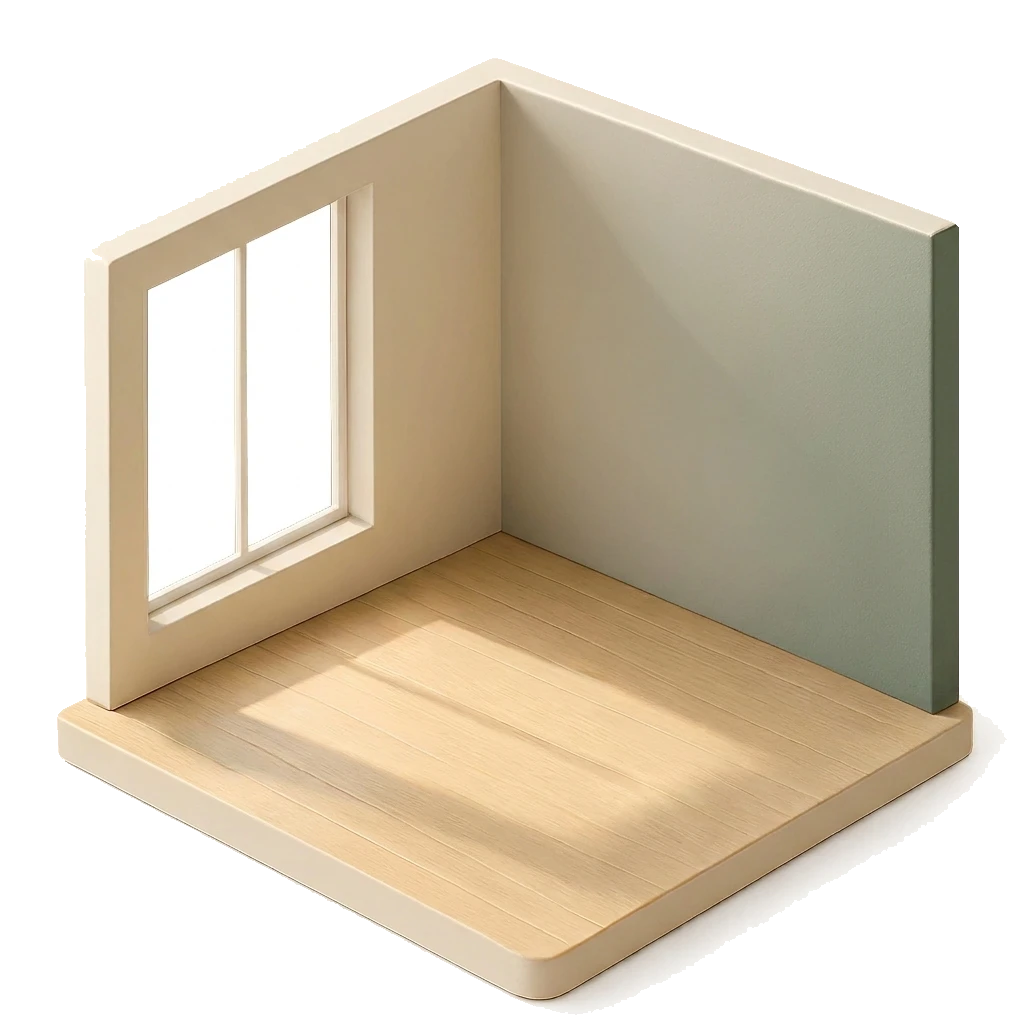
At 1 m from the window: bright light
Distance from the window
Move the plant around the room: for phalaenopsis, the recommended zone is 0,5 to 1,5 m from the glass. Light levels fall very quickly with distance.
A mini fits a narrow windowsill. Use leaves to adjust distance: firm, light green leaves mean suitable light; dark green and stiff means too little; yellow-green with reddish edges means too much.7
Watering a mini orchid: small pots dry quickly
Soak as for a large orchid, but more often. Follow the Muséum method: pot in a basin, water up to pot height, ten minutes, then drain completely.8 Frequency alone changes: the smaller the pot, the less stored water. The American Orchid Society gives figures: a large plant in a 20 cm (8 in) pot lasts a week between waterings even in warmth, while a young plant in 5–7.5 cm (2–3 in) pots may need several waterings weekly.3
17 cL every 11 days
About every 7 days
A little less often than in summer
About every 10 days
Forget a large orchid's schedule. Weigh the pot in your hand: it becomes much lighter as substrate dries, and you soon learn the weight.39 Moth orchids have no storage organ except leaves and must never dry completely: soak just before that point.109 Heat, light and dry air increase frequency; cool, dark rooms reduce it.3
Humidity and temperature: group small pots
Aim for 50–60% humidity, 24–29 °C (75–84 °F) by day and above 15 °C (59 °F) at night. The American Orchid Society recommends this relative humidity and these temperatures for the genus.310 With few leaves and little substrate, minis suffer sooner than large orchids in dry heated-room air.
Group pots together. Plants release moisture through leaves and substrate; a close collection withstands dry air better than isolated plants.3 Put them together on damp gravel trays, keeping pots clear of water.10
True miniatures are an exception. P. lobbii comes from regions whose source-described dry season, November–February, has under 13 mm (0.51 in) monthly rainfall and nights around 8 °C (46 °F): these plants need cool, dry winter rest and may become deciduous.11
Substrate and repotting: keep pots small
Fine bark, in a pot just larger than the roots. Indoors, the American Orchid Society recommends fine bark mix for all plant sizes, repotting every one to three years.10 Repot when bark breaks down: decomposed substrate holds water; brown coffee-ground-like particles escaping during soaking signal the need.9
Resist giving a small plant a large pot. Excess substrate stays wet too long and rots roots: reuse the old pot if cleaned roots fit.2 A clear pot reveals moisture beneath the surface and admits light to roots.2
Propagating mini orchids: keikis
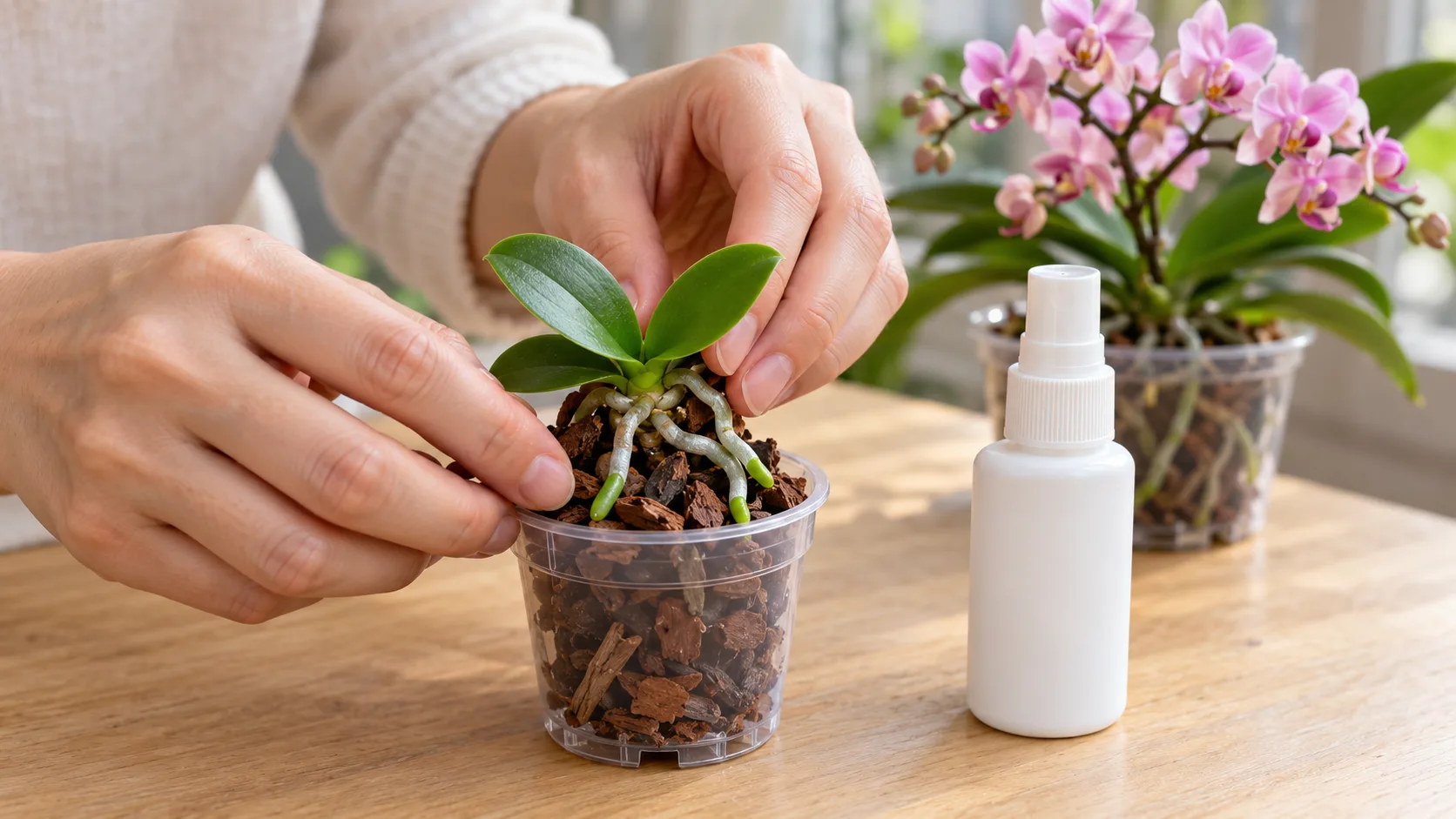
A plantlet grows from a spike node; separate it once several roots develop.2 A keiki rarely appears spontaneously; keiki paste on a node with its bract split sometimes produces one in six to eight weeks.2 A close relative of multiflora illustrates this: natural hybrid Phalaenopsis ×intermedia, from P. aphrodite and P. equestris, readily produces keikis at spike tips after flowering.6
After separation, pot the plantlet in fine bark, water sparingly and initially mist daily.210
Feeding, spikes and repeat flowering in multiflora
Very dilute orchid fertilizer, at most every other watering, never on dry substrate. Small pots are soaked more often; feeding every time concentrates salts. For small collections, the American Orchid Society recommends every other watering, warning that fertilizer on dry substrate burns root tips.3 Winter feeds become infrequent.2
Multiflora bear flowers on several spikes or one branched spike.1 While a spike stays green with unused nodes, cut above the second node below faded flowers: a flowering branch may emerge. Cut brown spikes at the base.12 To initiate spikes, the American Orchid Society recommends a few weeks of fall nights around 13 °C (55 °F).10
Mini orchid problems: diagnosis
Most problems reflect small volume: little stored water, few leaves, little margin. The table matches signs, likely causes and actions.
| Symptom | Likely cause | What to do |
|---|---|---|
| Two or three limp leaves instead of four or five firm ones | Air too dry 3 | Group pots on damp gravel trays |
| Wrinkled leaves, very light pot | Soaks too infrequent for a small pot 73 | Weigh the pot every two days; soak as it lightens |
| Wrinkled leaves, heavy pot, brown soft roots | Roots rotted by excess water 9 | Repot in fresh fine bark in the smallest possible pot |
| Buds fall before opening | Dry air or sudden temperature change 310 | Keep the plant in place and increase humidity |
| Burnt root tips | Fertilizer on dry substrate 3 | Soak in plain water first; feed less often |
| True miniature loses leaves in winter | Natural dry rest in species such as P. lobbii 11 | Water less often and await regrowth |
| White cottony clumps in leaf axils | Mealybugs 13 | Alcohol-soaked cotton swab, weekly checks |
Wrinkling while the pot stays heavy can mislead: the plant wilts because rotten roots cannot absorb water. Remove it from the pot before adding more water.13

Mini orchid care calendar
Soak more often during warm active growth, spring to late summer in the source’s seasonal example, and more slowly in cooler winter conditions, with true miniatures an exception. They flower in their native dry season, generally November to February or March in the habitat example described by the source; those months are not a universal home-care calendar.11
| Task | January | February | March | April | May | June | July | August | September | October | November | December |
|---|---|---|---|---|---|---|---|---|---|---|---|---|
| Watering | reduced | reduced | moderate | moderate | high | high | high | high | moderate | moderate | reduced | reduced |
| Growth | resting | active | active | strong | strong | strong | strong | strong | active | active | active | resting |
| Feeding | yes | yes | yes | yes | yes | yes | yes | yes | yes | no | no | yes |
| Repotting | no | no | favorable window | favorable window | favorable window | no | no | no | favorable window | no | no | no |
- Spring: repot in fine bark if substrate breaks down; resume dilute feeding.
- Summer: several weekly soaks in small pots; never direct midday sun.
- Fall: a few weeks of cooler nights for multiflora; weigh pots more often as heating starts.
- Winter: less frequent soaking and feeding; group pots away from radiators; cool, dry rest for true miniatures.
Frequently asked questions
How does a mini orchid differ from a regular orchid?
Plant and flower size, rather than care. The smallest moth orchids measure 15–20 cm (6–8 in) 2. Small pots store less water and need more frequent soaking 3. For light, substrate and fertilizer, follow the moth orchid guide.
How often should I water a mini orchid?
How long should I soak a mini orchid?
Ten minutes, with water up to pot height, as for a large orchid 8. Drain completely before returning it to its decorative outer pot.
Should I repot a mini orchid into a larger pot?
Does a mini orchid grow larger over time?
Why are my mini orchid’s leaves limp?
How long does a mini orchid flower?
Several weeks, often months. P. equestris, a multiflora parent, flowers for months on a slowly lengthening spike 6.
Should I cut a mini orchid’s spike after flowering?
Yes if brown: cut at the base. If green, cut above the second node below faded flowers, where a flowering branch may emerge 12.
Are mini orchids toxic to cats?
No. The ASPCA lists moth orchids as non-toxic to cats, dogs and horses 5.
Standard-sized orchids have their own large standard hybrids page, as do scented ones: fragrant orchids.
Other varieties

Groupe d'hybrides
Lightly scented species and hybrids, descended mainly from P. violacea and P. bellina, with brightly coloured, waxy flowers.

Espèce botanique
A botanical species with large white flowers, from which most commercially sold white hybrids descend.

Espèce botanique
A Philippine species with grey-mottled foliage and long, branched spikes of pink flowers with a light rose scent.

Groupe d'hybrides
Grexes with large, rounded white, pink or striped flowers, sold at garden centres.