
Phalaenopsis amabilis (Phalaenopsis amabilis, )
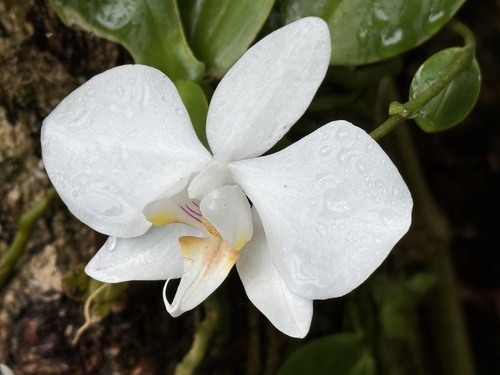
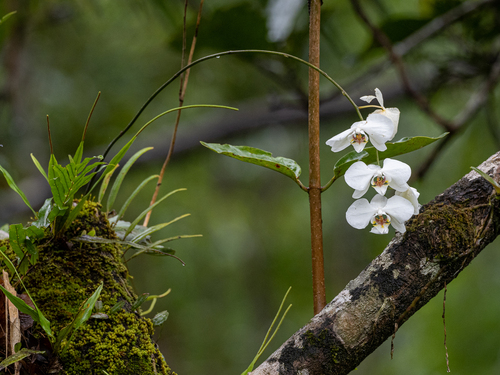
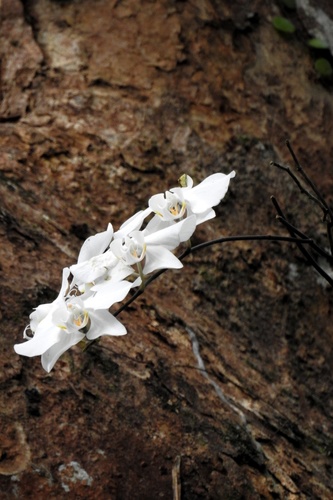
Phalaenopsis amabilis (L.) Blume (1825), the moon orchid, is an epiphytic orchid (Orchidaceae) of humid tropical forests, native from Malesia to northeastern Australia. It is recognized by its rosette of fleshy leaves, silvery aerial roots and large, long-lasting white flowers carried on arching spikes.
Read moreMoon orchid, Moth orchid, East Indian butterfly plant and Anggrek bulan
Place in indirect light or in a shaded room.
Global distribution
POWO/WCVP gives a native range from Malesia to northeastern Australia. The regions listed here follow the distribution units used by POWO and Trefle; metropolitan France is treated as an area of cultivation, not of introduction or invasion.
- Native10
- Bismarck Archipelago
- Borneo
- Java
- Lesser Sunda Islands
- Maluku
- New Guinea
- Philippines
- Queensland
- Sulawesi
- Sumatra
Hexagons: sourced regions. Green dots: native range. Statuses according to POWO (Kew).
Identity
Phalaenopsis amabilis (L.) Blume is an accepted species in the orchid family, Orchidaceae. POWO/WCVP dates the combination to 1825, in Bijdragen tot de flora van Nederlandsch Indië, with an older basionym published by Linnaeus as Epidendrum amabile. 1 2
In garden centers, moth orchid usually covers the whole genus Phalaenopsis. Phalaenopsis amabilis itself is a single white species, widely grown and, according to the AOS, the type species of the genus. 3 4
Names such as moon orchid, moth orchid, East Indian butterfly plant and anggrek bulan help track the plant down in English or Indonesian sources, but the stable name remains the botanical binomial. 5 6 4
Recognition
A short rosette with almost no visible stem carries a few broad, fleshy, glossy leaves. Horticultural sources usually describe 3 to 5 leaves, and define the genus Phalaenopsis by its lack of pseudobulbs, its aerial roots and its flowers borne in clusters from the leaf bases. 4 7
The spike is arching or branched, with long-lasting white flowers that are often fragrant in the species. RHS describes flowers up to 10 cm (4 in) across, with a white and yellow lip and a red throat; the AOS likewise describes white sepals and petals, a three-lobed yellow lip spotted with red, and flowers about 8–10 cm (3–4 in) wide. 4 3
So a Phalaenopsis picked up at the supermarket is not automatically P. amabilis. Many are hybrids. The safest clues are a botanical label, the typical white flowers, a rosette without pseudobulbs and a plant consistent with an epiphyte of filtered light. 4 7
Useful taxonomy
As the accepted name, POWO keeps Phalaenopsis amabilis (L.) Blume and lists three homotypic synonyms at species level: Epidendrum amabile L., Cymbidium amabile (L.) Roxb. and Synadena amabilis (L.) Raf. 1
The same source also accepts three infraspecific taxa: P. amabilis subsp. amabilis, subsp. moluccana and subsp. rosenstromii. Without evidence, they should not be turned into "store varieties": these are taxonomic ranks, not ornamental cultivars. 1 2
Phalaenopsis aphrodite is the tricky case. RHS shows it among its horticultural synonyms, while POWO/WCVP and the AOS treat it as a distinct species, historically confused with P. amabilis. The taxonomy here therefore follows POWO/WCVP and flags the confusion rather than merging the two names. 4 1 3
Habitat and range
According to POWO, P. amabilis is native from Malesia to northeastern Australia, with native records for the Bismarck Archipelago, Borneo, Java, the Lesser Sunda Islands, Maluku, New Guinea, the Philippines, Queensland, Sulawesi and Sumatra. The Trefle data consulted give the same list of regions. 1 6
Mostly epiphytic, the species belongs to the humid tropical biome. That ecology explains what it needs in cultivation: a very open mix, roots that can breathe, humid but moving air, filtered light and no standing water around the crown. 1 8
Outside the tropics, the plant is best understood as a cultivated orchid for the house, a conservatory or a warm greenhouse. None of the references consulted describes it as invasive in France or documents any naturalization there. 1 9
Life cycle, cultivation and care
Indoors, the roots and the flower spike tell you where the plant stands. Silvery roots turn green after watering; the leaves store some water, but the AOS points out that Phalaenopsis should not stay completely dry for long. Water thoroughly, let it drain, then wait until the mix is almost dry. 8 4
Light should stay bright but filtered. The AOS recommends a bright window with little or no direct sun, and RHS places the species in partial shade, under cover, in a free-draining mix. Cold is a hard limit: RHS rates P. amabilis H1A, meaning under glass all year, and the AOS recommends warm household temperatures with nights generally above about 16 °C (61 °F). Where winters bring frost, that means a heated room; in frost-free climates, outdoor culture still depends on those night temperatures. 8 4
Reblooming depends on a well-rooted plant, enough light and a slight cue from cooler nights in autumn. Spikes that are still green can be cut back above a low node to encourage another flush of flowers; yellow or dry spikes are removed. 4 8
Repot mainly after flowering, once the bark breaks down or the roots fill the pot. Because the roots are fleshy and fragile, avoid needless repotting, dense mixes and decorative cachepots that hold water. 8 4
Uses and risks
Its main use is ornamental: a flowering houseplant, a warm-greenhouse or bright-conservatory plant, or a collector's orchid. RHS notes the AGM for P. amabilis, while the AOS stresses its important place in the background of modern white hybrids. 4 3
On pet toxicity, the ASPCA lists Phalaenopsis sp. as non-toxic to dogs, cats and horses, and the CSV data consulted repeat those three statuses. The plant is therefore rated safe for cats, dogs and horses, with caution for people: no reference consulted supports any food use. 5 10
In cultivation, the real risks are horticultural: crown rot if water sits in the rosette, black roots in a broken-down mix, mealybugs and scale, aphids, thrips, spider mites and Botrytis on the flowers in humid, still air. 4 7
Variants, look-alikes and related plants
In the everyday trade, the subspecies accepted by POWO are not always recognizable. A plant sold as a "white moth orchid" is often a Phalaenopsis hybrid, not a pure botanical species. The careful approach is to reserve the name P. amabilis for correctly labeled plants. 1 3
Useful look-alikes include:
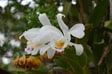
- Phalaenopsis aphrodite, a close species long confused with P. amabilis
- white garden-center hybrids, often without a reliable species name
- Doritaenopsis and Doritis, older names or horticultural groups found in some growing guides
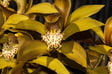
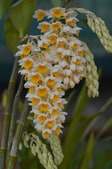
- other indoor orchids such as Cattleya, Cymbidium or Dendrobium, which often bear pseudobulbs or canes that Phalaenopsis lacks
Read the full label. "Moth orchid" can describe the genus or a hybrid; Phalaenopsis amabilis calls for an explicit scientific name consistent with taxonomic sources. 7 4
Main sources
- Plants of the World Online / Kew, Phalaenopsis amabilis (L.) Blume
- Royal Horticultural Society, Phalaenopsis amabilis
- NC State Extension Gardener Plant Toolbox, Phalaenopsis
- American Orchid Society, Phalaenopsis culture sheet
- American Orchid Society, Phalaenopsis, The Genus
- ASPCA Animal Poison Control, Phalaenopsis Orchid
Frequently asked questions
Is Phalaenopsis amabilis toxic to cats?
The ASPCA lists Phalaenopsis sp. as non-toxic to cats, dogs and horses. That does not make the plant food; unusual ingestion is still worth watching.
Is this orchid edible?
No edible use is recorded. The references consulted document mainly its ornamental use and pet safety, not any use as human food.
Is it invasive?
No invasive status is recorded in the references consulted. In temperate regions, P. amabilis is grown as a houseplant or in a conservatory or warm greenhouse.
Why do the roots turn silvery?
Phalaenopsis roots carry an absorbent tissue that looks silvery when dry and turns green after watering. It is a handy moisture indicator, not a disease.
Are Phalaenopsis amabilis and Phalaenopsis aphrodite the same plant?
Not under the POWO/WCVP taxonomy followed here. Some older horticultural sources mix them up, but the AOS and WCVP treat them as separate species.
Should the whole flower spike be cut after blooming?
Not always. If it stays green, cutting above a low node can trigger another round of flowers; if it yellows and dries, it can be removed.
Similar plants
Botanical data compiled from reference sources (RHS, Kew Gardens, POWO). This profile is for guidance only and is not a substitute for advice from a botanist or veterinarian if you have concerns about toxicity.