
Queen of orchids (Cattleya, )

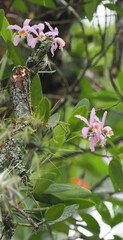

Cattleya (Cattleya Lindl.) is a genus of tropical Orchidaceae native from Costa Rica to tropical South America and Trinidad, most of them epiphytes. A creeping rhizome carries upright pseudobulbs with one or two leathery leaves. Large, long-lasting flowers often have a contrasting lip.
Read moreQueen of orchids, Cat orchid and Brazilian orchid
Allow a few hours of direct sun per day, preferably morning or evening.
Bright light; gentle or filtered sun


© photo
Kahio Tiberio Mazon · cc0
Rosario Douglas · cc-by
Kai Squires · cc-by


Global distribution
POWO places the genus from Costa Rica to tropical South America and Trinidad. NC State describes an American tropical origin as far as Argentina and worldwide cultivation. In metropolitan France these orchids are cultivated.
- Native9
- Costa Rica
- Colombia
- Venezuela
- Trinidad
- Ecuador
- Peru
- Bolivia
- Brazil
- Argentina
Hexagons: regions where the plant occurs. Green dots: native range.1
Identity
Cattleya (Cattleya Lindl.) is an accepted genus in the Orchidaceae. POWO records its first publication in Collectanea Botanica in 1824 and a native range from Costa Rica to tropical South America and Trinidad. GBIF also treats it at genus rank. 1 2
Names such as corsage orchid, queen of orchids and cat orchid belong chiefly to horticultural usage. NC State explains that the genus honors British horticulturist William Cattley. That history alone does not identify a modern nursery plant, however: many plants sold as cattleyas are hybrids. 3
Cattleya denotes a genus with shared traits and important variation. Some species carry one leaf per pseudobulb, others two, while many commercial plants belong to the wider Cattleya alliance rather than a pure botanical species. 5
Recognition
The pseudobulb is the starting point for recognition. A creeping rhizome advances over a support or through the pot, producing fleshy roots and upright pseudobulbs with one or two thick, waxy, leathery leaves. Pseudobulbs store water and nutrients, allowing brief drying between waterings. 3 6
Flowers usually arise at the top of a mature pseudobulb, sometimes from a sheath. They are large, colorful and often fragrant in classic forms, with a prominent lip frequently contrasting with the rest of the flower. NC State gives a usual two to five flowers per inflorescence, while noting that some species carry many more. 3
Britannica describes many cattleyas as epiphytes or lithophytes with large pseudobulbs, somewhat succulent leaves and flowers with three sepals and three petals, including a prominent lip. The combination of rhizome, pseudobulbs, leathery leaves and broad lip is more useful for recognition than color alone. 8
Useful taxonomy
Cattleya taxonomy has changed more than its familiar florist image suggests. POWO accepts Cattleya as a genus, but horticultural books and old labels may retain names moved to other genera, merged or treated as synonyms under different classifications. 1
The American Orchid Society notes a practical complication: species formerly placed among Brazilian Laelia or in Sophronitis have moved into Cattleya, while several former Central American cattleyas are now treated in Guarianthe. Old labels, cultivation books and grex names can therefore be difficult to interpret. 5
The unifoliate–bifoliate distinction remains useful, without being absolute. Classic large-lipped cattleyas often carry one leaf per pseudobulb and large flowers; bifoliate types carry two, sometimes three leaves and more numerous flowers. Always compare the actual plant with its complete label. 5 3
Habitat and range
The genus comes from tropical America. POWO places its range from Costa Rica to tropical South America and Trinidad; NC State describes the American tropics from Costa Rica to Argentina, with worldwide cultivation. 1 3
Many wild cattleyas grow on branches, their rhizomes moving across the surface and roots exposed to air. Some species also grow on rock. This ecology differs from that of plants rooted in ordinary potting soil: the support must dry quickly, retain air spaces and let the roots breathe. 3 8
Naturalization and invasive status in metropolitan France remain unestablished. These orchids are grown in bright interiors, conservatories or greenhouses, or outdoors only during warm summer conditions, protected from cold nights and persistent wetness. 3
Life cycle, light and watering
The American Orchid Society identifies light as decisive for growth and flowering. A cattleya needs bright light, often more than a supermarket Phalaenopsis. Indoors, the AOS recommends a very bright window, ideally offering more than four hours of gentle direct sunlight for flowering. 4
Watering follows an epiphyte’s cycle: wet thoroughly, let the pot drain, then wait for the medium to dry. The AOS says cattleyas like drying between waterings but should be watered once the medium reaches that dry state. NC State also advises against cold water, sodium-softened water and ice cubes. 4 3
Temperature requirements vary with species and hybrid, but the AOS gives a practical starting range: nights around 13–22 °C (55–72 °F) and days around 21–29 °C (70–84 °F). Higher temperatures are tolerated if humidity, water, air circulation and shade increase. Useful humidity is in the air, not in saturated bark. 4
Repot when new roots begin growing, the rhizome extends beyond the pot or bark breaks down. The AOS advises against dividing too early: each division should retain several pseudobulbs, otherwise flowering can easily stop. 4
Flowering and hybridization
Flowering develops on a mature pseudobulb. Depending on the species or hybrid, a stem emerges from a sheath at its top or near the leaf base. Flowers may be solitary, grouped or very numerous. NC State describes a typical two to five flowers while acknowledging more floriferous species. 3
Horticultural hybridization is central to the group. Britannica identifies Cattleya labiata as widely cultivated and crossed with many other genera to produce thousands of showy hybrids. The RHS also notes that Cattleya is often crossed with related genera and occurs in the ancestry of many intergeneric hybrids. 8 6
NC State lists Brassocattleya, Brassolaeliocattleya, Cattleytonia, Cattlianthe, Epicattleya and Rhyncholaeliocattleya as examples of this alliance. Such names explain why “a pink cattleya” is an incomplete description of a commercial plant: grex, parentage, clone and growing conditions affect size, scent, flowering season and tolerance. 3
Toxicity, buying and cultivation risks
The ASPCA lists Cattleya trianaei, sold as Christmas orchid or winter cattleya, as non-toxic to dogs, cats and horses. This assessment concerns that species and does not establish the veterinary status of the whole genus Cattleya. No human food use is documented for the genus. 7 3
Buying and keeping plants requires a different precaution. NC State recalls excessive wild collection in the nineteenth century and notes CITES Appendix II coverage today. Avoid wild-collected plants or plants of unclear origin, especially when seed-grown, divided and tissue-cultured plants are widely available. 3
Cultivation problems are familiar ones for bright-light orchids: scale insects, thrips, spider mites in overly dry air, slugs and snails outdoors, and root rot if the pot remains wet. A healthy plant has firm pseudobulbs, active roots, airy bark and enough light to keep leaves medium green to chartreuse. 4 3
Main sources
- Plants of the World Online / Kew, Cattleya Lindl.
- GBIF Backbone Taxonomy, Cattleya Lindl.
- NC State Extension Gardener Plant Toolbox, Cattleya
- American Orchid Society, Cattleya culture sheet
- American Orchid Society, Cattleyas for the Beginner, Part 2
- Royal Horticultural Society, Cattleya genus description
- ASPCA Animal Poison Control, Christmas Orchid
- Encyclopaedia Britannica, Cattleya
Frequently asked questions
Is a cattleya always a botanical species?
No. Many plants sold as cattleyas are hybrids or crosses within the Cattleya alliance. The complete name on the label is the only reliable reference.
Why is my Cattleya not flowering?
Insufficient light is the most common cause. The American Orchid Society identifies light as a key factor for cattleya growth and flowering.
What do the pseudobulbs do?
They are thickened stems that store water and nutrients. This helps explain the need for wet–dry cycles rather than a constantly moist pot.
Can I use general-purpose potting soil?
No. Epiphytic orchid roots need plenty of air. Coarse bark or another freely draining support is more suitable.
Is Cattleya toxic to cats?
The ASPCA lists Cattleya trianaei as non-toxic to cats, dogs and horses. This assessment does not cover the whole genus Cattleya, whose veterinary status remains unestablished. Caution remains appropriate for human ingestion and undocumented hybrids.
Should I divide a large clump?
Not too soon. Small, weak divisions often stop flowering; cultivation references recommend keeping several healthy pseudobulbs on each division.
Similar plants



If you are unsure about a plant’s toxicity, ask a botanist or veterinarian for advice.